Cómo la búsqueda multi‑agente cambiará el GEO en 2025
Descubre cómo la IA multi‑agente revoluciona el GEO y la visibilidad en AI Overviews en 2025. Análisis experto, datos clave y pautas para tu estrategia. ¡Actualízate ahora!

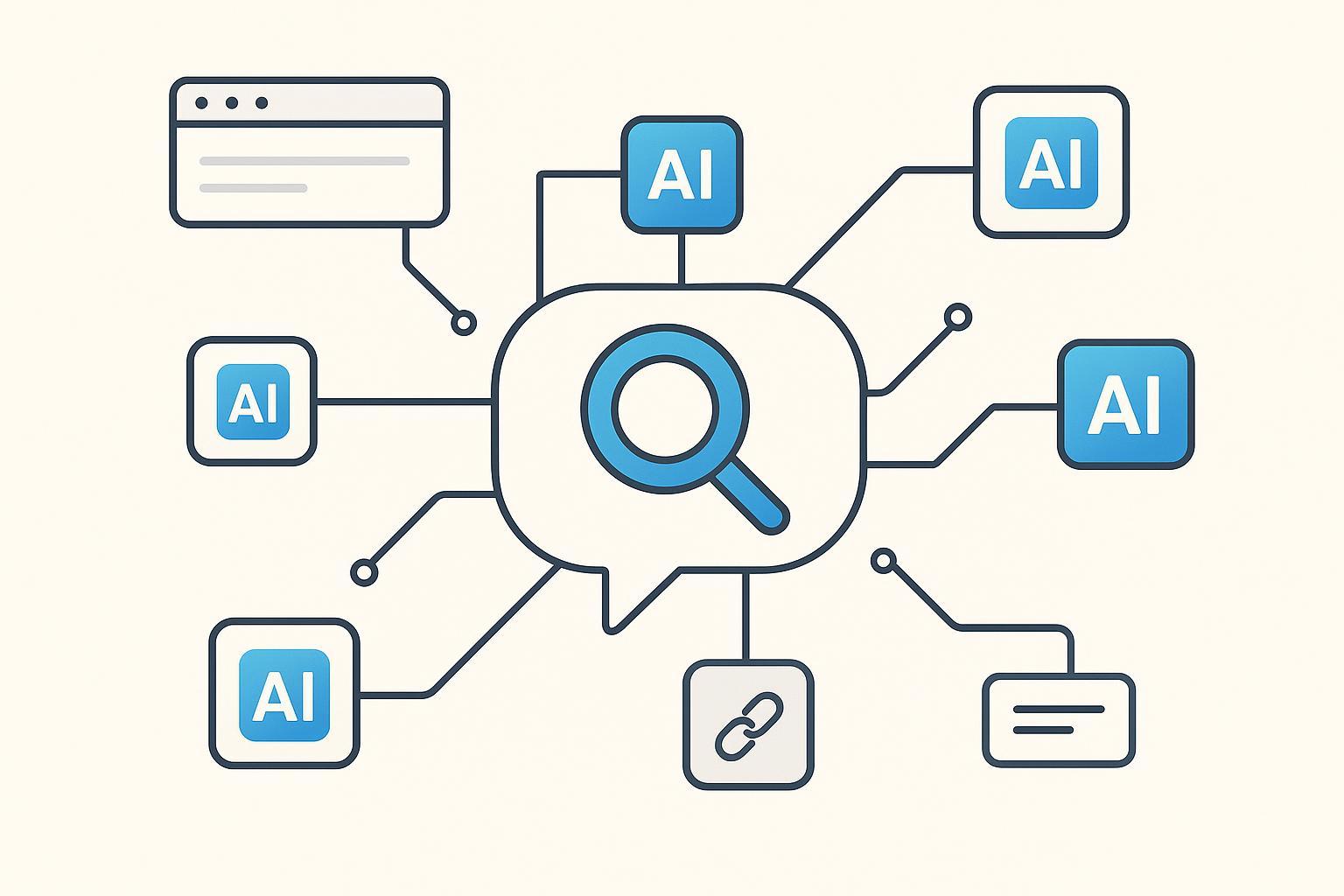
If generative answers become the first stop for complex questions, the playbook to earn visibility must change with them. Multi‑agent orchestration—systems that split a query into specialized subtasks and then synthesize an answer—is quickly becoming the default behavior in AI search experiences. That doesn’t just change ranking signals; it rewrites how “being cited” happens.
Here’s the deal: when engines decompose a question, each subtask pulls on different signals—definitions, comparisons, steps, local data, and explicit evidence. GEO (Generative Engine Optimization) succeeds when your content is discoverable, extractable, and cite‑worthy at every one of those micro‑moments.
What “multi‑agent” means for AI search today
Google has publicly described behaviors that look like orchestration. In its Spain announcement for Modo IA (October 2025), the company says it “desglosa tu pregunta en una serie de subtemas y lanza una ráfaga de consultas simultáneas,” then lets users dive deeper with useful links to the web. See the official note in the anuncio del Modo IA en España (2025).
Also, Google’s documentation for AI features emphasizes that these experiences show “enlaces relevantes” to help people verify and explore. To even be eligible as a contributing link, pages must be indexable and snippet‑friendly, as explained in Funciones de IA y tu sitio web (Search Central, actualizado 2025).
Do we have a full public blueprint of Google’s internal agent architecture? No. It’s an evolving area. Still, research into multi‑agent patterns offers helpful mental models: parallel planning and aggregation, debate/consensus formation, role assignment, and guardrails to reduce failure modes. Useful framing comes from work such as Optimizing Sequential Multi‑Step Tasks with Parallel LLM Agents (arXiv, 2025). Treat these as conceptual guides, not as claims about any one engine.
GEO isn’t classic SEO—and the playbook changes
In classic SEO, your goal is to rank and win clicks. In GEO, your goal is to be cited as the evidence a generative answer uses—and still earn engaged traffic when users open the links. That means the content has to be both “agent‑readable” and “human‑useful.” If you need a concise refresher on the shift, this overview of Traditional SEO vs GEO maps the differences in objectives, signals, and measurement.
Two consequences matter immediately: rankings aren’t a reliable proxy for citability, and evidence density and clarity matter more. Engines reward pages that make claims verifiable and extractable, with clear provenance.
Make your content agent‑readable (structure for subtasks)
Think of a multi‑agent system as a team. One agent clarifies definitions. Another assembles comparisons. A third validates local context. If your page bundles all of this into one long, unfocused block, it’s harder to extract.
Practical adjustments:
- Create modular sections that map to likely subtasks: crisp definitions, head‑to‑head comparisons, step‑by‑step procedures, local data callouts, and an explicit evidence summary. Use short, descriptive subheads so agents can latch onto each unit.
- Keep pages snippet‑eligible. If your goal is to be cited, avoid restrictive preview controls. Search Central clarifies that preview directives like nosnippet or overly tight max‑snippet limits can constrain how your content appears in AI features; details live in the same Funciones de IA y tu sitio web (Search Central) guidance.
Engineer citability with living evidence
Citability is earned. Make it easy for agents to trust, quote, and link back.
- Stamp claims with dates and link to primary sources using descriptive anchors in‑sentence. Links like “methodology (2025)” or “official guidance (Google)” help both humans and agents assess reliability.
- Add a compact table or summary block with key numbers, definitions, and scope. Then keep it updated. Versioned content (with a change‑log) improves reproducibility and E‑E‑A‑T.
- Use structured data and consistent metadata. Stable URLs, canonical tags, and a clear last‑updated pattern reduce ambiguity.
- If you must limit previews, do it intentionally. For broader control over what gets shown, Search Central covers robots and preview directives; see Introducción a robots.txt (Google).
Measurement and experiment loop (where the work compounds)
You can’t fix what you don’t log. Set up a lightweight but rigorous protocol to track how generative answers treat your brand across platforms and time.
- For every tested query, capture: the exact prompt, timestamp, platform/model, geography, device, cited URLs, and sentiment or stance toward your brand.
- Track share‑of‑answer (how often you’re cited when the answer appears), the position/format of the link, and whether your language/region is respected.
- Run controlled edits. Update a single evidence block or FAQ, re‑crawl/refresh if needed, and re‑measure after a fixed window.
Tools can help automate the grind. For example, platforms like Geneo can monitor cross‑platform mentions, log historical answers, and analyze sentiment to support GEO experiments. Disclosure: Geneo is nuestro producto. For deeper background on the mechanics of mentions and metrics, see Why ChatGPT Mentions Certain Brands and LLMO Metrics: Measuring Accuracy, Relevance, Personalization in AI.
Technical signals that help orchestration
Not a full checklist—just the recurring issues that move the needle:
- Indexability and 200s: clean crawl paths, no brittle interstitials, and reliable availability.
- Structured data and schema: align types and properties with your content’s intent; don’t over‑specify.
- Canonicals and stable URLs: avoid fragmenting evidence across variants.
- Descriptive anchors (internal and external): link out to primaries where you cite numbers or policies; it’s part of being cite‑worthy.
- Evidence blocks with dates: compact tables/summaries and FAQs designed for extraction.
- Versioning and change‑log: note what changed and when; it increases trust and supports reproducibility.
What’s still evolving in 2025
Several levers remain moving targets. Google’s public guidance stresses helpful content, transparency, and technical eligibility; see Succeeding in AI Search (Google, 2025). Meanwhile, multi‑agent research is expanding rapidly (e.g., the parallel‑agent orchestration paper linked above). Expect policies around coverage, link presentation, and preview controls to continue to evolve—so build a cadence to review and refresh.
Wrapping up: a GEO program built for agents—and people
If engines decompose tasks, your content should, too. Structure for subtasks, back up claims with primary sources and dates, and keep a living evidence layer that’s easy to extract. Then measure. A consistent logging program will reveal which edits improve citability and where you need stronger proof.
Question to leave you with: if a team of agents picked apart your key pages today, would each subtask find what it needs—clearly labeled, current, and verifiable?
—
Change‑log
- 2025‑12‑23: Initial publication covering multi‑agent implications for GEO, eligibility in AI features, citability practices, measurement loop, and technical signals; includes references to Google’s 2025 guidance and a recent multi‑agent research frame.