
Traditional SEO Is Dying: What You Must Do to Stay Visible in 2025
Discover why traditional SEO is failing in 2025. See the latest stats, AI Overviews impact, and follow a proven playbook to keep your brand visible now.
What actually changed in 2025 (and why it matters)
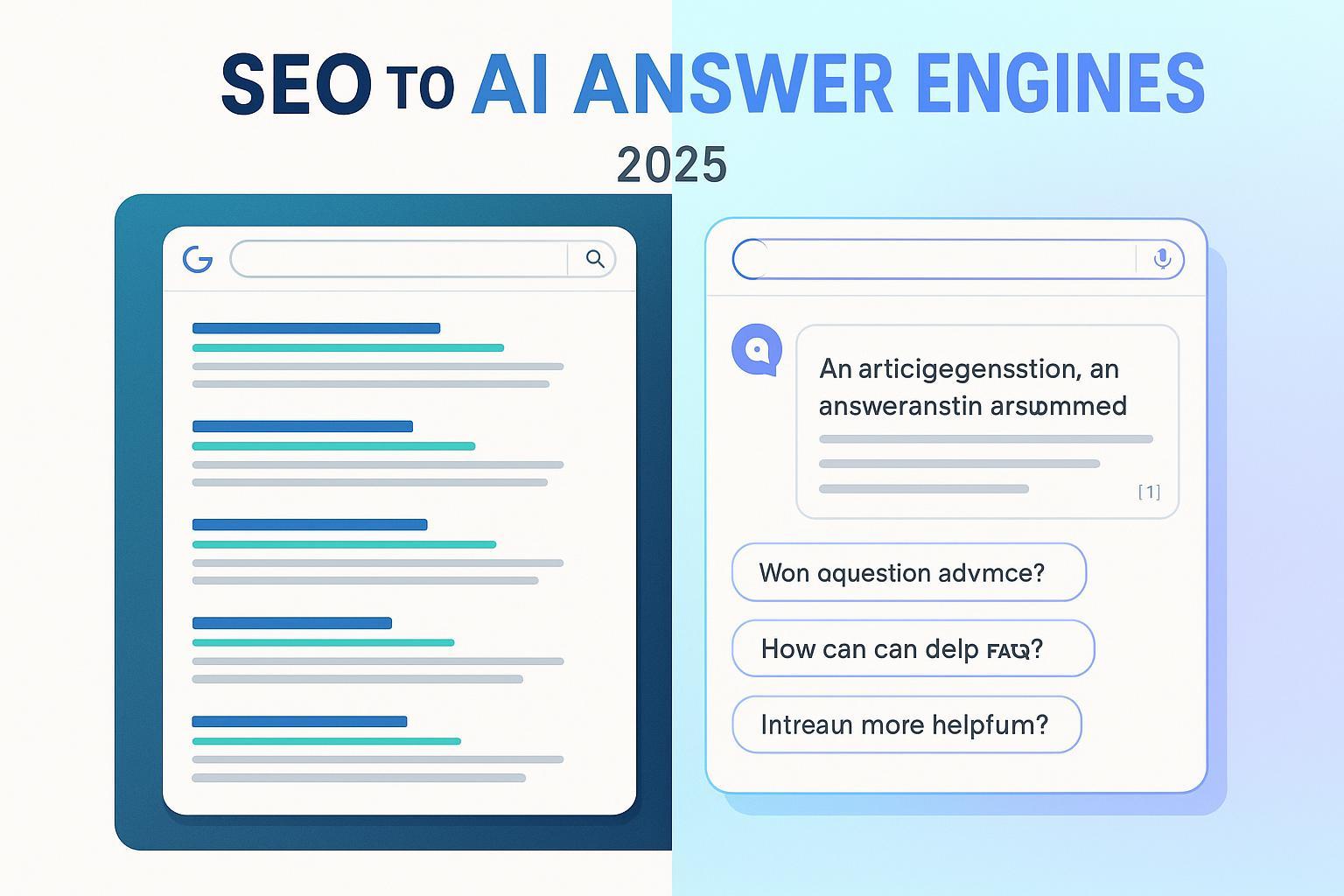
In 2025, search is no longer dominated by “10 blue links.” Google expanded AI Overviews globally and introduced a more conversational AI Mode, pushing users into answer-first experiences instead of click-first results. According to the May 2025 announcements on the Google Product Blog, AI Overviews rolled out to 200+ countries in 40+ languages, and AI Mode encourages deeper follow-ups with reasoning and multimodal context—the company also reported a >10% usage lift in markets like the U.S. and India for queries that show AI Overviews, as described in the Google Product Blog’s 2025 expansion and AI Mode update.
Why this matters: when AI summaries satisfy intent, fewer users click through to traditional results. Your visibility strategy must move from “rank for keywords” to “be cited inside answers and still earn the click with something users can’t get on the results page.”
Do this next: Reframe goals from “rankings and traffic” to “answer inclusion, citation quality, and conversions from assisted exposure.”
The data: clicks drop when summaries appear, and triggers are rising
Behavior changed measurably in 2025. A July 22, 2025 analysis by the Pew Research Center (68,879 Google searches from 900 U.S. adults in March) found users clicked a traditional result link in just 8% of visits when an AI summary was present, vs 15% when it wasn’t. Only 1% of visits with summaries resulted in clicks on links inside the summary, and sessions were more likely to end on the results page (26% vs 16%). See the full methodology and results in the Pew Research Center 2025 report on AI summaries and clicking behavior.
At the same time, the presence of AI Overviews increased materially in early 2025. Semrush’s dataset shows triggers rising from 6.49% of queries in January to 13.14% in March, concentrated in informational queries and longer phrases; notably, zero‑click rates in their panel slightly decreased over the same period (38.1% → 36.2%), underscoring that impacts vary by query set and layout. Details are in the Semrush 2025 AI Overviews study of 200,000 results.
Taken together: AI answer visibility is now a distinct, measurable surface area. Treat it as a new funnel stage.
Do this next: Tag your queries by intent and length; expect the highest summary rates on question-led, long-tail, and multi-step tasks.
What this means for your portfolio
- Rank-only tactics underperform on informational queries with summaries. Design pages to be quotable (clear claims, sources, structured answers) and to deliver “beyond-the-snippet” depth that still motivates a click.
- Community and experiential signals matter more. User-generated and practitioner content are increasingly cited by answer engines. UGC platforms like Reddit gained massive SEO visibility through 2024 and into 2025, according to SISTRIX IndexWatch 2024 winners (published Jan 2025). Treat communities as part of your discovery surface.
- Governance is non‑negotiable. 2025 core/spam updates sharpened enforcement around scaled low‑value content and site reputation abuse. You need documented controls.
Do this next: Map your content by “answer inclusion likelihood” and “click incentive strength.” Invest where you can both appear inside summaries and give users a reason to visit.
The playbook: Build for answer inclusion (and the click)
- Build for questions, not just keywords.
- Cluster around intents and multi-step tasks. Use headings that mirror how people ask (“How do I…”, “What’s the best way to…”). Add a tight summary box with a citeable, stepwise answer.
- Make your claims quotable.
- Use precise, checkable statements with source transparency. Where possible, include original data, screenshots, or brief methods so answer engines can attribute with confidence.
- Structure for machines and humans.
- Clean hierarchy, short paragraphs, scannable lists, and supportive tables. Use schema (FAQ, HowTo, Product, Organization) to clarify entities and relationships.
- Earn experiential authority.
- Publish demonstrations, mini case studies, and first‑party data. Encourage credible UGC participation. Integrate expert bylines and maintain reviewer notes.
- Design beyond-the-snippet value.
- Offer comparison matrices, calculators, templates, and downloadable checklists. Make the on-site experience obviously richer than any answer panel.
Do this next: Add a one-paragraph “Summary for AI” to target pages: definition, steps, a single stat with citation, and a clarifying example.
Monitoring AI answer inclusion across engines (neutral workflow)
You can operationalize an “AI citations pipeline” in weekly sprints:
- Discovery: Track which queries trigger AI answers and whether your brand, content, or experts are cited across Google, ChatGPT, and Perplexity.
- Diagnose: For non-included pages, compare your summary box, claims, and sources against the citations that do appear.
- Improve: Update content with clearer claims, better evidence, and schema; where needed, publish new, quotable artifacts (original data snippets, how-to diagrams).
- Outreach: Where appropriate, engage with authors or communities referenced in current answers to contribute improved sources.
- Re-measure: Log inclusion rate, citation share, and sentiment over time.
A practical way to do this is to monitor cross-engine citation and sentiment trends with Geneo. Disclosure: Geneo is our product.
For community tactics that increase credible citations, see our governance-focused guide on driving AI search citations through Reddit communities.
Do this next: Institute a weekly “AI visibility standup.” Review inclusion wins/losses, prioritize 3–5 pages for updates, and track changes over 4–6 weeks.
Measurement model and dashboards
Inputs to track (by engine and query cluster):
- AI answer inclusion rate (what % of monitored queries cite you)
- Citation share (domain-level contribution vs peers)
- Sentiment (polarity of brand mentions within answers)
- SERP CTR by rank (for queries with and without summaries)
- Branded vs non‑branded mix, device split, and geography
Outputs to attribute:
- Assisted conversions from sessions that began with an AI-cited impression
- “Protected traffic” reclaimed after content updates restore inclusion
- Net-new demand from community authority (e.g., high-quality forum threads that subsequently surface in answers)
Here’s a real-world style example: a compact query report that highlights brand presence and sentiment trends over a topic cluster, like this Geneo query report on recycled materials in smartphones.
Thresholds that trigger action:
- Inclusion decay: If inclusion drops >20% for a key cluster, schedule a refresh within 7 days.
- Sentiment drift: If sentiment turns negative or mixed on critical terms, investigate root causes and respond with clarifying content.
- CTR gap: If CTR falls ≥30% on pages behind summaries, add beyond-the-snippet assets and improve internal linking from high-intent pages.
Do this next: Build a living dashboard by cluster and engine; review weekly with SEO + Content + PR.
Governance and risk (what to avoid in 2025)
Google’s 2025 spam policies explicitly call out “site reputation abuse” (hosting third‑party pages mainly to exploit your domain’s authority) and abusive automation/unoriginal content at scale. Read the definitions and examples on the Google Spam Policies for Web Search (2025). The June core and late‑summer spam updates strengthened enforcement; many publishers saw volatility where these issues existed.
A quick checklist:
- Ownership: Name accountable editors for each content area; document human review for AI‑assisted drafts.
- Third-party content controls: Require topic alignment, editorial standards, and disclosure; audit existing hosted content.
- Evidence hygiene: Prefer primary sources; show dates, methods, and version history on research pages.
- Change logs: Maintain “Updated on” stamps and brief notes for major revisions.
Do this next: Run a 10‑page audit for policy risks; implement a gate that blocks publication without bylines, sources, and reviewer signoffs.
Channel resilience in an answer-first world
- Schema and feeds: Keep product/pricing feeds and structured data fresh to power accurate answer citations.
- Email and owned audiences: Convert passive visitors into subscribers; use content roundups to mitigate platform volatility.
- Partnerships and communities: Co‑publish original research with recognized experts; invest in credible forum participation.
- GEO mindset: Optimize for Generative Engine Optimization (GEO)—focus on quotability, evidence, and entity clarity across engines, not just Google.
Do this next: Allocate 15–25% of “SEO” budget to GEO assets (original data, tools, and community programs) and measurement.
Your 90‑day plan
Days 1–15
- Baseline: Build your monitored query set by cluster and intent. Capture inclusion, citations, sentiment, CTR, and conversions.
- Triage: Identify top 10 pages where summaries appear but you’re not cited; choose 3–5 to fix first.
Days 16–45
- Content rewrites: Add summary-for-AI blocks, clarify claims with sources, and implement FAQ/HowTo schema.
- Beyond-the-snippet: Add calculators, matrices, and downloadable checklists to priority pages.
- Community activation: Seed two credible discussion threads that showcase original data or methods.
Days 46–75
- Re-measure: Compare inclusion, sentiment, and CTR. Address inclusion decay and negative sentiment.
- Governance: Complete a 10‑page policy audit; fix third‑party content risks.
Days 76–90
- Portfolio balance: Shift investment toward clusters with rising inclusion potential; pause scaled tactics with low evidence density.
- Executive readout: Report assisted conversions and protected traffic; propose budget reallocation for Q4/Q1.
Do this next: Put the first standup on the calendar, nominate an “AI visibility owner,” and publish your first two original data notes.
Closing
Traditional SEO isn’t “dead,” but its monopoly is. In 2025, brands win by earning inclusion in AI answers and delivering on-site value that’s worth a click. If you want a neutral, repeatable way to track citations and sentiment across engines, consider setting up a weekly workflow with Geneo. We keep our approach focused on measurement and iteration—not promises.
—
Updated on 2025-10-10