
Social Search Is Rewriting SEO and Content Discovery in 2025: What Brands Need to Change Now
Social search is disrupting SEO in 2025—learn how Google’s Instagram indexing, TikTok Search Ads, and AI Overviews are changing brand strategy. Stay ahead now.
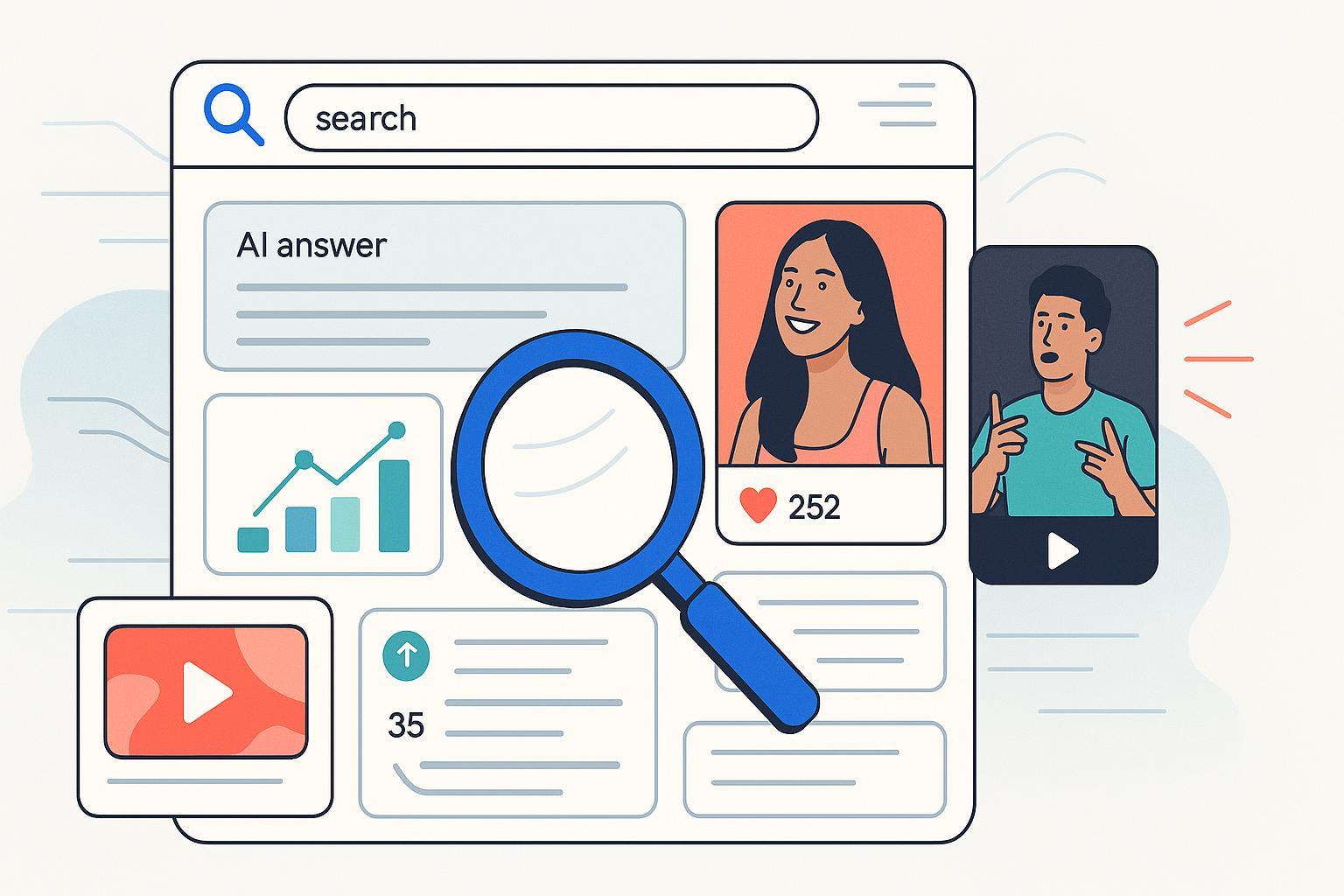
In 2025, “search” no longer means just ten blue links. Consumers start with TikTok, Instagram, YouTube, and Reddit—and now those social results increasingly surface on Google and inside AI-generated answers. For brands, discovery has become multi-surface and more conversational, demanding new playbooks that blend in-platform optimization, cross-indexing for Google and AI Overviews, and measurement beyond clicks.
What changed in 2025
-
Google began surfacing public Instagram posts from professional (business/creator) accounts in Search and Images starting in July 2025, expanding the footprint of Reels and posts in classic web results. While the precise first-party documentation is still emerging, multiple industry outlets corroborate the rollout—see Glossy’s July 2025 feature on the Google–Instagram search partnership.
-
TikTok Search Ads matured into a true intent channel with keyword targeting and negative keywords, plus reported performance lift. TikTok’s own 2025 meta-analysis found roughly 2x higher purchase lift for campaigns including Search Ads, per TikTok For Business’ Search Ads announcement.
-
Reddit discussions gained outsized visibility in Google’s AI Overviews following licensing deals, with ongoing renegotiations through late 2025. See Business Insider’s 2025 analysis of Reddit–Google licensing and AI visibility.
-
YouTube Shorts evolved as a discovery driver. Shorts length expanded to 3 minutes (announced in Oct 2024 and shaping 2025 workflows) as detailed by the YouTube Blog announcement, and YouTube updated how Shorts views are counted in March 2025 (plays/replays, with “engaged views” in Analytics), per Creator Insider’s March 2025 update video.
-
Social search is now mainstream consumer behavior. In March 2025, eMarketer reported that about two-thirds (66.6%) of US consumers have used social search—see eMarketer’s 2025 social search usage brief.
Why this reshapes brand SEO
-
Discovery is multi-surface: in-app social search, Google’s growing indexation of social posts, and AI-generated answers that cite communities. Winning requires harmonizing creative, metadata, and technical SEO across all three.
-
Authority looks like usefulness and community trust: Retention, saves, comments, and conversation quality are stronger signals than vanity reach—especially on TikTok, Instagram, and YouTube Shorts.
-
Measurement must evolve: Visibility now includes citations in AI Overviews, social surface area, and sentiment—alongside traffic and conversions. Dashboards need to track where and how your brand is referenced, not just how often someone clicks.
Platform workflows that map to today’s discovery
These blocks translate macro shifts into practical steps your teams can ship this quarter.
TikTok: From “For You” to intent with Search Ads
Objectives
- Capture high-intent queries inside TikTok search while informing creative that aligns to how people ask.
Setup steps
- Build a Search Ads campaign and choose keywords that mirror real queries (how-to, comparisons, local intent). Use broad/phrase for discovery and exact for the must-win terms. TikTok supports negative keywords at campaign or ad group level; see TikTok Help on negative keywords.
- Turn on and review the Search Terms report weekly to harvest winners, identify irrelevance, and expand or negate accordingly (also documented in TikTok Help).
- Align video creative to the searcher’s task: say the keyword phrase aloud early, use on-screen text, and include scannable captions.
Metrics to watch
- CTR and hold rate on search placements; search-driven CVR/ROAS for performance; saves/comments for intent fit. Consider brand lift where available.
Testing ideas
- Pair how-to and comparison angles; experiment with 15s vs. 35–45s formats; break out “near me” or local modifiers. Benchmark uplift vs. non-search placements—TikTok cites ~2x purchase lift in its 2025 meta-analysis (methodologies vary; validate in your own data via incrementality tests documented in platform experiments and MMM).
Instagram: Optimize for in-app search—and now Google
Objectives
- Make posts and Reels findable within Instagram and increasingly discoverable on Google for public professional accounts.
Setup steps
- Ensure the account is set to professional (business/creator) and public. Monitor Instagram’s privacy/searchability controls; several industry writeups note an opt-out toggle for search engine indexing—first-party documentation remains limited, so treat this as provisional and verify in-app.
- Encode intent into captions and on-screen text. Use descriptive, keyword-rich language that answers a task; add relevant hashtags without stuffing.
- Add alt text for accessibility and context. Favor content formats that carry over well into Google’s SERPs (clear visuals, descriptive titles, vertical video for Reels that can appear in video carousels).
Metrics to watch
- In-app search impressions, non-follower reach, saves/shares, and Google referrals that include instagram.com URLs post-July 2025.
Testing ideas
- Publish cluster content around a topic over 2–3 weeks; test 7–11 hashtag sets vs. minimal hashtags; compare posts with and without keyword-led on-screen text for search pickup.
YouTube Shorts: Retention and rewatchability drive reach
Objectives
- Achieve short-form discovery that ladders to long-form authority and web traffic.
Setup steps
- Script for “hook, value, loop”: deliver the answer quickly, then include a replay-worthy twist or visual.
- Consider lengths up to 3 minutes when the topic benefits from step-by-step or side-by-side comparisons (the cap increased, per the 2024 update that shapes 2025 norms via the YouTube Blog noted above).
- Title/description: phrase like a query; include key terms naturally and add chapters for 60–180s pieces.
Metrics to watch
- Average view duration, completion rate, replays, and “engaged views” (post–March 2025 change described by Creator Insider). Track Shorts → long-form session starts and channel-level subscriber growth.
Testing ideas
- Test 20–30s vs. 50–70s vs. 120–150s on the same topic; A/B first 3 seconds; vary caption overlays for readability; create Shorts that tease or summarize long-form videos and measure downstream watch time.
Measurement architecture for multi-surface visibility
KPI layers to combine
- Exposure: In-app search impressions (TikTok/Instagram/YouTube), Google impressions for social URLs, and presence in AI answers.
- Engagement quality: Saves, comments, average view duration, retention, replays, sentiment.
- Authority and citations: Appearances in AI Overviews; mentions and links across social and web; discussion quality in community threads.
- Outcomes: Assisted conversions, incremental lift (geo or audience splits), and branded search lift.
How teams can operationalize this
- Build a weekly “visibility standup” that reviews in-platform search metrics, Google appearances of social posts, and AI Overview citations.
- Define a blended visibility KPI. If you need a starting framework for a composite metric across surfaces, see the concept explained in What is AI Search Visibility Score?.
- Set up a cross-engine monitoring stack. A practical way is to track citations and brand mentions across ChatGPT, Perplexity, and Google’s AI Overviews, plus social mentions.
Neutral example of a workflow
- A team can use a unified monitor to capture where the brand appears across AI answer engines and social surfaces, then correlate those appearances with site traffic and conversions on a weekly cadence. A platform like Geneo supports tracking brand mentions, links, and sentiment across AI answers and social surfaces, helping you see where your content is cited and how it is perceived. Disclosure: Geneo is our product.
- New practitioners can follow a step-by-step setup in AI Search Visibility Optimization: Beginner’s Guide to Geneo and compare tool options for tracking AI Overviews in 7 Best AI Overview Tracking Tools (2025 Guide).
Attribution and testing notes
- Use incrementality designs where possible (geographic splits, time-based holdouts, or audience segmentation) to isolate the impact of social search and AI visibility on conversions.
- For paid efforts (e.g., TikTok Search Ads), triangulate platform-reported lift with site-side analytics and, where feasible, MMM or experiments.
Risk and guardrails: Reddit and community-driven visibility
Reddit threads can strongly influence AI answers and classic SERPs, but trust is community-earned. Participate authentically: disclose affiliations, add value before linking, and follow subreddit rules. Context from Business Insider’s 2025 coverage of Reddit–Google licensing and AI prominence underscores why these communities matter.
Governance checklist
- Establish response protocols for misinformation or off-brand threads.
- Track sentiment alongside citations to catch issues early.
- For regulated topics, implement legal/QA review for any community replies.
What to watch next (Q4 2025 → Q1 2026)
- Instagram × Google indexing scope: Any expansion to personal accounts, new surfaces (e.g., AI Overviews stability), and official documentation for privacy toggles.
- TikTok Search Ads: Match-type behavior, reporting granularity, and industry-verified lift benchmarks by vertical.
- Reddit licensing: Terms of any renewed/expanded deals and the downstream impact on AI citation patterns.
- YouTube Shorts: How the 3-minute ceiling and 2025 view-counting changes affect distribution and long-form funneling.
Pragmatic next steps
- Pick one product or topic cluster and run the three workflows above over 6–8 weeks.
- Stand up a weekly visibility review with a blended KPI spanning social search, Google appearances of social content, and AI citations.
- Tighten creative to the language users employ in-platform; keep captions and on-screen text query-like.
Soft CTA
- If you’re consolidating cross-engine monitoring, a platform like Geneo can help unify AI citation and social visibility tracking so your team can act on one source of truth.
Updated on 2025-10-09
Change-log
- Added July 2025 Google–Instagram indexing context with a provisional note pending first-party documentation.
- Incorporated TikTok’s 2025 Search Ads lift meta-analysis and Help documentation for negative keywords.
- Refreshed YouTube Shorts workflow with March 2025 view-counting change and 3-minute length context.
- Clarified measurement architecture and introduced a neutral workflow example with disclosure.