
Ultimate Guide to Generative Engine Optimization for Enterprise SaaS
Master GEO for enterprise SaaS: actionable strategies, schema, compliance, and measurement for AI answer engines. Read the 2025-ready practical guide.
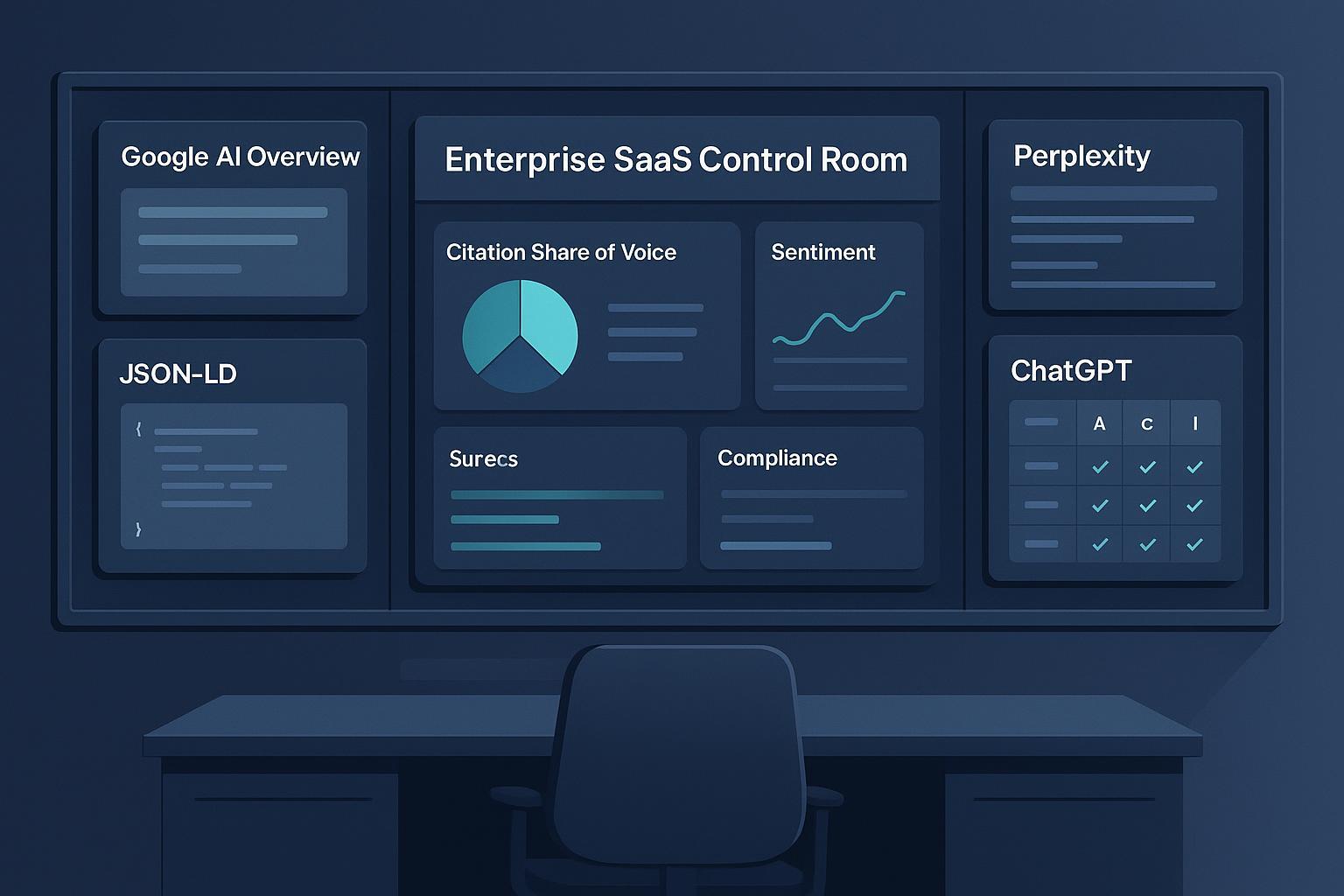
Your buyers are getting full answers inside AI experiences before they ever click through. If those answers don’t cite your pages—or worse, misstate your product—you lose influence in the moments that now shape B2B consideration. This guide lays out how enterprise SaaS teams can earn presence and accurate citations inside Google AI Overviews, Perplexity, and ChatGPT, with enterprise-grade governance and measurement baked in.
What GEO actually is (and what changes for B2B SaaS)
Generative Engine Optimization is the discipline of shaping your content and technical signals so generative answer engines can retrieve, trust, synthesize, and attribute your material. It complements SEO rather than replacing it. For a clear market definition and evolution, see the overview from Search Engine Land in What is Generative Engine Optimization (GEO) (2024–2025) which frames GEO as optimization for inclusion and accurate attribution inside AI answers rather than blue links alone: Search Engine Land’s GEO explainer.
For marketers used to classic SEO, the mindset shift is simple: optimize for being quoted correctly in the answer, not just ranked. If you want a side-by-side primer on how tactics shift, this comparison clarifies the differences in goals and KPIs: Traditional SEO vs GEO (Geneo): 2025 Marketer’s Comparison.
How answer engines choose sources in 2025
Google’s AI features still rely on crawling and indexing, reward helpful, unique content, and surface citations as links/cards within the generated answer. Official guidance emphasizes helpfulness, clarity, and standard snippet controls when needed—see Google’s “Succeeding in AI Search” (2025) and the AI features appearance guide. Perplexity performs real-time retrieval and lists numbered citations, favoring timely, authoritative, and well-structured pages with clear dates and provenance; their mechanics are described here: How Perplexity works (citations). ChatGPT’s web search shows sources inline and in a sources panel when browsing is used; its help docs outline how search and citations appear to users: ChatGPT Search: citations in responses.
The takeaway for enterprise SaaS: make your pages cleanly retrievable, excerptable, and unambiguous—especially on high‑stakes topics like security posture, integrations, pricing models, and migrations.
Enterprise SaaS page patterns that win citations
Across hundreds of enterprise deployments, the same templates outperform because they map tightly to buyer jobs-to-be-done and are easy for engines to quote. Pricing pages should open with a quick answer that defines the model and ranges, followed by a precise tier table, billing terms, procurement artifacts and SLAs, and date‑stamped updates with machine‑readable facts. Integration hubs perform best when they’re indexable directories with filters (category, auth method, data scope), clear capability depth, limits, and setup steps, supported by architecture diagrams and SDK repositories. Security and compliance pages benefit from a quick‑answer lead, a controls mapping table, certification badges with dates, data‑flow diagrams, a current subprocessor list, and a clear path to request reports (under NDA). Migration guides should cover phases, timelines, dependencies, risk/rollback plans, performance limits, and validation scripts.
For hands-on guidance to make these surfaces “citation‑ready,” including question‑first headings and snippet hygiene, this step‑by‑step resource is useful: How to Optimize Content for AI Citations.
Structured data and entity modeling (with copy-paste examples)
GEO benefits when your SaaS and brand entities are machine‑readable and consistent. Use JSON‑LD across docs, blogs, pricing, and integration directories. Link product and organization entities, keep dates explicit, and validate frequently.
SoftwareApplication example (adapt fields to your product; validate before production):
{
    "@context": "https://schema.org",
    "@type": "SoftwareApplication",
    "name": "Acme Platform Enterprise",
    "url": "https://www.acme.com/platform",
    "image": "https://www.acme.com/images/platform.png",
    "description": "Enterprise SaaS for secure collaboration and analytics.",
    "applicationCategory": "BusinessApplication",
    "operatingSystem": "Web, iOS, Android",
    "offers": {
      "@type": "Offer",
      "price": "Contact",
      "priceCurrency": "USD",
      "availability": "https://schema.org/InStock"
    },
    "featureList": [
      "SOC 2 Type II",
      "SSO/SAML, SCIM",
      "Audit logs",
      "Unlimited integrations"
    ],
    "publisher": {
      "@type": "Organization",
      "name": "Acme, Inc.",
      "url": "https://www.acme.com",
      "logo": "https://www.acme.com/logo.svg"
    }
  }
FAQPage example (target buyer questions with short, quotable answers):
{
    "@context": "https://schema.org",
    "@type": "FAQPage",
    "mainEntity": [
      {
        "@type": "Question",
        "name": "Does Acme support SCIM provisioning?",
        "acceptedAnswer": {
          "@type": "Answer",
          "text": "Yes. SCIM user provisioning is available on Enterprise plans with Okta, Azure AD, and Google Workspace."
        }
      },
      {
        "@type": "Question",
        "name": "Where can I access Acme’s SOC 2 report?",
        "acceptedAnswer": {
          "@type": "Answer",
          "text": "Request our current SOC 2 Type II report via the Security Portal. A mutual NDA is required."
        }
      }
    ]
  }
To improve inclusion odds, keep entity names, logos, and URLs consistent across your site and external profiles; use FAQPage and HowTo schemas where Q&A or stepwise procedures exist, with concise, current answers; and add explicit dates and named authors to reinforce credibility.
Governance and compliance: control the message, reduce risk
Enterprise GEO is as much about change management as it is about content. Treat high‑risk answers (security, data residency, SLAs, pricing exceptions) as versioned artifacts with approvals and an update log. Maintain a rapid remediation path when AI answers contain inaccuracies.
Suggested RACI for high‑risk answers and GEO governance:
| Workstream | Responsible | Accountable | Consulted | Informed |
|---|---|---|---|---|
| Canonical quick answers (pricing, security) | Content Strategist, Tech SEO | PMM/SEO Lead | Legal, Security | Comms, Sales |
| Schema/Entity hygiene | Tech SEO | SEO Lead | Engineering | PMM |
| Compliance artifacts (SOC 2, DPA, subprocessors) | Security/GRC | CISO/Head of Security | Legal, PMM | Sales, Support |
| Monitoring & remediation | SEO/Content Ops | PMM/SEO Lead | Legal, Security, Analytics | Exec Stakeholders |
When you reference SOC 2 or GDPR, keep claims factual and auditable. For SOC 2, align to AICPA Trust Services Criteria and maintain an access‑controlled route to the auditor’s report; see the AICPA overview of SOC services and criteria: AICPA SOC Suite of Services. For GDPR roles and processor obligations, rely on official guidance from European authorities: EDPB SME guide on controllers and processors.
If you need a deeper operational primer on defining the right measurements for answer quality—accuracy, relevance, and personalization—this framework can help: LLMO Metrics: Measure Accuracy, Relevance, Personalization, and More.
Measurement and attribution: show impact beyond clicks
You can (and should) quantify AI answer visibility and its business influence. Think of this as a parallel funnel: share of answer → AI referral traffic → assisted conversions → influenced pipeline. Start by standardizing parameters for AI referrals in GA4 with server‑side tagging (e.g., ai_provider, ai_answer_id, citations_count). Google documents sending events via server‑side containers in Tag Manager here: Server‑side tagging in GTM. To separate AI traffic cohorts in reports, this practical article outlines approaches to segment LLM traffic in GA4: Segment LLM traffic in GA4 (Search Engine Land, 2025). Define KPIs upfront—citation share of voice by query cluster and provider, retrieval hit rate where observable with answer fidelity and sentiment, and downstream referral sessions with assisted conversions and influenced opportunities—and review them alongside traditional SEO dashboards.
For a thorough audit process—what to monitor, how to set baselines, and how to iterate—see: How to perform an AI visibility audit for your brand.
Crawl controls and llms.txt: what actually works today
You control access for crawlers with established mechanisms; treat experimental files cautiously. Use robots.txt and page‑level directives to manage exposure without breaking eligibility for inclusion. Reference the spec and current guidance, such as the robots.txt specification (Google Developers). As of 2025, there’s no formal, widely adopted llms.txt standard. When you see proposals, treat them as advisory and keep using established controls. Google’s AI features guidance (linked earlier) remains the most reliable reference for visibility trade‑offs.
Internationalization: reduce misattribution across regions
Enterprise SaaS often serves multiple regions and languages. Poor hreflang hygiene causes engines to cite the wrong locale—or misinterpret content entirely. Focus on reciprocal hreflang, correct region/language codes, and alignment with canonical/noindex signals. A practical refresher on implementation and pitfalls is here: Hreflang basics and pitfalls (Search Engine Land guide).
A practical monitoring workflow (replicable example)
Disclosure: Geneo is our product. The following is a neutral, replicable workflow; similar steps can be performed with other multi‑engine monitoring solutions or internal scripts.
-
Define your monitored query set by buyer job and surface: e.g., “{your product} pricing,” “{your product} Okta SCIM,” “{your product} SOC 2,” and “{your product} migration script.” Include generic category queries where you aim to be cited as an example.
-
Track presence and citations weekly across engines (Google AI Overviews, Perplexity, ChatGPT web search). In a tool like Geneo, you can log citation share of voice, sentiment, and which URL was cited. Export history for trend analysis.
-
Investigate misses or inaccuracies. If Perplexity cites a competitor’s integration page because it’s more explicit about scope/limits, update your integration directory with clearer capability statements and add FAQ schema. If ChatGPT omits your brand on “best X for Y” prompts, strengthen category pages with evidence and comparisons.
-
Remediate and re‑measure. Ship the update behind approvals (see RACI), annotate the change log, and re‑check within 1–2 indexing cycles.
To understand engine‑by‑engine nuances and how to cadence monitoring, this comparison offers a useful overview: ChatGPT vs Perplexity vs Gemini vs Bing: AI Search Monitoring Comparison.
Troubleshooting two common enterprise scenarios
Low brand mentions in ChatGPT often trace back to weak category signals or outdated canonical answers. Start with diagnostic prompts, verify your pages are explicit and current, and ensure entity signals are consistent across properties. A deeper how‑to is here: How to Diagnose and Fix Low Brand Mentions in ChatGPT. When hallucinated security claims appear—say, an AI answer attributes a certification you don’t hold—correct your security page with a quick‑answer lead, add the controls mapping table, and clearly state what’s in progress versus complete. Consider a brief verification section that points to your trust center and artifact access process under NDA.
30/60/90-day rollout plan
- Days 1–30: Baseline audit and entity hygiene. Select 20–40 priority queries. Stand up monitoring. Convert pricing, security, and one integration area into question‑first, citation‑ready pages with JSON‑LD.
- Days 31–60: Expand to migration and ecosystem pages. Implement the RACI workflow and change logs. Add server‑side tagging for AI referral parameters and build an initial Looker/BigQuery view for KPIs.
- Days 61–90: Close gaps revealed by monitoring. Systematize quarterly refreshes for high‑risk answers. Pilot internationalization fixes and measure regional citation SOV.
If you want a blueprint for the audit steps and iteration cadence, this walkthrough pairs well with the plan above: How to perform an AI visibility audit for your brand.
Final thought: GEO is won by clarity, structure, and discipline
Think of GEO as operating a truth service for your product on the open web. Clear, quotable answers; solid entity/schema hygiene; a governance backbone; and disciplined measurement will move your presence from chance appearances to reliable citations. And yes, it’s still marketing—just with a stronger technical and operational spine.
Looking for a neutral way to operationalize monitoring while you build internal capacity? You can use a multi‑engine tracker such as Geneo to log citations, sentiment, and historical changes alongside your analytics stack, then swap in‑house later if you prefer.