
Understanding AI citations in performance reporting
Define AI citations vs mentions, choose defensible KPIs, and avoid noisy, misleading reporting across AI answer engines.
If you’re building a GEO/AEO service, “citation performance” sounds like an obvious metric: either the AI cited your client or it didn’t.
In practice, agencies get tripped up for one reason: teams use the word “citation” to mean three different things—a source link, a brand name drop, or “we showed up somewhere.” Those are not the same signal, and reporting them as one blended KPI creates bad decisions (and awkward client conversations).
This post gives you a clean definition of an AI citation, how it differs from a mention, and a small KPI set you can use without overpromising.
What is an AI citation?
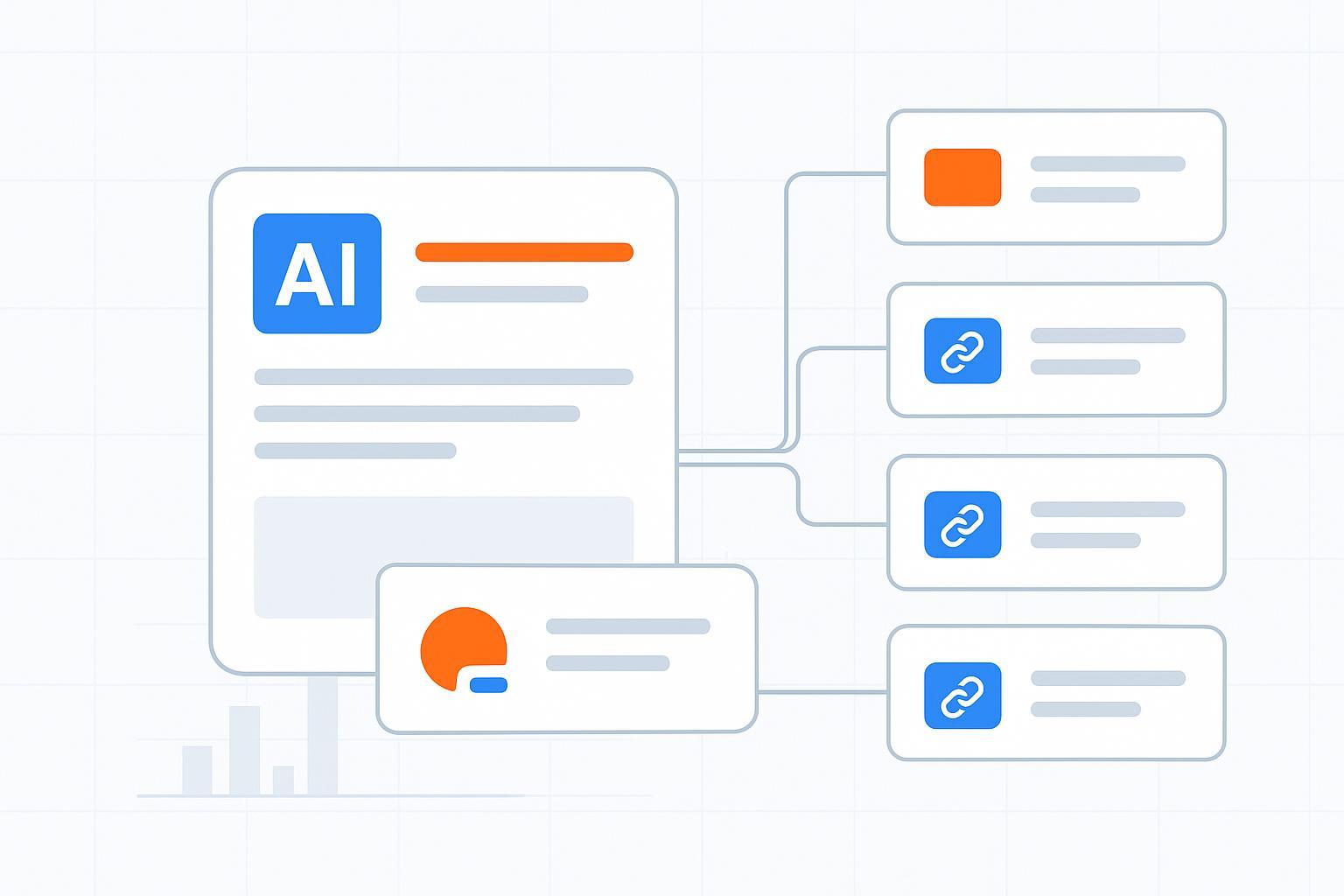
An AI citation is a source reference the system attaches to its answer—usually as a clickable link, card, or inline attribution—so the user can see where information came from.
Semrush describes AI citations as linked references to sources the system used to support a response in its overview of AI citations.
A citation is about source trust.
The system is saying: “This page supports what I just claimed.”
The user gets a path to verify (and sometimes click through).
What citations look like (across surfaces)
The UI differs by platform, but the concept is consistent:
In Google AI Overviews, citations often appear as source cards/links alongside or beneath the answer.
In other answer engines, citations can show up as inline references or a source list the user expands.
For measurement, you don’t need to obsess over the exact UI. You need one operational rule:
If the answer includes a link or explicit source attribution to a page, that’s a citation.
AI citations vs mentions: why two different metrics exist
A mention is when the model references the brand/entity name in the answer text but does not source a specific page.
Geneo’s overview of AI visibility KPIs (mentions vs citations/links) is useful here: mentions capture whether you’re being talked about; citations capture whether you’re being used as evidence.
The four common scenarios you’ll see
High mentions, low citations
The model knows the brand (entity salience), but it doesn’t trust (or doesn’t need) the brand’s pages as sources.
Typical causes: weak “extractable” pages, thin supporting evidence, or competitors have more cited-friendly resources.
High citations, low mentions
Your pages are used as sources, but your brand isn’t named.
Typical causes: the cited page answers the question but doesn’t clearly establish the entity/brand.
Mentions and citations both high
The brand is both salient and a trusted source.
Both low
Either the topic is outside your footprint, or your prompt set doesn’t reflect real buyer questions.
What “citation performance” means (and what it doesn’t)
Citation performance is not a proxy for revenue. It’s a proxy for whether your content is being treated as evidence.
Citations can be meaningful because they’re one of the few visible signals that:
your pages are discoverable by the system,
the content is formatted in a way the system can extract,
and the source is credible enough to attach to an answer.
But citations do not automatically mean:
users clicked,
users trusted the brand,
or the model’s answer was correct.
⚠️ Warning: AI answers are probabilistic. A single-run citation win (or loss) is not a trend.
If you take one screenshot and call it performance, you’re measuring luck.
A minimal KPI set agencies can defend
If you’re starting from zero, keep the dashboard small and honest. You’re trying to answer two questions:
Are we showing up?
When we show up, are we being used as a source?
A practical set:
1) Answer inclusion rate (AIR)
AIR answers: “Across our tracked prompts, do we appear at all?”
Geneo’s metrics post defines AIR as the share of prompts where the brand shows up in AI answers in GEO/AEO measurement metrics for AI search visibility impact.
2) Mention rate
Mention rate answers: “Do we get named, even without a link?”
This matters for brand preference and shortlists—but it’s not proof of authority.
3) Citation rate
Citation rate answers: “When the AI talks about us, does it cite our domain?”
4) Citation share (SOV-C)
Citation share answers: “In our category prompt set, what share of citations go to us vs competitors?”
It’s the easiest way to communicate competitive position without pretending the metric is deterministic.
5) Entity accuracy / sentiment (optional, but client-friendly)
For agencies, the reputational question is often more urgent than the traffic question:
Are we described correctly?
Are we being recommended for the right use cases?
Is the tone neutral/positive?
The measurement reality: volatility, variance, and attribution blind spots
You need to build measurement assumptions into the reporting.
Volatility is the baseline
Ahrefs notes that AI Overview outputs change frequently, and that citations can change materially over time in their guide on how to track AI Overviews.
That volatility shows up for Google AI Overviews citations and for other answer engines too, even when you keep the prompt “the same.”
Sampling beats screenshots
A simple agency-friendly approach:
Build a stable core set (e.g., 30–50 prompts).
Separate prompts into buckets (brand / soft-brand / non-brand).
Run on a consistent cadence (weekly is usually enough for TOFU reporting).
Track per engine, not blended.
Pro Tip: If you don’t separate prompt buckets, you’ll inflate results by accidentally “winning” prompts that include the brand name.
Attribution is imperfect
Even when a citation exists, you may not be able to tie it cleanly to clicks or pipeline.
Treat citation KPIs as leading indicators that help you decide where to invest content and authority building—not as conversion metrics.
Validation checklist: don’t ship fake or unsupported citations
Citations are supposed to increase trust. They can also backfire if you report them carelessly.
A peer-reviewed study in Scientific Reports found that when LLMs were asked to generate bibliographic citations, fabricated citations were common (reported fabrication rates included 55% for GPT‑3.5 and 18% for GPT‑4) in Fabrication and errors in bibliographic citations generated by ChatGPT (2023).
That study is about academic-style references, not AI Overview source cards—but the operational lesson carries:
Validation checklist: confirm the URL exists, the page supports the claim, and the attribution points to the original source.
What “good” looks like in 30 days
For an Awareness-stage program, “good” is not “we doubled citations.” Good is:
You have a stable prompt library per client/category.
You can explain AI citations vs mentions in one sentence.
You can report a small KPI set (AIR, mention rate, citation rate, citation share) with a time window.
You can point to 2–3 content or authority actions that plausibly explain changes.
Next steps
If you want to operationalize this for client reporting, start by building a prompt library and logging results weekly for a month. Once you have that baseline, you can decide whether you need a lightweight manual process—or a dedicated monitoring workspace.
If you want a centralized place to track multi-engine mentions/citations, keep history, and export client-ready reports, Geneo can be used as that hub—without turning citations into a vanity metric.