
Traditional SEO vs AI-Driven Search: 2025 Agency Comparison Guide
Explore Traditional SEO vs AI-Driven Search (Google AI Overviews, ChatGPT, Perplexity) in 2025. Compare discovery, KPIs, metrics, and hybrid strategies for agencies.
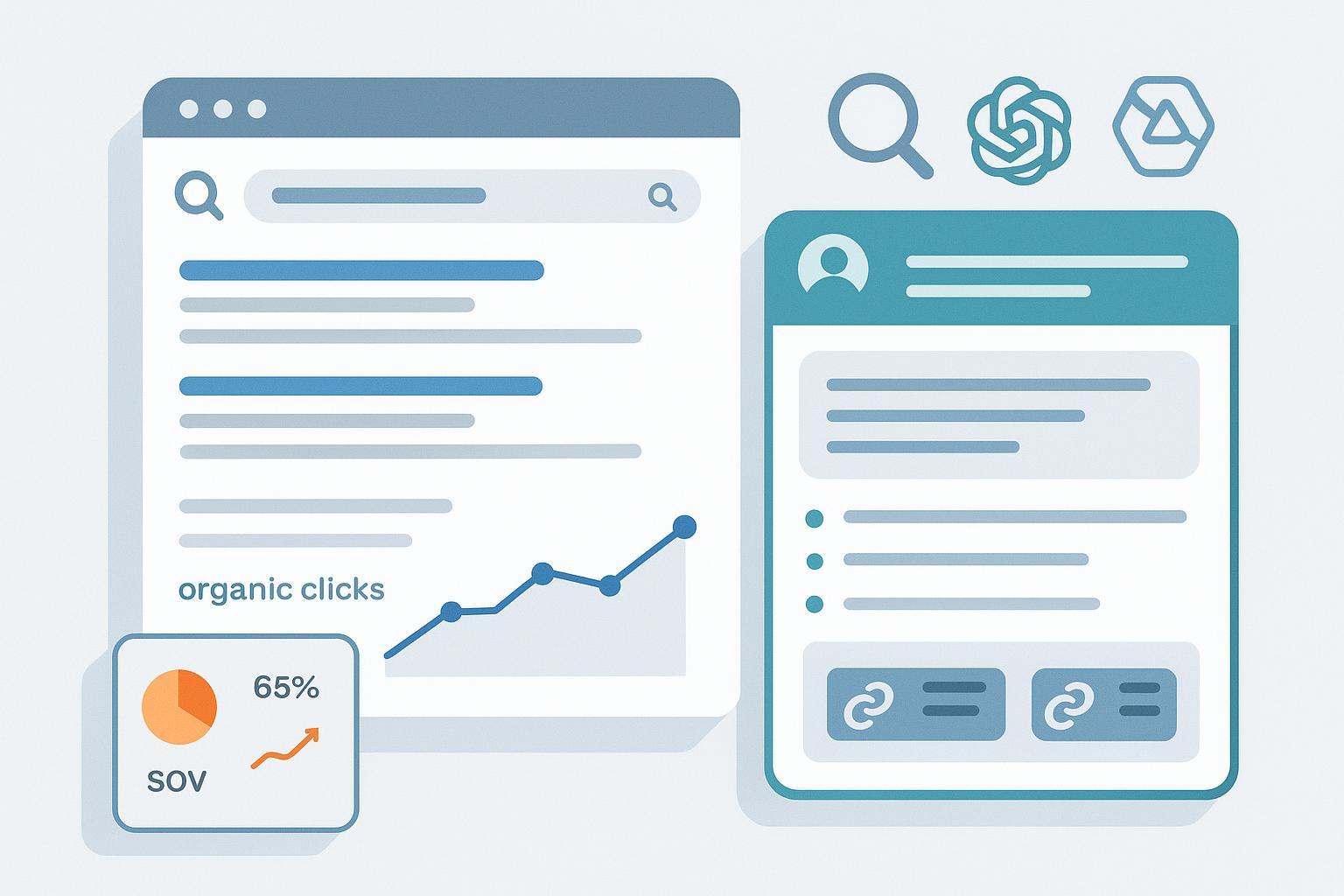
If your weekly standups now include “Why did non‑brand traffic drop on informational queries?” you’re not alone. AI‑driven answer experiences are changing how people discover and evaluate brands. The playbook isn’t to abandon SEO. It’s to run a hybrid model: protect what still works in SERPs while engineering content and measurement for AI answers.
How results are produced now
Traditional SEO returns a ranked list of web pages. Position, rich results, and on‑page clarity drive clicks and conversions. AI‑driven search—answer engines like Google’s AI Overviews (AIO), ChatGPT Search, and Perplexity—returns synthesized responses with citations and links.
- Google states AI Overviews are generated by customized Gemini models alongside Search systems, and they surface prominent source links intended to drive exploration, with updated guidance on how to succeed in AI search experiences (2025). AIO availability expanded globally through 2024–2025, with rollouts documented in Google’s product updates.
- OpenAI’s ChatGPT Search introduction (2024) describes timely answers with inline sources and an option for deeper multi‑step web analysis.
- Perplexity emphasizes citation‑first outputs to credit publishers; see its stance in the publishers program announcement (2025).
A practical implication for agencies: selection signals are no longer only about page‑level ranking strength. Extraction‑friendliness, provenance, and recency matter at the chunk level.
Side‑by‑side: where the models diverge
| Dimension | Traditional SEO | AI‑Driven Search (AIO, ChatGPT Search, Perplexity) |
|---|---|---|
| Discovery/output | Ranked blue links and SERP features; users click to evaluate. | Synthesized answers with cited sources; fewer clicks per impression but higher “on‑answer” influence. |
| Selection signals | Technical health, topical authority, intent alignment, internal/external links, schema, E‑E‑A‑T. | Extractable facts, chunk clarity, provenance/authority of sources, timeliness/recency, structured summaries (TL;DR, FAQs, tables). Guidance aligned with Google’s AIO docs. |
| KPIs | Rankings, impressions, organic sessions, CTR, conversions. | Answer Inclusion Rate (AAIR), Share of Voice in AI answers, citation/attribution rate, prompt‑specific retrieval rate; paired with assisted conversions/leads. |
| Content engineering | Comprehensive topic coverage; hub‑and‑spoke; long‑form depth. | Canonical, sourceable snippets: TL;DRs, Q&A blocks, data tables, explicit definitions; unambiguous entities; consistent schema. |
| Technical stack | Sitemaps, canonicalization, Core Web Vitals, log analysis, link acquisition. | Machine‑readable fact hubs/datasets, clean product/org facts, change logs, and (internally) embedding‑ready corpora for testing/verifying retrieval behavior. |
| Compliance/risk | Algorithm volatility, manual actions, content quality and spam policies. | Hallucination/misattribution risk; higher expectations for provenance. Monitor platform rules and evolving regulation (e.g., EU AI Act updates). |
What to measure in 2025
Are we visible inside the answer, and does that presence translate to outcomes? That’s the thread tying AI‑search metrics to commercial performance. For shared definitions and context, see the primer on AI visibility.
- Answer Inclusion Rate (AAIR): percentage of tracked prompts where your domain appears as a cited source. Formula: included prompts ÷ total tracked × 100. Segment by engine and intent.
- Share of Voice in AI answers: your proportion of mentions/citations among a defined cohort; weight by position within the answer and by prompt popularity where possible.
- Citation/attribution rate: proportion of answers with explicit links overall and to your domain; track anchor context (brand vs. entity/category) and position within the summary.
- Prompt‑specific retrieval rate: how consistently a canonical snippet (e.g., your definition or spec table) is pulled for a given query framing.
Pair these with GA4/CRM data—assisted conversions, lead quality, and pipeline velocity—because AI answer UIs often suppress clicks while still shaping buyer intent. Multiple datasets in 2024–2025 report that AI Overviews appear in a minority but meaningful share of queries (often cited around 13% in mid‑2025 snapshots), while reducing organic clicks on affected queries. See the mid‑2025 synthesis in Search Engine Land on 13% AIO appearance and the CTR decrease quantified by Ahrefs’ analysis of AIO‑affected keywords (2025).
For a field methodology to baseline and track these KPIs, use the step‑by‑step AI visibility audit guide.
Content engineered for extraction
Think of answer engines like meticulous editors: they prefer crisp, sourceable statements over meandering narratives. To win citations without sacrificing depth:
- Introduce a TL;DR at the top of cornerstone pages: 3–5 bullet sentences that state the what, why, and key numbers. Keep terminology consistent with your H1/H2s.
- Add Q&A blocks that mirror common prompts and variants; avoid compound answers that bury discrete facts.
- Use tables for specs, definitions, pricing windows, and comparisons so facts are unambiguous and copy‑ready.
- Mark up with appropriate schema (FAQPage, HowTo, Organization, Product) and ensure facts align across site sections and external profiles.
- Maintain canonical data hubs (e.g., /about/facts, /pricing/specs) with stable URLs so engines can rely on a single source of truth.
For practical patterns and examples, see the walkthrough on how to optimize content for AI citations. And because engines differ in sourcing behavior, it’s useful to understand monitoring nuances across them; a primer is here: ChatGPT vs Perplexity vs Gemini vs Bing (monitoring comparison).
Technical readiness for answer engines
You don’t need to expose a public vector index to be cited by answer engines, but you do benefit from thinking in “chunks.”
- Authoritative corpora: Maintain a clean, versioned corpus of canonical snippets (definitions, FAQs, specs) with stable IDs/URLs. This supports both public clarity and internal testing.
- Embedding‑ready datasets: Internally, keep a text+metadata export ready for embedding experiments. Treat it like a lab: can an in‑house retriever answer “What is your pricing model?” using only your canonical facts? If not, refactor content until it can.
- Change management: Publish change logs for critical facts. Engines—and your own teams—need to trace when/why a number changed.
- Developer handoff: Create a simple schema for canonical facts (field names, types, update cadence). Even a CSV/JSON endpoint for key specs can reduce ambiguity in how engines parse your pages.
Here’s the deal: the more consistent your facts are across pages and profiles, the less likely an engine is to grab an outdated or conflicting statement.
Risk, compliance, and governance
Answer engines accelerate research but raise accountability questions. Agencies should:
- Maintain audit trails for claims sourced from AI answers. Save the prompt, timestamp, engine, and cited links.
- Monitor platform policies: Google warns against scaled, low‑quality AI‑generated content and emphasizes people‑first creation in its documentation on using generative AI content in Search.
- Track regulatory context. In 2025, the EU advanced AI governance expectations, including transparency and copyright considerations for general‑purpose AI providers; see the Commission’s overview of the EU AI Act regulatory framework. While obligations sit largely with model providers, agencies serving EU markets should be prepared to correct misattributions and document provenance.
A simple safeguard: publish canonical fact pages and keep them updated. If an answer misstates your data, you’ll have a clear reference to share in correction requests.
Scenario guidance: where each path excels
B2B lead generation
- Expect smaller referral volumes from AI engines than from Google SERPs, but higher intent when cited. Prioritize comparison pages, canonical product specs, and original research that lends itself to quotation. Track AAIR/SOV for your head‑term landscape and tie to qualified pipeline.
Local services
- AIO penetration varies by query type; when AIO appears on service queries, answers often favor clean NAP details, service menus, and review recency. Keep Google Business Profile pristine and structure location pages with FAQs and explicit coverage areas. Monitor brand+location mentions across engines to catch recency gaps.
Publishers and content brands
- Build extractable data assets: methodology blurbs, key findings tables, and definitions that can be cited. For time‑sensitive topics, increase update cadence and include last‑updated stamps on the page.
Notice the throughline? Clarity and canonicalization increase your odds of being selected—and of being credited accurately when you are.
Workflow playbook for agency teams
- Establish dual‑track measurement: classic SEO KPIs plus AI‑search KPIs (AAIR, SOV‑AI, citation rate), segmented by engine and intent.
- Run an AI visibility baseline and set quarterly targets per client; refresh tracked prompts as products and seasons change.
- Retrofit priority pages with extraction‑friendly structures (TL;DRs, Q&A, tables) and align facts across site sections and external profiles.
- Build a canonical data hub and simple schemas/APIs for key facts; document change logs.
- Create an escalation path for misattributions: log the issue, update the canonical page if needed, submit feedback to the engine with references.
- Upskill: pair SEOs with content strategists and data/ops to manage prompt sets, tagging, and dashboards.
Also consider: related alternatives for monitoring
Disclosure: Geneo is our product. Agencies that need white‑label, client‑ready dashboards tracking AI answer inclusion, Share of Voice, and daily brand mentions across ChatGPT, Perplexity, and Google AI Overviews may consider Geneo (Agency) for monitoring and reporting.
Closing: adopt a hybrid operating model
The ground truth of 2025 is a blend. Traditional SEO remains the largest driver of organic opportunity, but answer engines influence consideration even when clicks don’t materialize. Agencies that measure AI presence, engineer content for extraction, and keep technical facts canonical will protect traffic while earning new forms of visibility.
One question to leave with your team this week: if an answer engine summarized your category today, would it quote your definitions and data—or a competitor’s? If the answer isn’t obvious, you know your next sprint.