
GEO for CRM Platforms: Salesforce vs HubSpot vs Dynamics 365 vs Zoho vs Pipedrive vs Freshsales (2025)
Compare Salesforce, HubSpot, Dynamics 365, Zoho, Pipedrive, and Freshsales for Generative Engine Optimization (GEO) in 2025. Review data unification, AI agents, schema, knowledge integration, and measurement to guide your decision.
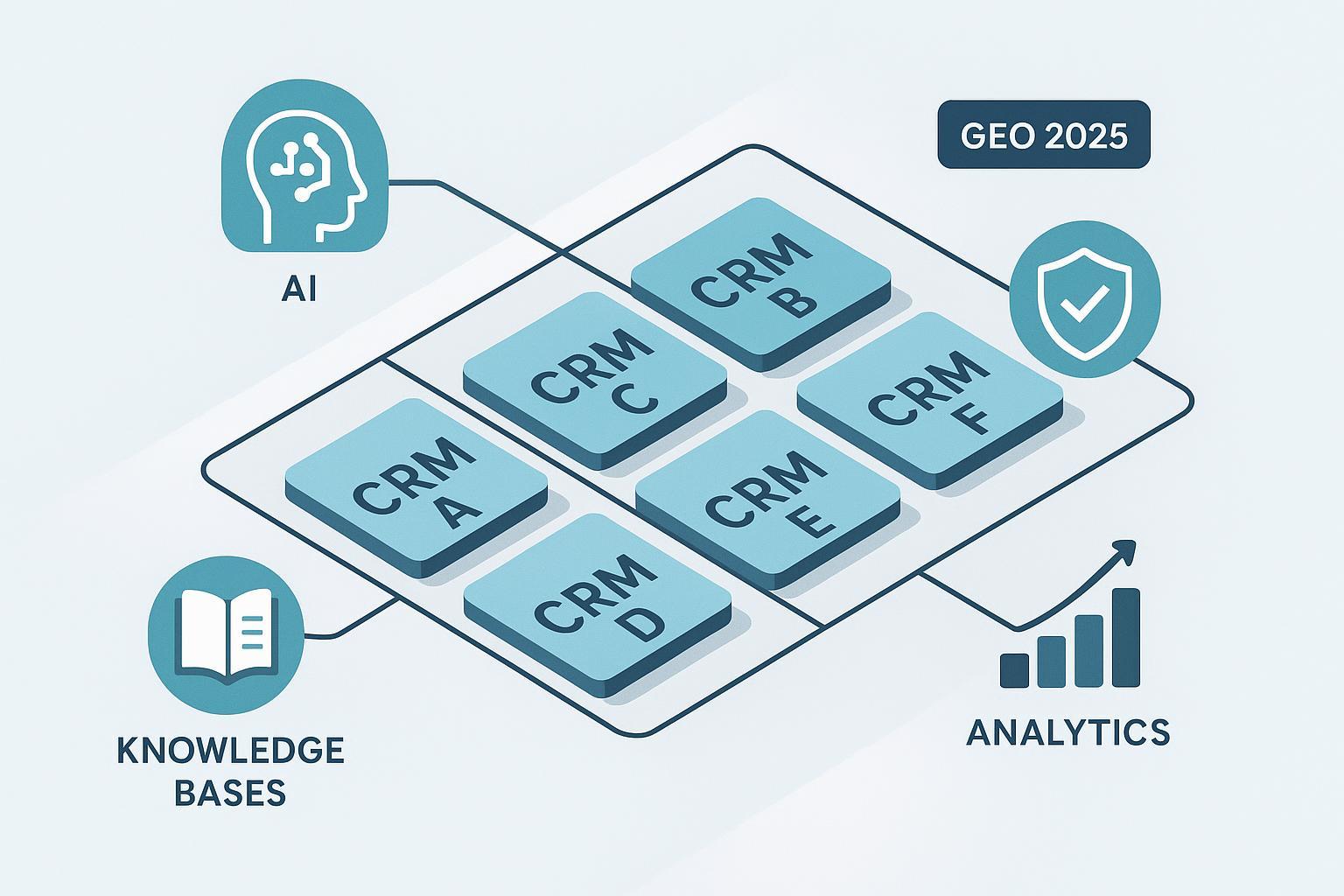
If you want your brand cited by AI answers, your CRM can’t just be a deal tracker. For Generative Engine Optimization (GEO), it needs to feed clean first‑party data into agents, tie into knowledge bases and publishing, support entity‑friendly content, and return measurable signals you can act on.
At‑a‑glance: how the big CRMs support GEO (2025)
| Platform | First‑party data foundation | AI agents/copilots (2025) | Knowledge/KB & CMS path | Schema/entity path | Measurement hooks | TCO/fit snapshot |
|---|---|---|---|---|---|---|
| Freshsales (Freshworks) | Unified CRM with built‑in comms; connectors to external apps | Freddy Copilot for summaries/replies; Freddy AI Agents with session‑based usage | Integrations to SharePoint/Google Drive/Confluence; public CMS external | Publish schema via external CMS | CRM reports; Freddy Insights (varies by product) | Accessible pricing; confirm Freshsales Suite tiers and Freddy inclusions |
| HubSpot Sales Hub | CRM + Data Hub across Hubs | Breeze Agents (Prospecting/Customer) on usage credits | Native Knowledge Base (Service Hub) and CMS in same ecosystem | Schema‑ready publishing via CMS (Content Hub) | HubSpot reporting; credit logs; add GEO tracking | SMB to mid‑market; fast time‑to‑value |
| Microsoft Dynamics 365 Sales | Dataverse with Microsoft 365 stack | Copilot for Sales; Sales Agent; Sales Chat | SharePoint/Teams for internal KB; public CMS external | Publish schema via external CMS | Dynamics reports + Power Platform telemetry | Strong in Microsoft‑standardized orgs |
| Pipedrive | Sales pipeline data; marketplace to connect data/BI | AI Sales Assistant for suggestions and summaries | Marketplace connectors to docs/KB; no native enterprise KB/CMS | Publish schema via external CMS | Pipeline analytics; add GEO tracking | Quick adoption for pipeline‑first teams |
| Salesforce (Agentforce Sales / Sales Cloud) | Data Cloud as governed, unified data | Agentforce/Einstein with RAG, conversation insights | Salesforce Knowledge + Experience Cloud or external CMS | Publish schema via Experience Cloud or external CMS | CRM analytics + Data Cloud logs; add GEO tracking | Enterprise‑grade, highly extensible |
| Zoho CRM | Broad native suite (Desk, Campaigns, Analytics) | Zia (agents, Ask Zia, scores) | Zoho Desk KB; Sites/Writer; or external CMS | Schema via Zoho Sites or external CMS | Zoho Analytics + Zia Insights; add GEO tracking | Competitive pricing; suite value |
Platform capsules (alphabetical)
Freshsales (Freshworks)
Freshsales brings CRM, telephony, chat, and email into one place, which helps consolidate the first‑party signals GEO teams need. Freddy Copilot speeds up summaries and replies, while Freddy AI Agents can automate steps that depend on CRM context and connected knowledge sources. Public, schema‑rich publishing typically lives outside Freshsales, so you’ll rely on an external CMS; AI Agent usage may also be metered by sessions. Freshworks documents the Freddy platform and session mechanics in its 2025 explainer; see the company’s overview in the Freshworks AI capability page.
Authoritative source: Freshworks’ 2025 platform overview details Freddy Copilot and AI Agents in the Freshworks AI capability page (2025-11-17).
HubSpot Sales Hub
HubSpot’s Sales Hub sits in an ecosystem with Content Hub and Service Hub, which matters when you need agents that can both prospect and help keep knowledge current. Breeze Agents run on HubSpot Credits and can handle prospecting tasks and content/knowledge workflows across Hubs. Advanced agent capacity depends on credits and tier, and some features appear first in Pro/Enterprise. Entitlements and limits are documented in HubSpot’s legal catalog—credits definitions, monthly allotments by tier, and purchasing options are spelled out in the HubSpot Product & Services Catalog (2025-10-01).
Microsoft Dynamics 365 Sales
Dynamics 365 Sales is anchored by Dataverse and integrates natively with Outlook, Teams, and SharePoint. Copilot for Sales delivers record summaries, email drafting, and guided actions; Sales Agent and Sales Chat extend conversational access to CRM context. Public schema publishing usually depends on an external CMS, and Copilot/Sales Agent licensing can vary by SKU. Indicative 2025 pricing shows Professional at $65, Enterprise at $105, and Premium at $150 per user per month (annual); confirm Copilot inclusions on Microsoft’s own pages, such as the official Dynamics 365 Sales pricing page (2025-07-21).
Pipedrive
Pipedrive prioritizes visual pipelines and quick automation. Its AI Sales Assistant suggests next steps, drafts emails, and summarizes activity, which helps sales teams move faster while you layer in GEO workflows via the marketplace. There’s no native enterprise KB/CMS, and AI features concentrate on sales productivity rather than content governance. Plans were refreshed in 2025 (Lite, Growth, Premium, Ultimate); examples commonly cite Lite ~$14 and Growth ~$39 billed annually, with Premium/Ultimate higher—verify your region’s list price on the live pricing page. Plan structure details are documented in the Pipedrive plan update knowledge base article (2025-11-03).
Salesforce (Agentforce Sales / Sales Cloud)
Salesforce combines governed data (Data Cloud), knowledge, and AI agents (Agentforce, Einstein) with a vast ecosystem. For GEO‑oriented teams, that means you can ground agents on approved CRM and Knowledge sources and route outputs to public sites via Experience Cloud or external CMSs. Complexity and cost can be higher than SMB tools, and schema‑rich public pages still need Experience Cloud or another CMS. Example 2025 list prices often cited: Sales Cloud Enterprise $165/user/month and Unlimited $330; Agentforce can be an add‑on or standalone edition—confirm current figures on official pages. Salesforce’s Spring ’25 announcement describes RAG, conversation insights, and governance controls relevant to sales; the canonical summary is Salesforce’s Spring ’25 product release announcement (2025-02-17).
Zoho CRM
Zoho CRM is part of a broad suite—Desk, Campaigns, Analytics, Finance, Sites, and more. Zia adds generative and predictive capabilities, including Zia Agents and Ask Zia, while Blueprint lets ops teams enforce consistent processes across content and engagement. USD pricing often requires the calculator; confirm Zia features by edition. Indicative annual USD/user/month via the calculator (2025): Standard ~$20, Professional ~$35, Enterprise ~$60, Ultimate ~$65; verify current USD figures for your region. For a first‑party summary of generative features, see Zoho CRM’s Zia overview (2025-07-09).
Which CRM fits your GEO scenario?
Enterprise/regulated with governed agents: Choose Salesforce or Dynamics 365 when you need a unified data layer (Data Cloud/Dataverse), audited agent actions, and cross‑suite orchestration. Their controls suit complex approvals and multi‑source grounding.
Content‑led SMB or mid‑market: HubSpot shines when you want schema‑friendly publishing and a native KB alongside sales ops. Breeze Agents plus the CMS shorten the path from CRM facts to public, answerable pages.
Cost‑sensitive teams that still want AI assist: Zoho CRM or Freshsales offer broad capability at approachable prices. Pair with your existing CMS and knowledge tools for public content.
Pipeline‑first speed: If you need momentum now, Pipedrive’s AI Sales Assistant and marketplace add‑ons get you moving, then you can add GEO measurement as you mature.
Curious how different engines surface brands? The comparison in ChatGPT vs Perplexity vs Gemini vs Bing: Monitoring Comparison outlines model‑specific behavior you’ll see in testing.
How to measure GEO impact with your CRM stack
Your CRM is the source of truth for people, companies, products, and conversations. GEO measurement attaches to that spine so you can tie AI citations and answer quality back to the content and knowledge your team controls.
Define the KPIs and baselines. Track model‑level visibility, citation share, accuracy, and sentiment. A practical framework is outlined in LLMO Metrics: Measuring AI visibility KPIs.
Instrument the publishing layer. Ensure your CMS/KB emits canonical URLs, FAQ blocks, and entity‑friendly metadata; map CRM objects (Organization, Product, Person) to public pages. Run recurring audits and iterate. Keep a record of the AI questions you test, the responses, and the content updates you make. Correlate gains back to CRM records. If you need a checklist, use How to perform an AI visibility audit for your brand.
Two pro tips: Think of GEO like a product feedback loop for your content, and treat your CRM as the data store that drives which facts deserve a prominent, schema‑ready page. Second, test across models regularly; what surfaces in Perplexity might differ from Gemini the same week.
Also consider (related companion)
If you need purpose‑built measurement for brand mentions, citations, and sentiment across ChatGPT, Perplexity, and Google AI Overviews—with historical tracking and optimization prompts—consider pairing your CRM with Geneo. Disclosure: Geneo is our product.
Notes on evidence and pricing
Facts and prices shift quickly. We referenced each vendor’s 2025 materials and recommend confirming live pages before budgeting. CRMs enable GEO by unifying first‑party data and powering agent workflows; measurement of AI citations usually requires a dedicated tool. Prefer pilots: wire up one or two high‑value entities (e.g., your flagship product and company page), publish schema‑rich answers, and verify movement before scaling. Ready to pressure‑test your stack? Which use case will you prove first?