
Why Track Perplexity Rankings: The Ultimate Guide to Generative Engine Optimization
Discover how tracking Perplexity rankings reveals competitive gaps in AI search. Learn executive KPIs and a step-by-step baseline audit for GEO success. Start your audit today.
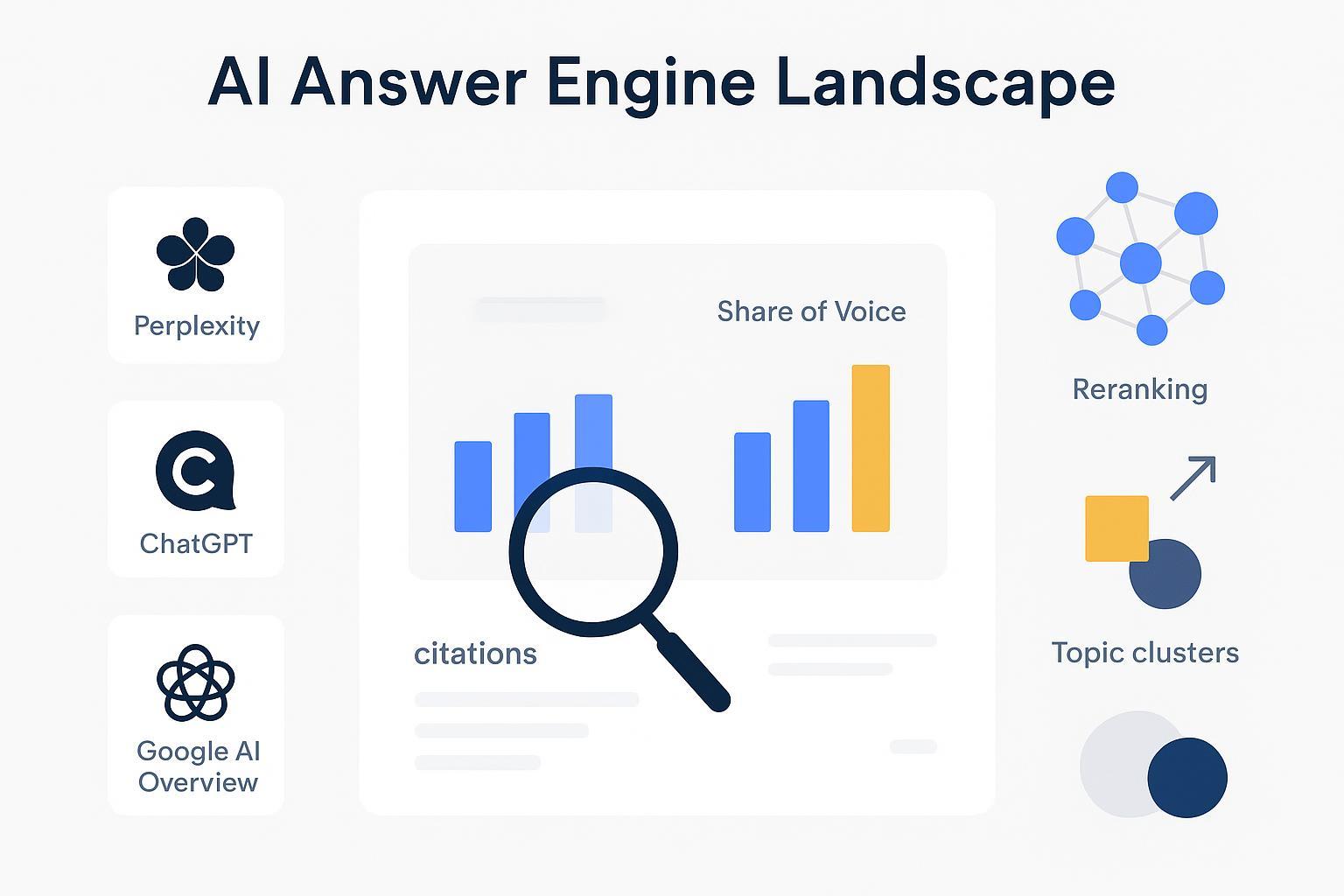
If your brand is strong on Google yet oddly missing from AI answers, you’re not alone. Perplexity, ChatGPT, and Google AI Overview (AIO) increasingly shape how people discover, compare, and decide—often without clicking through. That’s why tracking Perplexity rankings and citations is now a board-level visibility task. The goal here is simple: arm you with the “why,” the executive KPIs, and a practical baseline audit so your team can measure and close AI-era competitive gaps.
What Makes Perplexity Different (and Why It Matters)
Perplexity is an answer engine: it retrieves information in real time and displays numbered citations directly inside the response. The company’s help center notes that “each answer includes numbered citations linking to the original sources,” making verification built-in and transparent. See the official explanation in the Perplexity Help Center — How does Perplexity work?.
Visibility in Perplexity is not a blue link position—it’s whether your domain is cited as a trusted source inside the answer. Industry analysis shows meaningful overlap between Perplexity citations and Google’s top ten, but it’s far from a mirror. According to Search Engine Land’s coverage of citation overlap (2024), roughly 60% of Perplexity’s citations overlap with Google’s top organic results. In other words, classic SEO helps, but it won’t guarantee you’re the source Perplexity names in answers.
How Perplexity Ranks and Cites Sources (Signals You Can Influence)
Recent research (summarized by Search Engine Land) suggests Perplexity uses a multi-step retrieval and reranking pipeline. For entity and topic searches, an ML-based reranker evaluates relevance and authority after initial retrieval; freshness, semantic clarity, and structured formats count; there may also be domain-level boosts for recognized authorities. See How Perplexity ranks content: Research uncovers core signals (2025) for an overview of these signals.
Across reputable industry guides, the same families of influence emerge: trust/authority, relevance/helpfulness (aligned with E‑E‑A‑T), recency, extractable structure (definition blocks, lists, tables), topic clustering, and technical readiness. For practical guidance on optimizing answers for extraction and citation, consider Conductor’s Answer Engine Optimization primer.
A word of caution: practitioner posts sometimes offer aggressive tactics (e.g., ultra‑frequent updates, “quality scores,” or impression thresholds) without official confirmation. Treat those as experiments, not rules. Where you adopt them, instrument carefully and tie results to your KPIs.
The Competitive Gaps You’ll Only See by Tracking Perplexity
Citation-first transparency lets you observe which domains and URLs Perplexity trusts for your category, often surfacing expert publications, original research, and tightly structured explainers that aren’t top Google results. Cross-engine divergence reveals new competitors, since Perplexity may pull from a wider range of sources than Google. Freshness dynamics create visibility spurts that slow-moving organic rankings won’t show. And entity-led clustering rewards comprehensive coverage: interlinked hubs and evidence-backed explainers can earn priority even without the strongest classic SEO metrics. If you don’t track Perplexity, you miss who’s cited, why, and how your domain stacks up on the signals that actually drive AI answers.
Executive KPIs for AI Visibility
Below is an executive-friendly KPI set tailored to zero‑click, AI-led experiences. It complements—not replaces—classic traffic metrics. For deeper definitions, see Geneo’s AI visibility definition and an overview of LLMO metrics.
KPI | What it tells you | How to capture (Perplexity / ChatGPT / Google AIO) |
|---|---|---|
Brand mention rate | How often the brand is named in answers | Log appearances per prompt cluster; save screenshots/answer text |
Citation share | How often your domain/URLs are cited as sources | Count citations per prompt; track domain-level vs page-level |
Share of voice | Relative presence vs named competitors | Calculate % of mentions/citations per engine across the cluster |
Sentiment of mentions | Whether references are positive/neutral/negative | Tag answer tone; watch recommendation context |
Topical authority coverage | Strength across your strategic clusters | Map prompts → clusters; score coverage vs depth and evidence |
The Baseline AI Visibility Audit (Step-by-Step)
Your single next action: complete a cross‑engine baseline audit so you can prioritize fixes and quantify progress. Think of it like a quarterly brand health check for AI answers.
Define KPIs and competitors.
Choose 5–10 direct competitors. Confirm KPIs: mention rate, citation share, share of voice, sentiment, topical coverage.
Build prompt clusters from real questions.
Gather 50–100 queries from sales calls, support tickets, Reddit, and Search Console. Cover awareness → consideration → decision. Keep phrasing natural; AI engines respond differently to conversational prompts.
Run platform audits on Perplexity, ChatGPT, and Google AIO.
Test every prompt, save outputs, capture citations, and note which domains/URLs are recommended. Record sentiment and context (e.g., “best for,” “alternatives,” “warnings”).
Analyze patterns and competitive gaps.
Identify the domains consistently cited by Perplexity. Where are you missing? Which pages win citations—and why (structure, evidence, recency, authority)? If ChatGPT mentions you but Perplexity doesn’t, investigate extraction readiness and source trust.
Prioritize fixes and publish definition-ready assets.
Create crisp, fact-rich passages suitable for citation. Add tables, lists, and short definition blocks. Refresh high-value pages with current data and original evidence (studies, case summaries, expert quotes). For context on optimizing for answer extraction, see Conductor’s AEO guide.
Set a re-audit cadence and reporting loop.
Monthly for volatile topics; at minimum quarterly for leadership reviews. Maintain a prompt library and versioned snapshots of answers so you can track change over time. If your team needs a framework for diagnosing low brand mentions, Geneo’s diagnostic walkthrough on ChatGPT can help: How to diagnose and fix low brand mentions in ChatGPT.
The Perplexity-Specific Optimization Playbook
This is how you influence the signals Perplexity cares about without chasing myths.
Build authority assets.
Commission original research, publish methodologies, and cite external authorities. Earn links and mentions from reputable domains. Industry analysis of 8,000+ AI citations highlights how authoritative sources are favored; see Search Engine Land’s insights on AI citations (2024).
Structure for extraction.
Use clear headings, definition blocks, tables, and lists. Write concise factual passages that an answer engine can quote. For high-level guidance on optimizing for AI answer formats, Conductor’s primer is a useful reference.
Maintain freshness.
Update priority pages with new data, examples, and references. Avoid date-stale assets in fast-moving categories. Research indicates time decay and recency matter to rerankers; see Search Engine Land’s ranking signals overview (2025).
Cluster topics around entities.
Build interlinked hubs: glossaries, explainer series, and case references centered on your core entities (products, problems, categories). This improves semantic clarity and coverage that rerankers can detect.
Keep the tech clean.
Ensure crawlability, robust internal linking, and appropriate schema (FAQ, HowTo, Product). PDFs and structured assets can help if they present facts clearly.
Experiments to consider (clearly labeled): Some practitioners suggest ultra‑frequent updates or chasing early impressions; test selectively and watch the KPIs before adopting broadly.
A Neutral, Practical Example: Setting Up Your Baseline in One Week
Disclosure: Geneo is our product.
Here’s a pragmatic way a marketing director can stand up the baseline without heavy engineering. Days 1–2: Define KPIs, pick 5–10 competitors, and compile 75–100 prompts across awareness, consideration, and decision. Day 3: Run the prompts in Perplexity, ChatGPT, and Google AIO. In Geneo, teams typically log brand mentions, citation frequency, link visibility, sentiment, and share of voice per engine, with snapshots for auditability. Day 4: Analyze which domains Perplexity cites most in your category; flag missing clusters and stale assets. Day 5: Brief the content team on 10–15 high‑impact fixes (definition passages, structured tables, fresh data, authority references) and schedule your first re-audit.
If you prefer manual tracking, maintain a spreadsheet with columns for prompt, engine, cited domains/URLs, sentiment, and notes; store screenshots in a shared drive and tag by date and prompt cluster; visualize share of voice and citation trends in a simple dashboard.
Reporting Cadence, Ownership, and Risk Management
Set monthly check-ins for hot topics and quarterly executive reviews across all clusters. Assign marketing ops to maintain the prompt library and audit logs; content leads own fixes; SEO/GEO strategists govern schema, internal links, and clustering; analytics ensures KPI integrity. Avoid single-prompt snapshots, over-reliance on practitioner “leaks,” and neglecting freshness in fast-moving topics. Balance sources and prefer primary data and transparent methodologies. If a recommendation is negative or a warning mentions your brand, respond with factual improvements—don’t hide it.
Next Steps: Complete Your Baseline Audit and Consolidate Monitoring
You’ve seen the why and the how. The next step is to run the baseline across Perplexity, ChatGPT, and Google AIO, then prioritize fixes based on citation gaps and authority signals. If consolidating monitoring and reporting would streamline the process, platforms like Geneo can help centralize prompt libraries, snapshots, and share-of-voice tracking; agencies can also leverage white‑label reporting. Or, keep it manual—what matters most is that you start, measure, and iterate.
For broader context on traditional SEO vs. GEO, you can compare frameworks in Traditional SEO vs GEO (Geneo comparison). When you’re ready to measure beyond traffic, revisit the LLMO metrics overview to sharpen your KPI definitions.
One question to leave you with: if your brand isn’t being cited in Perplexity today, who is—and how long are you comfortable with them owning the story?