
Packaging GEO as a Premium Agency Service
Learn best practices for packaging GEO as a premium agency service in 2025. Covers tiered pricing, AI measurement, compliance, templates, and reporting for agencies.
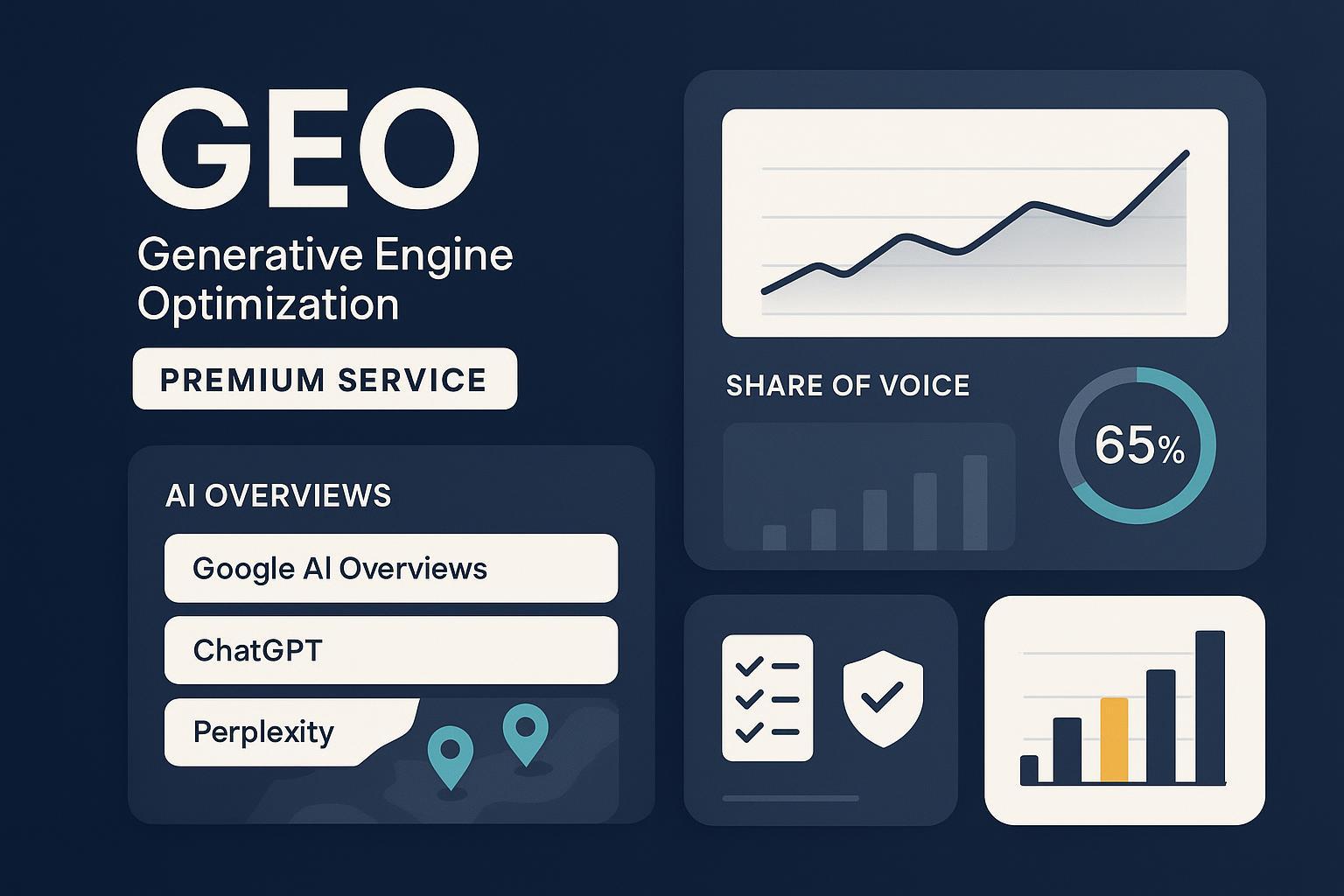
Agencies feel the local SEO plateau. Rankings and citations still matter, but executives now ask, “How does our brand show up in AI answers?” That question reframes value. Generative Engine Optimization (GEO) isn’t a bolt-on tactic; it’s a premium, ongoing program that blends traditional local SEO with monitoring, content governance, and executive-grade reporting across AI surfaces.
What makes GEO premium
GEO earns premium status because it targets discovery where AI systems synthesize answers and selectively cite brands—then changes fast. Google’s AI Overviews coverage materially fluctuated through 2025, expanding into commercial intents before stabilizing under ~16% of queries by November, with layout and ad adjacency shifts documented by industry analysts; see the year-end recap in Search Engine Land’s analysis of AI Overviews volatility (2025) and Google’s guidance on AI features inclusion and best practices (2025).
Premium GEO packages account for:
- Volatility and risk management: continuous audits of AI answers and citation presence; playbooks when brand is misrepresented or absent.
- Outcome alignment: executive KPIs like Share of Voice within AI answers, citation frequency, sentiment and entity accuracy, and position-weighted visibility.
- Multi-surface orchestration: Google AI Overviews, Perplexity (which foregrounds citations), and ChatGPT-linked experiences where publisher signals and authority drive inclusion. Perplexity’s publisher-facing stance is explicit—citations in every answer and a Publishers’ Program that clarifies participation.
A tiered packaging model
A clear tiering helps buyers understand scope and value. Ranges below reflect common U.S./Canada retainers; actual pricing depends on location count, content volume, and reporting cadence. Industry surveys place average local SEO retainers near the $1.5k/month mark, with agencies trending higher; see BrightLocal’s local marketing survey (2024) and Ahrefs’ SEO pricing analysis (2024).
-
Foundational (Local SEO + GEO readiness). Scope focuses on Google Business Profile (GBP) completeness, review program, essential citations, baseline schema, and quarterly AI answer snapshots. It fits single-location or small multi-location brands establishing hygiene. Pricing logic is driven by low content lift, limited audits, and lower reporting frequency.
-
Hybrid (Local SEO + ongoing GEO). Scope covers programmatic location pages, structured entity content, monthly AI answer audits across Google/Perplexity, citation tracking, and dual-lens reporting. It fits regional brands with 5–50 locations that need predictable reporting and content velocity. Pricing logic reflects moderate content lift, monthly cadence, and added measurement complexity.
-
Enterprise (Multi-location GEO at scale). Scope includes centralized data governance, automation for posts/reviews/photos, localization testing, escalation playbooks, and franchise dashboards with SoV and sentiment. It fits franchises and national portfolios with cross-functional stakeholders. Pricing logic accounts for high content lift, automation tooling, weekly monitoring, and governance overhead.
The operational blueprint
Getting premium GEO right takes people, process, and platforms.
People: Appoint a lead strategist (measurement and governance), a content/structured data specialist, a local ops manager (GBP and reviews), and an analyst for cross-surface audits. For enterprise, add a program manager for change management.
Process: Run monthly AI answer audits, quarterly content and schema refreshes, ongoing review responses, and incident workflows for misattribution or brand drift. Think of it like SRE for brand visibility—detect, triage, correct.
Platforms: Use listings management, review operations, schema tooling, and dashboards that unify traditional search metrics with AI answer KPIs. For practical how-tos on auditing AI presence, see the internal guide How to perform an AI visibility audit for your brand.
Multi-location specifics: Maintain a centralized source-of-truth for NAP, hours, services, and imagery. Build programmatic location pages that embed local proof (photos, testimonials, FAQs) and structured data. Automate GBP posts, review prompts, and photo refreshes, and implement QA checks to prevent template decay.
Measurement executives trust
Executives buy measurement. Use the AMEC Integrated Evaluation Framework (IEF), aligned with the Barcelona Principles V4.0, to connect activities to outcomes and reject vanity metrics. Review the Barcelona Principles V4.0 (AMEC, 2025).
Your dashboard should present two lenses. The traditional lens covers rankings, clicks, calls, directions, and conversions by location. The AI answer surfaces lens tracks Share of Voice within answers, citation presence and recency, sentiment and entity accuracy, and position-weighted visibility across queries. Perplexity’s citation-first behavior further supports validation of “AI Mentions” counts and citation quality; their publisher stance is outlined in the Publishers’ Program.
For traffic attribution considerations and pitfalls unique to AI surfaces, the internal post AI traffic tracking best practices (2025) covers setup ideas.
Compliance and E-E-A-T guardrails
Premium packaging demands premium governance. Two pillars matter: regulatory compliance and content quality signals.
FTC expectations: Truth-in-advertising rules apply to AI claims—no exemptions. Substantiate performance claims, disclose endorsements, and align privacy practices with promises. See the FTC’s AI guidance portal (2024–2025).
E-E-A-T: Strengthen author and entity signals—real bios, credentials, and schema; avoid scaled, thin AI-generated content. Google’s guidance on inclusion in AI features reiterates people-first content; read AI features inclusion and best practices (2025).
A compact checklist: Document methodologies and typical results. Maintain author/entity schema and source transparency. Keep client data handling and disclosures consistent.
For baseline AEO/GEO content quality practices, reference AEO best practices: Executive guide (2025).
Templates you can use
Start with three light but high-signal artifacts.
AI Answer Audit (snapshot): Select 25–50 priority queries by intent, including “best near me” and category + location. Audit Google AI Overviews and Perplexity, recording citation presence, sentiment, and position. Translate findings into actions such as entity naming fixes, schema updates, and location-specific explainers, then monitor change.
Onboarding Packet (multi-location): Capture NAP, services, photo library, and review policy. Define governance—who approves content, escalation paths, and cadences. Include playbooks for review responses, misattribution corrections, and localization tests.
Dual-Lens Dashboard (overview): Summarize traditional metrics (rankings, clicks, calls) alongside AI-surface metrics (Share of Voice, citations, sentiment, entity accuracy, position-weighted exposure). Present one page an executive can scan in minutes.
Example workflow note (vendor referenced as illustration): Some agencies host white-label dashboards on a custom domain and automate AI visibility audits across Google AI Overviews and Perplexity, rolling daily citation history into a single Brand Visibility Score. A platform like Geneo can streamline this reporting step while keeping the agency’s brand front and center. Disclosure: vendor referenced as an example; no endorsement implied.
Short case use (illustrative): In franchise onboarding, the audit template flagged inconsistent entity names across 120 location pages and weak schema. After governance fixes and programmatic updates, monthly AI answer audits showed rising citation consistency. A white-label dashboard (e.g., via Geneo) helped the client’s regional leads track progress without juggling spreadsheets. Disclosure: vendor referenced as an example; no endorsement implied.
Profitability math and pricing benchmarks
Premium packaging must pencil out. Use a simple model: set a base retainer by tier (informed by scope and market ranges), allocate per-location credits for audits and content units (for example, two audits and one content refresh per site per month), define query bundles by intent set to cap scope, and decide whether tooling is a pass-through or a margin line depending on contract norms. BrightLocal’s and Ahrefs’ surveys give directional context on retainers; combine that with your cost structure. Control scope tightly with SLAs that state the number of audits, content pieces, and reporting cadence per tier.
Packaging and pitch
Position GEO as risk management plus growth. You’re not selling screenshots; you’re selling governance and visibility across answers that shape decisions. Expect objections like “We just need more traffic.” Reframe with: “Do you want to be cited where decisions happen?” A short vignette: a regional services brand with 40 locations saw fragmented citations and sporadic AI inclusion. The team instituted monthly audits, structured content upgrades, and governance workflows. Over two quarters, AI answer Share of Voice improved and misattributions dropped, supporting steadier lead quality. Results were presented in a dual-lens dashboard the CFO could parse in five minutes.
Next steps
- Pick your tier framework and define SLAs.
- Build the audit and onboarding templates.
- Stand up dual-lens dashboards and governance playbooks.
- Pilot with one multi-location client, then roll out.
If you need an example of white-label AI visibility reporting to slot into your workflow, review Geneo for Agencies. Disclosure: vendor referenced as an example; no endorsement implied.