
Hybrid SEO + GEO: The Ultimate Guide for Modern Agencies
Unify traditional SEO and local SEO with AI answer surfaces. Discover agency workflows, reporting KPIs, and optimization strategies in this complete guide.
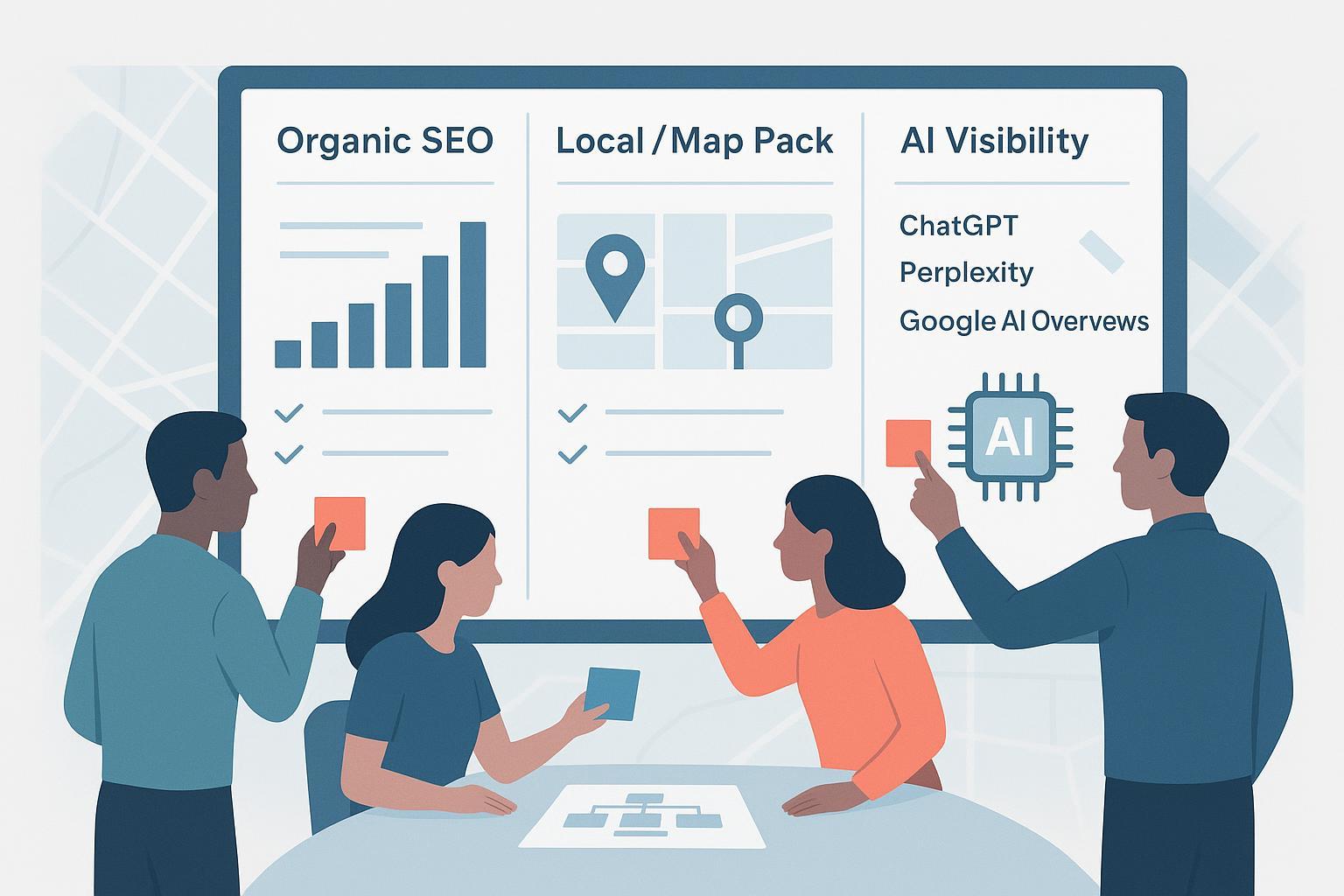
If your team still treats website SEO and Google Business Profile as separate tracks, you’re leaving performance (and proof) on the table. Clients don’t care which channel “owns” the win—they want more qualified calls, directions, forms, and brand presence where customers actually look: organic results, the map pack, and now AI answer surfaces. This guide shows how to fuse SEO and GEO into one plan your agency can run quarter after quarter—and how to measure it with credibility.
Why hybrid beats silos
When organic and local teams work in parallel but not together, both sides miss compounding gains. The site’s entity clarity, topical hubs, and internal linking reinforce relevance for local queries; GBP category accuracy, services, and reviews boost both conversions and local pack visibility. Google’s own framing of local results—relevance, distance, and prominence—explains why these signals need coordination rather than isolation. According to Google’s help guidance, local ranking is primarily influenced by how closely a profile matches the query (relevance), proximity to the user (distance), and overall prominence (including reviews and information from across the web) as defined in the official “Tips to improve your local ranking on Google” page (Google Business Profile Help).
Think of it this way: your site’s architecture and service pages shape relevance; your link profile and coverage across authoritative sites influence prominence; your GBP presence and reviews convert attention into actions. Split them apart and you’ll chase symptoms. Run them together and you’ll see compounding effects.
The handshake: mapping SEO signals to GEO levers
Hybrid execution starts by aligning entities, pages, and profiles. On the website side, build topical hubs with clear internal pathways to location and service pages. Use descriptive titles, concise H1s, and schema so search engines interpret your entities accurately. Google’s updated SEO Starter Guide highlights fundamentals like crawlable architecture, helpful content, and structured data to clarify meaning for search systems (Google’s SEO Starter Guide).
On the GBP side, primary category selection is a force multiplier, and secondary categories should mirror your service taxonomy. Moz’s analysis of fields with ranking impact underscores the importance of correct categories, accurate address data, reviews, and (where relevant) service/menu information in shaping visibility and click behavior (Moz’s overview of GBP fields that impact rank).
Where do these meet? Your GBP landing page. The page you link from GBP should align tightly with the listed category/service, reflect consistent NAP, and provide the evidence users and systems need—unique copy, media, FAQs, and supporting internal links. Citations (consistent references to name, address, and phone) reinforce this handshake by echoing the same entity details across reputable directories; while debates continue about their weight, they remain part of the local ecosystem, especially for new or lightly established entities.
Location and service pages that actually rank (and convert)
Strong location and service pages do double duty: they rank organically and give GBP a relevant, conversion-ready destination. The pattern isn’t complicated, but execution quality matters.
- Page focus and IA: Give each distinct city and each distinct service its own page. Avoid thin, templated copy. Explain the service in local context (coverage areas, regulations, case photos), and connect the page to a hub that clarifies entity relationships.
- Metadata and headings: Include the service + city in the title tag and H1 naturally—not stuffed. Reinforce with concise, readable subheads.
- Structured data: Use appropriate LocalBusiness (and subtype) schema for the business entity, and ensure addresses/hours match GBP. Don’t mark up first‑party “self‑serving” reviews for LocalBusiness/Organization; Google’s documentation and updates indicate such reviews aren’t eligible for rich result enhancements.
- Internal links: Link from service hubs and city hubs to these pages, and include cross-links where services naturally intersect.
- Media and trust: Add unique photos, team bios, certifications, and localized FAQs. These elements help users and also support entity clarity for systems that synthesize answers.
- UTM and analytics: Add UTM parameters to the GBP website link so you can segment traffic and actions in GA4 and Search Console.
Reviews: your conversion and prominence engine
Reviews influence both discovery and decision-making. BrightLocal’s 2024 Local Consumer Review Survey reports that recency, volume, and star rating materially affect consumer choice, and that readers scrutinize the authenticity signals (e.g., named profiles, detailed comments) when evaluating local businesses (BrightLocal Local Consumer Review Survey 2024). Agencies should design programs that drive steady, policy‑compliant review acquisition and timely responses.
- Acquisition rhythm: Aim for consistent velocity rather than irregular bursts. Diversify prompts (email/SMS post‑service, in-person QR codes) within platform policies; never “gate” reviews.
- Response playbook: Reply to both praise and complaints with specifics. A thoughtful response can offset a less‑than‑perfect rating by demonstrating accountability.
- Policy guardrails: Don’t offer incentives that violate policies. Don’t publish first‑party reviews with LocalBusiness/Organization review markup; it’s not eligible for review rich results, and misusing structured data invites suppression. Keep GBP’s name field clean—no keyword stuffing.
Why does this matter for hybrid outcomes? Because reviews touch prominence (how well-known and well-cited you are) and conversion (do users choose you in a crowded pack). They also seed language that AI systems may reuse when summarizing your brand. You’re not just improving stars—you’re shaping the evidence graph around your entity.
SABs and compliance: winning without risk
Service-area businesses work differently, and policy missteps can erase months of progress. Google’s guidelines make clear that SABs should hide their addresses and define service areas truthfully, and that virtual offices or PO boxes aren’t eligible as public storefront locations. Misrepresentation can result in verification failure or suspension; name stuffing is another common trigger. Review Google’s “All Business Profile policies & guidelines” and verification resources so your SOPs align with current enforcement patterns (Google Business Profile policies & guidelines; Verify your business).
Two realities matter most here. First, proximity to the searcher remains powerful for pack rankings; setting a large “service area” doesn’t override distance. Second, verification (often via video) expects real evidence—signage, vehicles, tools, premises that reflect the business as represented online.
AI answer surfaces enter the room
What changes with AI Overviews, ChatGPT, and Perplexity? The bar for clarity rises. These systems synthesize answers and cite sources; they tend to prefer pages with unambiguous entities, direct answers to common questions, and strong trust signals. Google’s guidance on AI features emphasizes that high‑quality, people‑first content and standard ranking systems drive inclusion—there’s no special markup to “opt in” to AI Overviews (AI features in Search: site owner guidance; see also Google’s directional advice in Succeeding in AI Search).
Practically, this means:
- Structure content to answer the exact questions customers ask—FAQ/Q&A patterns, concise definitions, steps, and eligibility/availability notes for local services.
- Use schema to clarify entities, products/services, and policies where applicable. It’s for understanding and eligible rich results—not a guaranteed AI Overview trigger.
- Strengthen E‑E‑A‑T signals: original photos, credentials, local awards/press, and reputable links.
Prevalence and impact vary by market and query type, and public CTR numbers are still unsettled. Some industry trackers have noted rising AI Overview frequency in certain locales, but agencies should treat broad statistics as directional and focus on their own measurement baselines (for example, SISTRIX has discussed prevalence trends without making definitive CTR claims in mid‑2025).
For foundational concepts and consistent terminology across your team, align on a definition of AI visibility—how often and how favorably your brand is mentioned or cited across AI surfaces—and how you’ll track it over time. A primer like this can help teams get on the same page: AI visibility definition and measurement concepts.
Measurement framework: organic + local + AI
Your reporting must show cause, effect, and context. That means aligning metrics across website, GBP, and AI surfaces and annotating major changes so stakeholders can connect the dots. Google continues to evolve Business Profile metrics (for instance, chat and call history were removed in 2024 while core engagement figures remain available in the product), so ground your definitions in in‑product Performance and Search Console where possible.
Below is a compact KPI map many agencies use to tell a cohesive story.
| Channel | Primary KPIs | Secondary KPIs | Evidence/Notes |
|---|---|---|---|
| Organic (Website) | Non‑brand sessions; conversions (forms, calls); indexed pages; service/location rankings | CWVs; crawl errors; internal link coverage to hubs | Anchor to Google’s SEO Starter Guide for definitions and best practices |
| Local (GBP) | Pack/map impressions; calls; direction requests; website clicks | Review volume/velocity/sentiment; photo views; profile completeness | Use in‑product Performance; keep a change log for categories/services/hours updates |
| AI Surfaces (AIO/LLMs) | AI mentions; citations; share of voice; platform breakdown | Trend over time; annotations after content/GBP changes | Align your team on definitions (see the AI visibility primer) |
Two habits make this framework work: annotate major changes (site releases, GBP category updates, review campaigns) and snapshot evidence (screenshots or exports) so you can demonstrate the before/after. Without these, it’s hard to prove impact.
Quarterly agency workflow (SOP)
A hybrid program needs a drumbeat. Here’s a pragmatic cadence you can institutionalize across accounts.
- Audit: Crawl the site; check indexation, CWVs, schema, and internal links to service/location pages. Review GBP categories, services, attributes, photos, and policy compliance (especially for SABs). Assess reviews: velocity, sentiment, response rates. Run an AI surface audit with a fixed prompt set and log mentions/citations per engine. A structured walkthrough like this can help standardize your approach: How to perform an AI visibility audit.
- Prioritize: Rank issues by effort x impact. Typically, category mismatches, weak or mismatched landing pages, and missing FAQs are high-impact quick wins.
- Implement: Ship content updates (FAQs, service clarifications, local proof), adjust GBP categories/services, and fix technical blockers. Capture before/after snapshots.
- Report: Roll up organic, local, and AI KPIs; attach change log and evidence. Explain what moved, what didn’t, and what’s next.
Who does what? Content leads own service/location pages and FAQs; technical SEOs own crawl/index/schema/internal linking; local specialists own GBP configuration and review operations; analysts own the cross‑channel dashboard and annotations. One owner, typically the AM, enforces the cadence.
Practical workflow example (with disclosure)
Disclosure: Geneo (Agency) is our product.
An agency managing a multi‑location home services client wants to understand why their “emergency repair” queries aren’t showing consistent AI citations even after content refreshes. The team runs its quarterly AI visibility audit using a fixed prompt set for ChatGPT, Perplexity, and Google AI Overviews, logs whether the brand is mentioned or cited, and notes which competitor entities recur. They notice the client’s pages lack direct Q&A around urgent availability windows and service radius—details that AI systems often summarize.
The content lead adds a concise FAQ block to each relevant location/service page, clarifies after‑hours availability, embeds a map of covered neighborhoods, and adds LocalBusiness subtype schema updates. The local specialist updates GBP services/attributes to mirror the on‑page changes. The analyst then tracks AI mentions/share of voice by engine over the next six weeks and annotates the release date. If using an AI visibility tool that supports cross‑engine monitoring and white‑label dashboards, like Geneo (which agencies can host on a custom domain and use to view metrics such as share of voice, AI mentions, and platform breakdown), the team can compare trends before and after. Neutral alternatives include manual tracking spreadsheets, in‑product Business Profile Performance metrics for local engagement, and Google Search Console plus rank trackers for organic visibility. The key is consistency of the prompt set, change annotations, and a single source of truth.
Within two reporting cycles, the team sees a rise in AI mentions for the targeted prompts and improved pack conversions (calls during after‑hours). They maintain the cadence, review new competitor claims that appear in AI answers, and incorporate those as future FAQ candidates. For context on how AI Overviews are measured and discussed at an executive level, share internal alignment materials such as this overview: AEO best practices and measurement considerations.
Troubleshooting playbook
Flat pack visibility despite solid organic rankings. Inspect GBP category alignment and landing‑page relevance. If the location page isn’t the best match for the primary category, update the landing page or category. Confirm NAP consistency and review velocity; consider whether proximity limits expectations for certain queries.
SAB verification or suspension issues. Re‑validate that the business model meets eligibility, that addresses aren’t virtual, and that video verification can demonstrate real operations. Reference Google’s policy hub to avoid repeated submissions that harden suspensions.
Thin city pages that don’t convert. Replace boilerplate with local proof: staff quotes, project galleries, permits/associations, and neighborhood lists. Add a short FAQ addressing availability, pricing transparency, and scheduling.
Review drought. Launch a compliant, steady outreach rhythm with clear requests tied to completed jobs. Train staff to seed specific prompts (“What did you book us for? Which neighborhood?”) without scripting or filtering.
AI citations not sticking. Compare your page’s direct answers against the competitors that do appear; often, missing specifics (coverage radius, turnaround time, warranty) make the difference. Add those details, then re‑measure with the same prompt set and timeframe.
Actionable next steps
In the next 30 days, align your taxonomy (services, locations, categories). Fix the top five GBP category/landing mismatches and ship FAQ blocks on the top three money pages.
By day 60, stand up the hybrid dashboard with organic, local, and AI KPIs; finalize your quarterly audit template and change log; and train account managers on annotation discipline.
At 90 days, run your first full hybrid audit cycle, correlate outcomes to actions, and set your next 90‑day plan based on evidence.
If you need a neutral way to present AI surface visibility alongside organic and local results in client‑ready, white‑label dashboards, you can review how agency platforms like Geneo (Agency) support cross‑engine AI mentions, share of voice, and client portal reporting. Keep your workflow tool‑agnostic; the critical thing is the cadence, the evidence, and the story your data can actually defend.
References and further reading
- Google: Local ranking factors—relevance, distance, prominence (Tips to improve your local ranking on Google)
- Google: Business Profile policies and verification (All policies & guidelines; Verify your business)
- Moz: Field‑level guidance for GBP configuration (GBP fields that impact rank)
- BrightLocal: Consumer review behavior and trust signals (Local Consumer Review Survey 2024)
- Google: SEO fundamentals (SEO Starter Guide)
- Google: AI features in Search and success factors (AI features in Search; Succeeding in AI Search)
- Context on AI Overview prevalence discussions (SISTRIX mid‑2025 note)