
GEO for Smart Home Brands: Strategy Comparison (2025)
Compare GEO, SEO, and Shopping Graph strategies for smart home brands in 2025. See which approach wins AI Overviews, shopping impact, and measurement.
Smart home buyers ask pointed questions: Is this doorbell waterproof? Does this bulb support Matter and Alexa? Which camera protects my privacy? In 2025, those questions increasingly surface in Google’s AI Overviews and AI Mode, where answers compress and links compete for limited attention. The stakes: protect organic traffic, earn citations in AI Overviews, and show up with accurate product data in shopping experiences.
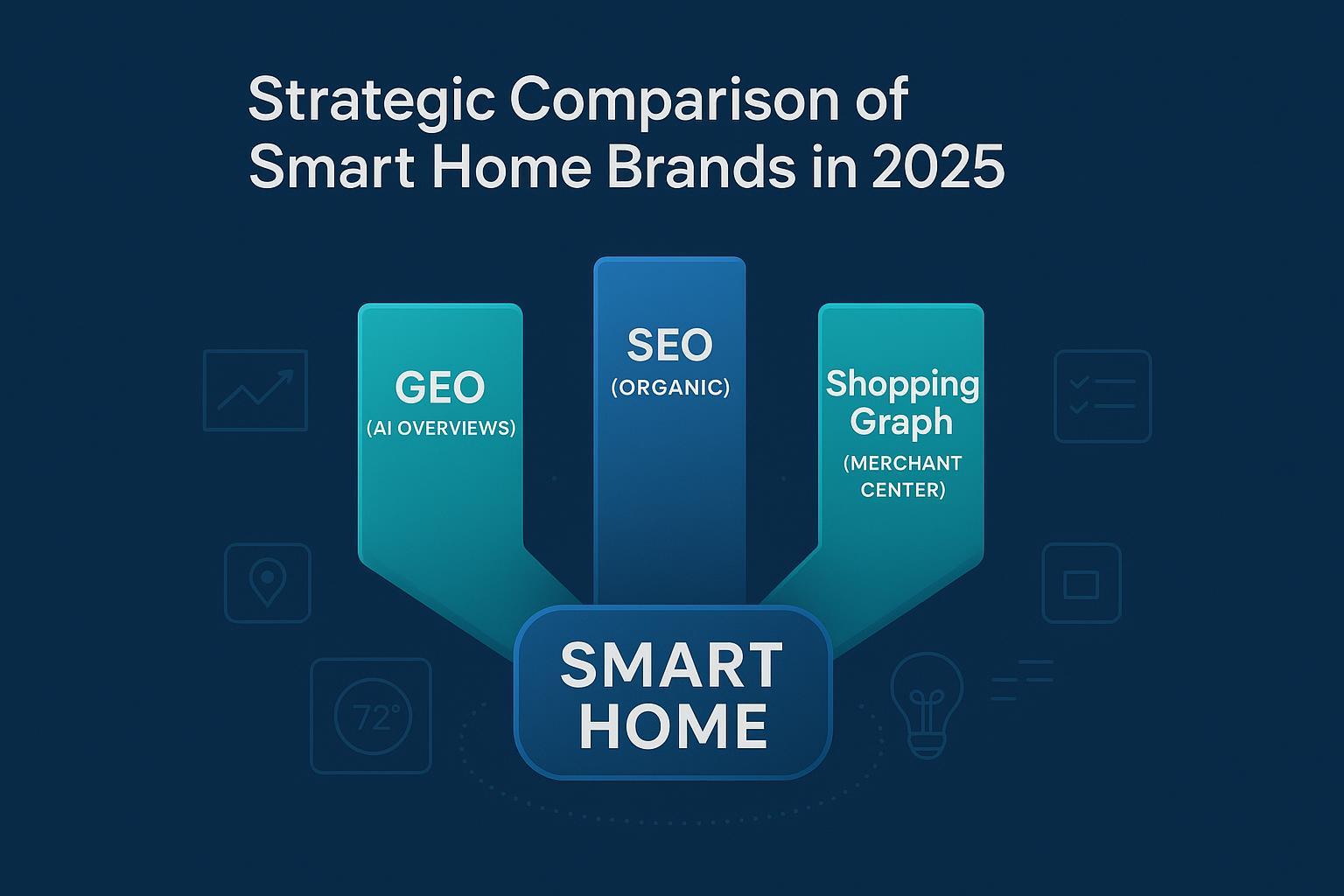
This article compares three approaches—GEO-focused for AI Overviews, Traditional SEO-first, and Retail/Shopping Graph optimization—through an evidence-led lens tailored to smart home brands.
Quick definitions and scope
- GEO-focused strategy: Generative Engine Optimization aimed at inclusion and citations in AI Overviews/AI Mode. Emphasizes concise, question-led content, first‑party documentation, structured Q&A (FAQ/HowTo/Organization/Product schema aligned to page content), and short video snippets. Google notes structured data supports clarity and eligibility but is not a special “switch” for AI features; inclusion hinges on helpfulness and authority, with impressions counted in Search Console’s Web search type, per Google’s own guidance in 2024–2025 (see Google’s AI features and success guidance: AI features and your site (Google, 2025)).
- Traditional SEO-first strategy: Evergreen content, topical authority, technical SEO, backlinks, and rankings—updated to answer question-based queries clearly so AI Overviews can select and cite.
- Retail/Shopping Graph optimization: Merchant Center feeds, rich product attributes, variants/images, and policy compliance to strengthen shopping experiences that can appear alongside or downstream of AI interactions. Google positions Shopping Graph improvements as powering shopping-specific surfaces rather than guaranteeing inclusion in universal AI Overviews (see Google Shopping and AI Mode coverage in Google’s shopping and AI updates (2024–2025)).
Side‑by‑side: where each strategy fits best (2025)
| Dimension | GEO-focused strategy | Traditional SEO-first strategy | Retail/Shopping Graph optimization |
|---|---|---|---|
| Inclusion likelihood in AI Overviews | High when content is concise, authoritative, question-led, with structured Q&A that matches on-page copy; short videos can add clarity (per Google’s AI features docs). | Moderate to high through rankings and topical authority; must adapt to question-led formats. | Mixed; primarily influences shopping experiences rather than universal AI Overviews. |
| Shopping Graph impact | Indirect; clarifies claims and specs referenced by AI. | Indirect; better product pages align with feeds. | Direct; feed completeness, images, variants, and availability drive visibility in shopping surfaces. |
| Evidence/YMYL requirements | Elevated for safety/privacy claims; publish certifications, standards, and versioned manuals. | Elevated; maintain evergreen accuracy and author transparency. | Elevated; attribute accuracy and policy compliance needed. |
| Formats favored | Short answers, lists, tables, structured Q&A, brief videos. | Guides, comparison hubs, reviews, technical docs. | Rich feeds with variants, images, local inventory, offers. |
| Operational complexity | Moderate: content + product + PR alignment; schema/video workflows. | Moderate to high: continuous content ops and link earning. | High: data QA, feed maintenance, image/policy reviews. |
| Measurement | Track AIO citations/near‑misses; impressions via Search Console Web type. | Track rankings, CTR, traffic; segment queries with/without AIO. | Track feed errors, coverage, and shopping panel presence. |
Sources referenced across this section include Google’s AI features documentation (2025) and Shopping/AI announcements (2024–2025).
Strategy capsules
1) GEO‑focused for AI Overviews
What it covers: Question-led pages that answer exactly what users ask—waterproof ratings, compatibility versions, setup steps, comparisons—supported by first‑party docs. Use FAQ/HowTo/Organization/Product schema that mirrors visible content, plus VideoObject where short demos help. Google emphasizes that structured data improves clarity and eligibility but doesn’t directly “flip a switch” for AI inclusion; overall helpfulness and authority matter most, and impressions are logged within the Web search type in Search Console according to Google’s AI features guidance (2025).
When it works best: New launches needing rapid clarity; competitive “best of” queries; precise specs and compatibility; safety/privacy claims requiring citations. Short, neutral summaries with links to detailed proof win more often than marketing fluff. Ask yourself: would this answer stand on its own if surfaced without a click?
Pros: Higher likelihood of citations in AI Overviews when your content is scoped to questions; faster inclusion velocity on timely topics; strong fit for complex specs common in smart home.
Constraints: Requires cross‑team coordination to ensure specs, claims, and schema remain synchronized; demands discipline to avoid promotional language in high‑stakes claims.
Team & ops notes: Pair content leads with product managers to validate specs; involve legal/PR for privacy/safety phrasing; build a repeatable schema and video workflow.
Measurement tips: Compare impressions and CTR on queries with/without AIO; track citation appearance, position, and frequency. Industry studies suggest AIO can reduce CTR for informational queries, so mitigating with citations matters—Amsive’s 2025 research observed average CTR declines of about 15% when AIO appears across large datasets, with variation by query type, as detailed in Amsive’s AI Overviews impact analysis (2025).
2) Traditional SEO‑first
What it covers: Topic clusters for thermostats, cameras, hubs, and lighting; evergreen docs; comparison guides like “Nest vs Ecobee”; long‑form reviews with spec tables and buyer advice. Technical SEO and link earning establish topical authority that AI Overviews can draw from.
When it works best: Mid‑ to long‑cycle queries where depth matters—comparison research, installation and troubleshooting, privacy policies, and firmware histories. Well‑structured long‑form content can still be cited if the lead answers are summarized up top.
Pros: Durable compounding returns; supports broad query coverage and brand authority; creates reusable assets for PR and partnerships.
Constraints: Slower to show impact for new launches; may underperform on terse, answer-first queries if not adapted; requires ongoing investment in updates and links.
Team & ops notes: Keep a living editorial roadmap tied to product roadmaps; prioritize “question first” sections atop evergreen pages; align internal linking to guide AI Overviews and readers to canonical answers.
Measurement tips: Segment performance by AIO presence; featured snippets and lower positions may suffer larger CTR declines when AIO appears, as other studies in 2025 reported, including coverage in Search Engine Land citing Seer Interactive’s analyses of informational queries in which organic CTR dropped sharply when AIO surfaced (Search Engine Land summary of AIO CTR impacts (Nov 2025)).
3) Retail/Shopping Graph optimization (Merchant Center)
What it covers: High‑quality Merchant Center feeds with complete attributes, GTINs, variants (colors/kits), image standards, availability, and policy compliance; onsite Product schema parity; local inventory; and periodic spec change adoption.
When it works best: Shopping‑led queries; price/availability lookups; model and variant exploration; bundles and accessories clarity.
Pros: Direct influence on shopping experiences powered by Shopping Graph; better coverage for variants and availability; supports visual assets that can travel into AI‑assisted shopping flows.
Constraints: Does not guarantee presence in universal AI Overviews; ongoing QA burden; regional spec changes can introduce sudden errors.
Team & ops notes: Build a weekly feed QA cadence; synchronize attributes with onsite schema and PIM; rehearse image reviews around launches; monitor spec changes using Google’s change log.
Measurement tips: Track feed errors/warnings, product coverage, variant exposure, and shopping panel visibility. Google’s Merchant Center change log documents annual spec updates—treat it as canonical when reconciling attributes and policy specifics (Merchant Center announcements and spec change log (2025)).
Scenario playbook for smart home brands
New product launch (e.g., a smart thermostat): Lead with GEO to earn early AI Overview visibility; publish a concise overview, authoritative spec page, FAQ with schema, and a 30–60 second demo with VideoObject markup. In parallel, ready Merchant Center feeds with complete attributes, images, and variants; reconcile with onsite Product schema. Use SEO-first to seed comparison and setup content that will mature over the next months.
Competitive “best of” and head‑to‑head queries: Pair GEO and SEO. Create neutral comparison capsules with pros/cons and “best for” judgments grounded in specs and third‑party references. Provide compact summary tables up top so AI Overviews can lift clear points. Shopping feeds support presence where users pivot to price and availability.
Specs and compatibility (e.g., Hue + Alexa, Matter versions): Publish first‑party documentation with structured Q&A for exact versions and edge cases; link to manuals and standards. Short videos demonstrating setup or pairing reduce ambiguity. Keep evergreen spec pages updated as firmware changes.
Safety/privacy (e.g., waterproof ratings, encryption): Treat as YMYL‑adjacent. Cite standards/certifications, versioned manuals, and consider expert review for sensitive claims. Avoid hyped language; present precise conditions (e.g., IP rating, submersion limits). This is where trust signals and author transparency carry the most weight.
How to implement and measure
Start with a definition of success. In AI search, “visibility” spans citations, mentions, link placement, and sentiment across engines. For a concise primer, see the introduction to the concept in What Is AI Visibility? Brand Exposure in AI Search Explained.
Operationally, treat optimization and measurement as a loop: set a baseline, implement changes, validate, then iterate. If you need a structured approach to content and metadata, the stepwise walkthrough in How to Optimize Content for AI Citations: Step-by-Step Guide maps content structure, schema parity, and technical fixes. For auditing mention and citation rates across AI engines—and benchmarking competitors—the workflow in How to Perform an AI Visibility Audit for Your Brand outlines practical KPIs and review cadences.
Also consider: If your team requires ongoing tracking of brand mentions and citations across Google AI Overviews and other AI engines, a monitoring platform can help centralize observations and historical queries. Disclosure: Geneo is our product. Learn more at Geneo’s platform overview.
A pragmatic 90‑day rollout plan
- Weeks 0–4: Baseline and hygiene. Inventory priority queries (launches, best‑of, specs, privacy). Establish baseline impressions/CTR and AIO presence using Search Console; document current citations and near‑misses. Fix obvious schema mismatches; publish or refactor 3–5 question‑led pages and one short demo video. Validate Merchant Center feed completeness and image standards.
- Weeks 5–8: Expand and align. Ship comparison capsules and spec/compatibility Q&As; update evergreen pages with summary answers up top. Reconcile Product schema with feed attributes; address Merchant Center warnings. Begin outreach for neutral expert coverage and third‑party references.
- Weeks 9–12: Validate and iterate. Re‑measure citations, impressions, and CTR deltas for target queries; review shopping panel coverage and variant exposure. Triage gaps (e.g., missing certifications, unclear compatibility), then schedule the next sprint.
Pitfalls to avoid (and quick answers to common objections)
- “Can we force our way into AI Overviews with schema?” No. Google says structured data supports clarity and eligibility but doesn’t guarantee inclusion; overall helpfulness and authority drive selection, and AI impressions roll into the Web search type in Search Console per Google’s AI features documentation (2025).
- “Will Merchant Center fixes boost universal AIO answers?” Expect mixed influence. Merchant Center primarily improves shopping surfaces, though stronger product data and parity with onsite pages can support broader trust. Google’s shopping updates in 2024–2025 frame these enhancements within shopping experiences (Google Shopping and AI updates (2024–2025)).
- “Is the AIO click loss overblown?” Multiple 2025 studies observed CTR declines when AIO appears, especially for informational queries; being cited can mitigate risk. See the methodological overview from Ahrefs in AI Overviews reduce clicks analysis (2025) for another perspective.
Bottom line for 2025
Pick your lead strategy by scenario, not dogma. For launches and precision questions, GEO leads with concise, verifiable answers and matching schema/video. For depth, comparisons, and brand authority, SEO-first compounds value—just front‑load your answers. For shopping presence, Merchant Center and Shopping Graph discipline determine coverage.
One last question to guide your next sprint: if your best prospective customer only saw a 3‑sentence AI Overview answer tomorrow, would it cite you—and would the claim be beyond dispute?