14 Best GEO (Generative Engine Optimization) Martech Tools for 2025
Discover 14 top GEO Martech tools for 2025 to track AI citations, optimize brand visibility, and keep your marketing ahead. See the full list now!
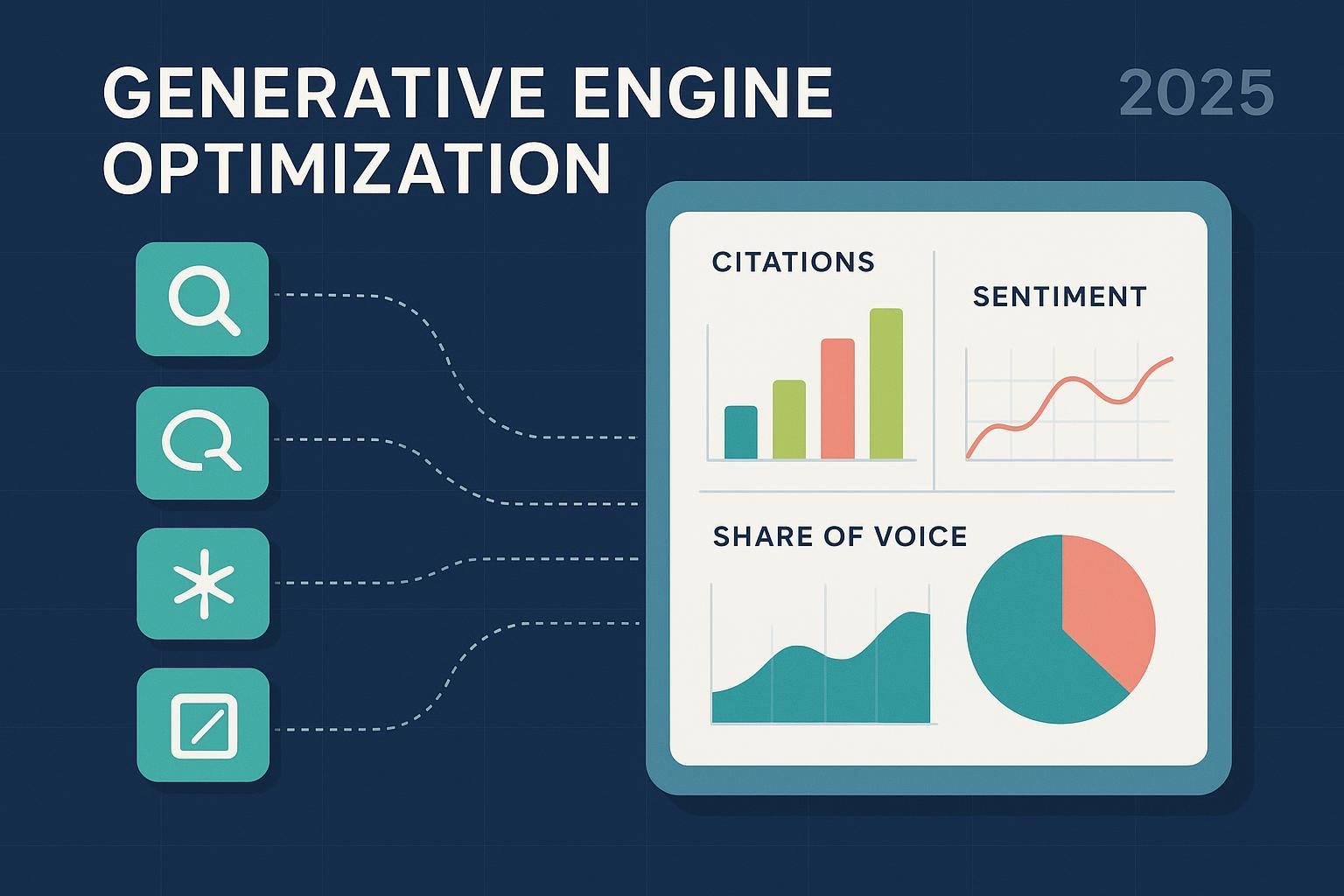
If answer engines increasingly “summarize the web” for your customers, will your brand be cited—or invisible? That’s the core question behind Generative Engine Optimization (GEO): optimizing your content and entities so AI systems like ChatGPT, Perplexity, and Google’s AI Overviews select, cite, and represent you accurately. Industry explainers from Search Engine Land characterize GEO as a distinct discipline from traditional SEO, focused on presence in AI-generated answers across engines and modes, not just blue links in the SERP. See Search Engine Land’s GEO overview (2024), and for broader process guidance, Walker Sands on GEO in 2025.
How we selected these tools
We evaluated platforms on seven dimensions most teams ask about:
- Coverage across engines (ChatGPT, Perplexity, Google AI Overviews/AI Mode/Gemini, Copilot)
- Monitoring depth (citations/mentions, prompt-level history, frequency/alerts)
- Data transparency (methods, update cadence, sentiment/accuracy scoring)
- Integrations/reporting (GA4/BI exports, APIs, white-label)
- Entity/structured data capabilities (schema/JSON-LD support)
- Update cadence and reliability during platform shifts
- Pricing clarity and value (noting that quotes and quotas are subject to change)
Two important notes up front: First, engineered snapshots and modeled indexes are common—some tools live-capture answers with screenshots, while others rely on sampled datasets; we call this out below. Second, pricing and quotas change frequently; treat ranges as directional and confirm with vendors.
Quick comparison (representative sample)
| Tool | Primary Coverage | Core GEO Functions | Update Cadence | Pricing Context (2025) | Notable Limits |
|---|---|---|---|---|---|
| Semrush AI Visibility | AIO, ChatGPT, Gemini, Perplexity, Claude | Mentions/citations, prompt tracking, SoV | Monthly/weekly/daily | Semrush One + add-ons | Modeled visibility; add-on costs |
| ZipTie | AIO/AI Mode, ChatGPT, Perplexity | Live capture, citations, AI Success Score | Scheduled/live | ~$69–$799+/mo (varies) | Conflicting public pricing |
| Ahrefs Brand Radar | AIO, AI Mode, ChatGPT, Perplexity, Copilot, Gemini | AI Responses, Entities, API | Rolling indexes | ~$199/index or ~$699 all | Sampled/indexed data |
| Keyword.com AIO | Google AI Overviews | Triggers, cited URLs, snapshots | Periodic + real-time | Included in plans | Google-focused scope |
| Geordy.ai | Entity/Schema | JSON-LD generation/validation | On demand | Tiered | Monitoring not included |
| Profound | 7–10+ engines | Live capture, volatility, enterprise APIs | Hourly windows | Enterprise | Pricey; content tooling separate |
Monitoring and alerts (multi-engine)
Semrush — AI Visibility Toolkit
Semrush’s AI Visibility Toolkit brings GEO-style tracking into the Semrush One suite. It measures citations and brand mentions across engines including Google AI Overviews, ChatGPT, Gemini, Perplexity, and Claude, with prompt-level tracking and competitor comparisons. Semrush documents an AI Visibility Score, “Sources” and “Cited Pages” reports, and daily prompt tracking, with weekly and monthly rollups. For methodology and features, see Semrush AI Visibility Toolkit documentation (2025). Pros: mature UX, integrated with broader SEO workflows. Cons: visibility is modeled and snapshot-based; add-ons can stack up for large prompt sets. Best for teams already on Semrush who want a familiar dashboard and comparative metrics. Pricing: plan-based with add-ons; confirm current limits and per-prompt pricing.
ZipTie — AI Overviews + ChatGPT + Perplexity tracking
ZipTie is purpose-built for AI answer monitoring. It captures the exact text and screenshots of answers, then extracts mentions and citations. Engines include Google AI Overviews/AI Mode, ChatGPT, and Perplexity. Pros: strong evidence logging and share-of-voice dashboards. Cons: public pricing and quota info varies by source; detection limits evolve with platform changes. See ZipTie’s site. Best for performance-minded SEO teams wanting live capture and CSV exports. Pricing: reported ranges from sub-$100 tiers to several hundred per month depending on checks; subject to change.
Hall — citation tracking and agency reporting
Hall tracks AI citations and conversation context, with agency-grade reporting features such as multi-brand dashboards, alerts, and sentiment/share-of-voice views. It also touts agent analytics and GEO/on-page audits. See Hall’s citation insights page. Pros: agency-friendly packaging and reporting. Cons: fewer public, quantified case studies; verify API depth based on plan. Best for agencies managing multiple brands that need white-label-ready reports. Pricing: not consistently public; confirm in demos.
Ahrefs — Brand Radar (AI indexes)
Ahrefs’ Brand Radar builds prompt indexes per AI assistant and reports brand mentions, citations, and entities across AI Overviews/AI Mode, ChatGPT, Perplexity, Copilot, and Gemini. It offers AI Responses, Cited Domains/Pages, and Entities reports, plus API access. The approach relies on large rolling indexes and custom checks rather than universal live capture. See Ahrefs’ Brand Radar help article (Dec 2025). Pros: robust data handling and API; helpful for trend analysis. Cons: sampled/modelled data means directional signal, not a complete per-query log. Best for data-driven teams already using Ahrefs. Pricing: reported ~$199 per index or ~$699 for all platforms; subject to change.
Otterly.ai — monitoring plus GEO audits
Otterly.ai combines monitoring with GEO audits and country-level tracking. Reported engines include Google AI Overviews, ChatGPT (with search), Perplexity, Gemini, and Copilot. It provides brand reports, link citation analysis, and automated insights. See Otterly’s feature overview. Pros: packaged audits and multi-country coverage. Cons: evidence is mainly first-party; verify alert cadence and quotas. Best for lean teams that want an audit-oriented start. Pricing: tiered; confirm on site.
Peec AI — prompt-level daily runs
Peec runs daily prompts across Google AI Overviews, ChatGPT, and Perplexity with dashboards for mentions, citations, and sentiment. It supports multi-country monitoring and competitor benchmarking. Public pricing pages suggest Starter/Pro/Enterprise tiers with increasing prompt counts; see Peec AI pricing (2025). Pros: prompt-centric workflow and clear daily cadence. Cons: alert specifics and engine add-ons vary by plan. Best for in-house teams piloting GEO with a manageable prompt set.
Google AI Overviews–specific tracking
Keyword.com — AI Overview Tracker
If you primarily care about when Google shows an AI Overview and which sources it cites, Keyword.com’s module integrates with traditional rank tracking. It flags AI Overview triggers, surfaces cited URLs, and saves SERP snapshots over time. See Keyword.com’s AI Overview Tracker. Pros: straightforward addition to existing keyword tracking. Cons: limited coverage beyond Google vs. multi-engine GEO platforms. Best for SEO teams that want AIO visibility alongside classic rankings.
Entity and structured data tooling
Geordy.ai — JSON-LD and entity hygiene
For GEO, clear entities and structured data help LLMs “understand” your brand and content. Geordy.ai automates JSON-LD generation and validation, converts content to structured outputs, and supports formats like JSON-LD, YAML, Markdown, and even llms.txt. See Geordy.ai’s schema JSON formats. Pros: accelerates structured data at scale with validation. Cons: it’s not a monitoring tool—pair with a GEO visibility platform. Best for technical SEO teams standardizing schema across large sites.
Enterprise testing, simulation, and advanced analytics
AthenaHQ — multi-engine prompt analytics
AthenaHQ focuses on prompt analytics, competitor benchmarking, and enterprise testing across multiple engines, with features such as a query volume estimation model (QVEM), source intelligence, and optimization “agents.” See AthenaHQ on QVEM methodology (June 2025). Pros: strong analytics and simulation posture. Cons: enterprise suitability and pricing vary by account; verify coverage in demos. Best for growth-stage and enterprise teams experimenting with GEO at scale.
Profound — enterprise GEO platform
Profound emphasizes live capture with screenshots, citation volatility analysis, SOC 2 posture, SSO and API integrations, and “Actions” automation. It covers a wide set of engines and highlights the limitations of pure API approaches for seeing what end users actually see. See Profound’s discussion of direct AI search monitoring (Mar 2025). Pros: enterprise integrations, live capture, and volatility views. Cons: enterprise pricing; you may still need separate content tools. Best for enterprises needing compliance-ready GEO monitoring.
Agency and multi-brand workflows
Geneo — multi-engine monitoring with sentiment and history (Disclosure: Geneo is our product)
For agencies and in-house teams managing several brands, Geneo provides cross-platform AI search visibility monitoring with prompt-level history, citation/link logging, and sentiment analysis across engines like ChatGPT (including browsing/search modes), Google AI Overviews/AI Mode/Gemini, and Perplexity. It also supports multi-team, multi-brand management and offers optimization suggestions based on gaps and trends. See the product overview on Geneo’s homepage. Pros: multi-brand collaboration and historical query tracking in one interface. Cons: exact quotas and pricing are not fully public; confirm tiers and add-on engines during trial or with sales. Best for agencies or B2B teams that need consolidated GEO reporting without stitching multiple tools.
Scrunch AI — monitoring plus optimization via AXP
Scrunch AI blends prompt-level monitoring with sentiment and misinformation flags and an “Agent Experience Platform” for optimization. Public materials note prompt grouping, a three-day refresh cadence with daily updates for new prompts, persona/geography granularity, GA4 and API integrations, and alerting. See the Scrunch July 2025 product update. Pros: thoughtful segmentation and integration options. Cons: limited independent, quantified case studies—pilot first. Best for B2B and SaaS teams prioritizing persona-based reporting.
Passionfruit Labs — visibility with attribution
Passionfruit positions itself around visibility, share of voice, sentiment, and revenue attribution tied to AI answer exposure. It offers page-level citation attribution, prompt-level tracking, geography filters, alerts, and competitive analysis. See the Passionfruit Labs Product Hunt profile (Nov 2025). Pros: attribution framing may help revenue-minded teams. Cons: marketing-led evidence; verify compliance and data residency. Best for teams testing closed-loop reporting hypotheses.
How to roll this out (without breaking your stack)
- Start with 25–100 priority prompts per market. Track brand inclusion, citations, and tone across ChatGPT, Perplexity, Google AI Overviews/AI Mode, and one “secondary” engine your audience uses. Want a systematic approach? This step mirrors the audit flow in our guide to performing an AI visibility audit.
- Define GEO KPIs that map to business goals. In addition to inclusion rate and citation share, monitor accuracy sentiment and update cadence variance. For discussion of measurement trade-offs, see the primer on LLMO metrics for accuracy, relevance, and personalization.
- Build a change log. Engines shift fast. Note date, prompt, engine/mode, and what changed (sources, tone, inclusion). This helps separate seasonality from model updates.
- Integrate reports into your existing stack. Export to BI, connect to GA4 where possible, and align cadences with board/exec reporting. If your stakeholders don’t live in GEO tools, they won’t see the wins.
- Tackle entity and evidence hygiene. Ensure your brand entity is unambiguous, your “about” and product pages are clear, and your best sources cite you. Structured data from tools like Geordy.ai can help supply the “lego bricks” that LLMs assemble.
- Test interventions. Add citations, improve claims with clear sources, update product FAQs, and strengthen E-E-A-T signals. Then re-run the same prompt set on a fixed cadence to attribute lift.
FAQ
- What’s the difference between GEO and SEO? GEO focuses on visibility inside AI-generated answers rather than solely ranking webpages. That requires entity clarity, evidence-rich content, and cross-engine monitoring. Search Engine Land’s explainers give a solid overview of how answer engines work today.
- How often should we refresh prompts? Weekly for active campaigns, with daily alerts for brand-critical queries. Engines like Google’s AI Overviews appeared in roughly the mid-teens percent of searches in late 2025, per published analyses, so watching volatility is prudent.
- Do we need both monitoring and entity tools? Usually yes. Monitoring shows what users see; entity/structured data work increases the odds your brand is selected and cited.
If you’re wondering where to begin, start small: pick a prompt set, establish baselines, and run a two-week pilot across two monitoring tools. You’ll quickly see which platform best fits your workflows—and where GEO can add real visibility to your 2025 growth plan.