
GEO for Open Source Projects: A Practical Guide for Maintainers
Learn what GEO means for open source projects—definition, key tactics, and how to boost citations in AI answer engines without confusion.
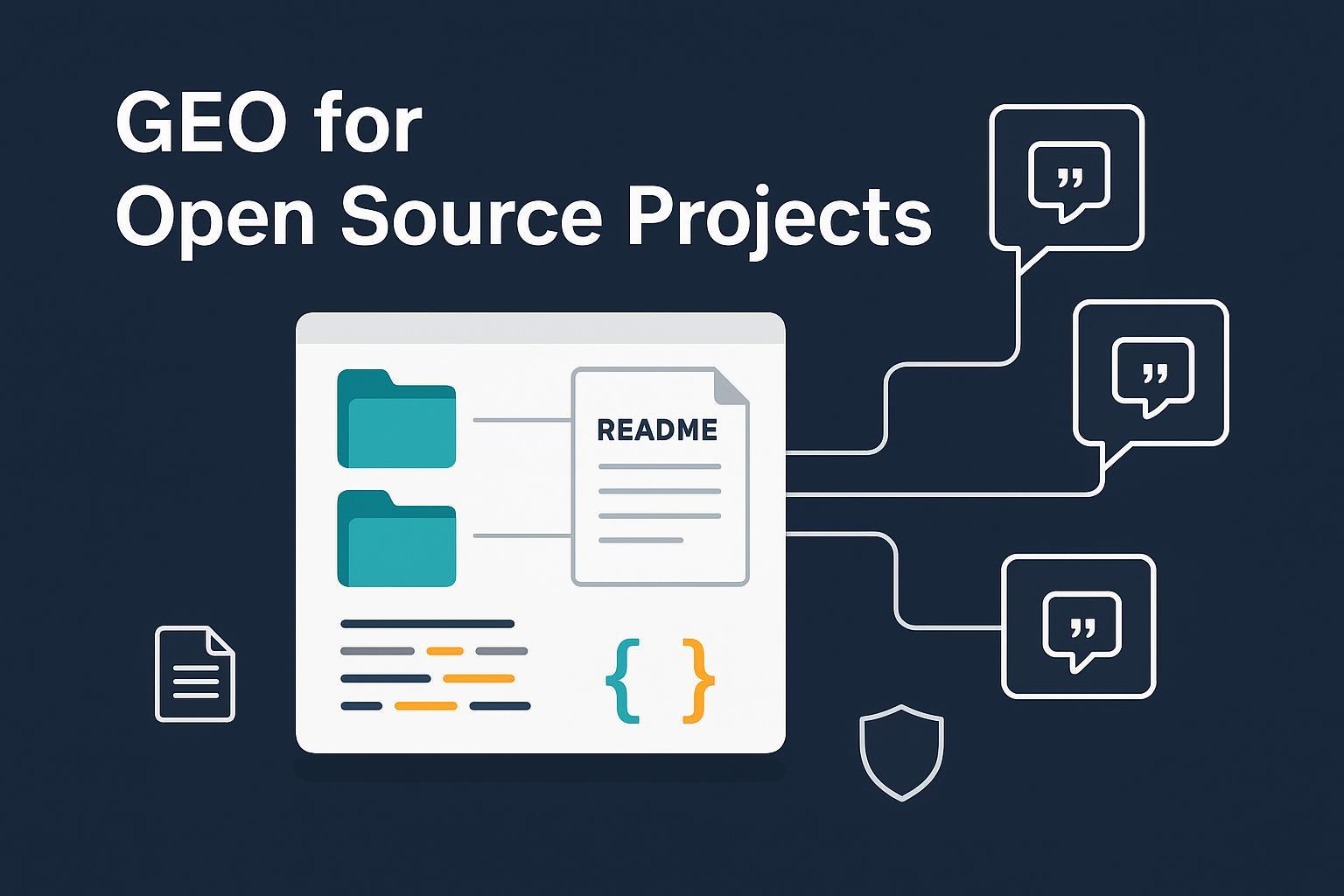
If large‑language‑model answers are becoming the first stop for developers, how does your project get cited—and cited correctly? This guide explains GEO (Generative Engine Optimization) in plain terms and shows exactly how open source maintainers can make repos and docs easier for answer engines to understand, summarize, and reference.
Quick note on naming: here, “GEO” means Generative Engine Optimization, not GitLab Geo (replication between sites). Different worlds.
What GEO is (and isn’t)
GEO is the practice of making your content clear and structured so generative answer engines can select, summarize, and cite it. The academic origin frames GEO as optimizing for visibility in LLM systems that synthesize responses from multiple sources and track impressions in those answers, as described in the original arXiv paper on Generative Engine Optimization (2023).
How it differs from adjacent ideas: SEO focuses on winning ranked links in traditional SERPs, while AEO (Answer Engine Optimization) aims to be selected for direct answers and featured snippets. GEO spans conversational and generative systems that compose answers from many sources; your goal is to present extractable facts, stable entities, and verifiable references that engines are comfortable citing.
Why this matters for OSS: clean, citeable docs increase adoption, reduce support confusion, and help prevent outdated or incorrect guidance from spreading. Think of GEO like labeling every drawer in a workshop so a helpful robot can assemble the right parts without guessing.
How answer engines handle sources (the knowns and unknowns)
- Perplexity consistently attaches citations in its reports and responses. Its Deep Research mode produces a clearly cited synthesis, which makes it ideal for auditing how your project is referenced. See Perplexity’s Deep Research overview for how its citation-first experience works.
- Google’s AI experiences (AI Overviews and AI Mode) follow the same fundamentals as Search: crawlability, indexability, and helpful, policy-compliant content. Google’s guidance on succeeding in AI search (2025) emphasizes matching structured data to visible content and maintaining technical hygiene; there’s no special “AI Overview tag,” but good signals help eligibility and clarity. See Google’s “Succeeding in AI search” (2025).
- ChatGPT now includes a Search experience that shows links to sources, but OpenAI hasn’t published thorough technical detail on how it selects and ranks those sources. Treat it as a partially undocumented system and validate outcomes in practice. Reference: OpenAI’s “Introducing ChatGPT Search”.
Practical takeaway: optimize what you control—content clarity, structure, and credibility—then verify how you’re cited across engines.
OSS-ready GEO tactics
1) Repository hygiene and community health
Answer engines prefer stable, trustworthy sources. Start by making your repository unambiguous and complete. GitHub supports org-level defaults for community health files so all new repos inherit them; see GitHub’s guide to creating default community health files.
Include and maintain:
- README with purpose, quick start, and links to docs, governance, and support.
- LICENSE that’s unambiguous and OSI-aligned.
- CONTRIBUTING with pathways for issues, PRs, and discussions.
- SECURITY with a private reporting channel and response expectations.
- CODE_OF_CONDUCT to set community norms.
Release discipline helps AIs (and humans) reason about compatibility. Use consistent tags (e.g., v1.2.3), semantic versioning, and human-readable release notes. Keep a changelog that surfaces breaking changes and deprecations near the top.
2) Docs-as-code with Diátaxis
Generative engines do better when documentation has distinct intents. The Diátaxis framework separates four modes—tutorials, how-to guides, reference, and explanation—reducing ambiguity and making extraction straightforward. If your API reference is precise and your how-to guides are task-oriented, answer engines can lift the right chunk and cite the exact page. Learn the model at Diátaxis: How to use Diátaxis.
A simple heuristic: ensure each main doc page starts by answering “What is this page for?” in a single, declarative sentence. Then structure headings to reflect tasks or concepts rather than narrative prose.
3) Structured data on your project site
If your project has a website (docs site, homepage, or both), add JSON-LD that clarifies entities. For open source, two types are especially useful: SoftwareSourceCode (for the repo) and SoftwareApplication (for the runnable artifact). Keep the markup in sync with visible content; don’t add facts the page doesn’t show.
Here’s a concise SoftwareSourceCode example you can adapt:
{
    "@context": "https://schema.org",
    "@type": "SoftwareSourceCode",
    "name": "Project Name",
    "description": "One-sentence, plain-language summary of what the project does.",
    "codeRepository": "https://github.com/org/project",
    "programmingLanguage": "Go",
    "license": "https://spdx.org/licenses/Apache-2.0.html",
    "author": {
      "@type": "Organization",
      "name": "Your Org or Maintainer Group"
    },
    "dateModified": "2025-12-01",
    "targetProduct": {
      "@type": "SoftwareApplication",
      "name": "Project Name",
      "softwareVersion": "1.2.3"
    }
  }
Validate markup regularly and update version, dates, and descriptions with each release.
4) Entity signals and a clean link graph
Engines model entities and relationships. You can help by:
- Using consistent project naming across repo, docs, package registries, and the project site.
- Publishing maintainer/author profiles and affiliations on the site.
- Adding canonical URLs to docs pages and avoiding duplicate content across subdomains.
- Linking to authoritative references (e.g., standards you implement, registries like PyPI/npm) to ground your claims.
These steps strengthen how your project appears as a distinct, trustworthy entity.
5) Answer-forward content patterns
Put the most extractable material first. Engines are more likely to quote a crisp definition at the top of a README or docs page than a buried paragraph three screens down. Practical moves:
- Start key pages with a one-sentence definition and an action-oriented “quick start.”
- Add short FAQs aligned to natural-language questions users ask (“Is X compatible with Y?” “How do I enable Z?”).
- Format how-tos with clear steps and minimal filler.
- Keep release notes scannable and link back to the full changelog.
For deeper patterns, see the step-by-step techniques in How to Optimize Content for AI Citations.
Measurement and monitoring
You can’t improve what you don’t measure. Track a small, stable set of queries over time—mix non-branded tasks (“compare X vs Y,” “how to do Z with K”) with branded ones—and record which sources engines cite.
Key metrics to watch:
- Citation/mention rate per query set across engines
- Share of voice versus peer projects
- Query coverage (head tasks vs long-tail)
- Sentiment in generated answers (positive/neutral/negative)
- Freshness signals (recent releases and updated docs)
A practical workflow: run periodic audits across Google’s AI experiences, Perplexity, and ChatGPT Search. Capture screenshots, URLs, and dates in a shared document so the team can see changes after each release. For teams that prefer a consolidated view, Geneo can be used to monitor cross-engine citations and mentions in one place—Disclosure: Geneo is our product. It supports tracking query sets, recording which pages get cited, and annotating changes so you can tie visibility moves back to specific docs or release work. If you’re building your own process, borrow the steps from our audit walkthrough in How to perform an AI visibility audit and adapt it to an OSS setting.
Tip: when ChatGPT or other engines do not show citations, copy the exact phrasing used in the answer and check your docs for that wording; mismatches often reveal where a definition or how-to needs to be clarified.
Risks, governance, and pitfalls
- Avoid overstating control. We don’t know the full mechanics of source selection in some systems (notably ChatGPT). Present GEO tactics as cumulative, not as switches that guarantee citations.
- Keep licensing and security explicit. Prominent LICENSE and SECURITY pages reduce ambiguity and build trust. Publish deprecations and breaking changes clearly in release notes.
- Disambiguate your own acronyms. If your project or docs use “Geo” for something else, add a short note to avoid collisions with Generative Engine Optimization and GitLab Geo.
- Don’t hide facts in structured data. JSON-LD should mirror what’s visible on the page.
A lightweight operating plan for maintainers
Start where you’ll get compounding returns. In the first sprint, add missing community health files, tighten the README’s top section (definition + quick start), and map your current docs to the four Diátaxis modes. In the next sprint, publish a clean changelog and release notes, add JSON-LD to the docs homepage, and set up a five‑query audit across engines. From there, iterate: each release updates the JSON-LD, touches the relevant how-to or reference pages, and logs what changed. After two or three cycles, patterns emerge—what questions are you winning, what’s lagging, and which pages feed the best citations. Isn’t that the kind of feedback loop you want as a maintainer?
Final thoughts
GEO for OSS isn’t a trick—it’s disciplined documentation, stable entities, and steady measurement tuned to how generative systems actually assemble answers. Keep your content extractable, your signals consistent, and your audits regular. The result is fewer surprises, clearer citations, and a project that’s easier for both humans and machines to trust.