
Why GEO Matters for Agencies: 2026 Trends and AI Visibility Insights
Discover why Generative Engine Optimization (GEO) is crucial for agencies in 2026. Learn actionable tactics, measurement frameworks, and AI engine trends. Stay ahead—read now!
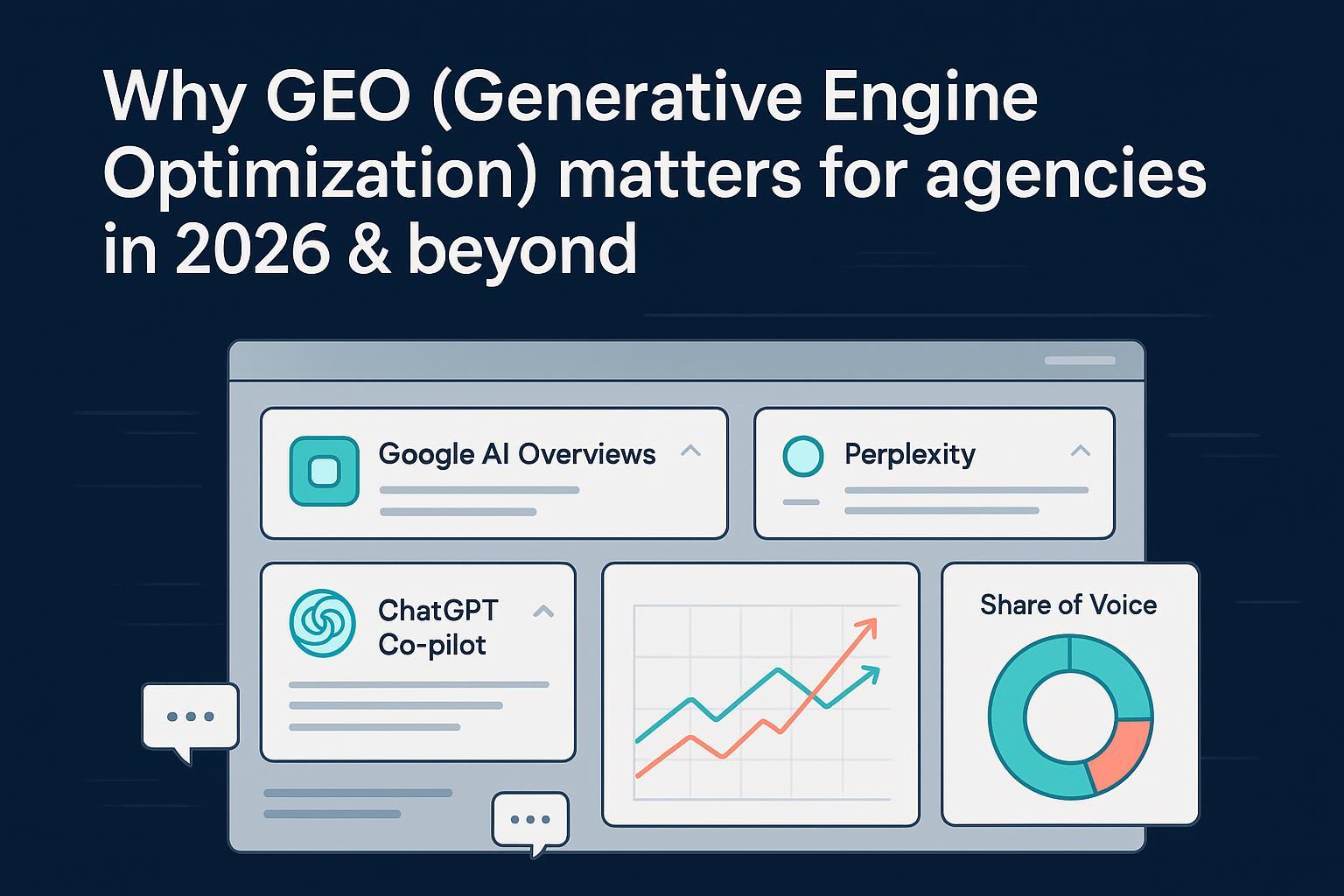
Ask any account lead what changed most in 2025 and you’ll hear a version of the same story: prospects increasingly meet brands inside AI answers—not on a ten‑blue‑links results page. Whether it’s Google’s AI Overviews, a Perplexity deep dive, or a ChatGPT/Copilot response with sources, the first impression now often happens in a synthesized summary. That’s exactly where Generative Engine Optimization (GEO) lives. For agencies, GEO isn’t a buzzword; it’s an operational layer that determines whether your clients get named, cited, and recommended when it counts.
GEO vs. classic SEO: what actually changes in operations
SEO fundamentals—crawlability, indexation, speed, content quality—remain non‑negotiable. GEO builds on them but shifts day‑to‑day execution in three ways. First, you adopt an entity‑first mindset. Rather than optimizing only around keywords, you maintain living entity graphs—organizations, people, products, attributes, and relationships—supported by schema, knowledge base references, and consistent naming. This helps engines recognize who the brand is and where it fits. Second, you prioritize information gain over repetition. Summarizers prefer sources that add verifiable facts, comparative tables, and practitioner proof rather than echoing consensus; original benchmarks and clearly attributed statistics win. Third, you practice authoritative sourcing discipline: cite primary sources, use answer‑first sections and scannable tables, and make your claims precise so engines can comfortably cite you.
How engines pick and show sources (and what it means for you)
The mechanics differ by surface, but a few themes guide agency playbooks. For Google’s AI Overviews/AI Mode, documentation states there are no special technical requirements beyond standard Search eligibility to appear as a supporting link in AI experiences. Pages must be indexable and meet regular snippet requirements; access is governed by the same robots/snippet controls you already manage. See Google’s guidance in AI features in Search (docs updated through late 2025): Google Search Central on AI features and eligibility/controls. A related post from May 2025 reiterates technical hygiene for AI Search exposure: Top ways to ensure your content performs well in Google’s AI search.
Perplexity prominently displays numbered citations linking to original sources, making audit and attribution straightforward for agencies; this is documented in the help center: How Perplexity works: citations in answers. For ChatGPT/Copilot, OpenAI’s enterprise features (Company Knowledge) emphasize clear citations you can click to view sources, while Microsoft notes a “sources” button when Copilot uses web search. See OpenAI’s description of enterprise citation behavior: Introducing Company Knowledge (2025) and Microsoft’s support article: Understanding web search in Microsoft 365 Copilot Chat.
What should an agency infer? Technical access is table stakes on Google; Perplexity and Copilot expose citations you can verify; ChatGPT’s public search behaviors continue to evolve, but enterprise patterns point toward traceable sourcing. Outcome: plan for presence and provenance across surfaces—not just rank.
Measuring what matters: a pragmatic KPI stack for GEO
Without clicks as your dominant proxy, you’ll need visibility and recommendation metrics that reflect how AI answers actually work. Start with appearance or visibility rate—the share of tracked prompts where the brand is mentioned or cited—segmented by engine, mode, and locale. Track citation rate and link attribution to see how often engines cite your domain versus a third‑party reference. Calculate AI share of voice across a defined competitive set to understand relative presence. Monitor platform breakdowns so you know whether movement is driven by Google AI Overviews/AI Mode, Perplexity, or ChatGPT/Copilot. Layer in sentiment and recommendation type to distinguish between positive recommendations and neutral mentions. Finally, manage trendlines and a simple change‑log so weekly or monthly deltas are annotated against major engine/model updates.
If you’re setting up measurement from scratch, a quick primer on instrumentation and reporting cadence is outlined in this executive guide to AEO best practices (2025). For a deeper overview of monitoring approaches and white‑label reporting considerations, see this review of AI search visibility tracking.
A 30–60–90 day operating cadence for agencies
Days 1–30 (Baseline): Build prompt sets by journey stage—often 50–150 prompts per segment. Run baseline checks across engines and locales. Log engine, mode, date, locale, prompts, citations, recommendation type, and sentiment. Capture snapshots for reference.
Days 31–60 (Sprints): Refactor priority pages for answer‑first sections, tables, step‑by‑step flows, and higher fact density (with primary sources). Expand schema coverage (Organization, Product, FAQPage/HowTo). Enrich entity profiles with consistent references across your owned properties and relevant knowledge bases.
Days 61–90 (Monitor and report): Run weekly spot checks on top prompts; complete monthly runs with share‑of‑voice deltas and platform breakdowns. Translate movement into executive insights and next actions. Decide what to scale into retainer work.
Practical example: instrumenting cross‑engine monitoring and client‑ready reporting
Here’s how a mid‑market B2B agency might operationalize measurement for a cybersecurity client. Define 80 prompts across awareness, consideration, and comparison—for instance, “best EDR for SMBs,” “XDR vs EDR for healthcare,” and “EDR vendor comparison 2026.” Run a baseline on Google AI Overviews/AI Mode, Perplexity, and ChatGPT/Copilot, and record whether the client is mentioned, correctly cited, and positively recommended. Produce a monthly executive summary showing appearance rate, citation rate, AI share of voice, platform breakdown, and a short narrative tying movement to next steps.
A monitoring platform that supports cross‑engine tracking, time‑series trendlines, and white‑label client portals can reduce overhead and standardize reporting. For example, agencies can use Geneo (Agency) to monitor brand mentions and citations across ChatGPT, Perplexity, and Google AI Overviews, aggregate signals into an AI visibility score with share‑of‑voice and platform breakdown, and export client‑ready dashboards. Disclosure: Geneo (Agency) is our product.
Cross‑engine parity playbook: actions that travel well
Why do some sources show up consistently across engines while others appear sporadically? Parity usually comes from stacking small, verifiable advantages. Lead major pages with answer‑first, scannable sections, then support them with evidence. Add fact density with provenance—unique data points, methodologies, and citations to primary or official sources—so models see information gain worth summarizing. Maintain Organization/Person/Product schema, author bios with credentials, and consistent references to external identifiers where appropriate. Keep practitioner bylines, conflict disclosures, and clear update notes; they signal reliability to users and systems. Finally, map prompts to the buyer journey so your content answers real questions succinctly rather than optimizing in isolation. If your brand rarely appears in conversational answers, debug the gap first—this workflow on how to diagnose and fix low brand mentions in ChatGPT is a solid starting point.
Budget and attribution: tying citations to pipeline
You won’t always get a click from an AI answer, but you can still prove value. Track assisted conversions on down‑funnel pages during periods when AI citations increase for relevant prompts. Capture qualitative signals—sales calls referencing “we saw you recommended in…,” RFPs citing your comparison guides, or partner referrals linked to specific summaries. Pair share‑of‑voice gains with branded search lift, changes in direct traffic, or higher demo‑to‑close rates for segments aligned to the prompts you track. Is it perfect attribution? No—and that’s okay. Think of GEO like earned media fused with structured content performance; your job is to instrument enough visibility metrics and business signals to show the through‑line.
What to watch in 2026
Policies and documentation for Google AI Overviews/AI Mode remain tied to standard Search controls, but presentation and inclusion nuances can shift—monitor Google’s official docs for changes to AI features and Search guidance: AI features in Search. Perplexity’s numbered citations and expanding partner ecosystem make auditing straightforward; keep an eye on help center and product posts for policy changes. ChatGPT/Copilot citation UX in enterprise already emphasizes traceability; as public search features evolve, expect UI changes that affect how sources are exposed. Industry analysts have flagged 2026 as a year when SEO alone won’t guarantee AI answer visibility, encouraging marketers to manage GEO as a distinct, complementary program—see Insider Intelligence/eMarketer’s perspective: Generative Engine Optimization in 2026 (teaser).
The through‑line: adopt a cadence mindset. Models and surfaces will change; your measurement rhythm shouldn’t.
Closing: your next three moves
Pick one client and run a baseline across 50–100 prompts spanning the buyer journey; document visibility and citations by engine. Make three surgical content updates that increase fact density and schema clarity on pages tied to those prompts. Stand up a monthly report that highlights AI share of voice, platform breakdowns, and recommended next steps.
If you want a standardized, white‑label way to monitor AI answer visibility and package insights for clients, you can evaluate Geneo (Agency) for cross‑engine tracking and client‑ready dashboards. Keep your stack lean, your cadence steady, and your client’s name where it matters most—inside the answer.