
Generative Engine Optimization (GEO) for IoT Products Explained
Learn what Generative Engine Optimization (GEO) means for IoT, how it differs from SEO, and practical steps to get your devices cited in AI search answers.
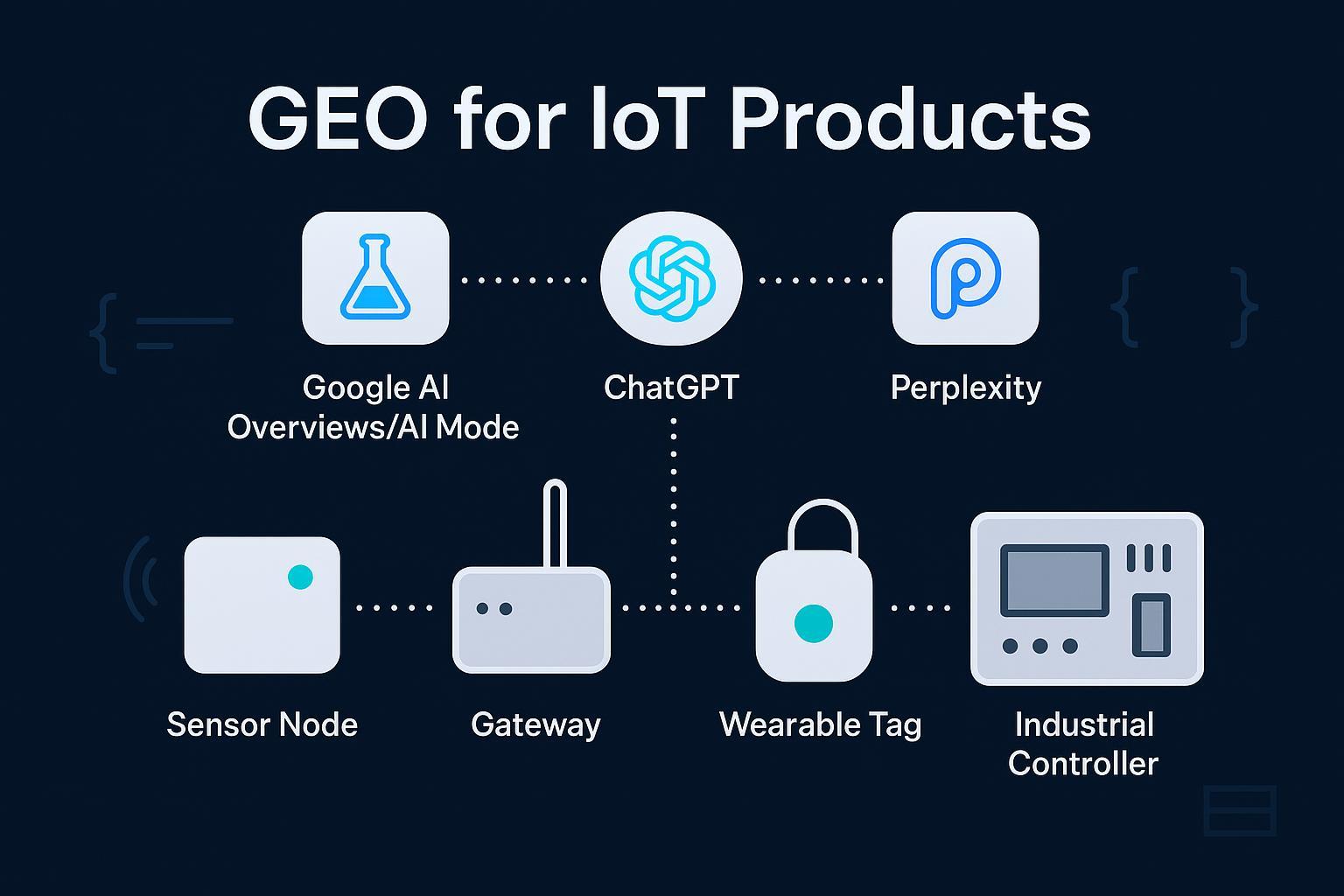
If a buyer asks an AI, “Which LoRaWAN temperature sensors are reliable for cold storage?” whose specs—and whose brand—will it cite? That’s the practical question behind Generative Engine Optimization (GEO): making your content, entities, and evidence easy for AI answer engines to understand and reference.
Put simply, GEO is about improving your likelihood of being quoted or linked inside AI-generated answers across Google’s AI Overviews/AI Mode, ChatGPT, and Perplexity. It’s distinct from classic SEO, which concentrates on ranking blue links. Industry explainers describe GEO as optimizing for visibility inside AI-driven answers rather than just SERPs; see the 2024–2025 primer: Search Engine Land’s GEO explainer.
Why GEO matters for IoT right now
Google’s guidance says eligibility for AI features follows the same fundamentals as Search: indexable, helpful, reliable content that’s accessible to crawlers, with structured data that matches what users can see. The official site owner page spells out how AI features surface links and where site-level controls apply; see: Google’s AI features in Search (site owner guidance). On the product side, Google rolled out AI Overviews in 2024 to summarize complex queries with links to sources; see the announcement: Generative AI in Search (May 2024).
Perplexity explicitly performs real-time retrieval and always shows citations in-line, which makes extractable specs and well-structured pages especially valuable. Its help center explains the sourcing model and how users can verify links: How does Perplexity work?.
Why is this acute for IoT? Buyers don’t search only for brand names; they ask use-case questions: “Predictive maintenance sensors for rotating equipment,” “BLE vs. Wi‑Fi for indoor positioning,” “IEC 62443 requirements for industrial gateways.” IoT Analytics’ 2024 analysis highlights high-ROI use cases like process automation, energy monitoring, predictive maintenance, and real-time tracking—exactly the kinds of queries AIs condense into short answers with links: Top IoT use cases (2024). If your specs, compliance proofs, and demos aren’t machine-readable, your product is invisible when those answers are generated.
Foundation: give every device a clean, consistent entity
Think of each product’s “entity page” like a passport. It confirms the canonical name, model numbers, category, protocols, and relationships (variants, bundles, kits). If that identity is fuzzy, AI engines hesitate to cite you.
What “clean” looks like in practice: a single, canonical product page per model with consistent naming and model numbers across your site, docs, datasheets, and channel pages. Keep descriptions short and unambiguous, and repeat the same key attributes everywhere (e.g., “LoRaWAN Class A sensor with IP65 ingress rating, -20°C to 60°C operating range”). Cross-link your product page to docs, firmware notes, changelog, YouTube demo, and comparison pages—and back—to reinforce the entity network. Do your specs and descriptions sound the same across your website, PDF datasheets, and marketplace listings? If not, harmonize them first; GEO wins are hard to sustain without entity hygiene.
Make specs extractable: tables and schema that AIs can quote
AI systems do something very simple before they do anything fancy: they scan for structured, comparable facts. Standardize your spec fields and units, present them in a table on-page, and annotate the page with JSON-LD that mirrors what users see.
Below is a compact reference for common IoT spec fields and formatting tips.
| Spec field | Formatting tip |
|---|---|
| Connectivity | List protocols precisely (e.g., “BLE 5.3; Wi‑Fi 6; LoRaWAN 1.0.4”); avoid marketing labels. |
| Operating temperature | Use SI units and ranges (e.g., “-20°C to 60°C”). |
| Ingress protection | Use standard codes (IP65, IP67); link to your test report summary if public. |
| Power/Battery life | Tie claims to duty cycle (e.g., “18 months at 10% duty cycle, 25°C”). |
| Sensors | Use a fixed order and exact sensor types (e.g., “Temp (±0.3°C), Humidity (±2% RH)”). |
| Edge inference | Name frameworks/ops (e.g., “TensorFlow Lite, INT8 quantized models”). |
| Security | Specify features (Secure Boot, TPM, TLS 1.3) and standards references. |
Add JSON-LD that reflects the visible content. For product families with variants, connect each device to its group using isVariantOf. Here’s an example tailored to a sensor variant:
{
    "@context": "https://schema.org",
    "@type": "Product",
    "name": "Acme X100 Temperature Sensor",
    "model": "X100-TH",
    "sku": "X100-TH",
    "mpn": "ACM-X100-TH",
    "brand": { "@type": "Brand", "name": "Acme IoT" },
    "isVariantOf": {
      "@type": "ProductGroup",
      "name": "Acme X100 Sensor Family",
      "productGroupID": "X100",
      "variesBy": ["sensors", "connectivity"]
    },
    "category": "Temperature & Humidity Sensors",
    "image": "https://www.example.com/assets/x100-th.jpg",
    "url": "https://www.example.com/products/acme-x100-th",
    "gtin13": "0123456789012",
    "additionalProperty": [
      { "@type": "PropertyValue", "name": "Connectivity", "value": "BLE 5.3; Wi‑Fi 6" },
      { "@type": "PropertyValue", "name": "Operating temperature", "value": "-20°C to 60°C" },
      { "@type": "PropertyValue", "name": "Ingress protection", "value": "IP65" },
      { "@type": "PropertyValue", "name": "Battery life", "value": "Up to 18 months at 10% duty cycle" },
      { "@type": "PropertyValue", "name": "Protocols", "value": "MQTT; CoAP" }
    ],
    "offers": {
      "@type": "Offer",
      "priceCurrency": "USD",
      "price": "79.00",
      "availability": "https://schema.org/InStock",
      "url": "https://www.example.com/products/acme-x100-th#buy"
    }
  }
Two practical notes: keep the JSON-LD in sync with the on-page table and copy—mismatches confuse parsers. And if you include downloadable PDFs, render the essential specs as HTML too. AIs are better at extracting from clean HTML than from flat PDFs.
Compliance and validation evidence AIs can quote
A lot of IoT queries boil down to “Is this device compliant and safe in my region/industry?” Publish precise, verifiable signals on every device page and link to authoritative sources.
CE marking: Identify applicable EU directives/regulations, publish your Declaration of Conformity, and explain how you assessed conformity (self vs. notified body). See the European Commission’s guidance: CE marking overview (Your Europe).
FCC equipment authorization (U.S.): Indicate the authorization route (Certification with FCC ID vs. SDoC) and link to the FCC ID record where applicable. Reference: FCC equipment authorization rules (eCFR Part 2 Subpart J).
Industrial cybersecurity: If you build for industrial environments, reference applicable parts of IEC 62443 and describe your secure development lifecycle at a high level. See the official catalog entries: IEC 62443 parts overview.
Pack these elements into a short paragraph or a compact on-page block with identifiers, scope statements, dates/versions, and links to test report summaries when permissible. Make it scannable so it’s easy to summarize and cite.
Video-forward demos that get cited
Google and other engines increasingly surface videos alongside text sources, and agencies studying AI Overviews inclusion patterns consistently see clear demos with chapters and captions show up more often. Observational guidance emphasizes semantic depth, extractable passages, and structured media data; for a representative discussion, see: GoFish Digital on AI Overviews SEO.
Publish on YouTube and embed on your site. Structure each demo as “problem → setup → validation,” add on-screen spec callouts, and include chapter timestamps. Mark up the page with VideoObject:
{
    "@context": "https://schema.org",
    "@type": "VideoObject",
    "name": "Acme X100 Gateway: Setup and Validation",
    "description": "Demo covering problem → setup → validation for Modbus-to-cloud telemetry.",
    "thumbnailUrl": ["https://www.example.com/thumbnails/x100-gateway.jpg"],
    "uploadDate": "2025-05-10",
    "duration": "PT6M45S",
    "contentUrl": "https://www.example.com/videos/x100-gateway-setup.mp4",
    "embedUrl": "https://www.example.com/videos/x100-gateway-setup-embed.html",
    "publisher": { "@type": "Organization", "name": "Acme IoT" },
    "hasPart": [
      { "@type": "Clip", "name": "Problem & architecture", "startOffset": 0, "endOffset": 60 },
      { "@type": "Clip", "name": "Setup & pairing", "startOffset": 60, "endOffset": 210 },
      { "@type": "Clip", "name": "Validation & metrics", "startOffset": 210, "endOffset": 405 }
    ]
  }
This helps AIs extract discrete steps (“pairing,” “OTA update,” “latency validation”) and pair the video with your device entity.
Documentation hygiene and comparison pages
Well-structured documentation is GEO fuel. Use hierarchical headings (H2/H3) and short paragraphs, then end each guide with a concise Q&A block that answers the most common troubleshooting questions in one or two sentences. Mark up FAQ sections with FAQPage schema only when the questions and answers are plainly visible on the page.
Create comparison pages that mirror how buyers and AIs think: range, throughput, latency budgets, ingress ratings, battery life under specified duty cycles, edge inference support, and security features. Keep matrices factual and sortable. Link each column cell back to the underlying product page and doc section so evidence is one click away.
Maintain a public changelog and firmware release notes. Include dates and version numbers to send freshness signals. When you cite standards or industry benchmarks, link to the official body or original research—then make sure your own claims are traceable back to those references.
Freshness and authority signals (and where to cite)
GEO rewards recency and evidence. Quarter by quarter, review the pages that drive your demand and refresh device pages with up-to-date specs, compliance versions, and firmware notes. Update demos with new chapters or short clips that answer common setup questions. Tighten FAQs with crisp, one-sentence answers buyers (and AIs) can lift.
When you explain “how to get cited,” it helps to use a practitioner’s checklist of extractable formats and references. For a deeper walkthrough on page patterns tuned for citations, see this practical guide: Optimize content for AI citations.
Measurement and iteration across engines
Here’s the deal: without measurement, GEO devolves into guesswork. Track which queries include your products in AI answers, which sources those answers cite, and how your brand is described. Review inclusion and citations by engine (Google AI Overviews/AI Mode, ChatGPT, Perplexity), your query coverage for target use cases and competitor share of voice, plus sentiment and accuracy of descriptions (are specs and compliance facts correct?).
Practical example: a team might compile a list of 50 priority queries (“LoRaWAN cold storage sensor IP rating,” “IEC 62443 gateway hardening guide,” “BLE vs Wi‑Fi indoor positioning latency”), run them in each engine monthly, and log citations, missing answers, and factual errors. Disclosure: Geneo is our product. A platform like Geneo can be used to track cross-engine mentions, citations, sentiment, and history for those queries so you can compare before/after changes and prioritize fixes. For step-by-step methods, see this audit walkthrough: How to perform an AI visibility audit and, for engine differences, this overview: ChatGPT vs. Perplexity vs. Gemini vs. Bing for monitoring.
One more perspective worth keeping in mind: Google reiterates that AI features rely on the same fundamentals as Search, and there’s no special markup to “force” inclusion. Focus on clean entities, extractable facts, and authoritative references—the foundations described in Google’s own guidance remain the north star: AI features and your website.
30-day rollout plan for an IoT product team
- Days 1–7: Entity and spec hygiene. Pick one hero device and fix naming/model consistency across site, docs, PDFs, marketplaces. Add an on-page spec table with standardized fields and units; mirror it in Product JSON-LD.
- Days 8–14: Compliance block. Publish CE/FCC identifiers and links, add brief IEC 62443 statements where relevant, and date/version your claims. Review with legal.
- Days 15–21: Video-forward demo. Script a “problem → setup → validation” demo with chapter timestamps, produce captions, publish on YouTube, and embed with VideoObject markup.
- Days 22–24: FAQ and comparison pages. Add a concise Q&A block to the product page; create or refresh one comparison matrix on buyer-centric attributes (range, throughput, battery life assumptions).
- Days 25–30: Measurement loop. Define 50 priority queries by use case, run them across engines, log citations and errors, and schedule a quarterly review. Implement fixes based on the biggest gaps.
Closing thought
GEO for IoT isn’t a trick; it’s the discipline of making your products’ facts, proofs, and demos easy to extract and easy to trust. Start with one device, get the entity and evidence right, and iterate. When the next buyer asks an AI about your category, will it have everything it needs to cite you accurately?