The Future of Search: The Rise of Generative AI Engines
Discover how generative AI answers reshaped search in 2025. Get expert data, compliance updates, and actionable tactics for agency visibility. Read now.
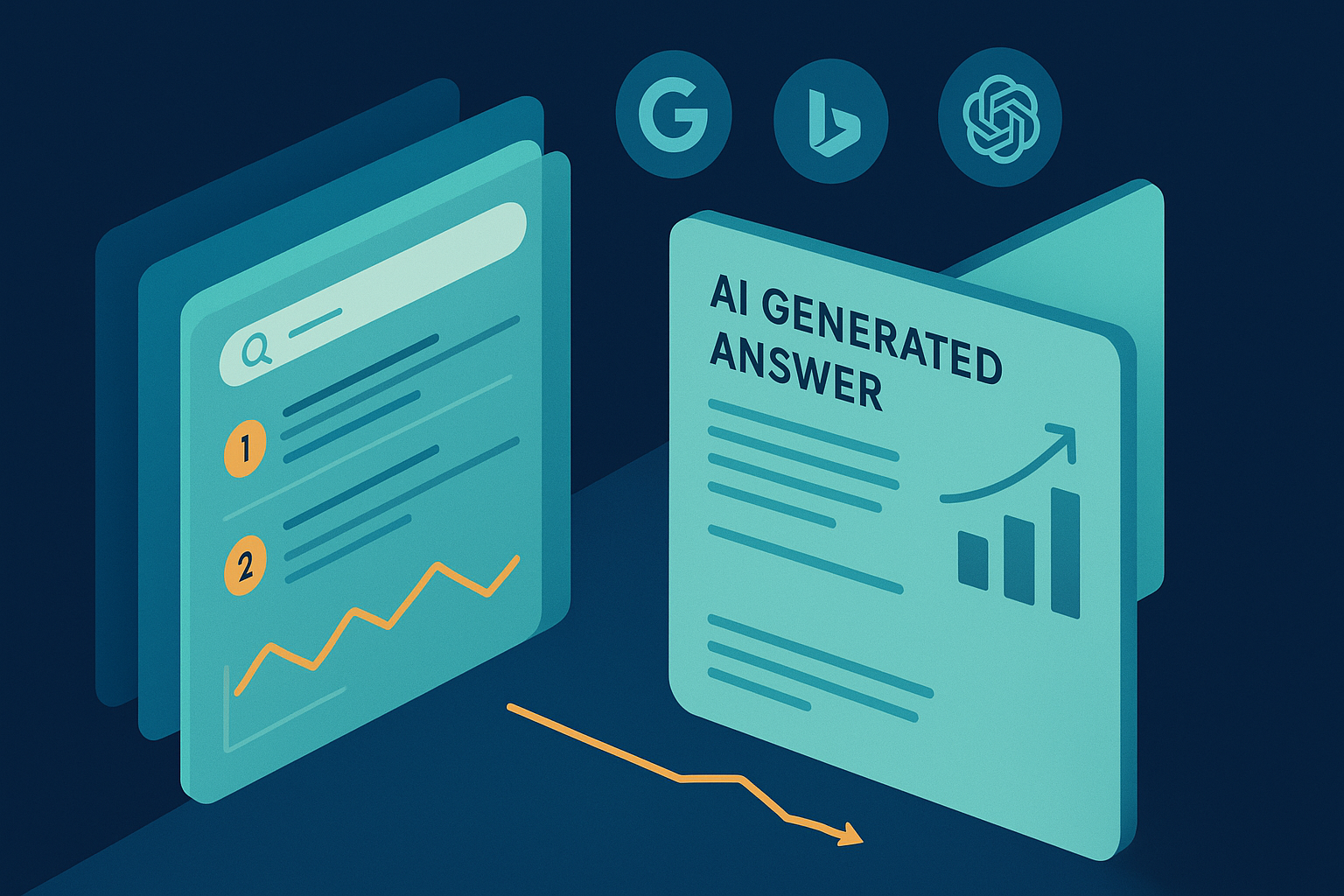
If you’ve felt organic traffic wobble in 2025, you’re not imagining it. Generative AI answer layers now sit on top of classic search results, satisfying more queries without a click and changing what it means to “rank.” For agencies, the mandate is clear: don’t chase only blue links—earn presence inside the AI answers themselves and prove that visibility with defensible metrics.
What changed in 2025 across major engines
Google formalized the shift at I/O: AI Mode moved from experiments to a broad U.S. rollout and is positioned as an end‑to‑end, link-forward experience that emphasizes “helpful links to the web” and deeper discovery. See Google’s May 2025 announcement in the company’s own words in the AI Mode update on the Search blog, which describes the rollout and link‑forward posture in detail: Google’s AI Mode update (May 20, 2025).
Perplexity doubled down on research-style answers. Its February 2025 release of Deep Research describes an agent that “performs dozens of searches, reads hundreds of sources,” then returns a synthesized report with citations: Perplexity’s Deep Research announcement (Feb 14, 2025).
Microsoft’s Copilot folded summarized results more tightly into Bing, with cited sources and richer answer cards. OpenAI’s ChatGPT continued to expand real‑time browsing behavior and shopping cards with source links. Net effect: all major engines now render AI-generated overviews that foreground a small set of sources while reducing the need to scroll through ten blue links.
What the data shows about traffic and clicks
The strongest 2025 evidence points to a measurable click squeeze when AI summaries appear. Pew Research analyzed March 2025 browsing data from 900 U.S. adults and found that when an AI summary appeared, participants clicked a traditional result in 8% of visits versus 15% when no summary appeared; clicks inside the summary itself occurred in only 1% of those page visits. Zero‑click sessions rose to 26% with a summary (vs. 16% without). See the primary source: Pew Research Center’s July 22, 2025 analysis of AI summaries and clicks.
Coverage prevalence also climbed meaningfully in 2025. A Semrush study of 10M+ keywords showed AI Overviews on 6.49% of queries in January, peaking near 25% by July and stabilizing around the mid‑teens by late year: Semrush’s 2025 AI Overviews study page. That pattern aligns with what many agencies observed in client analytics: more overviews, more volatility, fewer routine clicks.
Publishers felt the downstream impact. Digital Content Next reported median year‑over‑year Google referral declines of roughly 10% across 19 member companies during an eight‑week May–June 2025 window (non‑news brands −14%, news −7%): DCN’s August 14, 2025 findings on AI Overviews and referral traffic.
How AI answers are assembled—and what earns inclusion
Think of an AI answer as a compact briefing: retrieve, rank, synthesize, cite. Engines crawl and index broadly, but their answer layers elevate a limited set of “good enough” sources that are recent, consistent, and easy to quote. Google’s link‑forward rhetoric signals an intent to pass credit downstream, but the economics change if fewer users need to click.
For agencies, the content bar shifts from “rankable” to “citation‑ready.” That typically means:
- Clear definitions and short, unambiguous explanations of core terms.
- Evidence‑backed statements with named sources and dates in the prose.
- Original data, methods, or checklists that engines can quote and attribute.
- Structured markup and clean information architecture that improves snippet extraction.
If you need a deeper grounding in the terminology and metrics, this explainer unpacks the concept and why it matters: What Is AI Visibility? Brand Exposure in AI Search Explained.
Measurement: baseline AI visibility and share of voice across engines
Agencies need a repeatable baseline that works across Google AI Overviews, Perplexity, ChatGPT, and Copilot. Start by defining a prompt set that mirrors real user journeys—informational, commercial, and local—and keep phrasing consistent across engines. Capture the rendered answers, their citations, and positions. From those records, compute core KPIs: AI appearance rate (how often an answer layer renders for your prompts), brand mentions (your name appears anywhere in the answer), citations (your URL is cited), position‑weighted share of voice (your share of visible citations across positions), and net sentiment. Store weekly snapshots and compare them over time to detect shifts and regressions; keep an evidence log that you can repurpose in client communications.
For a step‑by‑step blueprint, this audit guide outlines sampling, storage, and scoring: How to Perform an AI Visibility Audit for Your Brand.
Practical example (neutral): An agency can centralize multi‑engine tracking in a white‑label dashboard that monitors brand mentions, citations, and position‑weighted share of voice across ChatGPT, Perplexity, and Google AI Overviews; one implementation is Geneo (Agency), which provides client‑facing reports and daily history suitable for benchmarking. Disclosure: Geneo (Agency) is our product.
Optimization workflows to earn citations
Here’s the deal: engines quote the sources that make their job easier and safer. Patterns that consistently help include:
- Publish evidence‑first pages with explicit methods and dates; cite the originals with descriptive anchors.
- Add tightly written definition blocks and FAQs that answer the exact query phrasing.
- Use schema where appropriate (Article, FAQ, HowTo), and keep headers consistent with the question.
- Contribute original data (surveys, benchmarks) and release it on a predictable cadence; include downloadable tables.
- Refresh high‑value pages on a schedule; log changes and surface “Updated on {date}” in‑page.
- Calibrate sentiment and tone; avoid speculative claims without sources. For measurement techniques, see Best Practices for Measuring Sentiment in AI Answers (2025).
Analytics and reporting: instrument AI referrals and reframe performance
Attribution gets messy when users consume answers without clicking. Instrumentation should blend AI visibility metrics with classic outcomes:
- Tag visits that originate from answer‑layer links where referrers are available; expect gaps and document assumptions.
- Build a dual‑lens dashboard: visibility (appearance rate, citations, SOV, sentiment) alongside conversions, assisted revenue, and brand search lift.
- Reframe client narratives around presence and influence: “We increased citation SOV in AI answers for commercial queries” rather than only “sessions grew.” For implementation detail, this guide covers tracking caveats and dashboard design: Best Practices for Tracking and Analyzing AI Traffic (2025).
Compliance watch: EU AI Act and U.S. state rules (2025)
Regulatory risk is rising, especially in the EU. General‑purpose AI provider transparency obligations begin phasing in during 2025–2026; deployers should expect labeling and documentation expectations to tighten. For dates and scope, see the official timeline summaries: EU AI Act implementation milestones (official trackers, 2025).
In the U.S., oversight is more fragmented. Several states introduced disclosure rules focused on political advertising and specific communications contexts, not broad mandates for search engines. For the evolving state landscape, consult the legislative trackers: NCSL’s overview of AI laws and election‑related disclosure rules (2025).
For agencies, the practical takeaway is simple: document sources and licenses, avoid unverifiable claims, and keep model provenance and content labeling in mind when publishing materials designed to be cited by AI engines.
Mini change‑log — metrics to refresh regularly (Updated on 2025-12-30)
These figures move quickly. Refresh this section every 4–6 weeks.
| Item to track | Current note | Next check |
|---|---|---|
| AI Overviews prevalence | Semrush shows ~mid‑teens coverage after a July peak | Late Jan 2026 |
| Click propensity deltas | Pew’s 8% vs 15% (with vs without summary); 1% clicks inside summary | Late Feb 2026 |
| Publisher referral trend | DCN median YoY Google referrals about −10% (May–Jun window) | Late Jan 2026 |
| Engine product updates | Google AI Mode iterations; Perplexity Deep Research changes; Copilot answer cards | Ongoing, monthly |
| Regulatory milestones | EU AI Act GPAI transparency phases; U.S. state election‑period rules | Feb–Mar 2026 |
Where this leaves agencies in 2026
Generative answers aren’t a sideshow—they’re the new surface where trust is earned. The advantage goes to teams that treat AI answers as a measurable channel, produce citation‑ready content, and report progress with visibility metrics their clients can understand. If you want a benchmark to get started, consider trialing a neutral monitoring tool to track brand mentions, citations, and share of voice across engines for a month and use that baseline to set 2026 targets.