Brand Voice Alignment & GEO Optimization for AI Search Visibility
Discover best practices for agency teams on brand voice alignment, closed-loop GEO optimization, and improving AI search visibility across ChatGPT, Perplexity, and Google AI Overview.
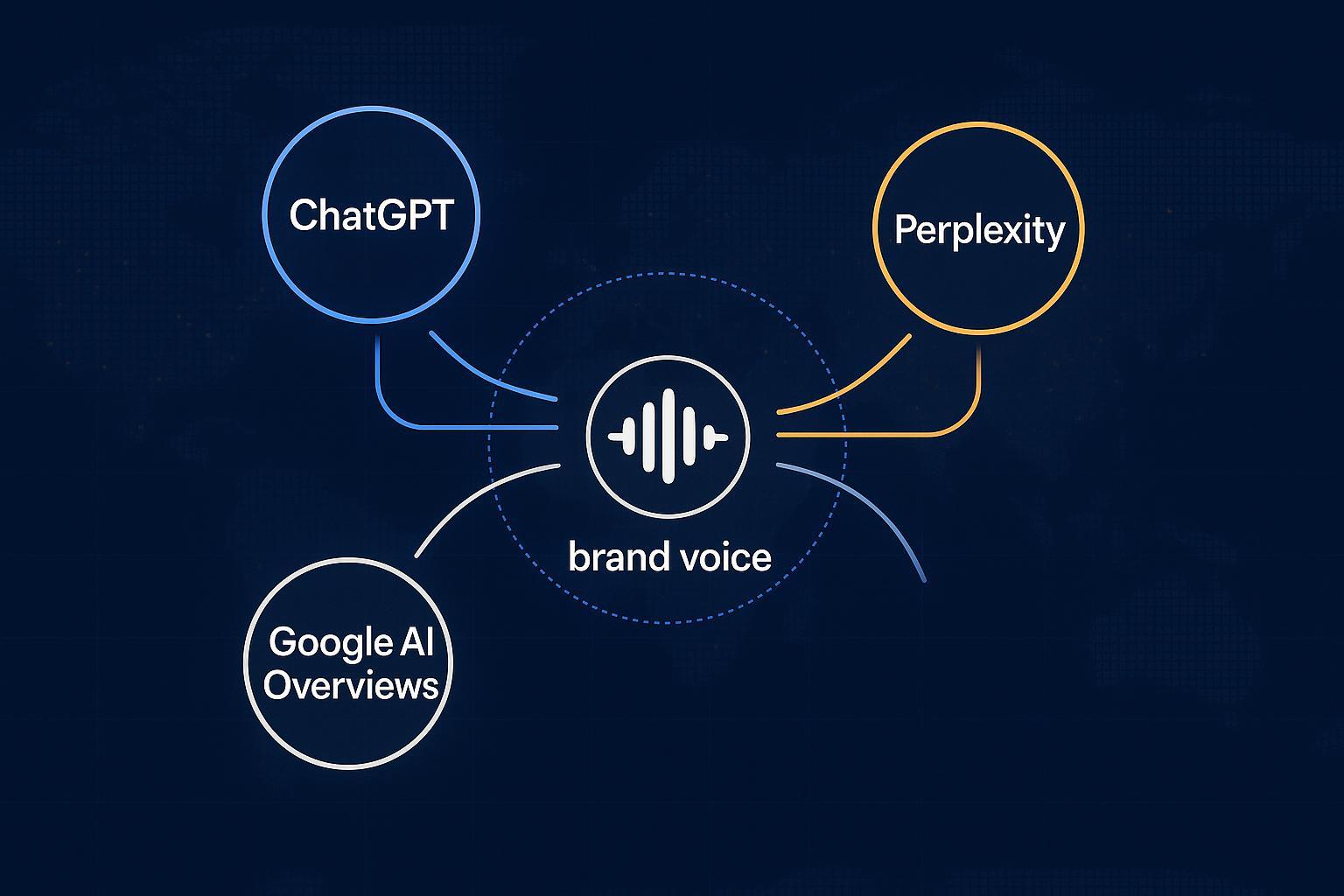
If you run delivery for an agency team, you’ve likely felt the gap: clients ask why ChatGPT says one thing, Perplexity cites different sources, and Google AI Overviews highlights competitors. Meanwhile, the brand voice wobbles from answer to answer. The fix isn’t a one-off content push—it’s a closed loop: baseline the visibility, enforce the voice, remediate gaps per engine, and re-measure on a steady cadence.
This guide outlines a practitioner workflow for agency-side GEO/AEO teams: how to systematize brand voice inside prompts and content structures, operate a cross-engine closed loop, and globalize without losing tone consistency. The end goal is clear: a repeatable process that reliably improves mentions, citations, and sentiment across ChatGPT, Perplexity, and Google AI Overviews.
What a closed loop looks like across ChatGPT, Perplexity, and Google AI Overviews
A single method won’t work across engines. You need engine-aware baselining and remediation informed by how each system surfaces and cites information.
Google positions AI Overviews as extensions of Search quality. They reward helpful, synthesis-ready content and do not disclose inclusion levers; structured data supports clarity but isn’t a guarantee, per Google’s own guidance in the AI features documentation and updates (2024–2025).
Perplexity consistently exposes inline sources and returns source metadata via APIs; optimizing for credible, comprehensive pages that earn citation is key, as implied by developer/help materials such as Perplexity’s prompt and quickstart docs.
ChatGPT’s consistency hinges on prompt design and session controls (system/developer messages, few-shot examples, and explicit output constraints) outlined in OpenAI’s prompt engineering best practices.
Engine | How answers surface | Source visibility | Practical optimization focus |
|---|---|---|---|
Google AI Overviews | Integrated into Search; favors helpful content for complex queries | Citations as “jumping-off points” | Build synthesis-ready, evidence-backed pages; strengthen E-E-A-T; schema supports clarity, not inclusion guarantees |
Perplexity | Conversational search with inline citations | Sources displayed; API returns metadata | Authoritative, comprehensive content; clear titles/canonicals; freshness and crawlability matter |
ChatGPT | Generative answers shaped by prompts/instructions | Browsing/tools can cite; otherwise opaque | Systematize prompts; enforce tone and format; require evidence references when browsing/tools are available |
If the engines differ this much, why chase a single tactic? The practical answer: run a closed loop that respects these differences while unifying how you measure brand visibility and voice.
Turn brand voice guidelines into prompts and content structures
Brand voice only scales when you encode it. Convert guidelines into durable instructions and guardrails so output quality isn’t left to chance.
System/developer message: Declare role (“You are a knowledgeable brand advisor”), tone (“confident, non-hype, American English”), and non-negotiables (e.g., cite verifiable sources when tools are available; avoid superlatives without evidence). This mirrors patterns in OpenAI’s prompting guidance.
Few-shot style examples: Provide 2–3 short, region-specific exemplars that show tone, sentence cadence, and formatting. Keep them concise to avoid overfitting.
Output structure: Specify headings, short paragraphs, allowed list usage, and any compliance notes (e.g., avoid medical/financial claims). Use delimiters so the model can parse sections.
Voice rubric and QA: Draft a 6–8 point rubric (tone, contractions, jargon density, evidence discipline, sentence variety, brand terms usage, linking policy, accessibility notes). After each generation, score outputs against the rubric and capture deltas for iterative improvements.
Think of it like a style sheet for a newsroom. You want every contributor and every engine session to inherit the same standards—even when briefs, languages, or product lines change.
Global visibility, local nuance: multilingual GEO without losing brand voice
Global brands succeed when they maintain entity and tone consistency while adapting for local semantics and expectations.
Map entities and variants: Normalize brand and product names across languages; note local category terms and synonyms. Keep a glossary in your prompt libraries so answers don’t drift.
Align URLs and metadata: Cross-link language/region pages with hreflang and standard canonical hygiene; Google reiterates that correct cross-linking between variants helps discovery and isn’t penalized when content is genuinely localized, per Search Central multilingual/hreflang guidance.
Local expertise and citations: Add regional expert bylines and locally credible citations to strengthen E-E-A-T. This often improves the odds of citations in engines that surface sources prominently (e.g., Perplexity).
Human-in-the-loop QA: Use native reviewers to check tone, register, and idioms. Machine translation is fine when high-quality and reviewed; low-quality translations should be fixed or noindexed.
What’s the pay-off? Fewer hallucinations about names and offerings, more consistent tone across locales, and better eligibility for engines to select your content as evidence.
The agency-grade closed loop
Closed loop means you measure the right things, fix the right gaps, and verify improvements over time. That requires engine-aware fieldwork and stable KPIs.
Baseline audit
Define priority prompts and intents across the funnel (brand terms, category definitions, comparisons, how-tos). Log answers from ChatGPT, Perplexity, and AI Overviews. Track brand mentions, citation depth, sentiment, and competitor share-of-voice. For definitions and KPIs, see the AI visibility concept explained.
Gap analysis
Identify absent, neutral, or negative mentions. Trace likely drivers: thin content, unclear evidence, weak entities/structured data, localization misalignment, or off-voice answers from inconsistent prompts. Differences by engine matter; compare monitoring nuances in the platform monitoring comparison for ChatGPT, Perplexity, Gemini, and Bing.
Remediation
Strengthen the source material: Add clearer evidence, expert bylines, FAQ/How-To blocks, and canonical URL hygiene; tighten schema for clarity (knowing it’s supportive, not decisive, for AI Overviews). Update prompt libraries to enforce tone and evidence requirements.
Re-monitoring cadence
Re-run the prompt set, capture deltas, and benchmark monthly. Because AI answer engines are volatile, build longitudinal baselines and compare trends over quarters. For industry context on volatility and measurement challenges, see Search Engine Land’s AI search visibility overview (2025).
Micro-case: a compact closed-loop example (tool usage disclosed)
Disclosure: The workflow below references Geneo for monitoring and reporting. Use any stack that lets you log prompt-level answers, mentions, citations, sentiment, and competitor share-of-voice without friction.
Scenario A multi-region B2B SaaS client reports inconsistent references in ChatGPT and scarce citations in Perplexity for mid-funnel category queries. Google AI Overviews intermittently includes the client but cites a competitor’s how-to page.
Setup
Prompts: We defined a 50-prompt baseline covering brand definitions, product differentiators, and task-focused how-tos across English, German, and Japanese. We encoded the brand voice as a system message with region-specific few-shots.
Logging: We captured engine responses, brand mentions, citation sources, and sentiment by prompt and locale. We tagged negative/neutral mentions and missing citations.
Actions
Content remediation: We published evidence-rich how-to pages aligned to the questions that AI Overviews tended to synthesize. Each page included expert bylines, step tables, and a short FAQ addressing ambiguous terms. We ensured canonical clarity and linked regional counterparts with hreflang.
Prompt/rubric update: We tightened the system message with explicit tone rubrics and added a constraint to reference verifiable sources when tools/browsing are available.
Localization: Native reviewers adjusted idioms and category names; we added local customer quotes and regulatory notes where relevant.
Outcomes (60–90 days)
ChatGPT: Brand voice became consistent across locales; hallucinated product naming dropped in QA reviews. Mentions increased on prompts tied to how-tos and comparisons.
Perplexity: Citation depth improved as our new pages earned inclusion; answers began to reference our evidence tables and FAQs.
AI Overviews: Inclusion frequency rose for targeted complex queries. While Google does not guarantee inclusion—per its own documentation—our synthesis-ready content coincided with more frequent citations.
Note: For teams diagnosing weak brand mentions in ChatGPT, this diagnostic guide for low ChatGPT brand mentions outlines prompt-level troubleshooting steps you can adapt.
Operating playbook: cadence, pitfalls, and handoffs
Cadence: Monthly re-monitoring for stable categories; biweekly for fast-moving product launches. Archive snapshots so you can show clients how answers evolve over time.
Pitfalls to avoid: Over-relying on schema to “force” AI Overviews; skipping native review in localization; letting prompt libraries drift without QA; ignoring canonical mismatches that fragment citations; and measuring only presence, not sentiment and citation quality.
Handoffs: Treat prompt libraries and voice rubrics as shared assets across content, SEO/GEO, and localization. Require a sign-off checklist before publishing or updating any page that feeds your high-priority prompt set.
Next steps: request a free AI visibility & brand voice consistency audit
If you’re running multi-market programs and need a neutral, data-led picture of how your clients appear across AI engines, initiate a free audit. We’ll baseline priority prompts across ChatGPT, Perplexity, and Google AI Overviews; assess brand voice adherence; and outline a remediation plan your team can run with. If you prefer a unified tracker and white-label reports, Geneo can support the workflow, but the audit output is stack-agnostic and focused on getting you to a closed loop.
Ready to see where the gaps are—and what it takes to close them? Let’s get your audit in motion.