Ranking the Best Answer Engine Optimization (AEO) Tools for AI Search (2025): Where Geneo Excels
Discover the 10 top Answer Engine Optimization tools for AI Search in 2025. Track citations, boost visibility, and compare their ROI impact. See which tools stand out!
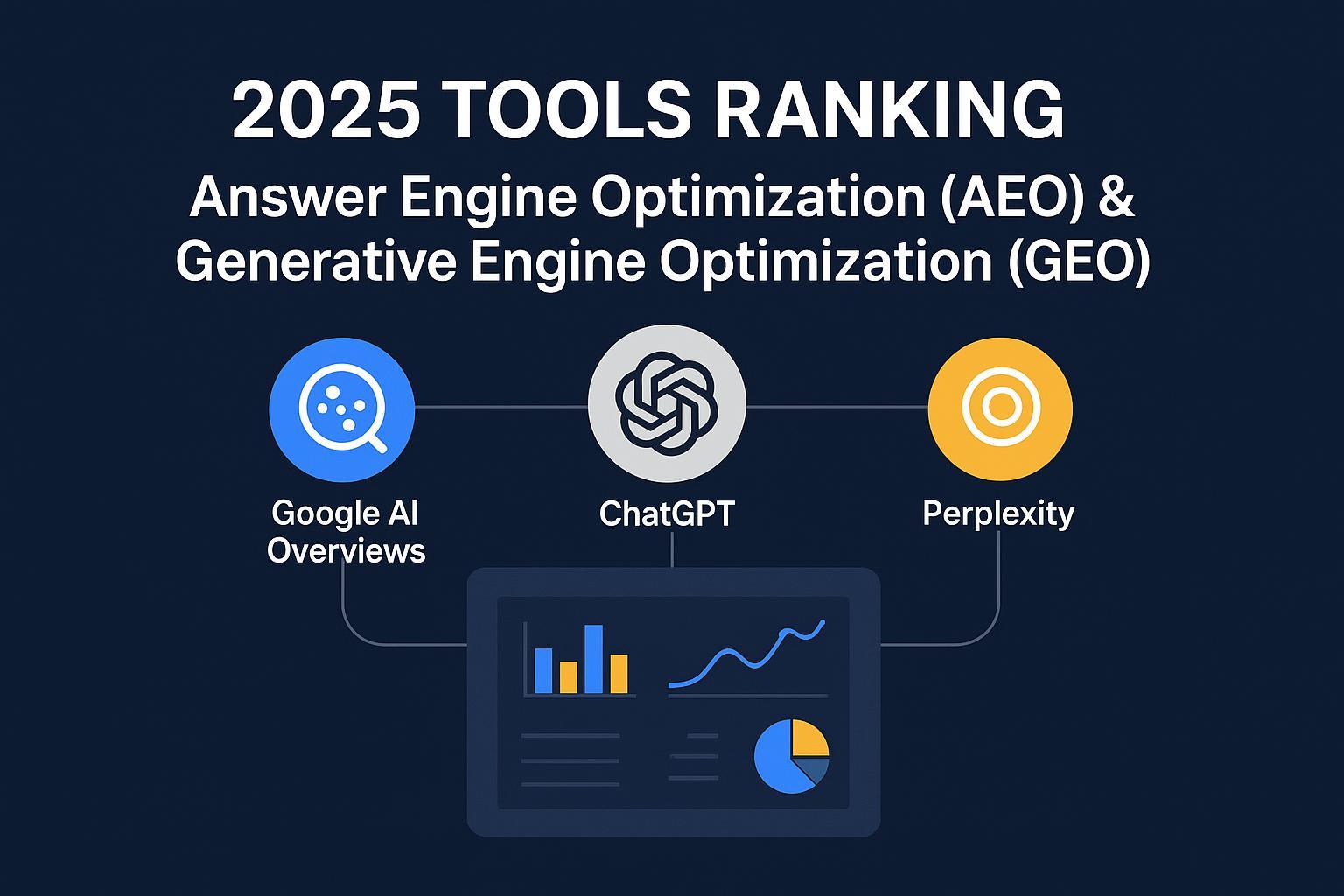
AEO/GEO isn’t just about “showing up” in AI answers anymore—it’s about proving impact and fixing what matters. If your leadership asks how AI citations across Google AI Overviews, ChatGPT, and Perplexity contribute to pipeline or revenue, you need two things: reliable cross‑engine visibility tracking and attribution proxies you can defend. This 2025 ranking focuses on the tools that help you log citations, quantify share of voice, and turn insights into action.
How we ranked (methodology)
We evaluated tools on what buyers need right now: cross‑engine coverage, in‑answer granularity, actionability, and the ability to link visibility to business outcomes. We combined user‑proposed models into a blended weighting that balances capability and business impact.
Criteria | Weight |
|---|---|
Capability match (engine coverage + prompt/answer granularity) | 30% |
Optimization & actionability (checklists, fix suggestions) | 25% |
Attribution & ROI proxies (citation/link logging, assisted conversion context) | 20% |
Evidence quality & recency (auditable docs, studies, changelogs) | 15% |
Reporting & collaboration (white‑label, exports, permissions) | 10% |
What we did not do: we didn’t score claims without a canonical source; pricing is noted as ranges or “from,” and it may change. Coverage varies by engine and evolves quickly, especially as Google’s AI Mode and AI Overviews update. For background on how Google positions AI features and citations, see Google’s Search Central guidance on AI features (updated May 2025).
The ranked tools (2025)
1) SE Ranking — Best overall AIO monitoring depth for most teams
SE Ranking’s dedicated AI Overviews Tracker documents whether queries surface AIOs and if your domain is cited, with historical snapshots and competitor comparisons. It’s pragmatic for teams that want repeatable, keyword‑level monitoring and exports they can fold into existing reporting. Official feature page: AI Overviews Tracker by SE Ranking.
SE Ranking stands out for clear AIO presence/citation logging, historical SERP copies, and competitive views supported by workflow guides. The trade‑off is that it’s primarily Google‑centric; ChatGPT/Perplexity monitoring typically relies on separate processes or other tools. In‑house teams and agencies needing a dedicated AIO tracker without heavy enterprise overhead will be comfortable here.
2) SISTRIX — Best for precise AIO filters and SERP archives
SISTRIX’s AI Overviews capabilities include in‑box analysis, cited domain tables, and expanded SERP archives that capture AIO content and URLs—useful for audit trails and change tracking. See SISTRIX AI Overviews hub and changelog for feature specifics.
You get granular filters, entity recognition, and archived evidence with solid change‑log transparency. The emphasis is on Google AIO; cross‑engine coverage beyond Google is limited. Practitioners who value documentation rigor and country‑level breadth alongside SERP archives will find SISTRIX well‑suited.
3) seoClarity (ArcAI 2.0) — Best enterprise AEO suite with AI Mode tracking
seoClarity’s ArcAI 2.0 introduces tracking for Google’s AI Mode and Overviews, with prompts at scale, competitor benchmarking, and prescriptive optimizers. Announcement and product pages outline link/reference detection and blueprint guidance. See seoClarity: AI Mode & AI Overviews tracking.
At enterprise scale, seoClarity offers prescriptive playbooks, reporting depth, and permissions suited to large teams. Pricing and features are enterprise‑oriented, so buyers should validate exact plan inclusions. It’s best for organizations needing governance, prompts at scale, and executive‑friendly dashboards.
4) Surfer — Best add‑on tracker plus actionable AI citation guidance
Surfer’s AI Tracker add‑on claims daily updates across AI Overviews/AI Mode and coverage for ChatGPT and Perplexity, paired with workflows that turn tracker data into an AI Citation Report. See Surfer AI Tracker and product updates for cadence details.
Surfer shines when teams want prescriptive, citation‑focused workflows. Add‑on pricing and exact engine depth vary by plan and time, so confirm current coverage before committing. It’s a match for content teams that want guidance tied directly to tracker signals.
5) Semrush — Best ecosystem approach via Position Tracking and Sensor
Semrush documents how to identify AIO presence and behavior through Position Tracking/SERP Features filters, Organic Research, and Sensor, supported by large‑scale studies. It’s not a single “AIO tracker” page, but the ecosystem offers robust context. See Semrush’s AI Overviews research and how‑to.
The breadth of datasets and studies helps teams add competitive visibility insights to a familiar workflow. The constraint is that AIO tracking is emergent across modules; features may require configuration and triangulation. It’s best for teams already embedded in Semrush who want to layer AIO context into existing reporting.
6) Advanced Web Ranking — Best for export‑heavy, white‑label reporting
AWR combines AIO signals with classic rank tracking and is known for scheduled/white‑label reports, CSV/FTP exports, and API/Looker Studio integrations. While specifics live across blogs and docs, reporting flexibility is the draw. See AWR’s workflows and articles like AWR on AI and testing workflows.
Agencies get efficiency from automation, white‑label options, and standardized deliverables. Consolidate capabilities carefully because the AIO feature set spans posts rather than one spec page. It suits agencies prioritizing reporting efficiency across many clients.
7) Profound — Best for multi‑engine brand visibility dashboards
Profound focuses on brand mentions/citations across ChatGPT and Perplexity with share of voice and sentiment, plus integrations and multi‑brand views. It’s oriented toward monitoring and competitive context. Overview: Profound platform.
Cross‑engine brand visibility, prompt customization, and agency reporting features are its strong points. You should verify Google AIO depth and attribution workflows because documentation varies by module. Profound is for teams prioritizing ChatGPT/Perplexity visibility with comparative dashboards.
8) ZipTie — Best for quick citations/mentions across engines
ZipTie surfaces citations and mentions across AI Overviews, ChatGPT, and Perplexity, with exportable reports and an “AI Success Score.” It’s quick to implement for snapshot visibility. See ZipTie overview.
It offers fast setup, clear citation logs, and screenshot/evidence export. Advanced optimization guidance is lighter, so validate refresh cadence for your market. SMBs and teams needing simple cross‑engine citation tracking will appreciate ZipTie.
9) Keyword.com — Best budget‑friendly prompt‑based tracking
Keyword.com’s AI Visibility tracker emphasizes prompt‑based monitoring for ChatGPT and Perplexity, logging brand mentions/citations with credits that fit smaller budgets. Feature page: Keyword.com AI Search Visibility.
The entry price is friendly, and prompts are targeted for straightforward monitoring. Google AIO coverage is limited or roadmapped, and attribution relies on clicks where links are present. It’s ideal for budget‑conscious teams testing prompt panels and basic visibility.
10) BrightEdge & Ahrefs — Best for research‑grade insights (context, not full trackers)
BrightEdge publishes AIO/LLM insights used by many teams to inform strategy, and Ahrefs runs deep, method‑transparent studies on AIO prevalence, CTR impact, and change frequency. They provide context more than project‑level trackers. For examples, see Ahrefs’ AI Overviews analysis and Search Engine Journal’s summary of BrightEdge’s findings in research on optimizing for Google AIO and ChatGPT (Aug 2025).
These resources are strong for executive education and planning, but limited for per‑project cross‑engine citation logging in one dashboard. Strategists who need evidence to frame priorities and set expectations will benefit most.
Where Geneo excels (and who it’s for)
Disclosure: Geneo is our product. Geneo focuses on multi‑platform AI visibility and optimization with cross‑engine monitoring (ChatGPT, Perplexity, Google AI Overviews), a Brand Visibility Score, competitive benchmarking, and agency‑grade white‑label reporting. See the Geneo homepage for a capabilities overview.
Geneo’s strengths include consolidated cross‑engine monitoring, share of voice and sentiment metrics, evidence logs for citations/snapshots/links, competitive analysis, and branded client reporting via CNAME portals. For workflows, Geneo’s explainer and guides—like the AI visibility audit tutorial—offer practical steps. Constraints to note: independent head‑to‑head benchmarks are limited publicly; attribution still depends on the presence of clickable links in answers (Perplexity is friendlier than ChatGPT here). Coverage and engine behavior change frequently—validate your setup before scaling. It’s best for agencies and in‑house teams that want multi‑engine monitoring plus actionable guidance without stitching multiple tools together.
What this means for your roadmap (next steps)
If the urgent question is “How do AI citations move the needle?”, start with measurement discipline and a short test window.
Assemble a prompt panel across Google AIO/AI Mode, ChatGPT, and Perplexity that mirrors your core topics and buyer intents.
Log citations, references, and links weekly; quantify share of voice against the top 3 competitors and capture screenshots for audit trails.
Implement the top five fixes (extractable summaries, authoritative sources, schema, unique data) and re‑test. Think of it like tuning a radio—you adjust the knobs, then listen again.
Tie any Perplexity clicks (and ChatGPT where links appear) to GA4 with consistent UTM conventions; use assisted conversion proxies to estimate business impact.
Re‑measure after two weeks and standardize reporting (white‑label if you serve clients).
You can run this with the stack you already have; if you need a cross‑engine monitor plus competitive context, Geneo and several tools above can help. For deeper background, see the GEO vs. SEO framework comparison and the engine coverage comparison.
— Measurement discipline, update cadence, and actionability are what separate noise from progress. Keep your methodology transparent, link claims to canonical sources, and revisit your stack as AI search evolves.