
Understanding AI Query Intent for GEO
Discover what AI query intent means in Generative Engine Optimization (GEO), how it shapes answers for Google AI Overviews, Perplexity, and ChatGPT, and why it matters.
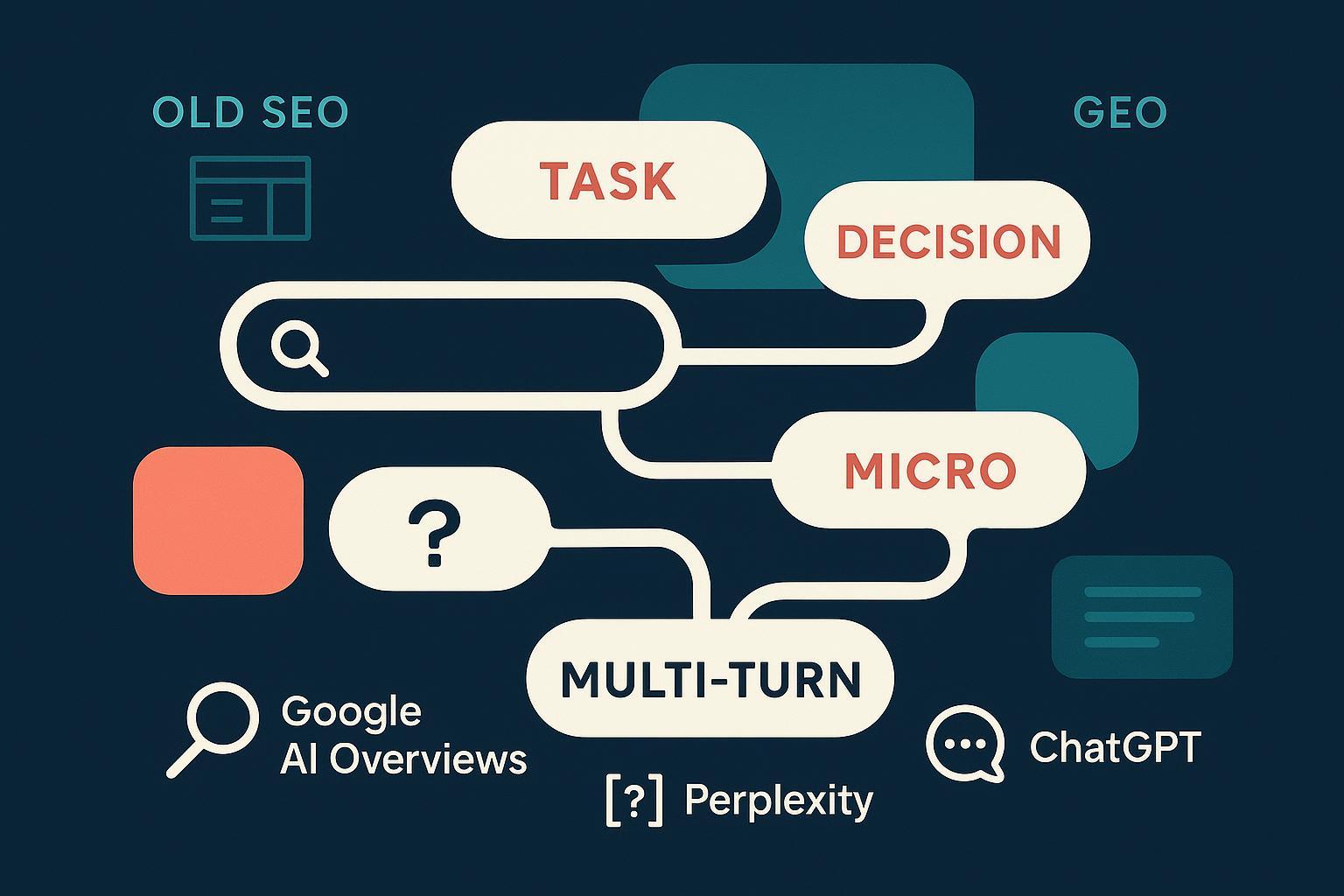
If answer engines now do the reading for us, your job is to help them understand exactly what users want. That’s where AI query intent comes in—and it works a bit differently from classic SEO intent.
Definition — AI Query Intent (for GEO) AI query intent is the underlying goal a user wants an AI answer engine to fulfill—what outcome they expect the system to produce (a direct answer, a step-by-step, a comparison, a decision helper). In the context of Generative Engine Optimization (GEO), it’s how you classify queries so you can structure evidence-backed passages that AI systems retrieve, synthesize, and (ideally) cite.
According to Search Engine Land’s 2024 explainer on GEO, the goal shifts from “ranking” to being used and cited inside AI-generated answers. That shift changes how we read intent, how we shape content, and how we measure success.
Old SEO vs. GEO: What changed about “intent”
Traditional intent models—informational, navigational, commercial investigation, transactional—are still useful. But answer engines infer goals more fluidly, often across multiple turns, and they reward concise, evidence-linked passages. Think of an AI engine like a meticulous librarian assembling a brief—your job is to give it quotable notes, not just a long book.
| Dimension | Old SEO (classic search) | GEO (AI answer engines) |
|---|---|---|
| Primary objective | Earn rankings and clicks | Be selected, summarized, and cited inside AI answers |
| Content unit that wins | Full page targeting a keyword | Passage-level blocks with clear questions/answers and adjacent evidence |
| Evidence & citations | Optional or end-notes | Essential; engines favor verifiable claims with source links |
| Measurement | Positions, CTR, sessions | Citation frequency/context, sentiment of mentions, entity coverage |
| UX expectation | Users click and read | Users scan synthesized answers; links support verification |
| Query patterns | Single-shot | Conversational, multi-turn, reformulated |
A practical taxonomy for AI query intent
Below is a working taxonomy for GEO planning. It complements the classic four intents by focusing on the shape of the answer the user expects from an AI system.
1) Task-oriented
What it is: The user expects steps to complete something (“set up,” “fix,” “prepare”). Typical answer shape: brief prerequisites, numbered steps, a short checklist, and links to primary docs. Example: “How do I export QuickBooks invoices to CSV?” Platform notes: Google AI Overviews often surface orderly step lists with links; Perplexity shows steps with inline citations; ChatGPT synthesizes steps and may not include source links by default.
2) Decision-support
What it is: The user is choosing among options and wants tradeoffs. Typical answer shape: a concise recommendation block, a small comparison table, and per-option rationale with citations. Example: “Best running shoes for flat feet under $150.” Platform notes: AI Overviews favor concise top-line picks plus links; Perplexity highlights comparison evidence with numbered sources; ChatGPT blends opinions and specs unless browsing/tools are enabled.
3) Micro-intent
What it is: A narrow, precise ask—often a single fact or definition. Typical answer shape: one-sentence answer with a clarifying note and a primary source. Example: “Vitamin D3 daily dose for adults?” Platform notes: High sensitivity to authoritative sources; make sure the exact fact lives in a tidy Q&A block with the source next to it.
4) Multi-turn journeys
What it is: A sequence of related queries where context carries over. Typical answer shape: logical breadcrumbs and links to likely next steps (e.g., from “Roth vs Traditional IRA” to “income limits” to “withdrawal rules”). Example: “Compare Roth vs. Traditional IRA tax treatment.” Platform notes: Clarity around entities, definitions, and edge cases prevents drift in later turns.
For a baseline on classic intent types, see Clearscope’s 2024 guide to search intent. The taxonomy above is purpose-built for answer shapes rather than SERP layouts.
Platform specifics: how engines interpret and cite
Google AI Overviews
In its U.S. rollout announcement, Google (2024) describes AI Overviews as summaries that reduce the legwork for complex queries while linking to sources. Practitioners consistently observe that pages with clear passage structure, strong entity clarity, and adjacent evidence links are more likely to be included. Treat that as guidance, not a guarantee.
Perplexity
Perplexity is retrieval-first, showing numbered citations alongside answers. Independent walkthroughs explain a pipeline of live retrieval, synthesis, and inline citations—useful for brands that want visible attribution. See Ethan Lazuk’s 2024 explanation of how Perplexity works for a practical view of this behavior.
ChatGPT
In standard chats, ChatGPT doesn’t automatically include external citations unless browsing/tools are enabled or prompted. Style bodies emphasize how to cite ChatGPT rather than ChatGPT auto-citing sources, which signals that transparent citations are not the default. The APA’s 2023 guidance on citing ChatGPT summarizes this norm.
If you need a deeper operational view of measurement and program setup, this step-by-step primer can help: Guide to tracking AI Overview traffic and How to Measure Generative Engine Optimization.
Intent-to-structure mapping (what to publish, where to place it)
Direct answers work best for micro-intent: open with one or two crisp sentences and place the primary source link immediately after the claim. For task-oriented queries, front-load prerequisites and then present 5–7 scannable steps, adding screenshots or transcripts where helpful. For decision-support, open with a brief recommendation, add a compact comparison table covering criteria users actually care about, and follow with short, evidence-backed blurbs per option.
To pressure-test a draft, ask yourself three questions: Does the opening passage match the expected answer shape for the query? Are core facts extractable as standalone sentences with adjacent citations? Are entities (people, products, organizations, standards) clearly named and disambiguated so retrieval systems can align them?
The technical bit (brief and practical)
Modern systems often infer intent implicitly from context and phrasing, not just pre-set categories. In practice, multi-turn context and query reformulation shape what gets retrieved. Research on zero-shot query reformulation shows that resolving coreferences and filling in omitted specifics improves retrieval and synthesis quality; see ZeQR (arXiv, 2023) on conversational query reformulation. The upshot for GEO: use explicit, unambiguous phrasing, and make sure key facts are packaged in passage-sized, citation-ready blocks.
Measuring AI query intent success (beyond rankings)
What does success look like when there’s no blue link to chase? Focus on three signals.
Citations inside AI answers indicate whether engines are selecting and reusing your content. Track frequency, placement, and context across engines and over time. Practitioner frameworks in 2025 recommend scoring visibility and reuse; the Profound GEO Guide (2025) is one example.
Sentiment of brand mentions shows how your brand is framed when it’s named. Note whether mentions appear in positive, neutral, or negative contexts and why.
Entity coverage and passage fit tell you whether you’re covering the right topics and whether your content matches common answer shapes (direct answer, steps, comparison). For a walkthrough on setting up tracking for AI Overviews specifically, see this guide.
Practical workflow example (neutral, real-world)
Scenario: Your team targets “What are the top 3 smartphones for photography under $1,000?” You classify it as decision-support with task elements (a quick pick plus a short comparison). Structure the page with a two- to three-sentence answer listing the three picks and why, a compact comparison table (sensor size, main camera resolution, stabilization, price band), and short passages for each recommendation with links to spec sheets and reputable reviews. Add a brief “how we chose” methodology and an update note for model-year changes.
Monitoring: Check whether Google AI Overviews excerpts your picks and links, and note which sentences are reused. In Perplexity, review the inline numbered sources and compare which passages it quotes. In ChatGPT, test prompts and browsing configurations to see if it cites or accurately summarizes your page. Disclosure: Geneo is our product. In this scenario, a tool like Geneo can be used to centralize cross-engine citations and brand sentiment, and to review historical query coverage so you can iterate your content structure.
Pitfalls and ethics to keep trust intact
Don’t over-claim—treat observed platform patterns as guidance, not guarantees, since Google doesn’t publish its AI Overviews selection logic. Cite primary sources next to claims and avoid vague “studies show” language. Keep superlatives in check, avoid disparaging competitors, and update time-sensitive facts (pricing, specs, regulations) on a predictable cadence.
Where to go next
Start small: pick 10 priority queries and classify each with the taxonomy above. For each, publish one answer-shaped passage near the top, add adjacent citations, and make sure the page is fast, indexable, and ungated. Then measure citations, sentiment, and entity coverage over a quarter. You’ll know quickly which answer shapes your audience—and the engines—actually use.