
AI-Optimized Travel Content for ChatGPT, Perplexity, and Google AI
Practical guide for travel and hospitality marketers: optimize content, schema, localization, and measurement to win citations on ChatGPT, Perplexity, and Google AI.
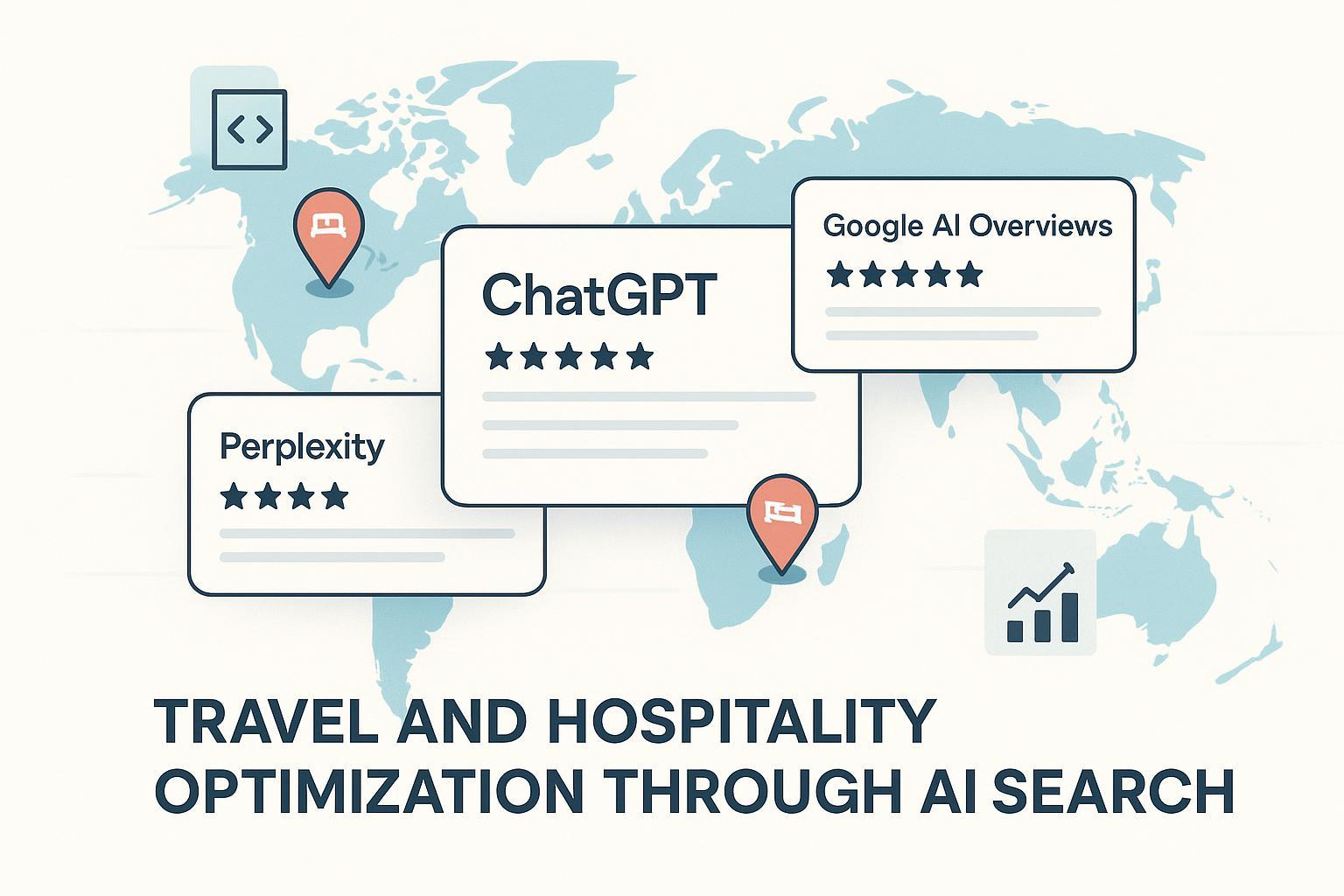
Want your hotel or destination to surface in AI answers? Start with concise, verifiable copy, travel-specific schema, localized pages, and real-time data that matches what a traveler sees. Measure AI citations and clicks alongside bookings, then iterate content weekly. That’s the backbone of AI-optimized travel content.
Why AI answer surfaces matter to travel
AI answers compress research. Travelers ask complex, multi-step questions and expect immediate clarity—nearby family hotels, what to do with toddlers, which month avoids storms, and how much it costs. When your site is eligible and clearly structured, these systems can quote and link you.
- Google’s own guidance emphasizes that AI features draw from content already eligible in Search, with standard snippet controls and no separate “AI-only” index. See Google’s documentation in AI features and your website and recent documentation updates.
- Perplexity provides answers with inline citations sourced from real-time web results, and users can deepen queries with Pro and Deep Research modes; see How Perplexity works and Deep Research overview.
- ChatGPT now offers web search with linked sources, and its app ecosystem includes travel partners; see Introducing ChatGPT search and apps in ChatGPT.
Foundations of AI-optimized travel content
Start with intent models that reflect real traveler needs, then write for conversational extraction.
- Lead answers: Open with a 1–2 sentence direct answer (e.g., best season, price range, family-friendly highlights), then add the supporting detail below.
- Progressive refinement: Offer short follow-ups like “Prefer quieter neighborhoods?” or “Traveling with infants?” to guide deeper questions.
- Verification and safety: Clearly note seasonal closures, local safety guidelines, and refund policies. It reduces hallucinations and builds trust.
Prompt templates you can mirror in copy
-
“Plan a 5-day family-friendly itinerary in Lisbon with toddlers, staying near parks, budget $250/night, walking distance attractions.”
- Your page should respond with a compact overview, day-by-day highlights, neighborhood notes, and a price/availability composite.
-
“Compare boutique hotels in Kyoto under $300/night, near Gion, with on-site breakfast and late check-in.”
- Provide a comparison micro-section: distances, breakfast hours, late check-in policy, and links to live offers.
-
“What festivals happen in Granada in September, and where should we stay to avoid noisy streets?”
- Include event dates (with Event schema), noise guidance, and quiet-area lodging suggestions with map cues.
Schema and content patterns that AI agents parse well
Keep copy scannable. Align H2/H3s to common questions. Use data-backed short sentences, then supply structured data to reinforce meaning.
- For hotels: Use Hotel/HotelRoom with offers in JSON-LD and keep prices/availability consistent with visible content and feeds. Google’s reference: Hotel price structured data.
- For timed activities: Use Event structured data and link clearly to event pages; Google documents the format in Event structured data.
- For itineraries: Model with schema.org entities (Place, TouristAttraction, Itinerary) to aid extraction even without a dedicated rich result.
{
    "@context": "https://schema.org",
    "@type": "Hotel",
    "name": "Riverside Boutique Hotel",
    "url": "https://example.com/riverside-boutique-hotel",
    "address": {
      "@type": "PostalAddress",
      "streetAddress": "12 Riverwalk Ave",
      "addressLocality": "Lisbon",
      "addressCountry": "PT"
    },
    "telephone": "+351-21-000-0000",
    "amenityFeature": [{
      "@type": "LocationFeatureSpecification",
      "name": "On-site breakfast",
      "value": true
    }],
    "containsPlace": {
      "@type": "HotelRoom",
      "name": "Deluxe River View",
      "occupancy": {
        "@type": "Occupancy",
        "minValue": 1,
        "maxValue": 3
      },
      "offers": {
        "@type": "Offer",
        "price": "245.00",
        "priceCurrency": "EUR",
        "availability": "https://schema.org/InStock",
        "validFrom": "2026-01-01",
        "validThrough": "2026-03-31"
      }
    }
  }
Note: Keep prices synced with your booking engine or feed. Google’s hotel price spec expects accurate, partner-aligned data displayed consistently with the page.
{
    "@context": "https://schema.org",
    "@type": "Itinerary",
    "name": "5-day Lisbon family itinerary",
    "description": "Toddler-friendly plan with parks, short walks, and nap-friendly pacing.",
    "itemListElement": [{
      "@type": "ListItem",
      "position": 1,
      "item": {
        "@type": "TouristAttraction",
        "name": "Jardim da Estrela",
        "isAccessibleForFree": true
      }
    }, {
      "@type": "ListItem",
      "position": 2,
      "item": {
        "@type": "TouristAttraction",
        "name": "Oceanário de Lisboa",
        "isAccessibleForFree": false
      }
    }]
  }
{
    "@context": "https://schema.org",
    "@type": "FAQPage",
    "mainEntity": [{
      "@type": "Question",
      "name": "Is late check-in available?",
      "acceptedAnswer": {
        "@type": "Answer",
        "text": "Yes, we offer late check-in until 1 a.m. Please notify us 24 hours in advance."
      }
    }, {
      "@type": "Question",
      "name": "What’s the quietest wing for light sleepers?",
      "acceptedAnswer": {
        "@type": "Answer",
        "text": "Rooms facing the inner courtyard are quieter; request floors 3–4 for minimal street noise."
      }
    }]
  }
Make content RAG-ready and fresh
Think of your content as feeding retrieval systems. If your facts are current and semantically tidy, AI agents answer confidently.
-
Canonical, crawlable pages for each core topic (property, neighborhood, itinerary). Avoid duplicate thin pages.
-
Live data alignment: pricing and room availability update at least nightly; keep schema in sync with visible values.
-
Snippet-ready summaries: put compact, verifiable blurbs at the top of pages.
-
Entity grounding: Organization, LocalBusiness, BreadcrumbList help systems understand who you are and how pages relate.
-
RAG-ready checklist:
- Use JSON-LD consistently on key pages.
- Keep short, verifiable lead summaries (40–60 words) per page.
- Nightly updates for offers/pricing where possible.
- Internal links that bind itineraries to hotel/property pages.
- Maintain an FAQ section answering traveler realities (policies, safety, seasonality).
Localization that converts
Hreflang signals help the right language/region version appear in search. Beyond tags, localization should change currency, units, microcopy, imagery, and policies to match expectations.
- Google’s guidance on alternates/hreflang: Localized versions of your pages. Use reciprocal links, valid codes, and x-default for global selectors.
<link rel="alternate" hreflang="en-us" href="https://example.com/us/hotel" />
  <link rel="alternate" hreflang="en-gb" href="https://example.com/uk/hotel" />
  <link rel="alternate" hreflang="pt-pt" href="https://example.com/pt/hotel" />
  <link rel="alternate" hreflang="x-default" href="https://example.com/" />
- Localization checklist:
- Currency and units (USD vs. EUR; miles vs. kilometers).
- Microcopy (holiday names, local customs, tipping norms).
- Policy differences (refund windows, tax and fee disclosures).
- Image swaps (seasonal weather, attire, accessibility cues).
- Offers tied to local calendars (school breaks, festivals).
If you operate in EEA markets, monitor Google’s structured data carousels beta for aggregation pages; see carousels (beta). For festivals and timed experiences, Event structured data can improve clarity and eligibility.
Measuring AI visibility, clicks, and bookings
You won’t find a distinct “AI Overview” filter in Search Console. Google confirms AI features’ impressions are counted under standard Web metrics. See AI features and your website. So, measurement depends on triangulation.
-
Workflow overview: export GSC queries/pages, detect AI Overview presence and citations via a rank tracker, then validate with GA4 conversions.
-
Segment by intent (inspiration vs. comparison vs. booking) to understand where AI answers help or hinder clicks.
-
KPI formulas:
- AI Overview Presence Rate = (Queries with AI Overview / Tracked queries) × 100.
- Citation Success Rate = (AI Overview appearances citing your domain / AI Overview appearances) × 100.
- CTR impact = CTR when AI Overview appears − CTR when it doesn’t (analyze by query cluster).
- Net impact windowed = Δ clicks and conversions across comparable periods.
For methodologies on detection and attribution, see Search Engine Journal’s AIO tracking write-up, GET STAT’s approach, and Bounteous guidance.
For deeper KPI definitions and an agency reporting framework, study AI Search KPI frameworks: visibility, sentiment, conversion.
Monitoring workflows and a neutral platform example
Here’s how to audit and monitor across the three surfaces:
- Perplexity citation check: Run your priority queries. Note which sources are cited; adjust your pages to offer clearer, verifiable answers and authority cues. Consider adding pointers to official sources within your content.
- ChatGPT search audit: Test “compare” and “plan” prompts. Verify whether your property pages or destination guides are being linked. Tighten your lead answers and schema where answers feel generic.
- Google AI Overviews presence tracking: Use a rank tracker that flags AIO and whether you’re cited. Pair those flags with GSC exports to quantify CTR changes by query cluster.
Disclosure: Geneo (Agency) is our product.
Practical example: Agencies managing hotel groups can use Geneo’s AI visibility platform to monitor daily if a brand is mentioned or cited across ChatGPT, Perplexity, and Google’s AI Overviews. Teams review “AI Mentions,” “Share of Voice,” and citation history, then correlate spikes with content updates (e.g., adding Event schema for festivals or refreshing FAQ answers). The workflow is neutral: detect mentions, validate content changes, observe trends, and export a client-ready dashboard—useful when you need to justify a weekly content cadence without relying on static screenshots.
Guardrails and governance
- Content freshness policy: Review seasonal pages monthly; sync schema with visible content after any pricing or policy change.
- Hallucination mitigation: Provide explicit facts (refund windows, safety advisories, closures) and cite authoritative sources within your copy where appropriate.
- QA cadence: Maintain a checklist for broken links, outdated times, and inconsistent units/currency.
- Privacy/legal: Ensure booking forms and analytics respect local regulations; limit PII in analytics exports.
30-60-90 day action plan
- Days 1–30: Audit top 50 queries. Rewrite lead answers and FAQs; add Hotel/HotelRoom schema to property pages; implement hreflang on core regions; start nightly pricing sync.
- Days 31–60: Add Event schema to festival pages; publish 2 itinerary guides per priority market; integrate GA4 goals and rank-tracker exports; compute Presence and Citation Success Rates.
- Days 61–90: Localize microcopy (currency, units, holidays); expand internal links between itineraries and hotel pages; tune content by markets where AI Overviews suppress CTR; establish weekly monitoring.
A final note: if you need a neutral way to report AI citations to clients, platforms that track cross-channel mentions and export clean dashboards can help. Keep evaluation criteria focused on accuracy, cadence, and transparency.