How Agencies Can Prepare for AI‑Driven Search Transformation
Discover the latest 2025 agency strategies for Google AI Overviews, ChatGPT Search, and more. See key CTR data and steps for AI visibility now.
Updated on: December 31, 2025
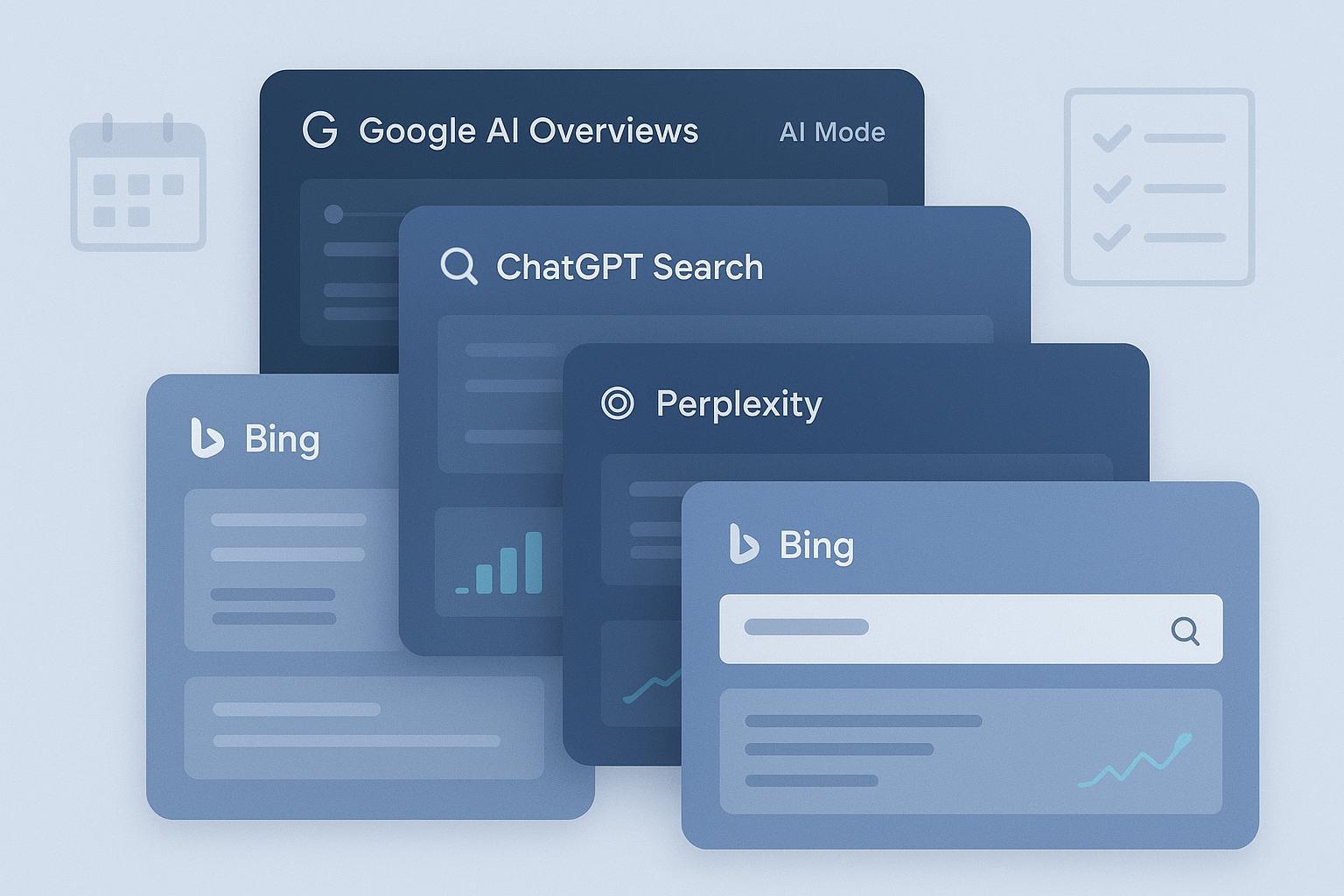
If your client reports still hinge on blue links and rank trackers alone, you’re flying with last year’s instruments. In 2025, answer engines—Google’s AI Overviews/AI Mode, ChatGPT Search, Perplexity’s Comet, and Bing/Copilot—started doing more of the “click-saving” for users. The job now isn’t just to rank; it’s to be cited, named, and recommended inside those answers.
To move fast without breaking trust, shift from keywords to citations, from static screenshots to ongoing monitoring, and from traffic-only to answer-surface visibility. Think of it this way: if a prospect gets a full, linked summary from an AI result, your brand must show up in that summary—or the click may never happen.
What actually changed in 2025 (and why it matters)
Google widened access to AI Overviews and introduced AI Mode, a conversational layer with follow‑ups and multimodal reasoning. Google emphasizes that answers include helpful links to original sources, and the experience expanded alongside Gemini upgrades in 2025. See Google’s own description in “Expanding AI Overviews and introducing AI Mode” (Google, 2025).
OpenAI pushed “deep research” and agentic browsing. The July update brought a visual browser inside ChatGPT’s agent, enabling multi‑step evidence gathering and more structured outputs that can include citations. Details are in “Introducing deep research” (OpenAI, 2025). Shopping‑oriented enhancements also landed this year; TechCrunch summarized April’s features that add product images, reviews, and purchase links in “OpenAI upgrades ChatGPT Search with shopping features” (2025).
Perplexity reimagined its Comet assistant for complex tasks, improving transparency (showing actions, preserving threads) and continuing to foreground source links in answers. See “The new Comet Assistant” (Perplexity, 2025).
Microsoft advanced Copilot capabilities across Edge and Microsoft 365, with increasingly structured responses and visible citations. For cadence and features, Microsoft’s TechCommunity provides quarterly roundups, such as “What’s new in Microsoft 365 Copilot — September 2025”.
For agencies, the pattern is clear: answers are richer, more conversational, and more likely to cite sources inline. If your brand isn’t in those citations, your visibility is at risk.
The traffic picture: what the data says
Two 2025 studies help quantify what many teams felt anecdotally.
Seer Interactive analyzed 3,119 informational queries across 42 organizations (June 2024–Sept 2025; 25.1M organic impressions; 1.1M paid impressions). When AI Overviews appeared, organic CTR dropped about 61% (1.76% → 0.61%), and paid CTR dropped about 68% for those informational queries. Sites cited within AI Overviews saw better CTR than those not cited. See Seer Interactive’s September 2025 update.
Previsible reported a sharp rise in AI‑sourced sessions year over year (January–May 2025 vs. 2024) across a 19‑property GA4 cohort, and a 12‑month benchmark suggesting small but growing overall share with high‑intent landing pages over‑indexed. Methodologies and caveats apply; use these as directional benchmarks. Reference Previsible’s 2025 AI SEO study.
Operational implication: protect and grow your presence inside AI answers. Being cited can cushion CTR losses and even create new pathways from AI engines that do send referral clicks, albeit inconsistently.
Your 60‑day ops sprint
-
Weeks 1–2: Instrument and baseline
- Build query and prompt sets by intent: commercial, informational, and local. Add conversational follow‑ups you expect from real users.
- Start cross‑engine monitoring (Google AI Overviews/AI Mode, ChatGPT Search/Deep Research, Perplexity Comet, Bing/Copilot). For definitions and scope, align your team on What Is AI Visibility?
- Log daily or at least thrice weekly: engine/model, query/prompt, presence, citation link(s), sentiment framing, and recommendation type (top pick vs. list vs. footnote). Capture screenshots.
-
Weeks 3–6: Optimize for citation inclusion
- Rewrite targeted hub pages and key local pages so each includes concise, well‑sourced answer blocks (40–60 words), clear claims, and reputable references.
- Add or tighten schema: Article, FAQPage, HowTo, Organization, Person. Ensure canonical URLs and clean, uncluttered source formatting. Use expert bylines and credentials.
- Publish original data where possible (benchmarks, charts), and resolve ambiguous statements that AI systems might avoid citing. Use this playbook: Optimize content for AI citations.
- Localize tests for priority markets and languages; document differences in answer composition and citations.
-
Weeks 7–8: Report and forecast
- Overhaul reporting to include answer‑surface visibility: presence rate, citation rate, Share of Voice (SOV) in AI answers, Total Citations, and platform breakdown. If you need a how‑to, see the AI Visibility Audit guide.
- Build impact scenarios. Use Seer’s CTR deltas and your impression data to estimate potential loss/gain and prioritize mitigations (e.g., pages to harden for citation, new assets to launch).
- Produce a monthly executive summary focusing on AI‑linked outcomes, trend lines, and next actions—keep it client‑ready and repeatable.
Platform playbook notes (quick checks)
Google AI Overviews/AI Mode: Put the “answer first” in a tight paragraph, then support with 2–3 clean citations. Include FAQs that mirror likely follow‑ups. Watch how your brand appears (named vs. linked vs. omitted).
ChatGPT Search and Deep Research: Test both short queries and long, multi‑step prompts. Verify whether outputs include source URLs and whether they’re your preferred pages. When missing, examine content clarity, claim specificity, and competing sources.
Perplexity Comet: Ensure source hygiene—title clarity, author credentials, and structured sections. Comet preserves context and shows steps; favor pages that explain methods and cite primary data.
Bing/Copilot: UI varies by rollout. Capture screenshots of citation display and note consistency by query type. Confirm that your brand appears as a clickable source when recommended.
For stack choices and differences across engines, this comparison helps teams decide monitoring coverage: ChatGPT vs. Perplexity vs. Gemini vs. Bing — monitoring comparison.
Metrics that stick (and how to log them)
Share of Voice (answer surfaces): Percent of all answer inclusions where your brand is present versus a defined competitor set.
AI Mentions and Total Citations: Count of brand mentions and unique linked citations across engines.
Platform Breakdown: Distribution by Google AI features, ChatGPT Search/Deep Research, Perplexity, Bing/Copilot.
Presence rate and citation rate: For tracked queries/prompts, how often you appear, and how often with an explicit link.
Sentiment and recommendation type: Positive/neutral/negative; top pick vs. list vs. footnote or “mentioned but not linked.”
Trend lines: Daily/weekly changes to show volatility and progress.
Logging tips: keep a consistent schema—engine, model/version (when visible), query/prompt, date/time, inclusion type, link targets, and screenshot path. Tie these to page‑level actions in your CMS and analytics so every optimization can be traced to movement in answer visibility.
Example: standing up a white‑label AI visibility program (disclosed)
Disclosure: Geneo (Agency) is our product.
Many agencies centralize this work in a white‑label dashboard so clients see AI‑answer visibility alongside classic SEO metrics. A practical approach is to use a platform that monitors Google AI Overviews, ChatGPT, and Perplexity daily; detects brand mentions; and rolls metrics like Share of Voice, AI Mentions, Total Citations, and Platform Breakdown into a single visibility score. For example, Geneo (Agency) can be used to host client‑ready portals on your own domain, apply your branding, and export trend reports—useful when you need to justify retainers with concrete AI‑answer KPIs.
Client conversations and reporting
Budget and impact framing: You can say, “We’re shifting from rank‑only reporting to answer‑surface visibility. Where AI Overviews show, organic CTR can drop by ~61% on average for informational queries, per Seer (Sept 2025). Our plan is to be cited inside those answers to protect and grow discoverability.”
Scenario planning: For forecasting, frame it this way—“If 20–30% of target queries trigger AI answers, we’ll model traffic under ‘uncited’ vs. ‘cited’ states and prioritize pages to harden for inclusion. You’ll see those projections in the executive summary each month.”
Local nuance and language: Set expectations—“We’ll test priority geos and languages and log differences in how engines compose answers. Where localization changes results, we’ll adapt content and track the gains in our AI visibility panel.”
What to do next
- Stand up multi‑engine monitoring and a daily/weekly logging cadence this week.
- Convert three priority hubs (and their local variants) to citation‑ready layouts in January.
- Add an AI‑answer visibility panel to your client dashboards before your next QBR.
If you want a deeper primer on concepts and execution, see What Is AI Visibility?, the AI Visibility Audit guide, and Optimize content for AI citations. Facts are moving fast—plan to refresh your tests and this playbook monthly, especially as Google, OpenAI, Perplexity, and Microsoft ship new models and UI changes.