
5 Essential Signs Your Agency’s Clients Are Getting Traffic from AI Answer Engines
Discover 5 crucial signs your clients are receiving traffic from AI answer engines. Learn how agencies can track, validate, and stay ahead. Read the list now.
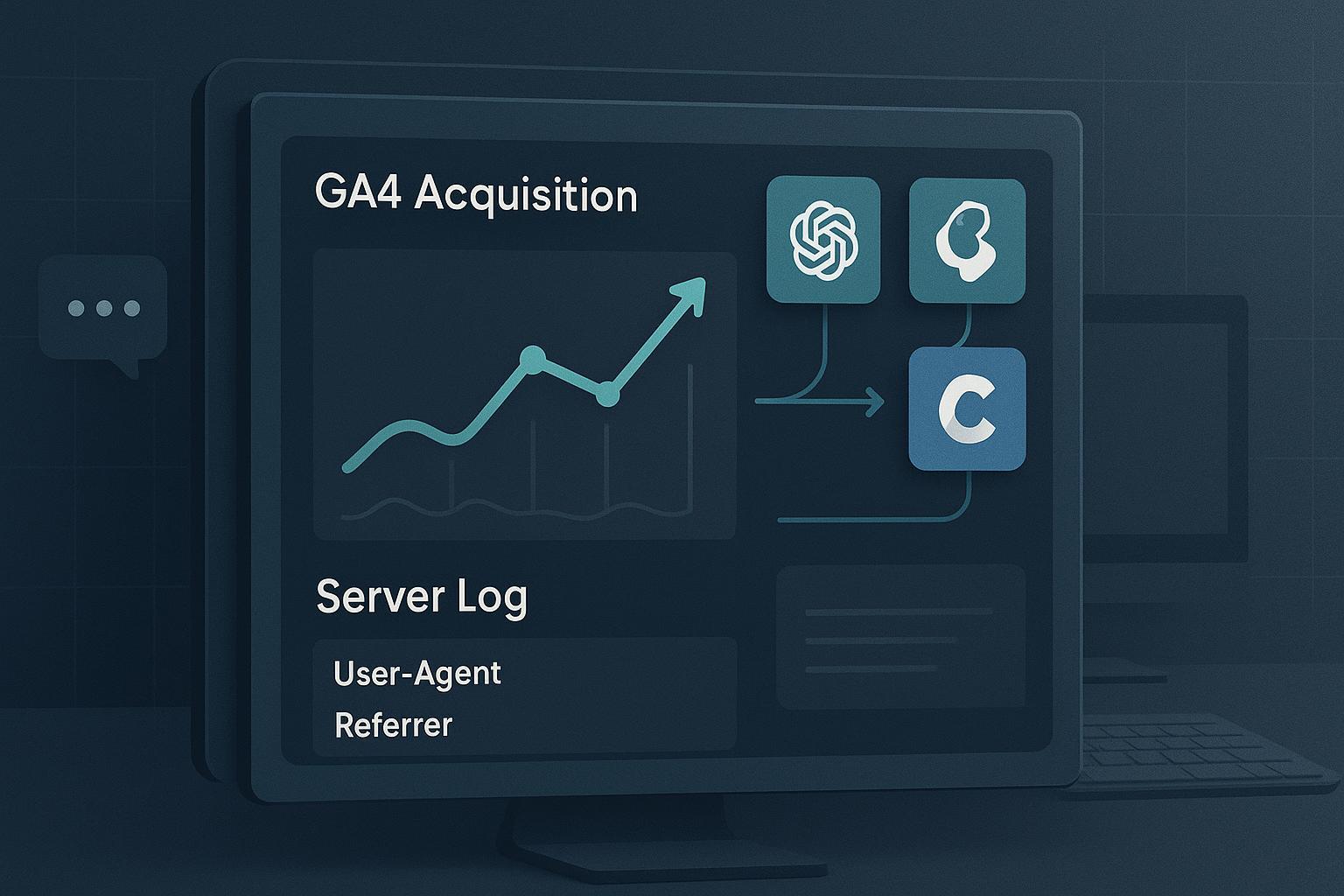
If you manage reporting for SEO or local campaigns, there’s a good chance AI answer engines are already sending visitors to your clients. The catch? Attribution can be messy. As of 2025, some assistants preserve referrers, others don’t, and Google’s AI Overviews often blend into organic. So how do you prove it without guesswork? Here are five practical signals—ordered from directly measurable to inference-based—that your clients are getting traffic from ChatGPT, Perplexity, Microsoft Copilot/Bing, Google AI Overviews, and similar assistants.
1) GA4 shows referral sessions from AI domains
Indicator: Sessions appear in GA4 with sources like chatgpt.com/chat.openai.com, perplexity.ai, copilot.microsoft.com, or bing.com/chat.
Where to check: GA4 > Reports > Acquisition > Traffic acquisition. Set the primary dimension to Session source/medium; optionally review Page referrer in Explorations.
How to validate:
- Filter by domains using regex (example:
(chatgpt|openai|perplexity|copilot|bing\.com\/chat|edgeservices\.bing\.com)). - Create a segment for AI referrals, then compare engagement and conversion rates to other channels.
- If needed, capture
document.referrervia Google Tag Manager as a custom dimension for extra context when it’s present.
Pitfalls/false positives: Not every AI click carries a referrer; some visits will land in Direct/(none) or Unassigned. GA4 doesn’t have a default “AI” channel, so you’ll maintain custom channel rules and keep regex updated as platforms evolve.
According to practitioner guides, GA4 can surface AI referrals when referrers are preserved and when you configure channel rules correctly. See the step-by-step methods in the Two Octobers GA4 tracking guide (2024–2025) and domain examples plus caveats in Addlly’s GA4 AI traffic tutorial (2025).
2) Server logs reveal AI bot vs. human patterns
Indicator: Access logs show User-Agent strings like GPTBot, ClaudeBot, PerplexityBot, OAI-SearchBot, or agent browsing identifiers (e.g., ChatGPT-User, claude-web). Human clicks typically execute JS and follow session-like patterns; crawlers do not.
Where to check: Apache/Nginx logs, CDN analytics (e.g., Cloudflare), or security tools. Review User-Agent, Referrer, IP ranges, and request rates.
How to validate:
- Filter known bot UA strings and examine hit patterns; bots often lack referrers and request raw HTML in bursts.
- Cross-check with GA4 or client-side analytics: crawler hits won’t fire client-side events; human clicks will.
- Maintain an allow/deny list and test
robots.txtor vendor-specific headers carefully to avoid over-blocking helpful crawlers.
Pitfalls/false positives: UA spoofing exists. Don’t rely on UA alone; combine with behavior (frequency, timing, JS execution) and IP reputation. Over-aggressive blocking can reduce the chance of being cited.
Adobe’s official guidance recommends server-side classification using derived fields for User-Agent and Referrer to report on LLM/AI-generated traffic; see Adobe Experience League’s derived fields use case (2025). For evolving crawler lists and blocking considerations, review Cloudflare’s AI bot controls (2024) and detection tips from Human Security’s crawler guide (2025).
3) Organic spikes align with AIO citations despite stable ranks
Indicator: Organic sessions increase during periods when Google AI Overviews cite your page, but your traditional blue-link rankings haven’t moved much.
Where to check: GA4 organic trends, weekly AIO citation monitoring, rank tracking for conventional results.
How to validate:
- Track when your pages are cited in AI Overviews. If sessions rise while legacy rankings hold steady, AIO exposure is a likely contributor.
- Use Looker Studio to overlay citation timing with organic session lines for the cited landing pages.
Pitfalls/false positives: This is correlation, not proof. AIO often doesn’t pass a distinct referrer, so many clicks blend into google/organic or Direct. Seasonality, news cycles, and SERP layout changes can confound your analysis; use baselines and compare multiple windows.
Practitioner analyses note that GA4 won’t label Google AI Mode as a separate source; traffic typically appears under Organic or Direct. See Long Weekend’s GA4/AIO tracking explainer (2025). For wider industry context on CTR changes and attribution ambiguity, examine Dataslayer’s AIO impact synthesis (2025) and the news traffic perspective in Generative AI Newsroom’s overview (2025).
4) Self-reported lead sources explicitly naming AI assistants
Indicator: Prospects select “ChatGPT,” “Perplexity,” “Google AI Overview,” or “Bing Copilot” in a “How did you hear about us?” form field—or mention them in free text.
Where to check: Website forms, intake questionnaires, and CRM lead source fields.
How to validate:
- Add enumerated AI options plus an “Other (specify)” field; store the raw text alongside a normalized two-level taxonomy (Channel = AI; Source = AI:ChatGPT, AI:Perplexity, AI:GoogleOverview, AI:BingCopilot).
- Enrich submissions with hidden fields (landing page URL, UTM, document.referrer when available, session ID, and an ai_detected_flag if you implement an AI source detector).
- Trend lead quality by assistant source and compare to Organic/Paid.
Pitfalls/false positives: Self-reporting introduces bias. Combine it with contextual signals (referrer, landing page context) to avoid over-attribution. If you ask for prompt text, obtain consent and avoid collecting sensitive information.
Measurement and taxonomy hygiene are essential here. See a cross-vendor overview in Digital-Power’s guidance on measuring AI referral traffic (2025) and common CRM taxonomy practices outlined in overviews like Monday.com’s AI lead scoring primer (2025).
5) Prompt audits + cross-engine citations correlate with landing-page traffic
Indicator: Your brand is repeatedly cited and linked across ChatGPT, Perplexity, Copilot/Bing, and Google AI Overviews, and the landing pages they cite show traffic lifts—even when referrers are missing.
Where to check: A structured prompt-audit workflow (weekly) across engines; GA4 landing-page reports; multi-engine visibility dashboards.
How to validate:
- Build an audit spreadsheet or dashboard that tracks query sets, engines, citation presence/position, link presence, and sentiment. Compare weekly to landing-page sessions and conversions.
- Treat lifts on frequently cited pages as assisted outcomes when direct referrers aren’t available; annotate the timeline so analysts and clients understand the context.
Pitfalls/false positives: Citations don’t always produce clicks; many interactions are zero-click. Engines change citation and link behavior frequently, so keep your queries current.
Users are less likely to click when an AI summary appears, so visibility and assisted outcomes matter. Pew Research reports reduced click behavior with AI summaries present; see Pew’s findings on lower click-through with AI summaries (2025). For adapting KPIs from pure clicks to visibility and assisted conversions, review Dataslayer’s guidance on AIO attribution and KPI shifts (2025).
Tools that help validate visibility: If you want to corroborate citations and trend shifts across engines, Geneo (Agency) can monitor brand mentions and links across ChatGPT, Perplexity, and Google AI Overviews, then aggregate those signals into visibility metrics such as Share of Voice and AI Mentions. Disclosure: Geneo (Agency) is our product. Use it alongside GA4 and server logs—it doesn’t replace them—to strengthen the assisted-attribution picture.
A practical way to report this today
- Clarify language with clients: visibility ≠ traffic, but consistent citations often precede demand. For a primer on visibility concepts and audits, see this AI visibility definition and audit guide.
- Document your methods: note where referrers are preserved vs. suppressed, and explain the inference used around AIO.
- Maintain hygiene: update regex, channel rules, and user-agent lists quarterly; annotate engine policy changes.
- Offer remediation: if citations are low or slipping, align content to questions assistants actually answer. Practical guidance is in best practices for optimizing content for AI citations (2025) and a multi-engine behavior overview in this comparison and case-study perspective.
One last thought: How would your reporting change if 30–50% of discovery happens inside assistants without clean referrers? Build the habit of correlating visibility signals with landing-page outcomes and keep your attribution language honest and clear.