Unified SEO & PPC Strategies for AI Search Success (2025)
Unlock best practice workflows for unifying SEO and PPC in AI-driven search. Learn proven 2025 techniques for maximizing visibility, ROI, brand coverage.
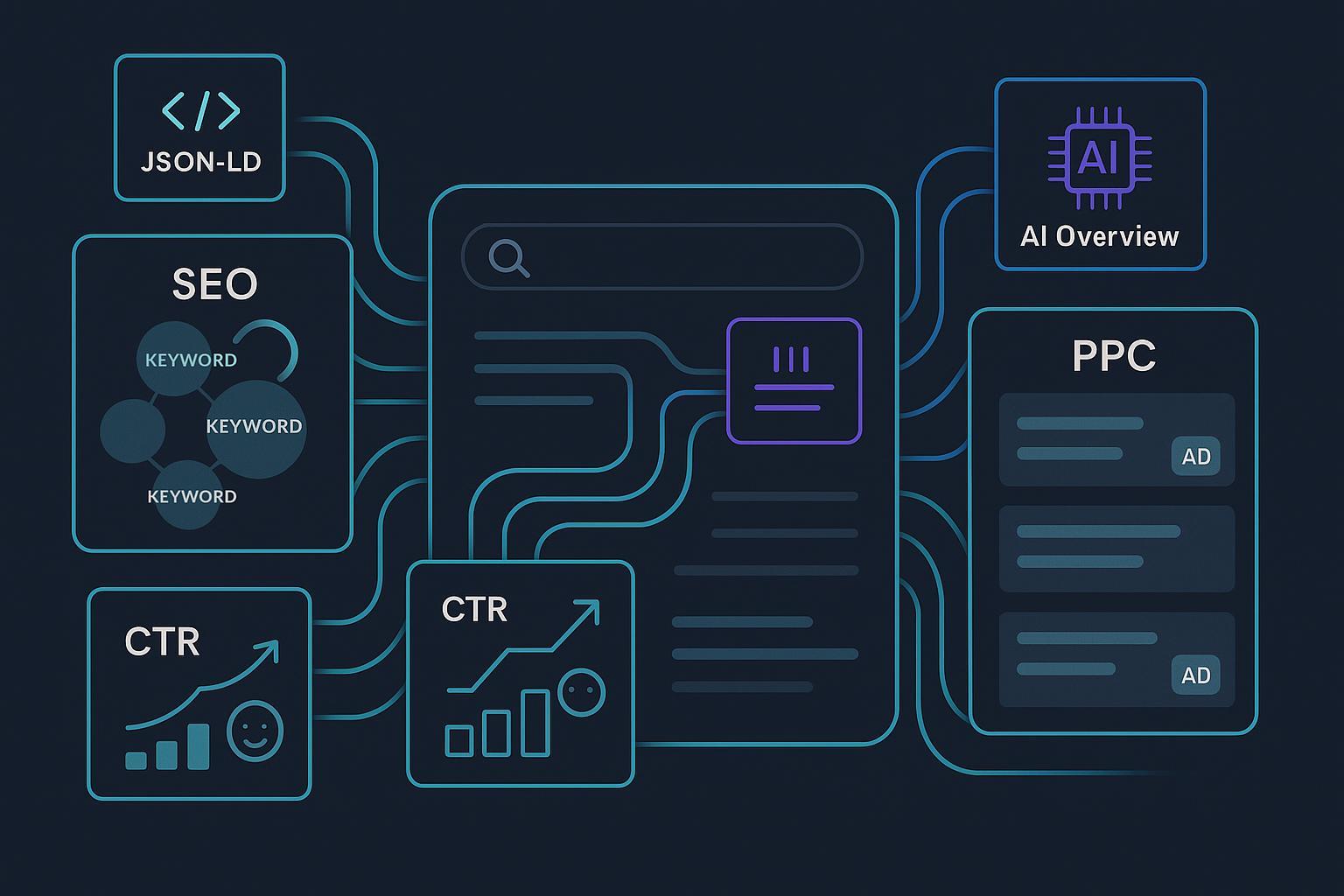
AI-driven interfaces like Google’s AI Overviews (AIO) have reshaped the economics of search. In 2025, you can no longer treat SEO and PPC as siloed channels and expect stable results. Multiple studies show that when AIO appears, organic clicks fall materially—Pew Research Center reported in 2025 that users clicked standard result links on only 8% of visits when an AIO was present versus 15% without, a roughly 46.7% relative drop, and links inside the AIO drew ~1% of clicks, as detailed in the Pew Research Center 2025 analysis of AIO click behavior. Semrush likewise observed in July 2025 that AIO appears on a growing share of queries and depresses traditional CTRs, especially for informational intents, per the Semrush 2025 AI Overviews study.
The takeaway for practitioners: a unified SEO + PPC approach is now the defensive baseline and the growth play. Below I’ll share the playbook we use with teams across B2B and B2C portfolios—what changed, what to align, pitfalls to avoid, and a 30‑day plan you can implement immediately.
What changed in 2024–2025—and why silos now fail
- AI answers sit above or interwoven with classic results. Google confirms that ads can appear above, below, or within AI Overviews depending on relevance and context; placements are evolving, which has direct implications for coverage and budgeting, as clarified by Search Engine Land’s May 2025 report on ad placements in AIO.
- Source selection for AIO is not a simple mirror of the top 10 organic listings. Industry analyses show that AIO citations draw from a broader set based on contextual relevance and entity clarity, not just rank order, as explained in Ahrefs’ 2025 overview of AIO sourcing and grounding.
- Volatility is the norm. Authoritas found significant turnover in which pages are cited in AIO over 2–3 months, underscoring the need for rapid monitoring and iterative updates, according to the Authoritas 2025 volatility research.
In short: if SEO and PPC operate independently, you’ll miss coverage during AIO surges, overpay for cannibalized traffic, and react too slowly to volatility.
Proof that unification outperforms silos
- In an agricultural retail example, shifting PPC budget from branded to non-branded while strengthening organic coverage maintained conversions and improved budget efficiency—see the Eyeful Media 2024 integrated search case study.
- Brafton’s 2025 integration roundup highlights a Rubbermaid Commercial Products AU initiative that produced a 55% conversion increase after aligning SEO content with targeted PPC and shared keyword intelligence, as summarized in Brafton’s 2025 SEO-PPC integration analysis.
Methodologies vary, but the pattern is consistent: shared keyword intelligence, message alignment, and blended measurement drive higher ROI than channel silos.
Core principles for AI-era search unification
- Intent and entity alignment over vanity rankings
- Build around user intents and entity clarity, not just keyword volume. AIO favors pages with strong entity definitions, structured data, and comprehensive topical coverage. Google’s guidance on eligibility underscores fundamentals: pages must be indexable and eligible for snippets—there’s no special “AIO tag”, but E‑E‑A‑T and structured clarity help, per Google Search Central’s 2025 AI features documentation.
- Cross-channel keyword ownership and cannibalization control
- Every priority query should have a declared organic owner URL and an associated paid strategy (bid posture, negative lists, or defense). Reconcile overlaps regularly.
- Message consistency from ad copy to title tags
- Winning ad headlines should inform SEO titles and H1s; similarly, best-performing organic hooks should flow into RSA assets.
- Blended measurement and fast feedback
- Make unified decisions using one dashboard: impression share, CTR, conversions, CPA/ROAS, assisted conversions, and AIO presence.
Practitioner playbook: The step-by-step workflow
1) Build a shared keyword map (and keep it live)
- Structure the sheet with columns: keyword, intent, cluster, CPC, volume, difficulty, target URL, PPC campaign/group, bid posture, negatives, competitive notes, AIO presence, owner, status, next action.
- Assign one primary page per keyword cluster to avoid organic cannibalization; designate PPC coverage strategy per query.
- Add an “AIO presence” flag to note whether the query reliably triggers AIO and whether you (or competitors) are cited.
- If you don’t have a template, borrow formats from established resources and adapt. Backlinko offers practical alignment ideas that translate well into mapping, detailed in Backlinko’s 2025 guide to aligning SEO and PPC.
Tip: Review the map weekly for top-priority clusters and monthly for the long tail. Lock in owners and SLAs for updates.
2) Create the RSA-to-SEO copy feedback loop
- Export top-performing RSA headlines/descriptions weekly and test them as variants in SEO titles, meta descriptions, and H2/H3 copy.
- Track the resulting SEO CTR and engagement metrics. Promote winners across both channels.
- Conversely, harvest strong organic hooks (FAQs, benefit statements) and push into RSAs. Keep a simple “copy wins” log in your sheet.
3) Align landing pages and creative across channels
- Ensure organic landing pages and PPC pages communicate the same value proposition and entity terms. If you run separate PPC pages for CRO reasons, keep content substance and schema aligned.
- Maintain an A/B roadmap: headline promise, proof elements, offer framing, and schema improvements. Validate with blended KPIs (conversions, assisted conversions) rather than silo metrics.
For deeper technical alignment tips (mobile performance, structured data), see this internal resource on mobile-first indexing and AI-era SEO practices.
4) Build a blended KPI dashboard (Looker Studio or equivalent)
- Minimum views: channel overview, keyword-level view, landing page view, and AIO monitoring view.
- Metrics: impressions (SEO + PPC), blended CTR, conversions, CPA/ROAS, assisted conversions, and revenue by cluster.
- Alerts: if AIO appears and your citation disappears for a priority cluster, trigger an action (content refresh or PPC bid shift). If organic ranks #1 with stable conversions, consider reducing PPC bids unless competitor aggression warrants defense.
5) Institute a weekly 30–45 minute joint standup
- Agenda: wins/losses; overlap review; AIO presence changes; upcoming launches; landing page tests; budget shifts; cross-team blockers; action items with owners.
- Artifacts: the shared map, the blended dashboard, and a one-page “troubleshooting matrix” (below).
6) AIO-specific optimization tactics
- Entity clarity: reinforce primary entities on the page (definitions, synonyms, relationships). Use structured data (JSON‑LD) where applicable to clarify context.
- Topical completeness: cluster content to cover the breadth of user tasks; AIO tends to cite comprehensive resources. Ahrefs’ 2025 guidance explains how AIO grounds answers beyond simple ranking, see Ahrefs on AIO grounding and citations.
- Freshness and revisions: in volatile spaces, lightweight refreshes (FAQs, updated stats, new internal links) can maintain eligibility.
- Monitor eligibility: remember Google’s 2025 docs emphasize indexability and snippet eligibility, not special markup—focus on fundamentals (indexing, helpfulness, clarity), per Google’s 2025 AI features guidance.
For practical tooling to watch when AIO appears and which sources are cited, see this overview of AI Overview tracking tools and methods.
7) Ads coverage in AI features: test-and-learn
- Coverage: Run exact match to protect must-win terms and test broad match with smart bidding to capture within-AIO opportunities where eligible. Placement specifics are evolving; industry coverage indicates ads may show above, below, or within AIO but not in multiple positions simultaneously—test and verify in your account, per Search Engine Land’s May 2025 placement clarification.
- Budget rules: For keywords where you have stable organic dominance and low competitive threat, reduce paid bids. For queries where AIO suppresses organic clicks or where competitors are frequently cited, increase paid coverage.
- Measurement: Evaluate by blended outcomes (incremental conversions, assisted conversions), not last-click alone.
Tools and monitoring (with one neutral example)
Teams often struggle to see how AI-era visibility shifts day to day. One practical approach is to track brand and competitor citations across AI Overviews alongside classic SEO/PPC metrics.
Example (neutral): Teams use Geneo to monitor brand exposure and citations across Google AI Overviews, ChatGPT, and Perplexity, then adjust bids and content when competitors start getting cited for high-intent queries. Weekly history views inform the joint standup and the blended KPI dashboard. Disclosure: Geneo is our product.
To support content iteration speed, you can also review vetted tool roundups for writing and on-page optimization, such as this curated list of AI-powered content optimization tools for marketers.
Pitfalls, trade-offs, and how to avoid them
- AIO volatility and zero-click behavior
- Risk: Traffic swings and erratic citation changes undermine consistent planning.
- Mitigation: Monitor AIO presence for priority queries; implement small, frequent content updates; maintain entity clarity and structured data. Volatility patterns are well-documented in the Authoritas 2025 volatility research.
- SEO–PPC cannibalization
- Risk: Paying for clicks you’d get organically, or splitting conversions across similar pages.
- Mitigation: Use the shared map to assign one organic owner per topic, consolidate overlapping pages, apply canonicals where appropriate, and pull back paid bids where organic is dominant unless you need brand defense.
- Attribution confusion
- Risk: Channels claim the same wins, leading to poor budget allocation.
- Mitigation: Standardize conversion definitions and windows; track assisted conversions and blended ROI in one dashboard.
- Organizational silos and geo misalignment
- Risk: Fragmented teams cause duplicated effort and inconsistent landing pages.
- Mitigation: Weekly standups, shared artifacts, and geo-level audits (including hreflang and localized offers).
Quick-start 30‑day plan
Week 1
- Build the shared keyword map for your top 50–100 queries (include AIO presence column).
- Stand up the blended dashboard with at least channel overview and keyword views.
- Establish the joint standup cadence and owners.
Week 2
- Launch the RSA-to-SEO feedback loop (export PPC copy wins, ship two SEO title/meta tests).
- Audit overlapping landing pages; consolidate or align messaging and schema.
- Spin up a small broad match + smart bidding test on 5–10 mid‑intent clusters; protect brand exact.
Week 3
- Add AIO monitoring workflow: flag lost citations; prioritize refreshes for affected pages.
- Publish one entity-deepening update per priority cluster (FAQ additions, definitions, schema improvements).
- Calibrate budget rules based on early blended outcomes.
Week 4
- Review cannibalization: scale back paid on stable #1 organics where safe; increase paid where AIO depresses organic CTR.
- Expand the copy loop with a second set of RSA and SEO tests.
- Document playbook learnings and finalize the troubleshooting matrix.
For ongoing monitoring ideas and tool evaluations specific to AIO, see this practical overview of AI Overview tracking approaches.
Evidence-based FAQ for practitioners
-
How do I get cited in AIO? There’s no special markup. Ensure indexability, content helpfulness, strong entity signals, and structured data. Google reiterates these fundamentals in its 2025 AI features guidance.
-
Do ads within AIO require specific match types? Google hasn’t published hard rules. Industry reporting suggests testing broad match with smart bidding while maintaining exact match for control. Validate placements and performance in your account, guided by Search Engine Land’s May 2025 notes on AIO ad placements.
-
Are top organic rankings enough? Not reliably—AIO can cite sources outside the top organic set and suppress conventional CTRs, as shown by Pew’s 2025 click behavior analysis and Semrush’s 2025 AIO prevalence study.
Closing perspective
Unified SEO + PPC isn’t a nice-to-have in 2025; it’s the way you defend and grow share in AI-driven SERPs. The mechanics are straightforward—shared maps, copy feedback loops, aligned landing pages, blended dashboards, and a tight weekly cadence—but the discipline to operate them consistently is where teams separate. Start with your top 100 queries, track AIO presence, and make budget/content decisions from a single source of truth.
If you need to go deeper on alignment tactics, the practical patterns in Backlinko’s 2025 playbook for SEO–PPC alignment are a solid complement to the workflows above.