
AI‑Search Buyer Journey Mapping for Travel & Hospitality Companies
Comprehensive guide to map and measure AI-driven search touchpoints for travel & hospitality across Google AIO, ChatGPT, and Perplexity. Get frameworks and templates.
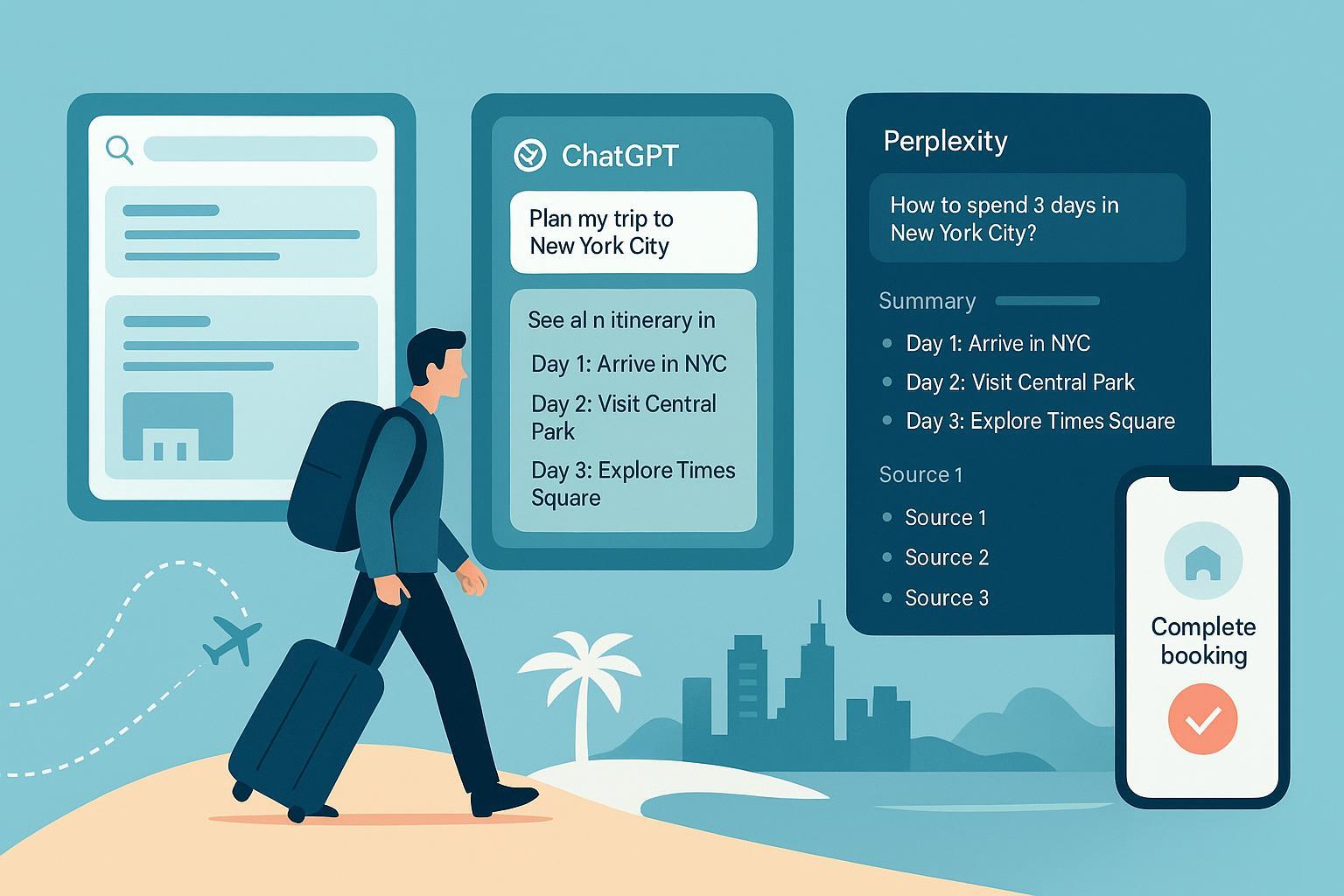
AI answer engines now sit between your potential guest and your booking engine. They summarize, compare, and increasingly take actions—reshaping how travelers discover destinations, shortlist hotels, and complete purchases. For travel marketers, that means your buyer journey map must expand beyond classic SERPs to include Google AI Overviews, ChatGPT-style assistants, and Perplexity-style answer engines, plus OTA/assistant planning tools.
According to industry syntheses through late 2025, when an AI Overview appears, both organic and paid CTRs tend to fall, although the magnitude varies by query and sector. Seer Interactive reported organic CTR declines when AI Overviews are present in two separate 2025 analyses, summarized for practitioners by the Dataslayer team. Search publications also documented KPI shifts toward generative visibility metrics. See, for example, the overview of CTR impacts and KPI changes in Search Engine Land’s 2025 reporting. We’ll link to those specific sources within this guide as we discuss each stage.
Why AI search is rewriting the travel buyer journey
Travel is especially exposed to answer-first behavior: people ask open-ended questions, want condensed recommendations, and rarely know the exact brand they’ll choose at the start. Several recent sources outline why your journey map must adapt:
- CTR erosion when AI Overviews appear. Seer’s early- and late‑2025 studies show material organic CTR drops in the presence of AI Overviews, with paid CTR also affected; Dataslayer’s recap explains practical adaptations for marketers. See the Seer analyses cited in the Dataslayer recap of Seer’s AI Overviews CTR impact (2025) and Seer’s own updates.
- Sector context for travel. Noble Studios outlined how AI Overviews surfaced in a large share of travel queries by late 2025 and why DMOs and hotels must optimize for answer visibility rather than just blue links. See Noble Studios’ travel SEO analysis (2025).
- Adoption of generative tools by travelers. Phocuswright’s 2025–2026 updates describe a steady rise in AI usage for planning, with a meaningful share of U.S. travelers experimenting with gen‑AI during research. See Phocuswright’s 2026 Travel Forward insights. Travelers value speed and personalization, though many voice privacy concerns; Kaspersky’s 2025 survey highlights the gap between satisfaction and data‑security anxiety.
- Agentic planning and early booking pilots. Trade coverage indicates Google is exploring agentic booking in AI Mode with travel partners, while OTAs expand trip planners and alerts. See TravelWeekly’s reporting on agentic AI for travel (2025) and Hotel‑Online’s roundup on Google AI in travel (2025). Timelines vary; treat this as emergent.
Here’s the deal: AI engines filter, summarize, and sometimes transact. If your brand isn’t cited or recommended inside those answers, fewer travelers will ever reach your pages.
The four‑stage travel map and where AI surfaces intervene
Think of the journey as four connected stages. Each stage now includes one or more AI surfaces that influence what travelers see and do.
1) Discovery (Inspiration)
Dominant surfaces: Google AI Overviews (destination primers, “best time to visit” answers), Perplexity Deep Research for early scoping, and ChatGPT for broad trip ideas.
What helps you get included:
- Destination guides and “best of” content with real depth and recent updates; authoritative sources and fresh reviews that engines can cite.
- Structured data coverage so entities and attributes are machine‑readable.
- PR placements and partnerships that create reputable, cite‑worthy mentions beyond your own site.
2) Consideration/Planning
Dominant surfaces: AI summaries that build or refine itineraries (Google AI Overviews, Perplexity), assistant‑driven comparisons (amenities, neighborhoods), and OTA planners with live inventory and alerts.
Optimization levers:
- Comprehensive itineraries and FAQs on-site, with rich details about amenities, accessibility, sustainability, and loyalty benefits.
- Hotel and lodging schema; pricing and availability feeds that reinforce accuracy and freshness.
- Localized content by market and language.
3) Booking
Dominant surfaces: Brand sites and OTAs, sometimes with chat assistants that hand off into booking flows; agentic booking pilots may appear in limited contexts.
Optimization levers:
- Accurate offers and policies, canonical URLs, fast pages, and clear UX.
- Clean UTM strategy for assistant referrals; ensure session continuity when assistants pass a deep link.
4) Post‑stay/Advocacy
Dominant surfaces: AI answers that reference reviews, local guides, and loyalty content; assistants for customer service, rebooking, and recommendations to friends.
Optimization levers:
- Review management and freshness; strong local content and community guides.
- Clear help content, action-oriented FAQs, and loyalty education that engines can summarize accurately.
Multi‑engine anatomy: Google AI Overviews vs ChatGPT vs Perplexity vs OTA agents
Each engine behaves differently. Your journey map should reflect those differences so teams can test and prioritize effort.
- Google AI Overviews (Gemini/Search): Pulls from the open web and Google’s knowledge graph, producing a compact answer block at the top of results. Citation patterns vary, but links and snippets typically appear within the overview. CTR to traditional listings declines when AIO is present, so inclusion inside the unit matters. See Search Engine Land’s discussions of KPI shifts and CTR changes in 2025.
- ChatGPT assistants: Often provide itinerary‑style guidance and can maintain context across turns. Source transparency varies by mode and plugin/data connectors. Hand‑off to websites usually occurs via links or suggested follow‑ups. In many planning scenarios, it’s the “brainstorming” and “refinement” layer.
- Perplexity: Prioritizes explicit source citations in answers and supports deeper iterative research via its Deep Research mode. For travel, that means your content and third‑party references need to be citation‑worthy and up to date. See Perplexity’s guide to how it works (2025) and Deep Research introduction (2025).
- OTA/assistant planners: OTAs and metasearch tools increasingly add AI planners and alerts that blend editorial content with live inventory and loyalty incentives. Google’s AI Mode and OTA assistants are experimenting with agentic booking, but deployments are still early; plan for variability by market and partner.
Bottom line: treat these engines as distinct channels with different citation incentives. Your content, data, and partnerships should match how each one decides what to show.
A travel query taxonomy you can use today
Your mapping effort starts with defining the questions travelers actually ask. Build a taxonomy you can track over time and localize by market.
Sample archetypes and prompts:
- Destination + constraints: “4‑day Aruba family trip under $2k, walkable beach, kid club.”
- Hotel amenity + neighborhood: “Best boutique hotels in Lisbon near Time Out Market, rooftop pool.”
- Comparison: “All‑inclusive vs boutique in Punta Cana for couples in May.”
- Itinerary refinement: “Swap hiking day for a cooking class in Kyoto; keep total budget under $1,500.”
- In‑trip moment: “Rainy day activities near Waikiki for toddlers today.”
- Disruption/rebooking: “What to do if my flight to JFK is canceled tonight? Hotels near terminal 4 with free shuttle.”
Non‑US localization example:
- “Puente de diciembre en Granada: mejores hoteles con parking céntrico y desayuno incluido.”
For each archetype, catalog:
- User intent (inspiration, comparison, booking, service)
- Primary surface(s) (AIO, ChatGPT, Perplexity, OTA planner)
- Desired outcomes (brand mention, link inclusion, assistant handoff)
- Evidence sources to seed (reviews, guides, partner citations)
Measurement blueprint for AI search buyer journey mapping
To manage what you can’t see, create observable metrics for AI answers. Start with a baseline across engines and track change weekly.
Core KPIs and definitions:
- AI Share of Voice: The percentage of tracked queries where your brand is present within AI answers on each engine.
- AI Mentions: Count of times your brand is named in AI answers, with or without a link.
- Total Citations and Citation Quality: Number of citations supporting answers that point to your properties or high‑authority third parties referencing you; quality factors include authority, relevance, and freshness.
- Platform Breakdown: Distribution of your visibility across Google AI Overviews, ChatGPT, and Perplexity.
- Recommendation Sentiment: Whether the answer positions your brand as a recommended option, a neutral mention, or a negative example.
- Journey‑stage proxies: Assistant referrals, brand vs OTA mentions within answers, and clicks from surfaced links (when available). Use tagged deep links and campaign parameters wherever possible.
Building baselines and dashboards:
- Start with a representative set of 100–300 queries from your taxonomy (by market and language).
- Sample each engine on a fixed cadence (e.g., daily or weekly) and record presence/absence, citations, and sentiment.
- Visualize AI Share of Voice and AI Mentions over time, with annotations for major content and PR changes.
If you need a step‑by‑step on white‑label dashboards and client-ready delivery, see this internal resource: how to set up a white‑label AI visibility dashboard (guide).
Operational playbooks
Seeding authority (content + PR)
- Identify 10–20 reputable sources that AI engines frequently cite for your markets (e.g., city tourism boards, trusted review publishers). Pitch or collaborate on content that mentions and links to your properties.
- Maintain editorial pages that answer canonical questions (best times, neighborhoods, family vs couples, accessibility) with current data and original visuals.
Structured data and feeds (what to implement and why)
- Hotel/LodgingBusiness schema: Mark up addresses, amenities, and offers so engines can parse key facts. See Google’s lodging schema reference (developers, 2025).
- Pricing and availability feeds: Keep inventory fresh and machine‑readable, which supports both rich results and potential assistant handoffs. See Google’s hotel prices feed reference (2025) and Offer schema basics.
- Carousels and lists: For collections (e.g., best hotels near a landmark), structure pages so each item has a dedicated URL and mark up lists to qualify for richer presentations. See Google’s carousels beta documentation (2025).
Minimal schema example (Hotel excerpt):
{
    "@context": "https://schema.org",
    "@type": "Hotel",
    "name": "Harborview Boutique Hotel",
    "address": {
      "@type": "PostalAddress",
      "streetAddress": "1 Seaside Ave",
      "addressLocality": "Monterey",
      "addressRegion": "CA",
      "postalCode": "93940",
      "addressCountry": "US"
    },
    "amenityFeature": [
      {"@type": "LocationFeatureSpecification", "name": "Rooftop pool", "value": true},
      {"@type": "LocationFeatureSpecification", "name": "Free breakfast", "value": true}
    ],
    "makesOffer": [{
      "@type": "Offer",
      "priceCurrency": "USD",
      "price": "229",
      "availability": "https://schema.org/InStock"
    }]
  }
Localization workflows
- Build localized taxonomies (ES, FR, DE, JP, etc.). Account for seasonal events (e.g., puente de diciembre in Spain) and regional amenities (onsen in Japan).
- QA assistants and AIO answers in‑market; maintain a change log by locale to catch drifts.
Risk governance
- Bias and privacy: Audit prompts and outputs for bias; provide clear consent and options when collecting data via assistants.
- Human QA: Establish review steps for itinerary and offer content before syndication to channels likely to be quoted.
Evidence snapshots (quick references)
- CTR declines and KPI shifts with AI Overviews present were discussed across multiple 2025 reports; a practical practitioner write‑up is the Dataslayer recap of Seer’s AIO CTR impact (2025).
- Travel-specific visibility implications are detailed in Noble Studios’ analysis of AI’s impact on travel search (2025).
- Traveler adoption of gen‑AI for planning is outlined in Phocuswright’s 2026 Travel Forward insights.
- Agentic booking pilots and assistant integrations are covered by TravelWeekly (2025) and Hotel‑Online (2025).
- Perplexity’s explicit citation model and Deep Research mode are described in Perplexity’s help and blog (2025).
Practical example: monitor and report AI visibility
Disclosure: Geneo is our product.
Here’s a neutral workflow you can replicate whether you use a platform or a manual process:
- Define a 200‑query set covering your key destinations, personas, and languages (e.g., “family weekend Paris under €800, near metro; rooftop pool”).
- On a weekly cadence, sample Google AI Overviews, ChatGPT, and Perplexity for each query. Record: presence/absence of your brand, whether you’re recommended, and the citations used.
- In a white‑label reporting setup, you can host client‑facing dashboards on your own domain, track AI Share of Voice, AI Mentions, Total Citations, and Platform Breakdown, and export reports for stakeholders. A specialized platform can help streamline this collection and presentation with client portals and daily history tracking.
- Alternatives: You can also maintain a spreadsheet and use screen captures, rely on general SEO suites that are adding generative visibility modules, or build internal scripts to sample AI outputs. The trade‑off is the time you’ll spend on QA and historical tracking.
If you need to operationalize white‑label delivery, the setup process is outlined here: Agency guide to white‑label dashboards and client portal setup.
Next steps and resources
- Put your first taxonomy into action: pick 150–300 queries across 3–5 markets and start sampling weekly. Align content and PR sprints to the gaps you observe in AI answers.
- Build a defensible reporting baseline with AI Share of Voice, AI Mentions, and Citation Quality, then review monthly with revenue management and CRM.
- If you need a white‑label dashboard to monitor AI answer surfaces across Google AI Overviews, ChatGPT, and Perplexity for travel clients, you can evaluate Geneo (Agency).
- For deeper how‑tos and comparisons on generative optimization and monitoring, see: GEO and AEO tools for agencies (roundup) and AI monitoring tools and white‑label reporting for agencies.
Question for your team: Which journey stage is losing the most visibility to AI answers today, and what single content or data change would most likely earn you a citation there next month?