
Tracking Perplexity Citations: Best Practices & Overlap Insights 2025
See 2025’s latest trends for tracking Perplexity citations vs. Google rankings. Get actionable frameworks, mini-study methods, and expert data. Start auditing now!
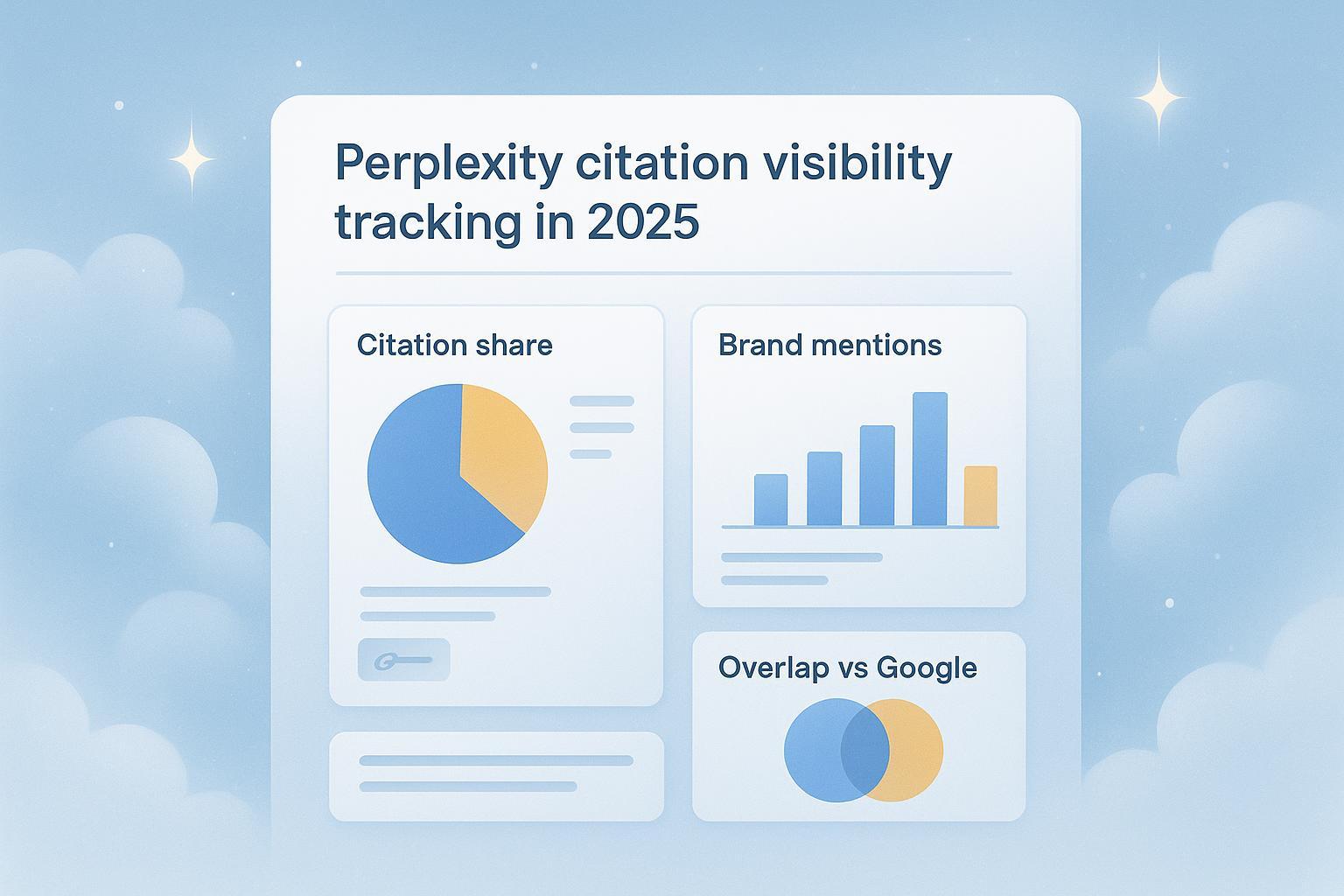
If you’re a Content/PR lead, “keyword rankings on Perplexity” isn’t really about classic positions on a SERP. It’s about whether your brand is cited, how prominently, and how often across a defined query set. In 2025, Perplexity’s modes (including Deep Research) and the new Comet Assistant changed how answers are assembled and how sources show up—so your tracking model has to shift from rank positions to citation presence, prominence, and share of voice.
Perplexity does not publish formal rules for how citations are selected or ordered. That means any claim about “ranking factors” should be treated as provisional and tied to observations you can reproduce. Several 2025 releases improved research depth and context retention, but they didn’t disclose citation logic. For fast-moving programs, the practical move is to set your own baseline and watch trends over time.
Key takeaways
Treat Perplexity tracking as a citations-and-mentions problem, not a classic rank problem. Define a query set and measure citation presence, position, and share of voice.
Overlap with Google’s top results exists but varies by method and time window; build a first-party baseline with a clear sample and dates before you set goals.
Recency, extractable structure, and credible sourcing raise your odds of being cited—especially on timely topics.
Maintain a weekly logging cadence with competitor context, and annotate content updates and PR events to explain swings.
Expect behavior shifts as models rotate and features evolve; keep a lightweight change-log and refresh your baselines regularly.
What you should actually track on Perplexity in 2025
Perplexity answers can cite multiple sources. For Content/PR programs, visibility hinges on whether your brand shows up, how it’s framed, and how often it’s selected among alternatives. Below are the core metrics that translate well to brand storytelling and executive reporting.
Metric | What it captures | Why it matters |
|---|---|---|
Citation presence | Was your domain cited for a query? (yes/no plus count) | Establishes baseline visibility across your query set |
Citation position | Where did your source appear among the cited links? (e.g., top 1–3) | Higher positions tend to get more clicks and credibility |
Share of voice (SOV) | Your share of total citations across a topic cluster or time window | Frames competitive standing for leadership |
Brand mentions in answers | Whether the brand is named in the generated text (with or without a link) | Helps PR track narrative exposure beyond links |
Referral impact | Downstream sessions/conversions attributable to Perplexity clicks (where visible) | Connects visibility to business outcomes |
Time-to-citation | Time between page update/publication and first citation | Guides refresh cadence and newsroom alignment |
A few cautions:
Perplexity hasn’t published citation ordering rules. Treat correlations (freshness, structure, authority) as hypotheses you validate for your niche.
Feature changes can alter behavior. Deep Research launched in February 2025 and performs multi-step retrieval across many sources, while the reimagined Comet Assistant rolled out in Q4 2025 with better long-running tasks and web interaction. These updates improve research depth but do not document citation ranking rules. See the official posts introducing Deep Research (Feb 2025) and The New Comet Assistant (Nov 2025).
API-level behavior shifted during 2025 as well. For instance, the developer docs note a change on April 18, 2025 regarding what usage fields return for certain models, which is a reminder to validate any automated parsing of outputs against current docs. See Perplexity Developer Docs — Changelog (2025).
Anchor insight for 2025: measuring Google–Perplexity overlap (and divergence)
Industry studies disagree on how much Perplexity’s citations overlap with Google’s top organic results, and the differences often boil down to method and scope. For example, the Semrush team described a July 2025 study setup of 5,000 keywords across intent categories to compare AI citations with Google’s top 10 results, yielding more than 150,000 citations across platforms. See the methodology notes in the Semrush AI Mode Comparison study (2025). In contrast, Ahrefs reported an average 11% overlap across AI assistants vs. Google/Bing top 10 from a 15,000-query dataset in 2025; see Ahrefs’ AI search overlap analysis (2025).
Because results vary, we recommend running a transparent, time-boxed mini-study to anchor your planning:
Sample size: 300–500 queries across 6–8 industries (SaaS, Health, Finance, eCommerce, Education, Travel, Dev Tools, Legal)
Window: 14 consecutive days to control for model rotations; repeat monthly for three months
Metrics: Domain-level and URL-level overlap with Google top 10; citation share by domain; average citation position; time-to-citation for newly updated pages; decay over time
Documentation: Publish your methods (query mix, industry tags, sample dates) alongside anonymized logs or screenshots. This keeps leadership aligned and builds trust.
We’ll update this article with our public mini-study dataset once collected and verified, including sample composition and the date windows.
A weekly tracking framework for PR/Content teams
Here’s a reproducible workflow you can run with a modest time investment each week.
Fix your query set
100–300 queries tied to brand reputation and buyer-intent topics. Tag by topic, stage, and region. Include FAQs that reflect how users actually ask questions.
Log citations and mentions
For each query, record whether your domain appears among cited sources. Note position (e.g., 1, 2, 3, other) and whether the answer text mentions your brand by name.
Track the same for a short competitor list (3–8 peer domains).
Track referral impact
In analytics, create segments or UTMs for links likely to be clicked via Perplexity. Annotate any identifiable spikes with content updates or PR events.
Maintain a content update ledger
Record each target page’s last updated date, change scope (minor/major), and any new structured elements (FAQs, tables, schema). Correlate these with changes in time-to-citation.
Cadence and reviews
Weekly: run the log, refresh SOV by topic, and flag deltas >20% for investigation.
Monthly: publish a short narrative summary with screenshots and 2–3 concrete actions (e.g., refresh X pages, add Y FAQs, pitch Z experts for quotes).
A compact logging template (adapt to your stack):
Query | Industry tag | Region | Your domain cited? (Y/N) | Citation position (1/2/3/other) | Brand mentioned in answer? (Y/N) | Competitors cited (domains) | Referral sessions (week) | Notes (content updates/PR)
Practical example: a weekly Perplexity citation audit workflow
One way to operationalize the framework is to run a weekly audit using a monitoring platform. For example, teams can use Geneo to track brand mentions, link visibility, and citation share across AI engines, including Perplexity. In a typical routine, you would:
Import or define your query set and competitor domains
Review weekly citation presence and average position for each domain
Tag notable changes (e.g., a fresh guide earning first-time citations)
Export a summary for leadership that combines SOV, top gains/losses, and planned content updates
Disclosure: Geneo is our product.
This neutral workflow mirrors the manual template above and helps standardize week-over-week comparisons without implying any specific outcome.
Optimization routines that raise your odds of being cited
While Perplexity hasn’t published ranking rules for citations, converging 2025 guidance points to a few durable habits: ship answer-first sections and extractable blocks; keep high-intent and definitional pages fresh; build authority with reputable references; add appropriate schema and crisp on-page structures; and monitor model/UI changes so you can revisit baselines after notable releases. For timeliness context, see the official April 2025 product update and the posts introducing Deep Research and The New Comet Assistant.
For deeper background on AI visibility concepts and cross-engine monitoring considerations, you can review our primers on AI visibility and the ChatGPT vs Perplexity vs Gemini vs Bing monitoring comparison. For hands-on on-page work, see Optimize Content for AI Citations.
Reporting to leadership: show SOV, sentiment, and variance drivers
Executives need a concise, auditable story. Month to month, summarize share of voice by topic cluster versus key competitors; note net change in top‑three citation positions and the content updates likely connected to those moves; add one or two sentiment cues from the answers (for example, whether the narrative lists balanced pros/cons or only risks); and call out variance drivers such as model rotations, new features, or big PR moments. Ground the narrative with a screenshot or transcript when helpful, and maintain an appendix of methods, date windows, and dependencies so finance, data, and comms leaders can audit the approach. If you’re running the overlap mini‑study, include the latest window and any directional changes.
Next steps
Stand up the weekly logging workflow and collect two weeks of baseline data before making optimizations.
Launch the 14-day overlap mini-study (300–500 queries, 6–8 industries) and document method details publicly.
Prioritize refreshes on pages mapped to queries with high intent and low citation presence.
If you want an out-of-the-box way to run the weekly audit and visualize share of voice across engines, you can trial a monitoring platform such as Geneo to standardize the process. We’ll update this page with our study results and any notable Perplexity feature changes as they ship.
Small change-log policy for this page
We maintain a light change-log here and refresh data sections monthly as 2026 begins.
When the overlap mini-study is complete, we’ll add a dated note with sample size, date windows, and links to methods/screenshots.