Why Tracking AI Search Traffic Matters More Than Ever (2025)
Discover how AI Overviews and ChatGPT reshape SEO in 2025. Cited studies reveal sharp CTR drops—see why agencies must adapt now. Start Free Analysis.
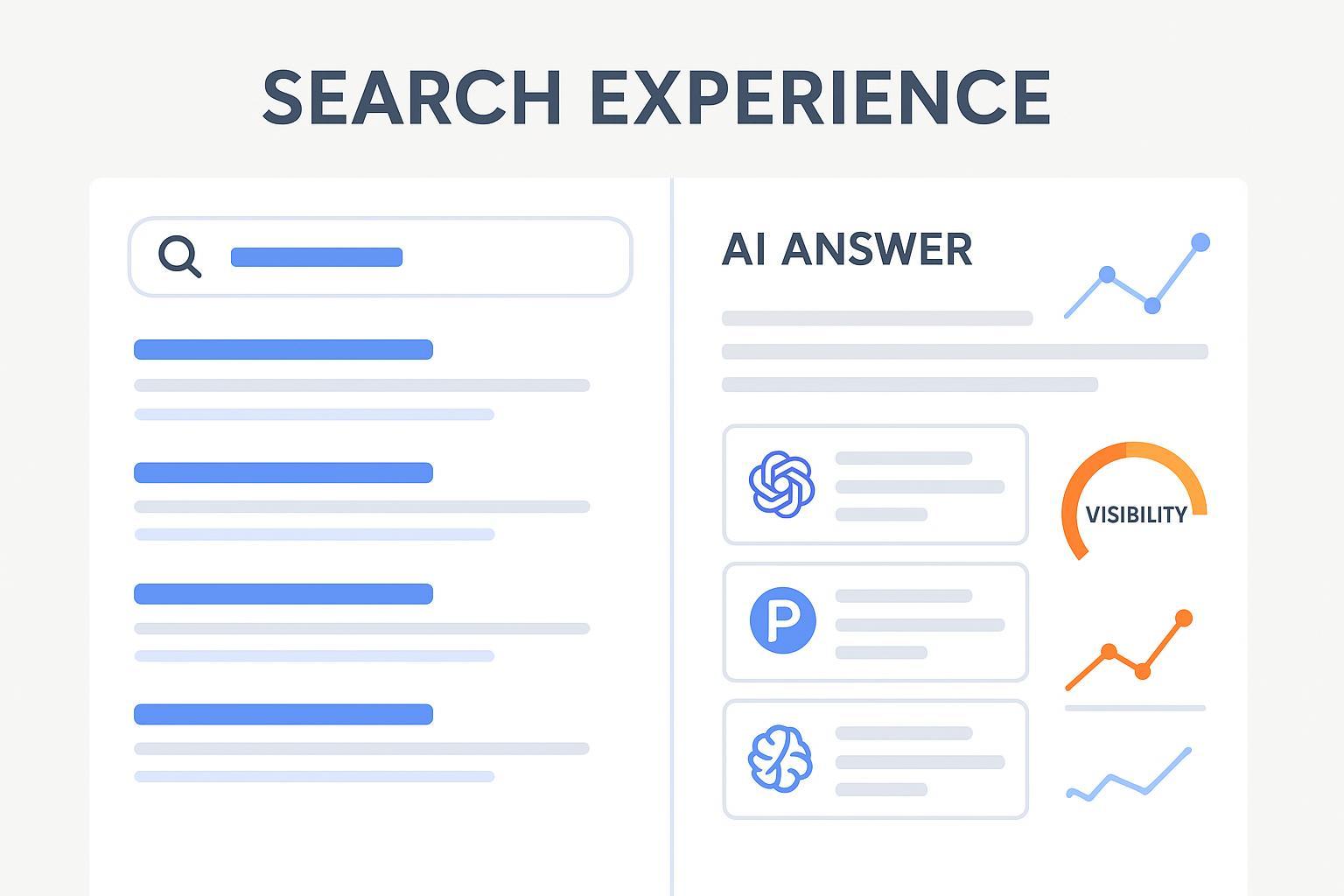
The world didn’t quietly shift from “10 blue links” to “one smart answer.” It jumped. If your agency still judges success by rank and CTR alone, you’re measuring the wrong game. Here’s the question worth asking today: How visible is your brand inside AI answers—across Google’s AI Overviews, ChatGPT, and Perplexity—and what are those answers prompting people to do next?
The evidence: discovery is compressing, clicks are redistributing
Google has made the transformation explicit. In May 2025, Google introduced AI Mode and expanded AI Overviews, noting that in major markets such as the U.S. and India, AI Overviews has driven “over 10% increase in usage” for queries that surface summaries, as described in “AI in Search: Going beyond information to intelligence” (Google Product Blog, May 2025). For publishers and brands, Google’s guidance is also clear: ensure indexable content, correct HTTP responses, and that Googlebot isn’t blocked—fundamentals that remain table stakes in an AI‑enhanced search environment per “Top ways to ensure your content performs well in Google’s AI‑enhanced Search” (Google Developers, May 2025).
What’s the practical impact on visibility and clicks? Large‑scale 2025 studies show AI Overviews expanded and then moderated throughout the year. Semrush tracked more than ten million keywords, reporting a coverage rise from ~6.49% (January) to a peak near ~24.6% (mid‑year), then a pullback to ~15.69% by November, with intent distribution shifting from ~91% informational (January) to ~57% by October as summaries appeared on more commercial queries, according to the Semrush AI Overviews study (2025) and Search Engine Land’s December recap of surge and pullback data.
Click behavior is changing too—and not uniformly. In a cohort focusing on informational queries, Seer Interactive observed that when AI Overviews appeared, organic CTR dropped 61% (from 1.76% to 0.61%) and paid CTR fell 68% (19.7% to 6.34%), summarized by Search Engine Land’s November 2025 analysis. Broader market snapshots show similar direction with different magnitudes; for example, the #1 result CTR fell from 7.3% (March 2024) to 2.6% (March 2025) on AI‑Overview keywords—a 34.5% decrease—per Digital Content Next’s May 2025 report. And behaviorally, users who saw an AI summary clicked fewer links than those who did not, according to Pew Research (July 2025).
The point is not to fixate on a single number. Methods differ, cohorts differ, and UI changes roll out quickly. The point is to accept the direction: AI answers compress discovery, redistribute clicks, and increasingly set the narrative before users ever reach your site.
From SEO to GEO: control your brand’s narrative inside AI answers
Classic SEO rewarded the best ten snippets; GEO (Generative Engine Optimization) rewards the best answer context. Think of it this way: instead of competing for a slot on a page of links, you’re competing to be named, cited, or recommended inside the answer itself. That answer influences whether users follow citations, open your resource, or rephrase their query.
Agencies that keep measuring only rank and CTR will miss what matters: presence, placement, and persuasion inside AI answers. Your brand can win even when clicks decline—if you’re consistently cited, positively framed, and supplying resources that answers recommend.
What to measure now: the AI visibility KPI framework
Below is a simple KPI shift agencies can adopt to capture reality across engines. It emphasizes being present in answers, the quality of citations, and the downstream engagement those answers generate.
KPI | What it captures | Why it matters |
|---|---|---|
Presence in AI answers (by engine & intent) | Whether your brand appears inside AI summaries on Google, ChatGPT, Perplexity; broken down by informational/commercial/transactional | Visibility now begins inside the answer. No presence, no influence. |
Citation quality & sentiment | How you’re referenced (brand name, product, expertise), whether a link is provided, tone of mention | Positive, linked citations drive qualified follow‑ups and trust. |
Follow‑up navigation & engagement | Click‑throughs from AI answers, time on page, task completion rates | Surviving clicks can be higher quality. Measure the depth, not just the count. |
Conversation‑driven query coverage | Longer, task‑oriented prompts where users “continue” the query | AI search favors iterative prompts; track visibility across conversation steps. |
Two helpful internal primers for teams building KPI definitions and audits: a methodology explainer on answer quality, accuracy, and personalization in AI systems in LLLMO metrics: measuring accuracy, relevance, and personalization in AI, and a 2025 view of how user behavior is changing in AI search user behavior (2025).
Multi‑engine realities: ChatGPT vs. Perplexity vs. Google AI Overviews
Not all engines behave the same way. ChatGPT often structures answers conversationally and may cite fewer, broader sources; Perplexity tends to surface a denser set of citations with short summaries; Google AI Overviews integrate citations alongside its familiar SERP, moderating coverage by intent over time. Industry analyses documenting these patterns can help shape monitoring tactics—see SE Ranking’s cross‑platform research and Yext’s citation behavior studies for directional guidance.
For operations, that means your measurement needs to consolidate cross‑engine visibility while respecting differences in citation logic. A practical comparison for monitoring requirements and behaviors is outlined in this multi‑engine monitoring guide.
A neutral, reproducible workflow agencies can use (with disclosure)
Disclosure: Geneo is our product.
Here’s a straightforward baseline workflow agencies can replicate to track AI visibility across engines without pausing their day job:
Assemble a representative query set per client (branded, category, and task‑oriented prompts). Keep it stable month to month.
For each engine (Google AI Overviews, ChatGPT, Perplexity), record whether the brand is named, cited, and linked. Capture sentiment cues.
Log follow‑up navigation: if the answer cites your resource, measure the click‑through and downstream engagement.
Roll up monthly dashboards, then quarterly executive summaries with change‑notes.
Tools can simplify this. Geneo supports multi‑engine monitoring, an AI visibility score, and white‑label, client‑ready reporting for agencies. It can be used to consolidate presence metrics and produce branded outputs on a custom domain at geneo.app so your team can present results consistently.
The agency‑first advantage: white‑label reporting builds trust
When clients ask, “How does our brand show up in AI answers?” they aren’t just seeking numbers. They want confidence that the story is handled. Agencies that deliver branded, white‑label reports—hosted on a custom domain and formatted in familiar KPI language—project control and clarity. That matters when traditional SEO graphs wobble.
An agency‑first workflow prioritizes:
Branded outputs your clients can share internally without extra explanation.
A repeatable cadence that shows presence, citation quality, and follow‑up engagement trends.
Accountability: clearly labeled query sets, engines, and time windows so changes can be audited.
Objections and nuances worth addressing
“The numbers don’t match across studies.” Correct—and expected. Cohorts, query intents, and update windows differ. Use ranges and keep your own baseline to anchor decisions.
“Clicks are down—are we losing?” Not necessarily. Remaining clicks often come from high‑intent recommendations within answers. Measure depth: time on page, resource downloads, task completion.
“Will engines change again?” Yes. That’s why consolidated tracking and quarterly rollups matter; you adjust as UI, coverage, and citation behavior evolve.
What to do next—and the single CTA
Establish an AI visibility baseline per client: queries, presence, citations, follow‑ups.
Reframe KPIs around answer presence and engagement quality, not just rank and CTR.
Report with white‑label outputs on a custom domain so clients see consistent progress.
Ready to see where you stand? Start Free Analysis.
References mentioned in this article:
Google’s 2025 framing of AI Mode and usage uplift: AI in Search: Going beyond information to intelligence
Google’s publisher guidance for AI‑enhanced Search: Top ways to ensure your content performs well in AI Search
AI Overviews coverage and intent shifts: Semrush AI Overviews study (2025) and Search Engine Land recap
CTR and behavior impacts: Search Engine Land analysis of CTR drops (Nov 2025), Digital Content Next’s CTR at #1 position, and Pew Research on link‑click behavior.