
How to Build a Step-by-Step GEO Strategy for Startups
Master step-by-step GEO for startups—learn AI search visibility, get cited in AI answers, track your share of voice and sentiment, and outpace your competition.
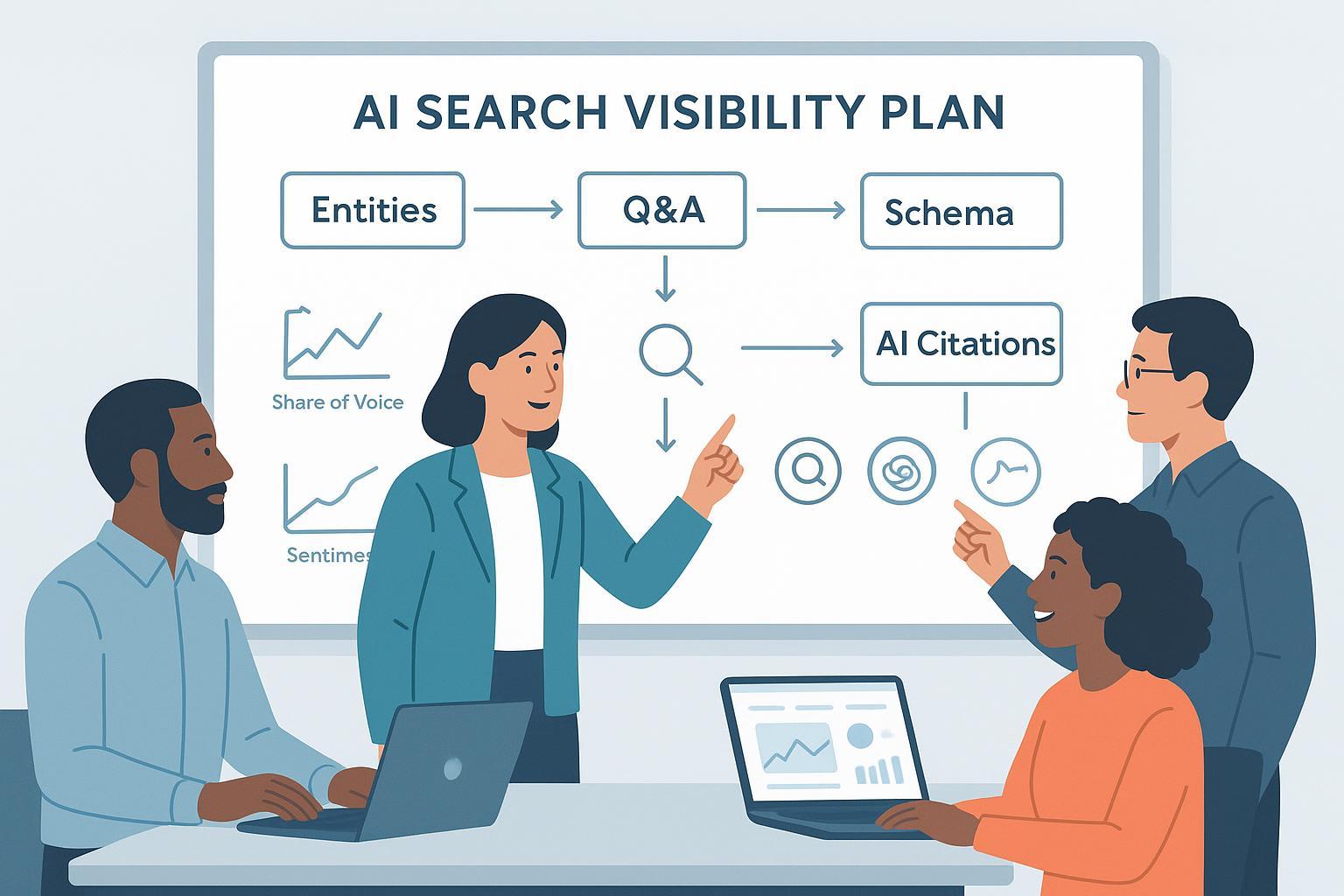
If you’re building a startup, you don’t have time for guesswork. You need your best answers to show up where customers actually read them—inside AI-generated results. That’s the point of GEO (Generative Engine Optimization): making your content and entities easy for AI systems to find, trust, and cite.
What GEO is (and isn’t)
GEO optimizes your content and brand entities so AI systems cite you in generated answers. It’s not a replacement for SEO; it’s a complementary focus that shifts success from clicks to citations, share of voice, and sentiment within AI answers. Think of SEO as owning the blue links and GEO as earning a seat at the AI answer table.
Two reputable 2025 explainers worth reading reinforce this distinction:
- According to the Strapi team’s 2025 guide, GEO prioritizes citations and coverage inside AI answers, while traditional SEO centers on rankings and traffic; both matter, but their primary outcomes differ. See their framing in the Strapi GEO vs. SEO guide (2025).
- Terakeet argues brands need both strategies working together—GEO to be referenced in synthesized answers and SEO to capture demand through organic listings. See Terakeet’s analysis (2025).
How AI answers attribute sources in 2025
Different systems show citations differently—and sometimes not at all.
- Google’s AI experiences link back to the web and recommend people-first content, accurate structured data that matches visible content, and strong accessibility. See Google Search Central’s “Succeeding in AI Search” (May 2025).
- ChatGPT may show sources when browsing or connectors are enabled; otherwise, it can answer from training data without explicit links. OpenAI documents these behaviors in the ChatGPT Release Notes (updated 2025).
- Perplexity and Microsoft Copilot frequently display footnote-style citations; Claude typically cites when live web access is enabled. Treat specifics as observed behavior unless vendor docs say otherwise.
Bottom line: aim for eligible, high-trust, quotable content across engines, and monitor where you’re actually cited.
The startup GEO workflow (7 steps)
Each step ends with a quick checkpoint so you can move fast and avoid rework.
Step 1 — Define entities and scope
Clarify the canonical entities behind your brand: Organization, Products, People (authors/experts), and core Topics. Publish an About page that spells out relationships. Keep names, aliases, bios, and descriptions consistent across your site, schema, and major profiles (LinkedIn, GitHub, Crunchbase, etc.). Create a public glossary for your domain terms and link to it internally.
Checkpoint: Your entity names and bios appear consistently in on-page text and JSON-LD, and match key external profiles.
Step 2 — Mine questions and gather evidence
Interview customers and sales. Collect forum and community questions. Map each to problem/solution stages. For each key answer, gather auditable proof: anonymized case metrics, customer quotes (with permission), benchmarks, and links to authoritative third parties. The goal is to give AI systems confidence by surrounding claims with evidence.
Checkpoint: Every major claim is backed by first-party proof or a reputable third-party source.
Step 3 — Produce answer‑ready content
Structure pages so models can lift useful snippets without contortions. Use clear H2/H3 headings, short Q&A blocks, definitions, and concise summaries. For each subtopic, include a 40–80 word canonical answer near the top and keep wording stable over time. Add original assets (tables, checklists) that are easy to quote. Keep URLs, slugs, and terminology stable to reinforce entity relationships.
Checkpoint: Each priority subtopic has a standalone 1–2 sentence answer with sources nearby.
Step 4 — Add structured data and authorship
Implement Organization, Product, and Person schema across key pages. Add FAQPage schema where Q&A is visible and helpful. Ensure authorship and reviewer metadata reflect real people with bios. Validate with Google’s tools and ensure markup mirrors on-page content; accuracy beats volume.
Checkpoint: Pages validate in Rich Results Test; JSON-LD aligns with what users see.
Step 5 — Technical hygiene for accessibility
Keep the plumbing clean: indexable pages, correct canonicals (no chains), accurate sitemaps with truthful lastmod, fast performance, mobile-friendly layouts, and no blocked CSS/JS required for rendering. Google’s guidance emphasizes accessibility and helpfulness for AI experiences—see Google’s “Succeeding in AI Search” (2025).
Checkpoint: Your key answer pages return 200, are included in the XML sitemap, and pass indexing and page experience checks.
Step 6 — Publish, distribute, and ensure eligibility
Ungate your best answers. Link them from your navigation or topical hubs. Submit sitemaps; keep lastmod honest. Avoid thin or duplicative content; consolidate and update instead. Share the content where customers hang out (newsletters, community posts) so it’s discoverable beyond search.
Checkpoint: Each target page is public, internally linked, and re-crawlable with an accurate lastmod.
Step 7 — Monitor AI citations and iterate
Track where and how you’re cited across engines. Identify which passages get quoted and which topics are absent. Improve weak spots by adding corroboration, clarifying entities, expanding Q&A coverage, and refreshing schema. Over time, aim for broader topic coverage and a rising share of voice within AI answers.
Checkpoint: Monthly review shows movement in AI citations, share of voice, sentiment, and topic/entity coverage.
KPI definitions and cadence
Use a tight set of KPIs you can check weekly and trend monthly. For deeper frameworks and instrumentation examples, see AI search KPIs (visibility, sentiment, conversion).
| KPI | What it measures | Practical notes |
|---|---|---|
| AI Citation Count | How often your brand/URLs are cited across AI answers for your priority topics/time window | Track per engine and per query set; log which passages were quoted |
| AI Share of Voice (SOV) | Your citations divided by total citations (you + competitors) × 100% | Compare SOV across engines; prioritize gaps where intent is highest |
| Sentiment of Mentions | Tone of AI answer text mentioning your brand (positive/neutral/negative) | Watch for negative patterns and address root causes in content and product |
| Topic/Entity Coverage | % of your priority topics/entities that receive citations | Expands as you publish more answer-ready content |
| Referral/Assisted Conversions | Traffic and conversions influenced by AI citations | Use UTMs where links exist; correlate spikes with citation events |
Cadence:
- Weekly: scan citations/SOV and sentiment for anomalies; fix page-level issues.
- Monthly: review trends; expand topic coverage; fold findings into the next content sprint.
For conceptual grounding on how GEO complements SEO and why structure matters for generative engines, see a16z’s “GEO over SEO” (2025) in addition to the Strapi and Terakeet material above.
Practical example: monitoring your AI SOV with Geneo
Disclosure: Geneo is our product.
Here’s a lightweight workflow a two-person team can run:
- Define your query sets: pick 10–20 buyer-intent questions per engine (Google AI experiences, ChatGPT with browsing, Perplexity, Copilot). Include brand and competitor terms.
- Centralize monitoring: use Geneo to track citations, share of voice, and sentiment across engines. Segment by topic and note which page/claim each citation references.
- Interpret patterns: if Perplexity prefers your benchmark table but Google cites your glossary definition, lean into both by tightening the canonical answers and adding corroboration.
- Iterate content: where citations lag, add a Q&A block, strengthen evidence, or clarify entity relationships. Re-validate schema and update lastmod truthfully.
- Report monthly: share SOV and sentiment trends, highlight the 3–5 pages that moved, and propose next-step content aimed at uncovered questions.
Why this matters: Google confirms that helpful, accessible content with accurate structured data is more likely to be surfaced and linked in AI experiences, per Google’s 2025 guidance. And when browsing is enabled, tools like ChatGPT can display sources, as documented in the OpenAI release notes (2025). Your job is to be the most quotable, verifiable answer.
Common mistakes and quick fixes
- Inconsistent entities and schema mismatches: fix JSON-LD so it mirrors visible content; standardize names across site and profiles; re-run validators.
- Thin or duplicative pages: consolidate and add first-party evidence; include a short canonical answer at the top.
- Broken crawl paths: unblock required CSS/JS, use absolute canonicals (no chains), keep sitemaps accurate with real lastmod.
- Overusing FAQ schema: apply only where Q&A is visible and helpful; schema aids understanding even without guaranteed rich results.
- Ignoring measurement: without citation and SOV tracking, you won’t know which claims resonate; instrument before you scale content.
Your 30‑day GEO plan
- Days 1–7: finalize entities and glossary; collect top customer questions; draft 3 canonical answers with evidence.
- Days 8–14: implement Organization/Product/Person schema; publish the pages; validate; ensure sitemaps and canonicals are correct.
- Days 15–21: add Q&A blocks and a benchmark table; share in your newsletter/community; confirm pages are indexable and fast.
- Days 22–30: monitor citations and SOV; patch weak spots; queue the next 3 answers based on gaps.
For ongoing context, trends, and definitions you can reference in your writing, bookmark GEO and AI search insights. If you’re watching the SERP evolve and want a rationale for tracking AI answers alongside rankings, our note on Google’s updates explains why monitoring AI visibility belongs in your operating cadence: recommendation to monitor AI answer visibility.
Final thought and next steps
If GEO sounds new, it isn’t a wholesale reinvention—it’s your existing SEO discipline tuned to how answers are assembled now. Start with entities, publish concise, verifiable answers, keep the plumbing clean, and iterate based on what gets cited. Ready to centralize monitoring without spinning up internal scrapers? Start a free trial of Geneo to track citations, SOV, and sentiment in one place—then use what you learn to ship the next, more quotable answer.
Questions as you implement this? Which topic do you most want AI engines to cite you on next week—and what proof will you publish today to earn that mention?