
Schema App vs WordLift vs Rank Math: Schema Tools 2026
Compare Schema App, WordLift, Rank Math and more (2026): automation depth, maintenance cost, validation, and impact on ChatGPT/Perplexity brand mentions to guide technical SEOs.
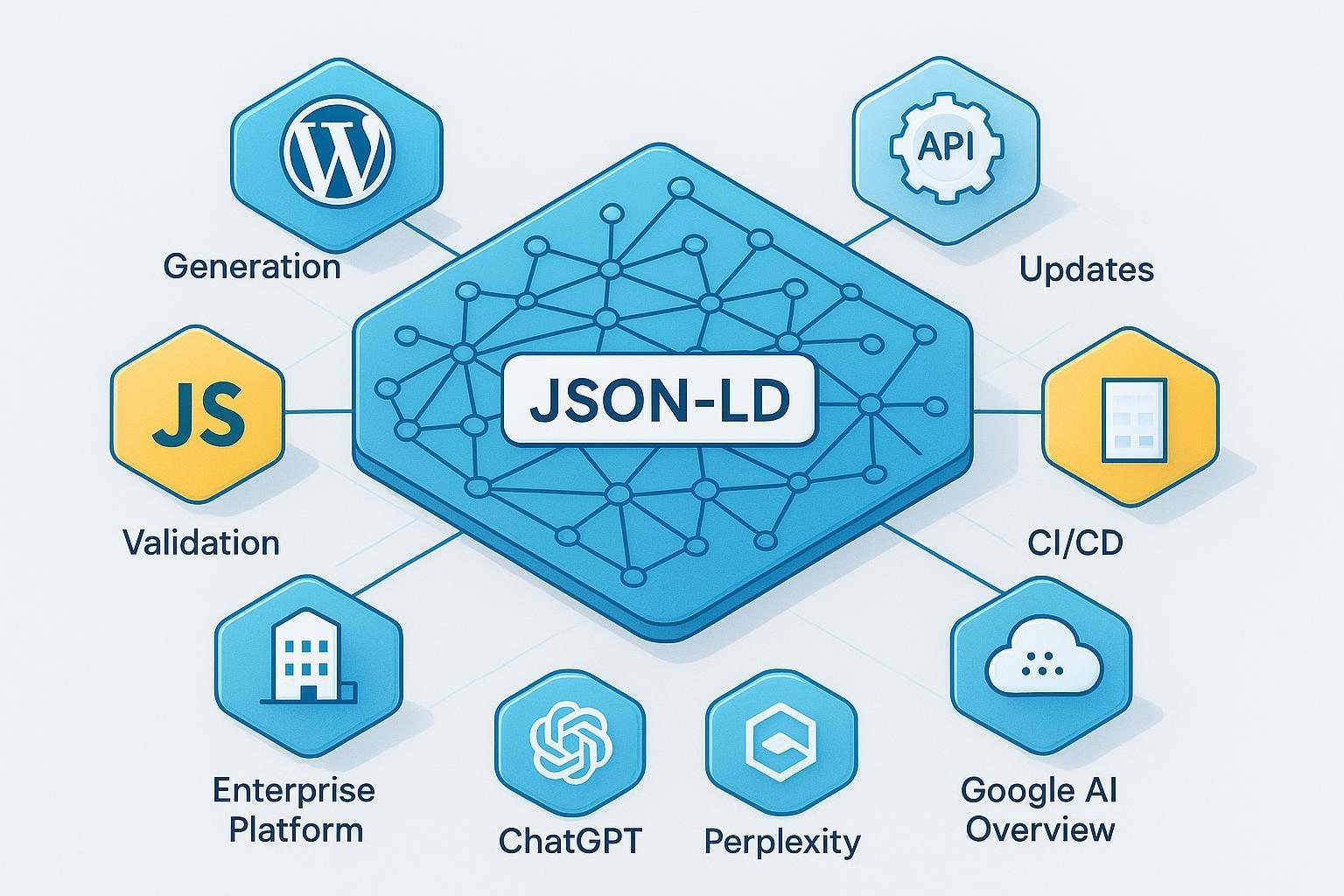
Automated Schema Markup Tools Compared (2026): Enterprise & WordPress Options for AI Search Visibility
Technical SEO has become a systems problem. If you manage tens of thousands of URLs, the real question isn’t “which plugin adds schema?”—it’s how deeply automation reaches (generation, updates, propagation) and how much maintenance you’ll carry (validation, governance, CI/CD). This comparison focuses on automated schema markup tools through that lens and ties recommendations to a practical evidence metric: downstream AI visibility, namely brand mentions and link visibility in ChatGPT and Perplexity. That relationship is correlational, not causal—but consistent, high-quality structured data improves interpretability and “citability,” which you can monitor over time.
How to choose automated schema markup tools for your stack
Automation depth describes how a tool produces schema at scale and keeps it current when models or templates change. Strong systems support:
Rule/model-driven generation that binds fields to content types and entities
Update propagation across templates and large catalogs
Conditional logic and inheritance (e.g., product variants, author profiles)
Maintenance cost encompasses the governance required to keep markup valid and aligned:
Validation at scale (Google Rich Results Test, Schema Markup Validator)
CI/CD fit: pre-release checks, fail-fast rules, rollback plans
Deployment and rendering realities (server-side JSON-LD vs JS injection)
A quick caution on JavaScript-injected schema: discoverability can be timing-dependent. If JSON-LD is injected late or conflicts with existing markup, crawlers may miss or discount it; mitigate by injecting early, avoiding duplicates, and validating regularly using Google’s Rich Results Test and the Schema Markup Validator.
Comparison table: automated schema markup tools (2026)
Tool | Core use case | Automation & updates | Validation & CI | Knowledge graph / entity | Deployment model | Scalability notes | Pricing posture | Evidence |
|---|---|---|---|---|---|---|---|---|
Schema App | Enterprise end-to-end schema + content knowledge graph | Model/template-driven; Editor & Highlighter; cross-site reuse | Audits; ongoing optimization; use Google Rich Results + Schema Markup Validator | Content Knowledge Graph; MCP server explorations | CMS plugins, tag manager, templates | Multi-domain, complex entities | Quote-based enterprise | Enterprise WordPress integration |
WordLift | AI schema + RDF knowledge graph; product graph | Automated entity extraction; AI Agent; KG automation | Validate with Google & SMV; data quality workflows | RDF KG; GS1 Digital Link | WP plugin; APIs; Azure/AppSource | Multilingual; enterprise integrations | Contact/demo | Developer docs |
InLinks | Entity-first internal linking + JS schema | JS snippet injects JSON-LD; FAQ detection | Validate; watch injection timing | Site-level entity mapping | JS injection; WP plugin | Scales via credits/pages | From $49/mo (100 pages) | Pricing model |
Rank Math | WordPress schema templates & custom builder | Global defaults; reusable templates; multiple schemas | Code validator; RRT integration | Plugin-level entity hints | WordPress plugin | Large WP sites; multisite via WP | Free + affordable tiers | Feature/pricing overview |
Yoast SEO | Site-wide schema graph automation | Interconnected graph; per-post type settings | Rich Results; Search Console reports | Graph pieces via Schema API | WordPress plugin | Widely used; add-ons for niches | Premium + add-ons | Product page |
SEOPress | Visual builder + global rules (WP) | Automatic rules; manual builder; JSON-LD | Guides; use Google & SMV | Plugin focus (no native KG) | WordPress plugin | WooCommerce & CPT mapping | Free; PRO $49–$149/yr | Schema builder overview |
Merkle Generator | Manual JSON-LD snippets | Form-based; no automation | Basic checks; validate externally | None | Copy/paste into site | N/A | Free | Tool page |
BrightEdge | Enterprise SEO suite; AIO tracking & schema guidance | Recommendations; CMS push via teams | Platform audits + Google tools | Platform data models | Enterprise suite | Large enterprises | Quote-based | API portal |
Notes: Plugins can model entities via schema but aren’t full knowledge-graph platforms. Treat BrightEdge as a research/strategy partner rather than a generator.
Product capsules (alphabetical)
BrightEdge
Core use case: Enterprise SEO suite with AI Overview tracking and structured data guidance; a research and orchestration layer, not a dedicated generator.
Automation & updates: Provides recommendations and workflows; schema typically deployed via CMS connectors or team processes.
Validation & CI: Platform audits plus standard Google tools; integrate checks into your pipeline.
Deployment model: Enterprise platform with connectors and reporting.
Constraints: Quote-based contracts; confirm module coverage with sales; not a schema generator.
Pricing posture: Enterprise, custom.
Evidence: See the AI Catalyst objects in the BrightEdge API portal.
InLinks
Core use case: Entity mapping, internal linking automation, and runtime JSON-LD injection.
Automation & updates: Central JS snippet and WordPress plugin handle injection; detects FAQ patterns from headings.
Validation & CI: Validate frequently; ensure injection occurs early in load; monitor for duplicates and conflicts.
Deployment model: JS snippet (site-wide) and WP plugin integration.
Constraints: JS-injected schema can be timing-sensitive; ensure SSR or progressive enhancement where possible.
Pricing posture: Credit-based SaaS starting around $49/month for 100 pages; enterprise options.
Evidence: Pricing and deployment are described in the InLinks pricing model.
Merkle Schema Markup Generator
Core use case: Free manual creation of JSON-LD snippets for common types.
Automation & updates: None—form-based generation; copy/paste into templates or tag manager.
Validation & CI: Use Google Rich Results Test and Schema Markup Validator across environments.
Deployment model: Manual embedding in CMS templates or GTM.
Constraints: Not suitable for large-scale automation or complex graphs; good for prototypes.
Pricing posture: Free.
Evidence: Official tool page at technicalseo.com.
Rank Math
Core use case: WordPress schema automation with templates, custom builder, and multiple schemas per page.
Automation & updates: Global defaults and reusable templates; per-post overrides available but don’t auto-update from template changes.
Validation & CI: Built-in code validator; use Google’s Rich Results Test for eligibility.
Deployment model: WordPress plugin, suitable for multisite.
Constraints: Manage plugin conflicts; no native CI/CD promotion—use WP deployment processes.
Pricing posture: Free plus paid tiers (e.g., PRO, Business, Agency) with affordable rates.
Evidence: Feature and tier details in the Rank Math overview.
Schema App
Core use case: Enterprise end-to-end schema and content knowledge graph with model-driven automation.
Automation & updates: Editor/Highlighter for scale; template/model-driven propagation; cross-site reuse.
Validation & CI: Emphasizes audits and ongoing optimization; pair with Google Rich Results Test and Schema Markup Validator.
Deployment model: CMS plugins, tag manager, or template embedding; platform orchestrates authoring and updates.
Constraints: Role-based workflow and CI/CD details aren’t fully public; tag manager deployments require rendering diligence.
Pricing posture: Quote-based enterprise.
Evidence: Integration and enterprise context on the Schema App WordPress page.
SEOPress
Core use case: WordPress schema with a visual builder, global targeting rules, and JSON-LD output.
Automation & updates: Global rules bind schema to post types and custom fields; JSON-LD preview aids QA.
Validation & CI: Follow guides to fix missing fields; validate with Google and Schema Markup Validator.
Deployment model: WordPress plugin; integrates with ACF/JetEngine.
Constraints: Some advanced types require PRO; avoid redundancy by disabling default WooCommerce schema where needed.
Pricing posture: Free; PRO pricing documented between $49–$149/year depending on plan and site count.
Evidence: See the schema builder overview on SEOPress.
WordLift
Core use case: AI-powered entity extraction with RDF knowledge graph; strong focus on product catalogs and semantic SEO.
Automation & updates: Automates JSON-LD via NLP and builds a reusable graph; AI SEO Agent supports workflows and auditing.
Validation & CI: Validate with Google and Schema Markup Validator; emphasize data quality and fact-checking.
Deployment model: WordPress plugin, APIs, and Azure/AppSource integrations.
Constraints: Public tier pricing is limited; confirm plans and enterprise modules directly.
Pricing posture: Contact/demo; tailored plans.
Evidence: Capabilities documented in the WordLift developer docs.
Yoast SEO
Core use case: Site-wide schema graph automation for WordPress (WebSite, WebPage, Article, Organization/Person, Breadcrumbs), plus FAQ/HowTo blocks.
Automation & updates: Interconnected graph output configurable per post type; extensible via Schema API and add-ons.
Validation & CI: Validate eligibility with Google’s Rich Results Test; monitor Search Console rich result reports.
Deployment model: WordPress plugin; extensible via filters/hooks.
Constraints: Fewer manual schema UI controls vs some competitors; deeper customization requires developer work.
Pricing posture: Premium license plus add-ons; bundles exist for WooCommerce and Local.
Evidence: Details on the Yoast SEO product page.
How we measure the downstream impact (methodology and limitations)
To connect schema automation choices to AI search visibility, track correlational proxies over time:
Choose 2–3 templates (Article, FAQ, Product) and deploy schema via your chosen tool.
Validate across environments: use Google’s Rich Results Test and the Schema Markup Validator; add a programmatic validator to CI to fail builds on missing required properties.
Monitor weekly for 8–12 weeks:
Brand mentions and link visibility in ChatGPT and Perplexity for a defined prompt set.
Google AI Overview presence rate for queries tied to your templates.
Record maintenance hours (setup, monthly updates, fixes); note propagation time after template/model changes.
This approach won’t prove causation; it gives directional evidence that better automation and lower maintenance correlate with higher “citability” in AI answers.
KPI playbook and monitoring cadence
Schema validation pass rate: target ≥95% across sampled URLs; track regressions per release.
Update propagation time: measure how long template/model changes appear across representative URLs.
AI visibility metrics: weekly brand mention rate and link visibility in ChatGPT/Perplexity; Google AI Overview presence rate for target queries.
Maintenance hours: initial rollout vs monthly upkeep by role (SEO, dev, QA).
Incident count: duplicate/contradictory schema, JS injection timing failures, over-markup warnings.
For foundational context on Generative Engine Optimization and cross-engine nuances, see the GEO comparison article on ChatGPT vs Perplexity vs Google AI Overview in the Geneo blog.
TCO guidance: modeling the real cost
When estimating total cost of ownership, include:
Licenses: plugin tiers vs enterprise contracts
Implementation: template modeling, field mapping, migration
Validation & CI: initial setup and ongoing test maintenance
Monitoring: weekly checks of AI visibility and structured data health
Rollback & remediation: playbooks for regressions and conflicts
Team time: SEO, developer, QA, and content operations
Expect lower license fees with WordPress plugins but higher governance overhead for very large catalogs. Enterprise platforms often trade higher licenses for stronger model-driven automation and support, reducing hands-on maintenance.
Recommendations by scenario
Enterprise, multi-CMS, complex entities: Schema App or WordLift for model-driven automation and graph-based governance; BrightEdge as a research partner for AI Overview tracking and orchestration.
WordPress-only at scale (multisite, large catalogs): Rank Math, SEOPress, or Yoast SEO for affordable automation; favor template-centric workflows and developer extensibility.
Mid-market agencies needing quick wins and entity linking: InLinks for internal linking plus automated schema via JS; validate rigorously and mitigate timing risks.
Prototype or manual control: Merkle Schema Markup Generator for snippets, then graduate to automation once patterns stabilize.
Also consider: AI visibility monitoring
Disclosure: Geneo is our product. If you need to measure brand mentions and link visibility across ChatGPT, Perplexity, and Google AI Overview while you iterate on schema, the Geneo platform provides cross-engine monitoring and KPI frameworks. Learn more at the Geneo homepage.
Selecting automated schema markup tools in 2026 is less about ticking a feature box and more about designing a resilient pipeline: model-driven generation, fast update propagation, rigorous validation, and continuous monitoring of AI search visibility. Test, measure, and iterate—then scale the approach that minimizes maintenance while steadily improving your brand’s presence in AI answers.