
Top Real Estate AI Questions: How Agencies Can Optimize for AI Answers
Discover the most common real estate questions customers ask AI assistants—and clear agency tactics to earn visibility and citations in AI answers.
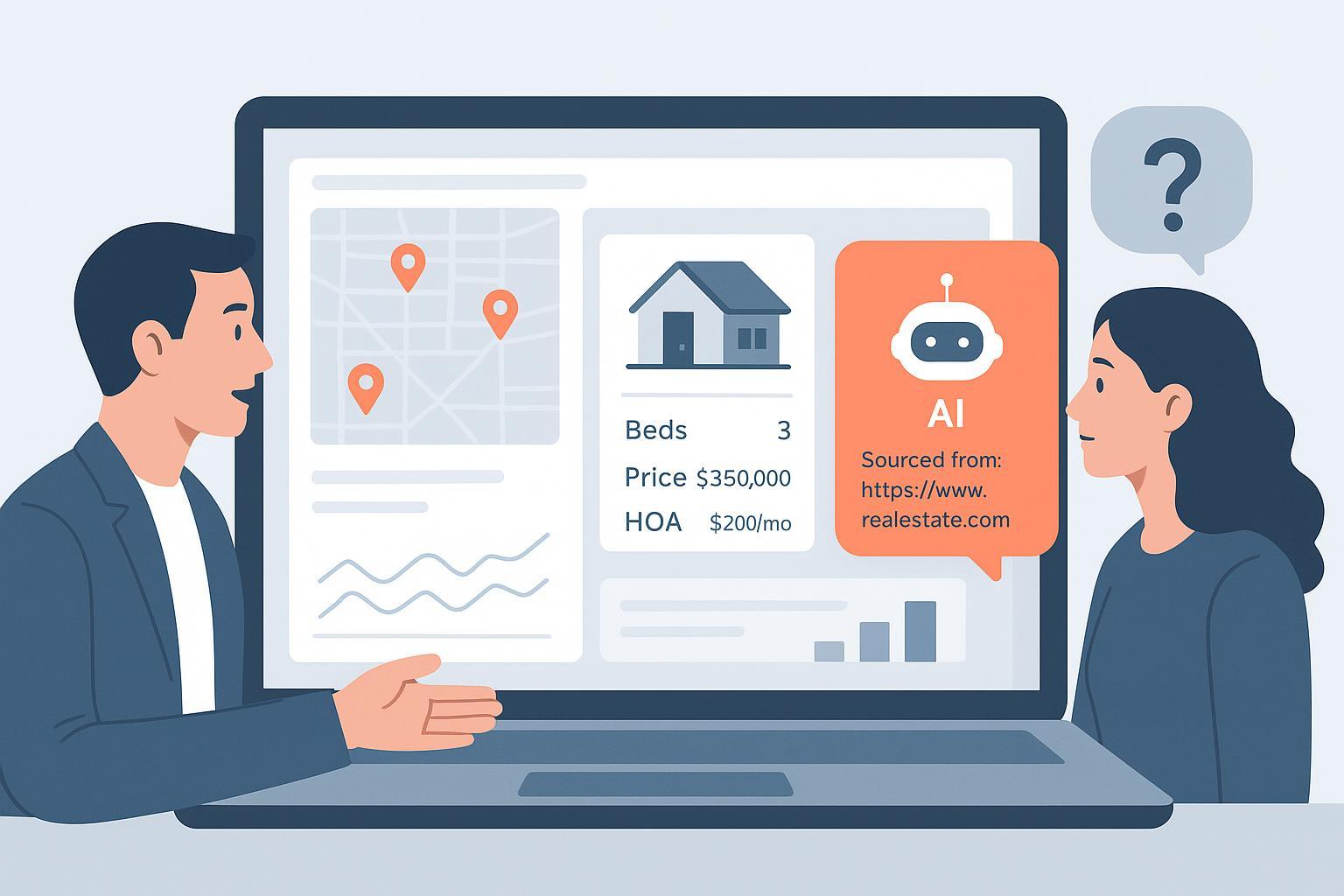
Consumers increasingly lean on AI assistants for home-buying and selling guidance before they ever hit a portal or call an agent. That shift matters: answer engines like ChatGPT, Perplexity, and Google’s AI Overviews now summarize local context, cite sources, and sometimes recommend agents or route tasks such as tour scheduling. If your clients aren’t cited or recommended in those answers, discovery happens without them.
Google’s AI Overviews appear widely across categories, and when they do, organic clicks often drop on informational queries—a reality documented by industry analyses through 2025. Agencies need content that’s scannable, local, and source-backed so answer engines can quote and credit it. See the industry discussion in the Xponent21 analysis, “Google AI Overviews Now Appear in 60% of Searches” (late 2025), alongside broader Search Engine Land syntheses on prevalence and click-through impacts.
Buyer & Property Discovery
“Show me 3-bedroom homes under $500K in [city/ZIP] with low HOA fees.”
Customers expect natural-language filters like bed/bath counts, price caps, and HOA/condo rules alongside photo-rich listings and immediate context. To be cited for these prompts, mirror conversational constraints in headings and on-page filters. Spell out “3-bedroom homes under $500,000” in H2s and body copy so answer engines can parse intent. Implement robust JSON-LD on listing pages—Residence/House, Offer, PostalAddress, GeoCoordinates, images—with complete price, currency, availability, and bed/bath data. Schema.org references such as Residence, Offer, PostalAddress, and GeoCoordinates provide the structure AI parsers rely on.
Feed hygiene matters, too. Align data fields with the RESO Data Dictionary so list price, status, timestamps, and bedroom/bathroom counts are consistent. Add a small on-page Q&A module answering obvious follow-ups (“What counts as a low HOA?” “How often do prices change?”). Even though Google limits FAQ rich results to select sites, clear Q&A formatting helps both users and AI parsing; see the policy notes in Google’s Search updates. Keep Fair Housing top of mind and describe HOA fees objectively; HUD’s Fair Housing Act overview outlines the guardrails.
Measurement note: Track whether ChatGPT and Perplexity cite your neighborhood or listing pages for constrained prompts, and correlate changes in citations with schema completeness and feed integrity improvements.
“Which neighborhoods fit [school rating/commute/amenities] within my budget?”
Users expect neutral, sourced neighborhood profiles covering schools, commute times, parks, and typical price ranges. Build neighborhood pages with a consistent structure: a concise overview, objective statistics such as median list price trends or typical HOA ranges, permitted references for school information, and transit context. Cite authoritative sources and include last-updated stamps. Add ItemList schema for “Homes for sale in [Neighborhood]” index pages and Article schema on deep guides; link internally between neighborhood pages and relevant listings. Round out the foundation with a complete Google Business Profile—accurate categories (Real Estate Agency/Real Estate Agent), service areas, recent photos, and a clear description. For practical guidance, see Search Engine Land’s Google Business Profile guide.
Measurement note: Watch whether answer engines reference your neighborhood pages for school or amenity queries, and annotate content updates when you add sources or refresh local stats.
Financing & Process Literacy
Important disclaimer: Financing content must remain neutral and educational. Do not provide individualized financial advice. Link to authoritative sources and encourage readers to consult licensed lenders or financial advisors.
“How much house can I afford and what are closing costs in [state]?”
A strong explainer page breaks down monthly payment components—principal and interest, mortgage insurance, property taxes, homeowner’s insurance, HOA dues—and sets expectations for maintenance. Provide typical closing cost components and ranges with source notes; for state-specific pages, include authoritative references and last-updated markers. The Consumer Financial Protection Bureau’s materials are well-suited for these explanations; link to the CFPB mortgage hub and CFPB guidance on Loan Estimates. Keep the layout scannable with question-mirroring subheads such as “What’s included in closing costs?” and “How do I compare Loan Estimates?”
Measurement note: Track whether AI answers quote your definitions or tables when users ask affordability and closing questions. If citations are rare, tighten headings to match common phrasing and strengthen links to authoritative sources.
“Pre-approval vs pre-qualification; FHA vs conventional?”
Offer neutral comparisons and eligibility basics with links to authoritative resources. Clarify document requirements for pre-approval versus pre-qualification and the typical characteristics of FHA versus conventional loans. For loan standards and policy context, reference HUD and FHFA conforming loan limits (2025). For tax considerations, link to IRS Publication 530. Use FAQ-style headings that mirror user phrasing, add Article schema, and place a visible methodology/disclaimer block.
Measurement note: Monitor whether Perplexity and ChatGPT link to your glossary or comparison pages; add missing terms and improve internal linking between financing explainers to increase citation chances.
Local Market Conditions
“Is [city] a buyer’s or seller’s market right now?”
Users want a snapshot: months of supply, days on market, price changes, and inventory context—with transparent methodology. Publish monthly summaries using permitted sources (MLS-approved aggregates, relevant public records, or allowed data from major portals). Define each metric and how it’s calculated, avoid predictions, and keep charts accessible with alt text. Use Article JSON-LD with author, datePublished, and citation links. For broader search context on AI Overviews appearance rates and their impact on click behavior, see Search Engine Land’s ongoing coverage, including “Google AI Overviews drive drop in CTR” (2025).
Measurement note: Tag and observe which snapshot pages get cited when users ask trend questions; adjust cadence or add clearer definitions if answer engines prefer competitors’ summaries.
Seller & Valuation
“What’s my home worth in [ZIP], and should I sell now or wait?”
Provide a transparent valuation methodology—data sources, comparable selection, adjustments, and limitations—and frame timing considerations neutrally. Include a local comps summary with methodology and links to public sources where permitted, and refresh monthly. Add structured data (Article) and a compact Q&A block answering common questions such as “How often do valuations change?” For listing and marketing rules, maintain compliance with MLS/IDX policies; NAR’s Multiple Listing Policy handbook outlines model rules and recent flexibility.
Measurement note: Track which valuation pages get cited for “what’s my home worth” queries; test question-mirroring headings and add clarifying disclaimers if necessary.
Agent Selection
“Who are the best agents in [city], and how do I choose?”
Users evaluate trust signals: recent reviews, transaction volume, specialization, awards and press, and community involvement. Consolidate these signals on agent profile pages with clear service descriptions and authentic reviews. BrightLocal’s survey underscores the importance of recent feedback; see “Local Consumer Review Survey 2024”. Optimize Google Business Profiles for agents and offices—correct categories, complete NAP, high-quality photos, and active updates—and maintain consistent citations across reputable directories. Consider a dedicated “How to choose an agent in [City]” guide with clear criteria and links to third-party recognition.
Measurement note: Monitor whether AI answers recommend your agents and which profiles are cited; refine review acquisition cadence and surface awards and press in structured, scannable formats.
Measurement & Iteration Workflow (Agency Playbook)
Answer engines change fast, and visibility can shift weekly. You need a repeatable loop that ties content structure and local signals to real AI citations. Define question clusters by persona and category (buyer basics, financing, neighborhoods, valuation, agent selection). Establish a baseline across platforms to learn which pages get cited, how often, and with what anchor phrasing. Implement content and markup adjustments—tighten question-mirroring headings, complete JSON-LD, add neutral citations, and refresh Google Business Profile assets—and re-measure on a fixed cadence, such as monthly. Prioritize clusters where AI presence is frequent and winnable.
Practical example (disclosure and neutral reference): Disclosure: Geneo (Agency) is our product. Agencies can use Geneo’s white-label AI visibility reporting to monitor brand mentions and recommendation frequency across ChatGPT, Perplexity, and Google AI Overviews. It supports tracking metrics like Share of Voice and total citations and provides client-ready dashboards. For foundational definitions, see our overview of AI visibility and multi-platform monitoring, and for attribution guidance in a zero-click environment, review AI traffic tracking best practices.
Governance and compliance: Financing pages must maintain disclaimers and authoritative links (CFPB/HUD/FHFA/IRS) and avoid individualized advice. Fair Housing requires neutral, objective descriptors and prohibits demographic targeting. MLS/IDX usage must adhere to model rules and local policies; evaluate third-party integrations carefully.
Closing: What to Do Next
Pick one customer theme per market—say, “first-time buyer steps in Austin”—and build a scannable Q&A page with neutral citations, complete schema, and tight internal links to listings and neighborhood guides. Refresh monthly, and instrument it for AI citation tracking. Then ask yourself: if a buyer whispers this question to an AI assistant tonight, would it naturally quote your content?
For agencies formalizing this workflow, two resources can help orient teams and clients: see our platform monitoring comparison across ChatGPT, Perplexity, Gemini, and Bing and a KPI primer contrasting GEO with traditional SEO in “Traditional SEO vs GEO”.