
Quantifying Tone Consistency for AI Visibility
Practical guide for SEO/GEO agencies to measure tone inconsistencies, operationalize an Entity Consistency Score, and boost AI citation and visibility.
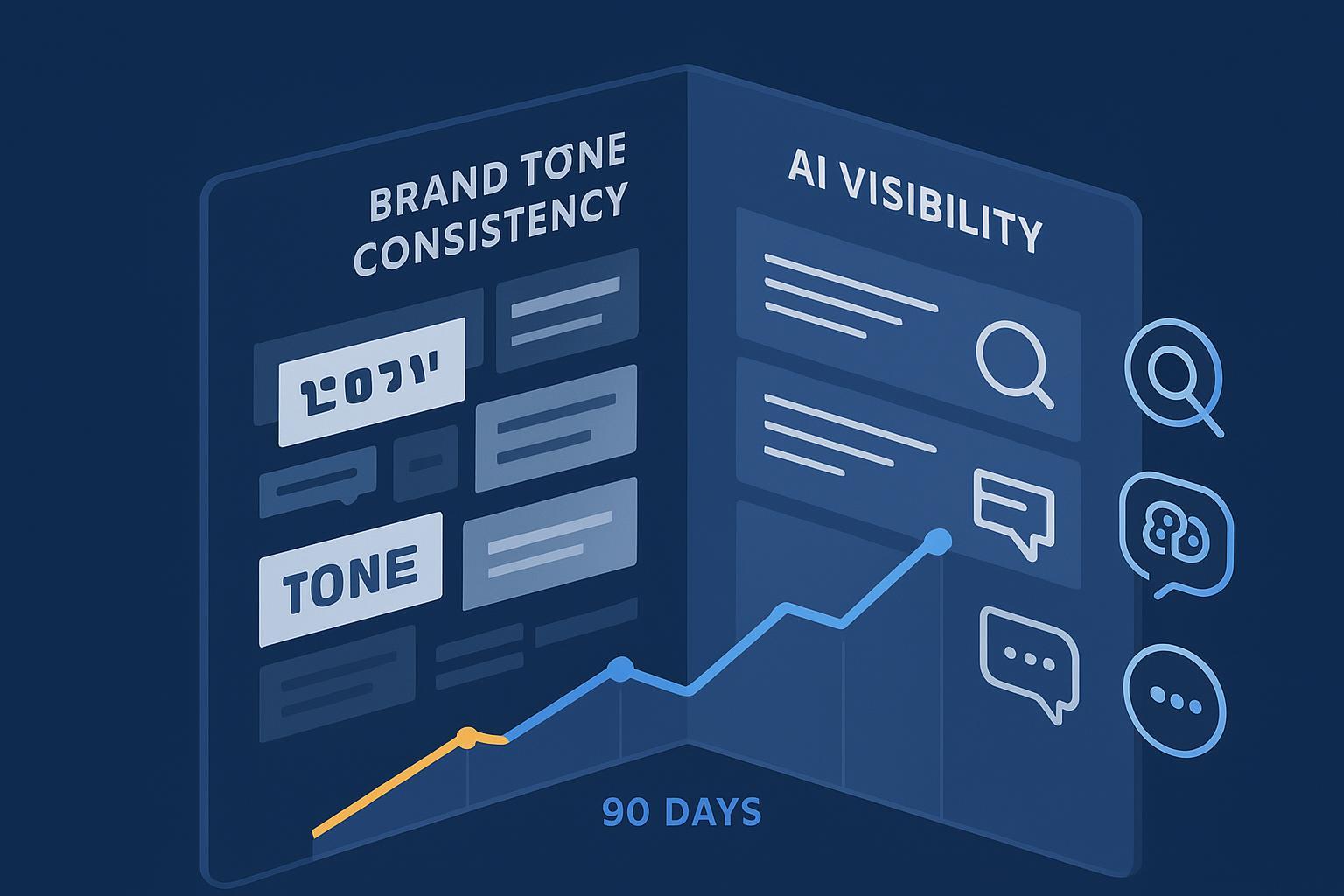
Agencies feel the pressure to prove why voice and editorial discipline are not just brand nice‑to‑haves. When answers in Google’s AI experiences, Perplexity, and ChatGPT choose which sources to surface, inconsistency in tone and entity signals can quietly push your clients out of the frame or muddle attribution. This guide shows a reproducible way to measure that risk, improve it, and report the lift. We anchor on a single KPI you can carry into QBRs and dashboards and we deliver a 90‑day DTC example you can mirror. Put bluntly, if you care about tone consistency AI visibility, you need measurement, not vibes.
How AI engines reward consistency
AI answer experiences spotlight sources that are clear, authoritative, and aligned with the query. Google explains that AI features show links to supporting pages and rely on content quality signals and structured data that matches visible content. See Google’s publisher guidance in the AI features documentation and its 2025 guidance on succeeding in AI search for specifics on links and schema alignment. According to the Search team’s guidance in 2025, matching structured data to what users see and maintaining people‑first content improves eligibility for display in AI features. Read the official documents here:
Google’s AI features documentation in Search Central: the section on how AI features show links and how publishers can manage eligibility — see the AI features guidance from Google Search Central in 2025 Google AI features for Search
Google’s 2025 explainer on publisher success in AI experiences, which reiterates alignment between structured data and visible content — see the 2025 post Succeeding in AI search
Perplexity emphasizes transparent sourcing in every answer and refines selection based on relevance and research depth. Its Help Center outlines inline citations and Deep Research behavior, making clear that clarity and corroboration matter for inclusion. See the Help Center overview How Perplexity works and cites sources.
Put simply, when your brand’s entities and voice are consistent across pages and authors, AI systems are more likely to find, attribute, and cite you correctly. That is why we tie tone consistency AI visibility together with a measurable entity signal.
KPIs for tone consistency AI visibility
The primary KPI in this framework is the Entity Consistency Score. Supporting KPIs round out the picture and help with diagnosis and governance.
Entity Consistency Score Definition: Percentage match between authoritative entity records and entities extracted from AI answers across a sampled prompt set. Formula: ECS = matched AI responses divided by total responses, multiplied by 100. Tracked fields: canonical brand name, author names and titles, product names or SKUs, corporate descriptor, canonical URLs. Use structured data like Organization and Product to reinforce these fields in a machine‑readable way. See the schema reference Schema.org Organization and Product.
AI Citation Rate Definition: Percent of sampled AI answers that cite or reference your brand content. Track by engine and aggregate for rollups.
Author Attribution Stability Definition: Percent of answers that correctly attribute content to the canonical author names when relevant.
Tone Deviation Index Definition: A distance score between your brand’s tone profile and tone inferred from AI answers. Use a lightweight classifier and a small set of tone markers.
Placement Score Definition: Normalized position within multi‑source answers where ordering is exposed. Treat it as directional.
Thresholds and statistical notes
Sampling window: 90 days. Weekly batches of 200–500 prompts provide stable estimates.
Risk threshold: ECS under 70 is high risk. A reasonable short‑term target is a 15‑point lift in 90 days.
Reporting: For proportions like ECS and AI Citation Rate, report 95 percent Wilson score intervals, which offer better coverage than simple Wald intervals. See a methodological review of Wilson intervals with links to the original 1927 work Review of the Wilson interval.
Measurement recipe for agencies
You need a process you can hand to a strategist, an editor, and a data specialist without ambiguity.
Build a canonical entity registry and tone rules Create a registry for brand and author identities and product naming. Include accepted aliases and capitalization rules. Write tone rules that cover CTA phrasing, terminology, and formality. Ensure JSON‑LD for Organization, Person, Product, and Article is deployed and matches on‑page content.
Create a rotating prompt library and sampling cadence Assemble 200–500 prompts per week across informational, commercial, and transactional intents for your DTC category. Rotate weekly to avoid overfitting and store raw answers and citations by engine.
Parse answers then extract and normalize entities Pull answer text and citations. Extract brand, author, and product mentions. Normalize against your registry with exact matches and alias maps. Flag tone markers such as CTA phrases or technical jargon to feed the Tone Deviation Index.
Compute ECS and supporting KPIs then trend them Calculate ECS, AI Citation Rate, and Author Attribution Stability per engine and as an aggregate. Report rolling 90‑day averages, Wilson intervals, and week‑over‑week deltas.
Diagnose and plan remediation Correlate ECS changes with downstream shifts in AI Citation Rate using a small lag. Identify the biggest sources of drift such as author aliasing, SKU variants, or inconsistent CTA language. Prioritize fixes, assign owners, and schedule QA.
Example ECS calculator pseudo‑code
# inputs: ai_answers: list of dicts with fields {'engine','prompt_id','answer_text','citations'}
  # registry: dicts for canonical brand, authors, products, canonical_urls, alias maps

  matches = 0
  n = 0
  for ans in ai_answers:
      n += 1
      extracted = extract_entities(ans['answer_text'], ans['citations'])  # your NER + citation parser
      normalized = normalize_entities(extracted, registry)  # exact+alias mapping
      fields_ok = [
          normalized['brand'] == registry['brand']['canonical'],
          normalized['author'] in registry['authors']['canonical_names'],
          normalized['product'] in registry['products']['canonical_names_or_skus'],
          normalized['url'] in registry['canonical_urls']
      ]
      if sum(fields_ok) >= 3:  # require 3 of 4 fields to match
          matches += 1

  ECS = (matches / n) * 100
Example prompt lines for a DTC footwear brand
what makes a lightweight stability running shoe comfortable for daily miles
  best neutral trainers for half marathon prep under 150 dollars
  how to clean knit uppers without damaging the weave
  brand x model y vs model z for plantar support
SQL‑like parsing sketch
SELECT
    answer_id,
    CASE WHEN brand IN (SELECT canonical FROM brand_registry UNION SELECT alias FROM brand_aliases) THEN 1 ELSE 0 END AS brand_match,
    CASE WHEN author IN (SELECT canonical_name FROM authors) THEN 1 ELSE 0 END AS author_match,
    CASE WHEN product IN (SELECT canonical FROM products UNION SELECT sku FROM products) THEN 1 ELSE 0 END AS product_match,
    CASE WHEN cited_url IN (SELECT url FROM canonical_urls) THEN 1 ELSE 0 END AS url_match
  FROM ai_answers_extracted;
DTC ecommerce 90 day micro case
Scenario A DTC ecommerce site with a content hub and product pages. We sampled 2,400 prompts across 12 weeks, capturing Google AI experiences, Perplexity, and ChatGPT outputs.
Baseline weeks 1 and 2
Entity Consistency Score 62
AI Citation Rate 11
Author Attribution Stability 68
Placement Score low
Key issues
Author names varied across posts and schema
CTA phrasing alternated between pushy and informative styles
Product model names and SKUs appeared with inconsistent hyphenation
Canonical URLs missed on several older blog posts
Remediation weeks 3 to 6
Published a unified voice and tone guide, with fixed CTA language and terminology
Deployed JSON‑LD Person, Organization, Product, and Article with matching on‑page content
Standardized author bios and centralized them for reuse
Normalized product naming and SKUs across PDPs and articles
Fixed canonical URLs and tightened internal linking
Post remediation weeks 7 to 12
Entity Consistency Score 78 which is a 16 point improvement
Author Attribution Stability 84 which is a 16 point improvement
AI Citation Rate 13 which is a two point increase that reached significance at n above 200 using Wilson intervals
Placement Score improved in engines that expose ordering
Before and after summary
Metric | Baseline Weeks 1–2 | Post Weeks 7–12 |
|---|---|---|
Entity Consistency Score | 62 | 78 |
AI Citation Rate | 11 | 13 |
Author Attribution Stability | 68 | 84 |
Placement Score | Low | Directional lift |
Interpretation Entity governance lifted consistency and produced modest gains in AI citations and better attribution. We do not claim causation. The likely mechanism is improved eligibility and clearer signals that align with how engines pick and cite sources.
For traffic context, independent research has tracked how AI answer features can affect clicks and selection behavior. Ahrefs reported on how AI Overviews can reduce clicks for some queries while still citing high quality sources. See the 2024 and 2025 research roundup for details on prevalence and click effects Ahrefs analysis of AI Overviews and clicks. Semrush has also published cohort analyses tracking AI visibility metrics and traffic risk by query class, useful for benchmarking Semrush AI search traffic study.
Practical example and tooling options
You can run this program with in‑house scripts and spreadsheets or with a monitoring platform that centralizes prompts, answers, extraction, and reporting.
DIY approach
Use a scheduled prompt runner to gather weekly answers from each engine where allowed. Store answer text, citations, and placements. Parse entities with a simple NER model and citation parser. Compute ECS, AI Citation Rate, and Author Attribution Stability. Visualize weekly trends and 90‑day averages with confidence intervals. Keep an alias map for normalization and version your registry.
Platform approach example Disclosure: Geneo is our product. A platform that monitors ChatGPT, Google AI experiences, and Perplexity, tracks a Brand Visibility Score, and reports link visibility, brand mentions, and reference counts can streamline this workflow. An agency can ingest weekly prompt batches, parse outputs, and compute an Entity Consistency Score by matching extracted entities against a canonical registry. Dashboards can show entity match rates and AI citation trends, and competitive benchmarks help set thresholds by category. White‑label reporting supports client‑ready monthly and quarterly reviews. For background on AI visibility definitions and KPI frameworks, see our resources on AI visibility and brand exposure and the 2025 discussion of AI search KPI frameworks. For implementation details, review the product documentation hub.
Governance playbook for agencies
Make governance the habit that keeps ECS high and reduces firefighting. Assign a strategist to own the entity registry and thresholds. Editors enforce voice and tone rules and review CTAs, terminology, and capitalization on every draft. Developers maintain schema templates and ensure that Organization, Person, Product, and Article fields mirror visible content. QA runs a pre‑publish checklist that includes tone markers, author bylines, canonical URLs, and schema validation. Program managers coordinate remediation tickets and watch for drifts such as an unexpected drop in Entity Consistency Score or a slide in AI Citation Rate. When ECS falls below 70 or Author Attribution Stability below 75, trigger a one‑week fix window and review the alias map, bios, and schema deployment. Use monthly reviews to evaluate whether changes in ECS precede shifts in AI citations and adjust thresholds by vertical. If tone consistency AI visibility is your client’s mandate, governance is the operating system that sustains it.
Next steps
If you want a ready‑to‑run measurement and governance workflow for tone consistency AI visibility across engines, set up the program with your preferred tools and start with a 90‑day target of a 15‑point Entity Consistency Score lift.
References for deeper reading
Google explains how AI features display links and how publishers should align structured data with visible content in its Search Central documentation in 2025 Google AI features for Search
Google outlines success patterns for publishers in AI experiences in 2025 Succeeding in AI search
Perplexity describes sourcing and citations in its Help Center How Perplexity works and cites sources
Schema reference for entity clarity with Organization and Product types Schema.org Organization and Product
Ahrefs quantifies click impacts and citation patterns in AI Overviews Ahrefs analysis of AI Overviews and clicks
Semrush provides cohort studies on AI search traffic impacts Semrush AI search traffic study
A review of Wilson score intervals for proportions with references to the original 1927 paper Review of the Wilson interval