
The Science Behind Perplexity Rankings: Perplexity ranking tracking for brand growth
Learn how to track Perplexity rankings for brand growth in 2026. Discover frameworks, actionable strategies, and management-ready reporting for quantifying visibility.
If your brand is being recommended—or ignored—by Perplexity, it’s already affecting discovery, trust, and conversions. Tracking how, when, and why you appear is no longer a nice-to-have; it’s an operational discipline. This guide shows how to quantify visibility, build a reliable tracking stack, and translate Perplexity results into growth decisions.
Key takeaways
Establish a consistent query set and sample cadence to measure visibility, citations, mentions, sentiment, and Share of Voice across Perplexity.
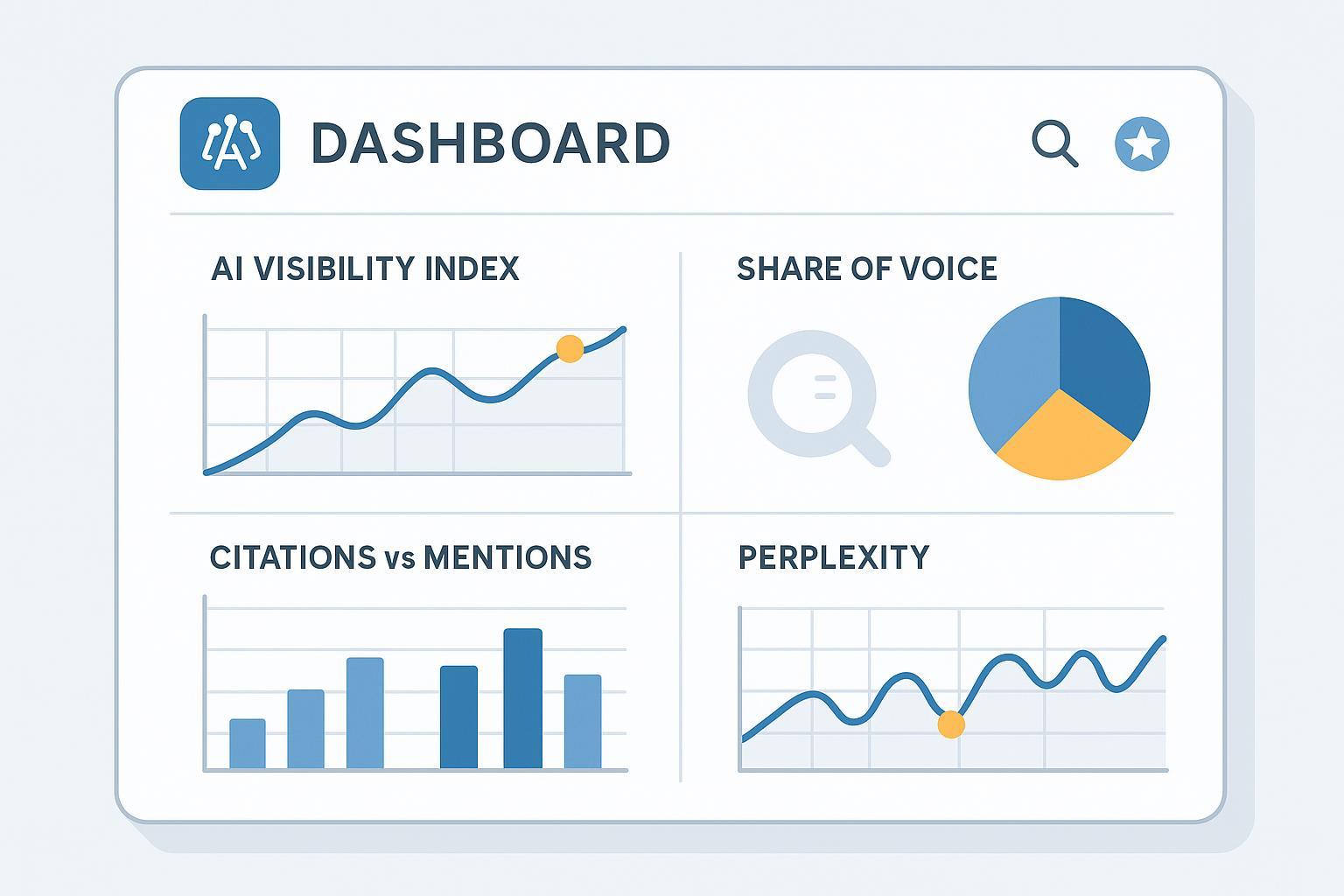
Normalize results into an AI Visibility Index so executives can read one score that rolls up presence, position, tone, and accuracy.
Use a hybrid stack: manual QA + programmatic capture via APIs to scale while keeping quality high.
Report deltas and run pre/post analyses against content changes to connect visibility shifts to business outcomes.
Respect crawl governance: allowing PerplexityBot may increase citation opportunities; blocking can reduce inclusion in answers.
Keep claims conservative; Perplexity’s exact ranking signals are proprietary—track what you can observe and validate.
How Perplexity ranks and cites content
Perplexity blends real-time web retrieval with LLM synthesis and exposes clickable citations in answers. Independent practitioners have observed signals that look familiar to SEO—content clarity and structure, authority and trust, freshness, semantic relevance—and added AI-centric confidence elements. Search Engine Land summarized reported mechanics, including potential entity-level reranking and domain boosts that combine traditional signals with AI certainty measures; details remain proprietary. See the synthesis in Search Engine Land’s research on how Perplexity ranks content (2025).
Because answers cite sources, tracking both citations (linked sources shown in outputs) and mentions (textual references without links) is essential. Practitioner explainers highlight Perplexity’s citation-heavy behavior and live sourcing, which distinguishes it from purely generative tools; for an overview of AI ranking factors across engines, consult WebFX’s AI ranking factors breakdown (2025).
Implications for tracking: you’ll want to log which of your pages are cited versus merely mentioned, the position of your brand within multi-source answers, and whether freshness or authoritative references correlate with inclusion.
Build your tracking stack
A resilient approach mixes methods to balance scale and accuracy.
Manual baseline (low complexity): Maintain a spreadsheet of 250–500 queries mapped to buyer intents and topics. Weekly, record brand mentions, citations, sentiment, and competitor coverage. This establishes trend visibility and grounds automated checks.
Hybrid (recommended): Use Perplexity’s Search/Chat APIs to programmatically run your query set, parse citations and brand mentions, and store results. Layer manual QA to validate ambiguous references or edge cases.
Automated platforms (time-saving): Evaluate trackers that provide cross-engine monitoring, citation intelligence, SOV dashboards, and competitive benchmarks. Ensure they support Perplexity, handle deduplication, and let you export raw data for custom analysis.
Pros/cons: Manual ensures accuracy but doesn’t scale; hybrid scales with your QA capacity; automated platforms accelerate operational tempo but require vendor due diligence and occasional manual checks.
Step-by-step workflow to measure Perplexity visibility
Define your query set: Include navigational (brand), informational (problem/solution), and transactional (feature/pricing) intents. Aim for 250–500 queries representing high-value topics.
Set cadence: Daily for volatile categories, weekly for most brands. Keep the cadence consistent to reduce noise.
Capture data: For each query, log presence (visible/not), citation count and type (linked vs unlinked mention), position within answer, sentiment (positive/neutral/negative), and accuracy notes.
Normalize: Convert raw counts into standardized fields (e.g., binary presence, weighted citation score, sentiment index) to compute an AI Visibility Index.
QA: Spot-check samples each cycle; confirm that references truly point to your site or official assets; fix entity-resolution issues.
Trend: Visualize time-series deltas and segment by topic cluster to identify what’s improving or slipping.
Act: Prioritize content updates for queries missing citations or showing low sentiment; add authoritative references and clear answer structures.
90-day plan for Perplexity ranking tracking for brand growth
Weeks 1–2: Build the query set, decide crawl governance (robots.txt, firewall policies), and log a baseline across presence, citations, mentions, sentiment, and SOV.
Weeks 3–6: Stand up a hybrid tracker (APIs + storage + QA). Ship dashboards for index score, SOV, and topic clusters. Identify gaps: pages that are mentioned but not cited; low-sentiment clusters.
Weeks 7–10: Execute content improvements—clarify answer blocks, add FAQs, strengthen E-E-A-T signals, include authoritative references, and update freshness cues. Monitor weekly shifts.
Weeks 11–13: Run pre/post analysis around the improvements. Correlate visibility changes with business KPIs (trial signups, demo requests, conversion rate). Prepare an executive readout and a backlog for the next sprint.
KPI map: what to track and how to use it
For definitions and deeper workflow guidance, see the AI visibility frameworks in this Geneo guide to AI search buyer journey mapping for FinTech.
Metric | What it measures | Practical use |
|---|---|---|
AI Visibility Index | Composite of presence, position, sentiment, accuracy | Single executive score; compare across topics and time |
Share of Voice (SOV) | Your brand’s portion of mentions/citations vs competitors | Identify category leaders; allocate resources to lagging clusters |
Citations vs Mentions | Linked sources vs textual references | Prioritize pages with mentions to earn citations; validate authority signals |
Sentiment | Tone of how your brand is described | Inform messaging updates and reputation work |
QA and accuracy checks
Deduplication: Consolidate repeated citations pointing to the same page and handle canonicalization.
Entity resolution: Ensure all brand mentions, abbreviations, and product lines map to a single brand entity.
Source validation: Click citations; verify they’re your official pages or trusted third-party references.
Anomaly detection: Flag sudden drops or spikes; investigate crawl policy changes, site updates, or model shifts.
Documentation: Keep a methods page describing how you collect, classify, and normalize data.
Practical workflow example (Geneo)
Disclosure: Geneo is our product.
Teams often want a single place to monitor AI visibility across engines. In a typical workflow, you would define the query set, ingest results from Perplexity via programmatic capture or manual sampling, and compute metrics like AI Visibility Index and SOV. A platform such as Geneo can centralize this: track Perplexity citations and mentions alongside ChatGPT and Google AI Overview, benchmark competitors, and produce white-label reports. The key is neutrality—export raw data, run your own normalization, and use dashboards to spot clusters where you’re mentioned but not cited. Keep the vendor footprint light: validate outputs weekly and maintain your internal QA routine.
Reporting and attribution: connect visibility to growth
How do you prove the business value? Pair visibility metrics with outcomes. For a selected set of high-intent queries, track trial signups, demo requests, newsletter subscriptions, or assisted conversions. Run pre/post windows around content changes and compare deltas. Use regression or simple difference-in-differences logic to control for seasonality. When you see a rise in citations within Perplexity for a product-feature query, watch whether high-funnel engagement follows—shorter research cycles, higher demo completion, or improved lead quality.
A broader industry context helps management understand the stakes. AI summary and answer engines reward authoritative sources and reduce clicks for non-cited pages. Studies in 2025–2026 show that engines emphasizing citations give disproportionate visibility to trusted references; see the synthesis in Search Engine Journal’s overview of AI Overviews effects (2026).
Governance: be intentional about crawling
Crawl policies influence whether your content is eligible for citation. Reports in 2025 documented disputes over PerplexityBot behavior and publisher blocking trends; Cloudflare’s investigation alleged stealth crawlers and led to delisting of Perplexity as a verified bot. Read the context in Cloudflare’s report on undeclared crawlers (2025). The takeaway isn’t to panic; it’s to decide your posture. If citations drive measurable value, align robots.txt and firewall rules accordingly and monitor impacts.
Where to go next
Ready to operationalize Perplexity ranking tracking for brand growth? Start with your query set and baseline, build a hybrid tracker, and ship the first dashboard in two weeks. For deeper frameworks on AI Visibility Index and workflows, see the Geneo blog’s buyer journey mapping guide, and explore ongoing thought leadership on the Geneo blog.