
The Science Behind Ranking on Perplexity: Semantic Relevance, Authority, and Engagement
A field-tested checklist for Perplexity: maximize semantic relevance, authority, and engagement. Proven strategies for agencies to boost citation rate and Share of Voice in 2025.
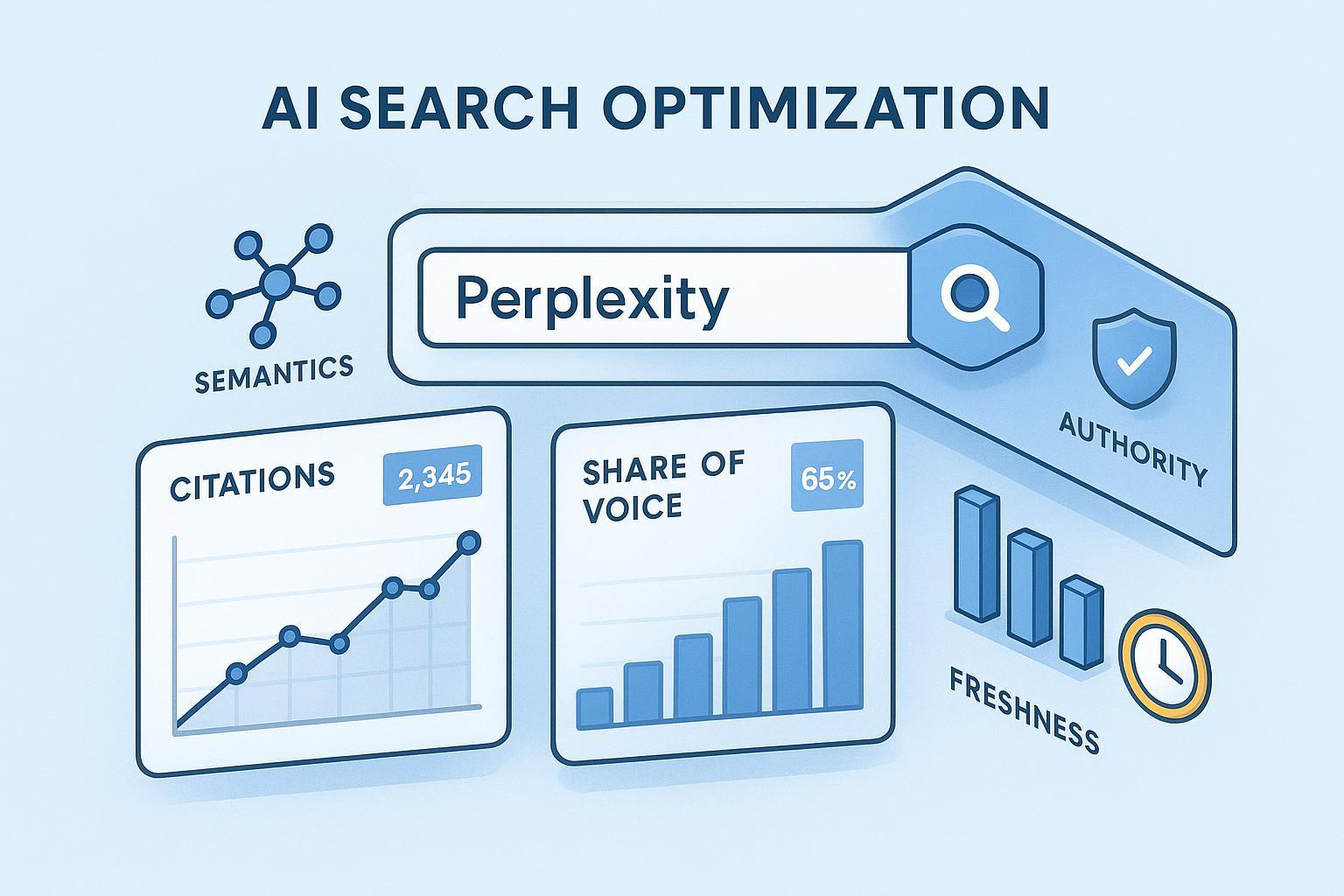
If your goal is to “rank” on Perplexity, you’re really aiming to be cited in its answers—and to grow your Share of Voice (SOV) against named competitors. Multiple 2024–2025 practitioner studies show Perplexity favors trustworthy, well-structured, fresh, and highly relevant sources, often overlapping with Google’s top results. For instance, according to Search Engine Land’s 2024 analysis of Perplexity citations vs. Google’s top 10, there is substantial overlap by query, with variance by vertical—underscoring the role of traditional authority while rewarding clarity and recency in AI answers. Treat the following as a field-tested checklist, not a theoretical primer.
Checklist A: Nail Semantic Relevance and Structure
Perplexity leans on LLM-driven retrieval and synthesis. Make your pages easy to extract, verify, and quote.
Lead with answer-first sections. Open with a concise summary that directly addresses the query, then expand with subheads and supporting detail. Practitioner guides emphasize that scannable, answer-first formatting boosts extractability for LLMs (see LinkGraph’s 2025 recommendations on ranking in Perplexity).
Map entities and concepts. Explicitly cover key entities (brands, products, people, places) and related terms. Add definition blocks, comparison sections, and short statistic callouts that mirror common prompts.
Use clear hierarchy. Keep a clean H1/H2/H3 structure, short paragraphs, and one idea per section. Front-load key facts, then support with examples and sources.
Include tables where useful. Simple tables that compare features, dates, or metrics are easy to parse and quote.
Write for conversational queries. Optimize titles and H2s that reflect how users ask questions; include synonyms and adjacent intents.
Why it matters: Across 2024–2025 studies, structured, entity-rich content correlates with inclusion in Perplexity answers. While Perplexity does not publish ranking weights, evidence points to clarity and coverage as consistent selection factors. See the synthesis in LinkGraph’s 2025 guidance and other practitioner roundups.
Checklist B: Build Verifiable Authority (without overclaiming)
Authority is table stakes—and it’s demonstrable, not decorative.
Cite authoritative sources in-text. Reference original research, standards, and official docs with descriptive anchors. Name publishers and include years so your claims are traceable.
Surface authorship and credentials. Add author bios, experience signals, and last-modified dates. These don’t guarantee citations, but they align with E-E-A-T and make verification easier.
Keep schema hygiene. Use appropriate Schema.org types (FAQ, HowTo, Product, Article) and ensure they’re valid and updated. Treat schema as supportive formatting, not a magic lever.
Earn third-party mentions. Pursue relevant directories, trade publications, expert quotes, and reviews—especially in your vertical. Diversify sources beyond a single UGC community.
Maintain topical depth. Build clusters with interlinked, expert-backed pages that comprehensively cover your domain.
Why it matters: Independent analyses in 2024–2025 consistently show Perplexity elevates trustworthy, expert-backed pages. Structured data and transparent authorship improve extractability and trust, even if no study proves they independently boost citations.
Freshness and Engagement Routines that Move the Needle
Perplexity shows a meaningful recency preference. Plan for velocity and verifiable updates.
Set a realistic update cadence. For time-sensitive topics, weekly refreshes are a good baseline; in high-velocity categories, practitioners like Nick Lafferty suggest even more aggressive cycles (every 2–3 days) with on-screen prominence tactics. See Nick Lafferty’s 2025 playbook for Perplexity inclusion—use these as heuristics to test, not guarantees.
Log substantive changes. Update data, add recent examples, and expand coverage to close query gaps—don’t just bump timestamps.
Front-load verified facts. Place key stats, definitions, and short answers near the top. Use quotes and citations to make the content easy to trust and cite.
Use scannable formatting. Short paragraphs, bullets sparingly, and occasional tables help LLMs and readers.
Monitor domain diversity. Track which domains Perplexity cites alongside yours; expect a head–long-tail pattern with UGC and authoritative institutions varying by vertical.
Evidence notes: Freshness patterns are echoed in 2024–2025 studies and Perplexity’s ongoing feature updates documented in the platform’s changelog. Lafferty’s benchmarks are aggressive, useful for testing, and clearly labeled as practitioner heuristics.
Measurement SOP: Prompts, Logging, and SOV
You can’t improve what you don’t measure. Standardize your testing and reporting.
Define prompt sets per engine, mode, and locale. Keep them stable for weekly or monthly runs.
Log citations, positions, sentiment, and referenced domains for each run.
Compute Perplexity SOV: (Your citations or mentions ÷ Total cohort citations or mentions) × 100% over a fixed window.
Archive screenshots and raw outputs for reproducibility and quality checks.
Flag change drivers. Annotate what changed—new data, refreshed sections, added schema—so you can correlate actions with results.
Cadence | What to log | Why it matters |
|---|---|---|
Weekly (baseline) | Prompts used; engines/modes/locales; cited domains; your pages cited; position in answer; sentiment | Establish trend lines and catch recency effects |
Monthly | SOV vs. cohort; topic clusters coverage; schema validation status; author bios/last-modified checks | Tie structural/authority changes to visibility |
Quarterly | Competitive shifts; domain diversity; content gaps; refresh backlog | Plan roadmap and campaign priorities |
Evidence and references to ground your SOP:
Search Engine Land’s 2024 analysis highlights overlap with Google’s top results and domain preferences, useful for competitive baselines.
Nick Lafferty (2025) offers cadence and formatting heuristics for rapid testing.
LinkGraph (2025) stresses answer-first structure and schema hygiene.
Perplexity’s changelog shows ongoing feature updates consistent with recency-aware retrieval.
Practical workflow example (Disclosure)
Disclosure: Geneo is our product.
A neutral way agencies operationalize this SOP is to pair weekly prompt runs with multi-engine visibility tracking and client-ready reporting. For example, teams can monitor brand mentions/citations across Perplexity, compare SOV against named competitors, and log Link Visibility and referenced domains, then produce white-label reports on a custom domain—keeping the focus on evidence, not spin. See AEO Best Practices 2025: Executive Guide to Measuring AI Voice (Geneo) for background on logging engines, modes, dates, locales, and reference domains without duplicating their guidance.
Common pitfalls to avoid
Assuming platform-side engagement (upvotes, follows, Collections) directly re-rank answers. We found no credible 2024–2025 evidence that Perplexity uses these signals in source selection.
Treating schema or author bios as causal levers. They are supportive for extractability and trust but not proven independent drivers of citations.
Ignoring domain diversity. Over-indexing on one community or publication type can limit inclusion chances across different query contexts.
Chasing freshness without substance. Cosmetic updates rarely move the needle; close real evidence gaps.
Closing & next steps
Build answer-first, entity-rich pages; strengthen verifiable authority; refresh with substance; and measure citations and SOV on a disciplined cadence. If you need an agency-ready way to monitor multi-engine AI visibility and produce client reports, consider setting up a neutral workflow with a tracker that logs brand mentions, link visibility, and referenced domains across Perplexity and peers—Geneo offers such capabilities with white-label reporting for agencies.
Further reading: How to Optimize Content for AI Citations (Geneo).
References (selected, 2024–2025):