
Original Research in GEO: How Unique Data Earns AI Citations
Understand original research in Generative Engine Optimization (GEO), its impact on AI visibility, and steps to get your research cited by AI systems.
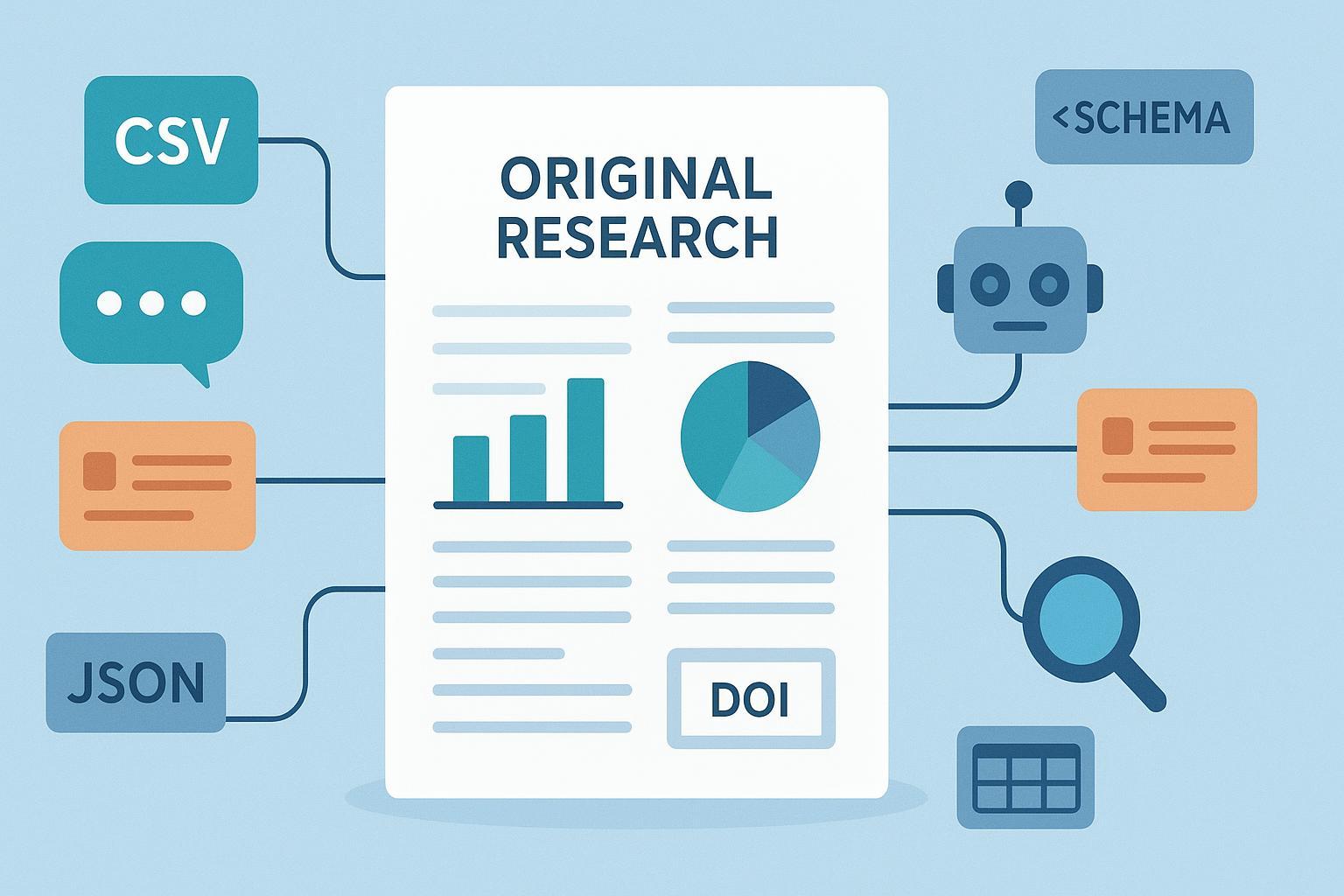
Why do some brands get quoted by AI assistants while others get ignored? Here’s the deal: assistants and AI answer surfaces have a strong appetite for specific, well-documented facts. Original research—your own surveys, benchmarks, experiments, and case series—creates those facts. This article explains what “original research” means inside Generative Engine Optimization (GEO), why it tends to earn citations from AI systems, and how to publish and measure research so it’s easy for large models and AI Overviews to understand and attribute.
What “Original Research” Means in GEO
GEO is the practice of optimizing content so it’s discovered, summarized, and cited by AI-driven answer engines. For a clear overview, see Search Engine Land’s 2024 explainer, “What is generative engine optimization (GEO)?”. In this context, original research is first‑party, non-derivative work that produces novel findings with transparent methods—think publishable numbers a model can quote and a journalist can verify.
If your goal is to be named in AI answers, your research isn’t just a content asset; it’s also a visibility asset. For a primer on why that matters, we unpack AI visibility and brand exposure in What Is AI Visibility? Brand Exposure in AI Search Explained.
What the Evidence Suggests About AI Citations
Experimental work indicates that verifiable facts help content show up more often in generative answers. The arXiv preprint “GEO: Generative Engine Optimization” (updated 2024–2025) reports that adding citations, quotations, and statistics tends to increase visibility in LLM-generated responses. Treat that as directional, not deterministic: it’s not that one number guarantees a citation, but well-sourced numbers make you a better candidate.
Observational studies also show platform-specific patterns. Semrush’s 2025 analysis of Google AI Overviews reports appearance in roughly the low‑teens share of queries and a strong overlap between cited sources and pages already ranking in the top 10—often in the 76–86% range, depending on the dataset and timing; see Semrush’s AI Overviews study (2025). Meanwhile, assistants like ChatGPT and Perplexity cite a wider mix of domains; Wikipedia is dominant in many datasets, and multimedia or community sources appear more frequently. For a snapshot of cross‑assistant behavior, Ahrefs compared most‑cited domains in mid‑2025 in “Top most‑cited domains by AI assistants”.
Put simply: authority, clarity, and recency still matter. Original research helps because it creates unique, attributable claims—and models need high‑signal claims they can verify against multiple sources.
What Makes Research “AI‑Citable”
- Novel, specific, quantifiable findings: numbers with explicit units, timeframes, and definitions.
- Methodological transparency: sampling frame, N, data cleaning/weighting, and limitations.
- Structured clarity: headings, captioned figures, and “Key Findings” blocks that can be chunked.
- Machine‑readable assets: CSV/JSON downloads, stable anchors for tables/figures.
- Recency with continuity: periodic updates that keep the entity fresh without fragmenting URLs.
| Research format | Why AI systems cite it | Common pitfalls to avoid |
|---|---|---|
| Industry survey (large‑N) | Clear percentages and segment cuts give models quotable facts | Vague sampling; undisclosed weighting; unclear definitions |
| Technical benchmark | Reproducible methodology; standardized test beds yield comparable numbers | Missing methods/code; cherry‑picked scenarios |
| Longitudinal index | Trend lines with consistent methodology are easy to summarize | Changing definitions or URLs breaks continuity |
| Case series or meta‑analysis | Concrete outcomes with context and limits aid safe summarization | Anecdotal framing without denominators or bounds |
Publish for Machines and Humans
Publishing choices determine how easily models can parse and attribute your work. A practical checklist:
- HTML‑first research hub with a canonical URL. Offer a human‑readable article and machine‑readable assets; avoid orphaned PDFs.
- Structured data: add relevant schema types (e.g., ScholarlyArticle/ResearchArticle on the article; Dataset on downloads). Google explains Dataset markup in Search Central’s Dataset structured data documentation, and schema definitions for articles live at Schema.org’s ScholarlyArticle.
- Data access: provide CSV/JSON for core tables and a methods appendix detailing sampling, timing, and limitations. If feasible, register a DOI and include it in metadata (see Crossref’s content registration for articles; DataCite is similar for datasets).
- Canonical hygiene: consolidate duplicates (HTML/PDF) and keep a single, stable URL for longitudinal series; add deep‑linkable anchors for figures and tables.
- Entity clarity: consistently name organizations, authors, products, and places; use descriptive headings, captioned figures, and units.
Distribute Like a Research Brand
Great research still needs a push. Package a press‑ready headline, a crisp executive summary, downloadable charts, and a methods note. Pitch niche publications and newsletters that habitually cite data. Share a short video walkthrough, a webinar recap, and a lightweight slide deck. Encourage expert commentary—models notice co‑mentions from credible entities. Most of all, stick to one canonical hub URL so attention consolidates where you want citations to point.
Measure GEO Impact of Your Research
How will you know if your study is actually being cited by AI systems? Track a small set of AI‑aware metrics alongside traditional SEO:
- AI Attribution Rate: percentage of tracked queries (by engine) where your brand or research URL is cited in AI answers.
- Multi‑Platform Citation Count: total citations across ChatGPT, Perplexity, Google AI Overviews, Gemini, and Copilot.
- Share of Voice in AI Answers: your presence vs. a defined peer set across a stable prompt/query list.
- Chunk Retrieval Coverage: how often key sections (e.g., “Key Findings,” tables) appear in AI summaries.
- Sentiment of AI Descriptions: tone when models paraphrase your findings.
For deeper definitions and workflows, see our internal guide, AI Search KPI Frameworks for Visibility, Sentiment, Conversion.
Practical Example: Tracking Citations After Launch (Using Geneo)
Disclosure: Geneo is our product.
Step 1 — Define the universe. Start with a compact query set: your branded research title, key statistics (“X% of buyers…”) with units and time frame, and a few problem‑based prompts an analyst might ask.
Step 2 — Establish a baseline. Capture current inclusion and attribution across ChatGPT, Perplexity, Google AI Overviews, Gemini, and Copilot. Note whether models quote your numbers verbatim, paraphrase them, or miss them entirely.
Step 3 — Monitor citations and sentiment. Track how often your research URL is referenced, whether attribution goes to you or to secondary coverage, and the tone used to describe your findings. Pay attention to which sections are most frequently pulled—models often favor clearly labeled “Key Findings” blocks and well‑captioned tables.
Step 4 — Diagnose gaps. If Perplexity cites a media article instead of your hub, ask why. Is your original study buried behind PDFs? Are figures missing alt text or anchors? Is the methods section thin? Tighten the publication details, reinforce the canonical URL in outreach, and consider a short “Data & Methods” page that’s easy to parse.
Step 5 — Iterate and republish. Publish minor errata, clarify labels/units, or add a small appendix if questions recur. When you issue an update (quarterly or annually), keep the same hub URL and add a changelog so both humans and machines can trace continuity.
What to Do When You’re Not Being Cited
First, confirm you’ve produced genuinely original, quantifiable findings with transparent methods. If yes, inspect structure and accessibility: make an HTML hub, add Dataset and Article markup, and provide CSV/JSON for core tables. Ensure figures and tables have stable IDs and descriptive captions. Then address authority signals: secure a handful of earned mentions from relevant publications, standardize your entity names, and make sure internal links reinforce the same canonical research page. Finally, give models a reason to revisit—publish a small update, clarify definitions, and tighten the executive summary so the quotable bits are unmistakable.
Next Steps
Pick one research play you can execute well—an annual benchmark, a focused survey with clean sampling, or a reproducible performance test. Publish it like a reference work, distribute it like news, and measure it like a product. If you’d like a single place to monitor citations, sentiment, and share of voice across AI answer engines, you can explore Geneo here: Geneo.