
Optimizing Education Content for ChatGPT, Perplexity, and Google AI
Learn 2026's best practices for optimizing education content for ChatGPT, Perplexity, and Google AI—covering schema, E-E-A-T, accessibility, and citation strategies.
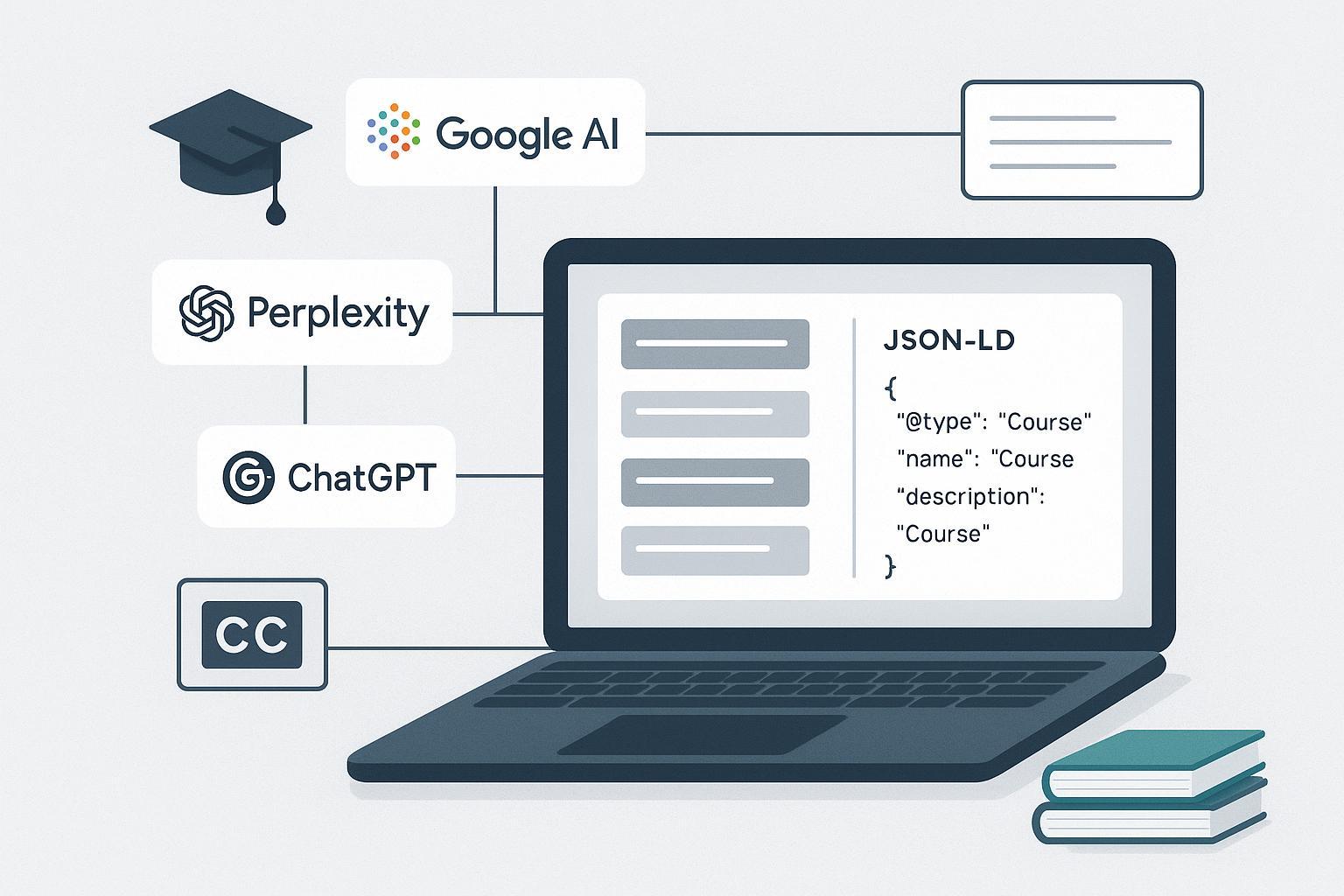
Generative answer engines have reshaped how learners, parents, and administrators discover education resources. If you advise universities, K–12 publishers, or edtech platforms, your goal isn’t just “ranking” anymore—it’s being cited, recommended, and trusted in AI-assembled responses. This guide distills agency-tested practices to make education content extractable, credible, accessible, and measurable across Google AI Overviews, Perplexity, and ChatGPT.
What AI answer surfaces value for education
Answer engines favor pages that make verification easy and learning outcomes clear. Across platforms, the strongest signals repeat: direct, structured answers to the exact questions learners ask; clean HTML hierarchy with scannable summaries; transparent authorship with visible instructor or reviewer bios; timely updates with revision notes; and accessible, non-paywalled pages that load fast and parse cleanly.
On Google’s side, AI features emphasize surfacing helpful content and expanding the set of relevant links via query fan‑out. Practically, pages that already perform well in classic Search are more likely to be included in AI Overviews. See Google Search Central’s “AI Features and Your Website” for guidance, and note industry analyses indicating a high overlap between AI Overview citations and organic results—Search Engine Land’s 2025 study of 75% overlap from top 12 results is one directional example.
Build answer-first content architecture and schema
Education pages that win citations read like excellent lesson plans. Start with the questions a learner or decision-maker is asking—what is the course, who teaches it, prerequisites, outcomes, assessment—and resolve them fast. Add a summary block at the top with 4–6 key facts such as duration, level, modality, start dates, fees, and accreditation. Use semantic headings for each unit and keep paragraphs concise; sprinkle short lists only where they improve clarity.
Implement JSON‑LD aligned to visible content. For the education sector, prioritize Course and LearningResource, and represent instructors with Person. Nest entities properly (Course → instructor Person; Course → provider EducationalOrganization), and validate routinely. Authoritative references: schema.org/Course, schema.org/LearningResource, and schema.org/Person.
Authority and E‑E‑A‑T tailored to educators
Trust is earned through clear expertise, transparent process, and reliable sources. Display instructor/faculty bios with degrees, publications, awards, and a concise “knows about” summary consistent with schema. Cite primary academic sources and standards, link to syllabi updates and reference materials, and maintain editorial transparency with update logs and review cadence. Technical hygiene counts too—HTTPS, privacy notices, and fast, stable delivery. For orientation on quality expectations, review Search Central’s “Succeeding in AI Search” (2025).
Accessibility and internationalization you can’t skip
Education content must be inclusive, and accessibility is not optional. Aim for WCAG 2.2 AA compliance: provide text alternatives for meaningful images; captions and transcripts for audio/video; ensure keyboard operability; fix color/contrast issues; label forms and errors clearly; and publish an accessibility statement. For authoritative guidance, use W3C/WAI’s WCAG 2.2 resources and the WCAG 2.2 specification.
Internationalization is equally important when you serve global learners. Use rel="alternate" hreflang annotations to map language/region variants with reciprocal links and x‑default fallbacks, and keep each page monolingual. Follow Google’s localized versions guidance.
Platform playbooks: Google AI Overviews, Perplexity, ChatGPT
Each answer engine has quirks. Align to the documented behaviors and keep measuring.
Google AI Overviews
Optimize for helpfulness and extractability, keeping essentials high on the page. Monitor AI features via Search Console’s web performance, and treat AI Overviews as additive to classic Search. Use controls judiciously (nosnippet, data‑nosnippet, noindex) if you need to restrict surfaces, per Google’s documentation. Expect high overlap with strong organic pages and some volatility in which links appear.
Perplexity
Perplexity highlights transparent citations and recency. Provide concise summaries, clear headings, and up‑front facts. Prefer accessible pages and canonical resources, and build Academic‑friendly content with strong references and explicit expertise. For platform orientation, see Perplexity’s “Getting started” hub and Help Center: How it works.
ChatGPT (web browsing / Search)
During browsing, ChatGPT surfaces verifiable sources. Keep pages tidy, timely, and easy to cite. Use structured summaries, clear attribution, and direct answers. For official feature overview, review OpenAI’s “ChatGPT Search” help.
Quick comparison
| Engine | What it favors | Monitoring approach |
|---|---|---|
| Google AI Overviews | Helpful pages with strong organic signals; clean structure | Search Console web performance; annotate updates; track queries |
| Perplexity | Transparent citations; concise answers; recency | Observe citation patterns for core queries; log changes weekly |
| ChatGPT (Search) | Verifiable, timely sources during browsing | Spot‑check key prompts; ensure pages are citation‑ready |
Measurement and iteration workflow (agency-friendly)
You can’t optimize what you don’t measure. Set up a repeatable cadence to track citations, recommendations, and visibility across platforms. Define tracked queries by intent (informational, navigational, evaluative), baseline current citation status by engine, implement answer‑first restructures and schema with accessibility and E‑E‑A‑T enhancements, then review weekly to log changes and attribute impact. Connect page edits to movement in citations and referral traffic so stakeholders see progress tied to work.
Disclosure: As part of a real-world agency workflow, some teams use monitoring platforms to track AI visibility and brand mentions. For example, Geneo provides white‑label dashboards that monitor citations and recommendations across ChatGPT, Perplexity, and Google AI Overviews, with metrics like Share of Voice and AI Mentions. See the Geneo agency overview for capabilities; evaluate any tool neutrally against your reporting needs.
For deeper process guidance, you can explore agency resources like GEO Beginner Guide (2025) and the step‑by‑step framework in How to Optimize Content for AI Citations.
Editorial operations that make this stick
Great optimization falls apart without stable editorial operations. Define roles and checkpoints: a strategist maps the query landscape and prioritizes pages; a subject‑matter editor (faculty or credentialed educator) verifies accuracy, outcomes, and references; a technical implementer adds JSON‑LD, fixes hreflang, ensures crawlability and speed; and an accessibility QA lead audits WCAG 2.2 AA compliance, ensuring transcripts, captions, and keyboard paths. Establish a quarterly review to refresh outcomes, update resources, retire obsolete materials, and re‑validate schema. Document changes and rationale to build institutional memory.
Pitfalls to avoid
Over‑markup that doesn’t match visible content, thin updates that only change dates, inaccessible media lacking captions or transcripts, and sloppy internationalization with incomplete hreflang sets all undermine visibility. Keep implementation honest and complete.
Compact action checklist
- Convert priority pages to answer‑first structure with summary blocks at the top.
- Implement Course/LearningResource JSON‑LD aligned to visible content and validate.
- Publish faculty bios with credentials; add citations and update logs.
- Fix WCAG 2.2 AA gaps: alt text, captions, keyboard navigation, contrast.
- Deploy complete hreflang sets with reciprocal links and x‑default.
- Monitor AI citations weekly; annotate changes and attribute impact.
Keep adapting and measure relentlessly
AI answer surfaces will keep shifting, but the core playbook holds: helpful, extractable content, proven expertise, inclusive design, and disciplined measurement. Think of your education site as a living curriculum. Keep it structured, keep it accessible, and keep it honest—and you’ll earn citations where it matters.
For more background on agency workflows in generative search, see the Ultimate Guide to How GEO Agencies Work.