
How to Optimize for Google AI Overview (2025): Best Practices
Discover actionable 2025 best practices for optimizing content and schema for Google AI Overview, boost citation eligibility, and protect brand visibility.
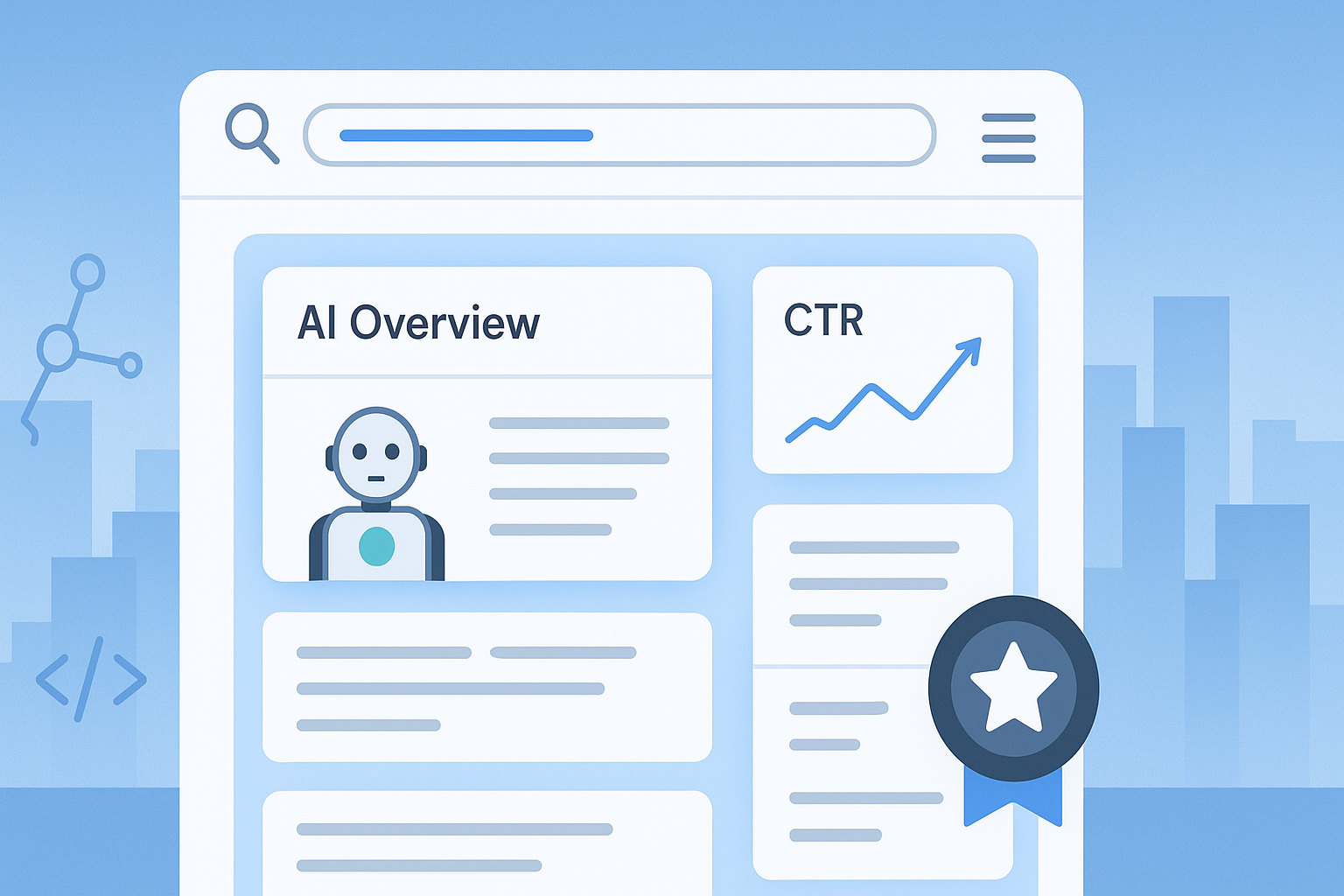
If you’ve seen your organic clicks dip this year, you’re not alone. Google’s AI Overviews (AIO) now appear across a growing share of queries, summarizing answers and surfacing a short list of citations. The brands that win those citations earn visibility and trust—even when total CTR falls. This guide shows you how to structure content, deploy schema, align entities, and run a measurement workflow that puts you back in control.
What AI Overviews are—and what Google actually says
AI Overviews are AI-generated summaries that help searchers “get to the gist of a complicated topic” and then explore cited links for more detail. Google has been explicit: there’s no special submission process; follow standard Search best practices (crawlability, indexability, helpful content) and make your answers easy to extract. See Google’s own guidance in AI Overviews expansion (May 2025) and AI features and your website, plus the technical checklist in Succeeding in AI Search (May 2025).
2025 impact: clicks are down, citations matter more
Across multiple studies, click behavior declines when AIO is present. In a March 2025 U.S. panel (900 adults, 68,879 searches), users clicked traditional links less when an AI summary appeared; zero-click searches rose, per Pew Research Center (2025). Publisher cohorts reported referral traffic declines (often 1–25%) linked to AIO, per Digital Content Next (May–June 2025 report).
On the flip side, cited sites often see relative gains over uncited competitors. Industry trackers observed CTR drops overall but noted uplift for pages that earn citations; see Seer Interactive’s September 2025 update. Treat specific percentages as directional—they vary by device, query type, and methodology.
How to earn citations: structure for extractability
Think of AIO like a discerning editor: it lifts direct, well-structured passages and rewards clarity. Here’s a playbook that consistently improves eligibility.
1) Lead with a direct, passage-first answer
Open pages with a concise 40–70 word summary that answers the core query in plain language, names the primary entity, and offers one actionable step. Follow with scannable H2/H3 sections—definition, how-to, tips, FAQs—and keep paragraphs tight (2–3 sentences). This mirrors patterns seen across credible guides such as Single Grain’s 2025 overview.
2) Deploy structured data that matches visible content
Use JSON-LD. Map content types (Article, FAQPage, HowTo, Product, Organization, Person). Ensure schema aligns with on-page text and includes author/organization details, dates, and sameAs links.
{
    "@context": "https://schema.org",
    "@type": "Article",
    "headline": "How to Optimize for Google AI Overview (2025)",
    "description": "Best-practice guide for earning citations in Google AI Overviews.",
    "author": {
      "@type": "Person",
      "name": "Your Name",
      "sameAs": [
        "https://www.linkedin.com/in/your-profile",
        "https://en.wikipedia.org/wiki/Your_Name"
      ]
    },
    "publisher": {
      "@type": "Organization",
      "name": "Your Brand",
      "sameAs": [
        "https://yourbrand.com",
        "https://www.wikidata.org/wiki/Q000000"
      ]
    },
    "datePublished": "2025-12-14",
    "dateModified": "2025-12-14"
  }
{
    "@context": "https://schema.org",
    "@type": "FAQPage",
    "mainEntity": [{
      "@type": "Question",
      "name": "Do structured data help with AI Overviews?",
      "acceptedAnswer": {
        "@type": "Answer",
        "text": "Schema adds machine-readable context that improves entity recognition and eligibility for AI features when it reflects visible content."
      }
    }]
  }
{
    "@context": "https://schema.org",
    "@type": "HowTo",
    "name": "Refresh a page for AIO eligibility",
    "step": [{
      "@type": "HowToStep",
      "text": "Add a 50-word direct-answer summary under the H1."
    }, {
      "@type": "HowToStep",
      "text": "Align Article/FAQ/HowTo schema to visible content."
    }, {
      "@type": "HowToStep",
      "text": "Link author and organization via sameAs to credible profiles."
    }]
  }
3) Align entities with the Knowledge Graph
Use Organization and Person schema with sameAs pointing to canonical profiles (Wikidata, Crunchbase, LinkedIn), and cite verifiable facts on-page. Build internal link clusters that reinforce topical authority. While Google doesn’t guarantee inclusion based on entity linking, practitioners consistently see better grounding.
4) Fix indexability and canonicalization
Confirm HTTP 200 status codes, allow Googlebot, minimize client-side rendering that hides primary text, and set clear canonicals for duplicates. Google emphasizes these fundamentals in Succeeding in AI Search (May 2025).
5) Keep pages fresh and strengthen E-E-A-T
Update high-value pages quarterly with current stats, examples, and expert bylines. Use Person schema to expose credentials; add Organization schema with sameAs for official profiles. YMYL topics require stricter sourcing and disclosures, per AI features and your website.
AIO mini-audit: what to check before you publish
| Area | What “good” looks like | Quick check |
|---|---|---|
| Passage summary | 40–70 words, answers the query, includes the entity, one actionable step | Present under H1 |
| Schema | JSON-LD for Article/FAQ/HowTo/Product; matches visible content | Valid via Rich Results Test |
| Entities | Person/Organization linked via sameAs to canonical profiles | Linked + consistent |
| Indexability | HTTP 200, allowed crawlers, clean canonicals, minimal hidden text | Server logs + Search Console |
| Freshness & E-E-A-T | Recent dates, expert byline, references to 2025 data | Visible on-page |
Vertical playbooks (quick wins)
Healthcare (YMYL)
- Author/editor bios with credentials; Person schema includes occupation and sameAs to licensing boards.
- Cite peer-reviewed sources; add dates and disclaimers. Separate general information from medical advice.
Ecommerce
- Use Product schema (offers, aggregateRating, review). Provide comparison tables, pros/cons, “best for” use cases, and buyer FAQs.
- Sync product data with Merchant Center and ensure fast performance.
Finance
- Show credentials (CFA/CPA) and link to regulators/data providers via Organization sameAs. Use fresh data tables and explain methodologies.
- Avoid speculative tone; update frequently and disclose assumptions.
Mobile vs. desktop patterns (with caveats)
Observations suggest desktop AIO may take more screen real estate and appear more often for complex queries, while mobile experiences favor quick shopping or informational summaries. Citations can differ by device and across refreshes. Treat these as patterns, not rules, given Google has not published device-specific inclusion rates. A practical approach: design concise, scannable sections for mobile, and include deeper passages and a compact table for desktop readers. Makes sense, right?
Measurement and optimization workflow (with disclosure)
Disclosure: Geneo is our product.
You need to quantify inclusion, citations, and sentiment—then iterate. A practical quarterly cycle looks like this:
- Define KPIs: AIO inclusion rate for target queries, citation frequency per page/domain, impression estimates, sentiment of mentions, and quality metrics such as accuracy, relevance, and personalization (LLMO). For deeper background on metrics, see the LLMO Metrics Guide.
- Track cross-engine visibility and citations; log query → AIO presence → cited links → sentiment → changes over time. For foundational concepts, review AI Visibility Explained.
- Iterate quarterly: refresh passage-first summaries, update schema, fix indexability issues, strengthen author bios, and benchmark competitors. For audit tooling and examples, see GEO audits and tracking context.
Troubleshooting notes
- De-citation events: when a page loses its citation, compare passage summaries, freshness, and schema alignment versus newly cited competitors. Often, the fix is a clearer direct-answer block plus updated data.
- Conflicting entities: if AIO misattributes, tighten sameAs links, add unambiguous on-page facts, and standardize internal links that reinforce the topic cluster.
- Render-blocked content: if key text loads client-side only, server-render that section or provide pre-rendered HTML so Google can parse it reliably.
Example schema snippets for Product and Organization
{
    "@context": "https://schema.org",
    "@type": "Product",
    "name": "Example Pro Widget",
    "image": ["https://yourbrand.com/images/widget.jpg"],
    "description": "Durable widget for enterprise teams.",
    "brand": {
      "@type": "Brand",
      "name": "Your Brand"
    },
    "offers": {
      "@type": "Offer",
      "priceCurrency": "USD",
      "price": "99.00",
      "availability": "https://schema.org/InStock",
      "url": "https://yourbrand.com/widget"
    },
    "aggregateRating": {
      "@type": "AggregateRating",
      "ratingValue": "4.6",
      "reviewCount": "124"
    }
  }
{
    "@context": "https://schema.org",
    "@type": "Organization",
    "name": "Your Brand",
    "url": "https://yourbrand.com",
    "logo": "https://yourbrand.com/logo.png",
    "sameAs": [
      "https://www.wikidata.org/wiki/Q000000",
      "https://www.crunchbase.com/organization/your-brand",
      "https://www.linkedin.com/company/your-brand"
    ]
  }
Keep your cadence: quarterly audits, monthly refreshes
Plan quarterly AIO audits and monthly micro-refreshes for priority pages. Rotate through:
- Passage-first summary improvements
- Schema validation and updates
- Entity alignment and sameAs consistency
- Fresh data/statistics and expert bylines
- Device checks (mobile scannability, desktop tables)
Final reminder
There’s no magic submission for AI Overviews. Earn citations by structuring direct answers, proving expertise, keeping your data fresh, and measuring what matters. If you want a practical way to monitor and iterate across Google AIO and other AI engines, consider piloting a workflow with Geneo.