
How Multi-Agent AI Search Will Change GEO in 2025: Key Trends
Discover how multi-agent AI search is reshaping GEO in 2025. Insights, data & expert guidance for brands. Read now to future-proof your strategy!
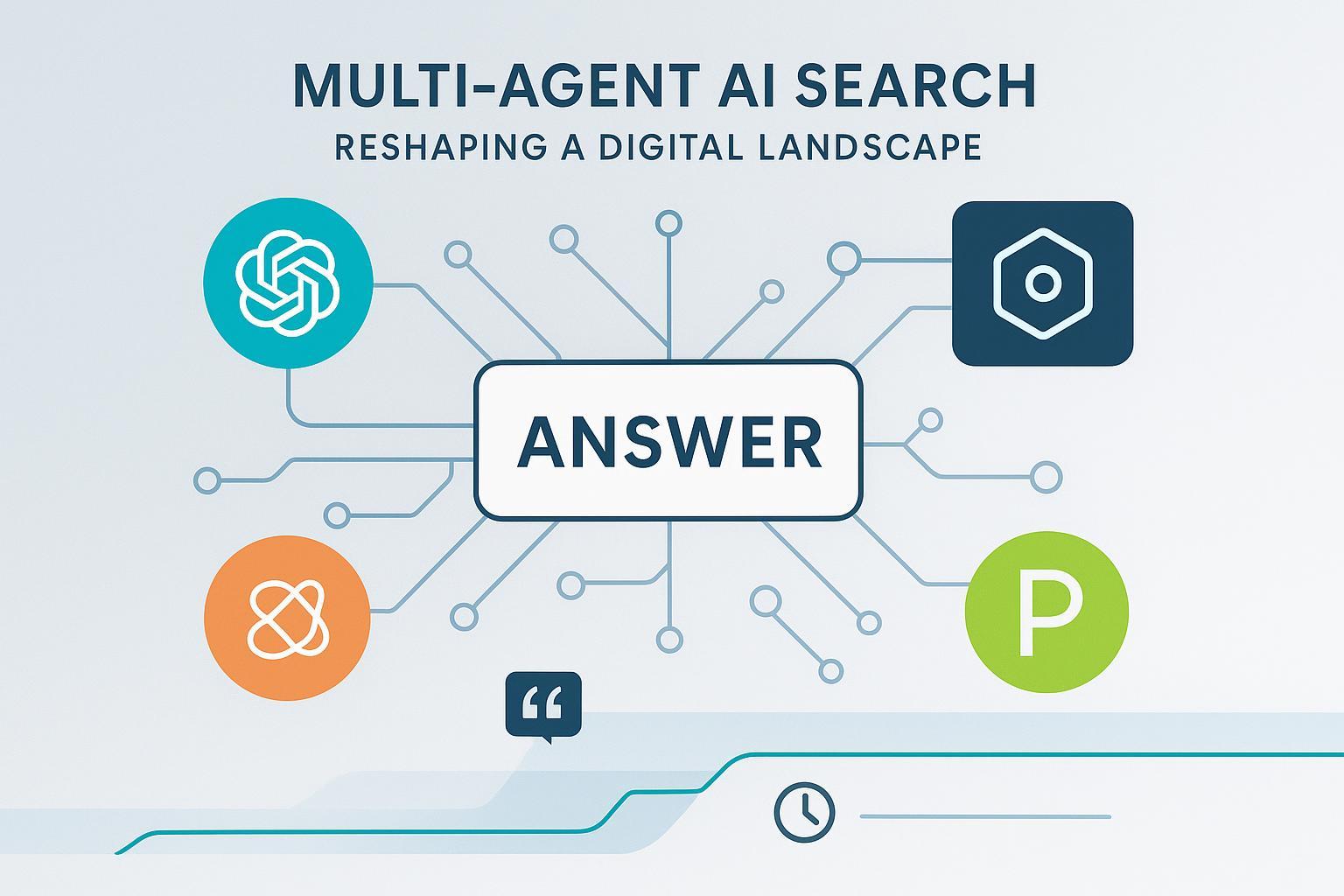
Why multi-agent search matters now (2025)
Single-agent “browse and summarize” is giving way to orchestrated research systems. In 2025, leading engines formalized multi‑agent workflows where a planner coordinates specialized subagents for retrieval, synthesis, and citation verification. Anthropic describes Claude’s Research as a lead agent that plans, spawns subagents for parallel searches and workspace tasks, and then hands off to a dedicated citation process, built for reliability and observability. See the engineering note in Anthropic’s multi‑agent research system (June 2025) and their production guidance on harnesses for long‑running agents in Effective harnesses for long‑running agents (Nov 2025).
Other engines show similar emphasis on provenance. OpenAI confirms that when ChatGPT uses its search/browse modes, responses include citations in the UI, per ChatGPT Search for Enterprise and Edu (OpenAI Help, 2025). Google’s AI Overview (AIO) positions answers as jumping‑off points while urging site owners to publish clear, helpful content; see Google Search Central’s guidance on AI features and your website (2025). Adoption momentum is strong but uneven—McKinsey’s 2025 AI survey overview notes most organizations are using AI and 62% are at least experimenting with agents. IBM cautions that production value requires governance, observability, and an operating model; see IBM’s “AI agents: expectations vs. reality” (Feb 2025).
For GEO—Generative Engine Optimization—the consequence is clear: agentic search raises the bar. It rewards authoritative entities, citation‑friendly content, and freshness with auditable change‑logs. Keywords alone won’t earn you consistent mentions or links in AI answers.
What’s changing in optimization signals
Multi‑agent systems cross‑verify across sources and emphasize provenance. That shifts the optimization stack in four practical ways.
- Entities and authority: You need canonical, well‑defined entity pages with first‑party data and corroborating references. Lead agents and critic/evaluator subagents favor sources that are consistent and cross‑checked.
- Citations hygiene: Neutral phrasing, explicit methods and time windows, and standards‑compliant documentation make it easier for citation agents and UI policies to include your links. OpenAI’s search mode and Claude’s Research emphasize transparent sourcing.
- Freshness discipline: For time‑sensitive queries, agent pipelines show stronger recency bias than traditional SERPs. Visible “Updated on {date}” plus a concise change‑log helps evaluators trust your material.
- Structured content and schema: Modular architecture with FAQ/HowTo/Product/Article schema, clear headings, and stepwise logic improves agent parsing, even if schema isn’t a guarantee by itself.
| Old SEO emphasis | GEO emphasis for agentic search |
|---|---|
| Keywords and dense keyword matching | Entities with canonical definitions and corroboration |
| Long monolithic pages | Modular sections, FAQs/HowTos, stepwise logic |
| Occasional updates | Visible update cadence with change‑logs |
| Thin or vague sourcing | Neutral claims with auditable methods and descriptive anchor‑text citations |
| Schema as afterthought | Schema and clean structure to aid agent parsing |
Note: Perplexity’s UI surfaces citations, but official 2025 docs on exact formatting and freshness thresholds are limited. Treat any specific claims about its policies as provisional; continue monitoring for updates.
Content architecture for agent workflows
Think of agentic search like a newsroom staffed by specialists. A planner sets the angle, researchers gather sources, a fact‑checker validates citations, and an editor crafts the final answer. Your content needs to be ready for that production line.
- Modular sections and explicit logic: Break topics into scannable blocks with crisp headings and 3–6 step sequences where relevant. This reduces ambiguity and helps subagents summarize accurately.
- Methods, time windows, and data hygiene: Bind performance claims to a method statement and time window. For example, “Based on a 2024–2025 dataset from North America, using the X methodology…” If you publish benchmarks, share enough detail to be auditable.
- Neutral phrasing: Avoid marketing claims without evidence. Write in precise, calm language that makes it easy for citation agents to lift lines and link them.
- Structured schema: Apply FAQ/HowTo/Product/Article schema where appropriate. Don’t rely on schema alone; align it with clean HTML, accessible pages, and reliable anchors.
- Engine‑specific realities: Respect what engines disclose. ChatGPT’s search mode includes citations when browsing is used (OpenAI Help). Claude’s Research is explicitly citation‑forward (Anthropic Support). Google’s AIO is designed to point users to helpful sources but doesn’t promise any schema‑based inclusion. Perplexity’s specifics remain underdocumented—monitor changes before assuming rules.
If you’re new to GEO terminology and measurement, start with a foundational primer on AI visibility and exposure in AI answers: AI Visibility definition and measurement (Geneo).
Measurement that leadership will trust
Traffic alone won’t capture GEO value. Executives want visibility, quality, and business impact.
- AI visibility and citations: Track whether your brand is mentioned, whether a link is present, and whether it’s first‑party or third‑party. Segment by engine (ChatGPT, Claude, Perplexity, Google AIO) and by query clusters.
- Sentiment: Capture the tone of mentions in AI answers—positive, neutral, or negative—especially for comparative queries.
- Share‑of‑voice: Benchmark mentions and links against competitors over time.
- Quality metrics: Measure answer accuracy, relevance, and personalization with an explicit rubric. A practical framework is outlined in LLMO metrics for measuring accuracy, relevance, and personalization.
- Business KPIs: Annotate GEO changes (new entity pages, schema updates, link wins) against pipeline metrics—qualified leads, opportunities, revenue—so leaders can see cause and effect.
IBM’s guidance on operating models and observability reinforces the need for audit trails and governance (see IBM’s operating model perspective, Oct 2025). In short: measure what matters, record how it changed, and tie it to outcomes.
Brand and agency playbook (2025–2026)
If you’re leading GEO, treat it as a channel with cadence, governance, and instrumentation.
- Cadence: Update cornerstone pages quarterly; refresh fast‑moving pages monthly. Add visible “Updated on {date}” and maintain a short change‑log.
- Multi‑engine monitoring: Track visibility, citation frequency, link presence, and sentiment across engines. Maintain a share‑of‑voice dashboard with query clusters and competitor slices. For agencies that need multi‑brand operations, review white‑label multi‑brand monitoring models.
- Governance and observability: Version control your content, log changes, and document methods. If you adopt internal agents for content operations, follow enterprise guardrails—observability, decision logging, least‑privilege tools, sandboxing, and kill‑switches—as described by IBM.
- Regional considerations: If your market relies on Google AI Overview and has regional nuances, explore stack-specific guidance such as Google AI Overview tracking tools and regional considerations (China focus).
Example workflow: Monitoring and iterating GEO across engines
Disclosure: Geneo is our product.
Below is a vendor‑neutral workflow you can run with in‑house tools or platforms that support multi‑engine monitoring. It maps to how multi‑agent search evaluates and cites content.
- Define entities and queries: Establish canonical entity pages (products, concepts, brand) and map them to query clusters. Include definitions, first‑party data, and 1–2 corroborating third‑party references per page.
- Publish structured, citation‑friendly content: Use clean headings, stepwise logic, and neutral claims with explicit methods and time windows. Apply relevant schema.
- Monitor visibility and sentiment across engines: Track mentions, links, and tone in ChatGPT, Claude, Perplexity, and Google AIO. Segment by query type and competitor.
- Annotate changes and tie to KPIs: When you update content or win citations, log the change and review impact on qualified leads, opportunities, and revenue.
- Iterate monthly: Address gaps (missing entity pages, stale sections, unclear methods). Add or refine corroborating references that improve provenance.
This is the area where a platform like Geneo can help operationalize the routine (multi‑engine monitoring, citation tracking, sentiment analysis, and optimization suggestions) while you retain vendor‑neutral strategy and governance.
What’s next
If multi‑agent AI search is reshaping the ground under traditional SEO, GEO is your playbook for stability.
- Focus on entities, provenance, and freshness discipline.
- Instrument visibility, citations, sentiment, and share‑of‑voice—then bind everything to business KPIs.
- Keep a monthly refresh rhythm and a visible change‑log.
Engines will keep evolving—watch for updates to citation policies, schema parsing behavior, and Perplexity’s documentation. For agency teams, ensure your operating model covers governance and observability, and consider dedicated tooling if you manage many brands at once. When you’re ready to operationalize multi‑engine monitoring and iterate with confidence, explore Geneo’s homepage to see how this workflow can be supported without locking you into a single engine’s quirks.