
Meta’s “Business AI” in 2025: Automation Without the Replacement Hype
Discover how Meta Business AI, reported in October 2025, augments—not replaces—human sales reps. Get readiness tips, privacy alerts, and expert insights.
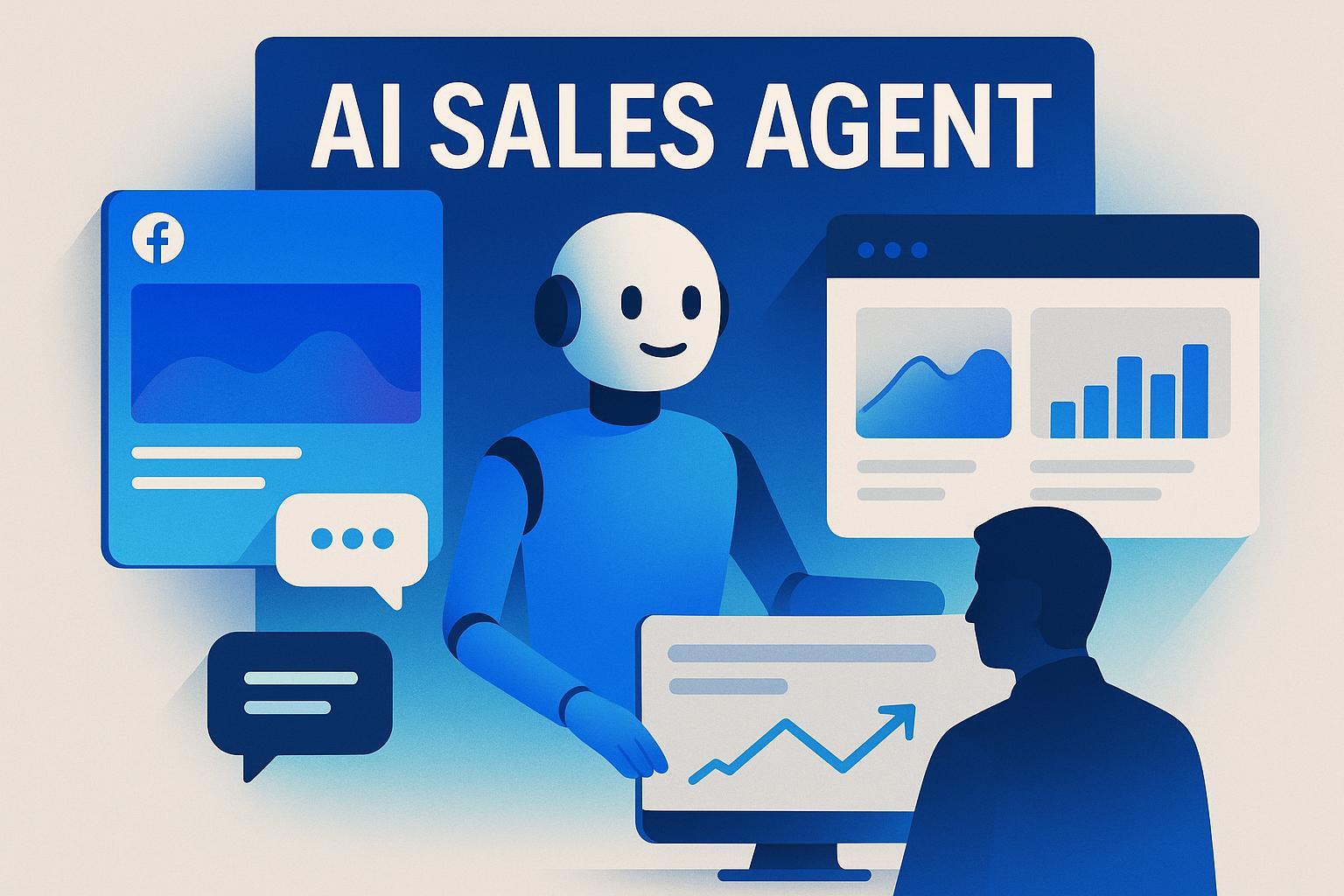
Updated on Oct 3, 2025: Multiple reputable trade outlets reported Meta’s “Business AI” as a customizable, always‑on agent for ads and websites. We have not found a dedicated Meta product page confirming all details; treat specifics as evolving. Next checks: Oct 6, Oct 13, Oct 20.
What’s been reported—and what’s not yet official
Several marketing trades on Oct 2, 2025 described Meta’s “Business AI” as a branded AI agent that businesses can deploy in Meta ads and on their own sites to answer product questions, qualify leads, and guide purchases. Coverage highlights include a training approach based on first‑party content (site, catalog, social posts, ad campaigns) and pilots for U.S. SMBs.
- According to the Oct 2, 2025 feature summary in Marketing Dive’s report on streamlining AI for brands, Business AI is positioned to help guide shoppers and assist brands across Meta surfaces and websites.
- Social‑focused coverage like the Oct 2, 2025 analysis from Social Media Today on expanding AI ad tools and website agents describes the agent learning from a company’s existing content.
- Ad industry reporting—see Adweek’s Oct 2, 2025 overview of AI agents for ads and shopper assistance—notes the tool’s availability in ads and the option to embed it on third‑party sites.
As of Oct 3, 2025, we have not located a clearly indexed Meta Newsroom post that formally introduces “Business AI” with setup docs, pricing, or a feature matrix. That absence doesn’t invalidate the reporting, but it does mean marketers should treat channel coverage, pricing, and handoff behaviors as provisional until Meta publishes official documentation.
Can it really replace human sales agents?
Short answer: No credible evidence suggests Meta claims full replacement. The media framing centers on automation of routine presales conversations, triage, and scale—not eliminating human roles. Analyst perspectives in 2024–2025 reinforce this augmentation thesis: sales outcomes still depend on human oversight, clean data, and process discipline. For instance, Bain’s 2025 technology report emphasizes that AI’s productivity gains in sales are gated by data quality and governance, not a swap‑out of people; see the context in Bain’s 2025 perspective on AI transforming productivity in sales.
Our view: Treat Business AI as a conversion layer that absorbs FAQs, resolves objections faster, and deflects unnecessary calls or chats, while human reps focus on high‑consideration, nuanced interactions.
Privacy and data governance: the update that matters
One official development does affect how you plan: On Oct 1, 2025 Meta announced it will start personalizing content and ad recommendations based on people’s interactions with generative AI features—AI chats included—starting Dec 16, 2025. See the statement in Meta Newsroom’s Oct 1, 2025 announcement about AI‑driven personalization. Trade and tech outlets echoed the implication that conversation data could influence targeting; for broader context, review TechCrunch’s Oct 1, 2025 coverage of targeted ads informed by AI chats.
What this means for brands:
- You should disclose AI‑assisted chat to users and explain how data may be used (and obtain consent where required under laws like CCPA/CPRA or GDPR).
- Avoid training on sensitive personal data; set clear guardrails for topics the agent should decline.
- Prepare opt‑out/configuration paths (site privacy center, messaging disclosures) and log chat data usage for audits.
Readiness checklist: content hygiene, handoffs, and guardrails
If you plan to pilot Business AI, start with the fundamentals. These steps both improve agent quality and reduce operational risk.
- Inventory FAQs and objection handlers: Capture high‑intent questions (shipping, fit/sizing, compatibility, pricing, return policy, warranties), and align them to your catalog taxonomy. Keep product data fresh and variant mapping accurate.
- Tone and guardrails: Define brand voice, restricted topics, and “no‑go” areas. Provide fallback responses and escalation cues (e.g., after two “I’m not sure” replies, or when the user requests a human).
- Human handoff rules and SLAs: Specify triggers for agent‑to‑human transfer, staffing windows, and response time standards. Ensure handoffs preserve chat history for continuity and QA.
- Privacy notice updates: Add language that explains AI‑assisted chat, retention, and ad‑personalization implications. Consider region‑specific consent banners.
- Content humanization: Even accurate answers can sound robotic. Apply best practices to keep responses personable; for guidance, see Humanize AI Text: The Ultimate Guide for Engaging Content.
Where content ops can help: Teams often need to create or refresh FAQ pages, comparison guides, and landing copy that the agent will learn from. The AI writing and SEO workflow in QuickCreator can be used to spin up, organize, and update these resources quickly so your training corpus stays clean and current. Disclosure: QuickCreator is our product.
Experiment design: how to test without the hype
You won’t know the ROI until you test rigorously. Design experiments that isolate agent impact and produce decision‑ready data.
-
Click‑to‑message ads (Facebook/Instagram)
- Test A: Standard flow, no AI agent. Test B: Business AI enabled.
- KPIs: Conversion rate (CVR), cost per acquisition (CPA), time‑to‑first‑response, lead qualification rate, and human‑handoff rate.
- Controls: Same audience, creative, and offer; rotate prompt templates weekly and collect CSAT after chats.
-
On‑site agent on high‑intent pages
- Target product detail pages (PDPs), cart, and pricing pages.
- KPIs: Assisted conversion rate, average order value (AOV), deflection of repetitive inquiries, and exit rate reduction.
- Segmentation: Compare new vs. returning visitors; track performance by category.
-
Prompt library iterations
- Build reusable response templates for common objections.
- Weekly review for accuracy and tone; prune low‑performing prompts.
- Tie prompts to product attributes (size charts, compatibility matrices, service tiers) updated from your catalog.
For foundational expectations of chatbot capabilities and limitations, you may also examine Claude vs. ChatGPT: capabilities and features for chatbots to inform prompt design and error handling.
Measurement and attribution: instrument the agent’s impact
Set up clean measurement so you can attribute lift (or lack thereof) to the agent rather than confounding variables.
- Event instrumentation: Log agent engagement start, “qualified lead” flag, human handoff, and assisted conversions. Separate agent‑assisted paths in analytics using UTM parameters and custom events.
- Assisted conversion logic: Define windows and rules for attribution (e.g., a chat within 7 days that precedes purchase counts as assisted). Avoid double‑counting across channels.
- FAQ schema and content ops: Publishing clear FAQs can reduce repetitive queries and improve SEO. For technical implementation, see CMS SEO Best Practices: Key Features & Checklist for 2024/2025.
- Data quality audits: Reconcile catalog data, pricing, and inventory nightly; stale answers erode trust and conversion.
Replacement myth vs. operational reality
Even strong AI agents don’t close nuanced deals alone. Complex B2B configurations, financial conversations, and high‑stakes purchases require empathy, negotiation, and authority—human skills that AI can augment but not replicate. Industry context in 2025 consistently points to augmentation: IBM’s enterprise guidance underscores that AI agents improve efficiency and streamline workflows rather than replace sales reps; see IBM Think’s 2025 guidance on AI agents in sales. Meanwhile, macro findings on sales ops stress prerequisites like data hygiene and governance (again, see Bain 2025 above). In short: invest in people and process first, then layer automation.
What to watch next (and how to prepare)
- Official docs: A product page or Help Center guide for “Business AI” covering setup, channels (Messenger, WhatsApp, Instagram DMs), pricing, and human‑handoff controls.
- Privacy specifics: Clear mapping of AI chat data to ad targeting controls, consent flows, and retention policies.
- Early case studies: Directional benchmarks on conversion lift, lead quality, and operational savings.
If your team needs to stand up and continuously update the FAQs, comparison pages, and testing documentation that feed the agent, AI‑assisted content ops in QuickCreator can help you move fast while maintaining structure and SEO hygiene.
Our update protocol
We will monitor Meta’s official channels and refresh this article as the facts evolve.
- Updated on Oct 3, 2025: Verified media reports; awaiting Meta newsroom confirmation.
- Next checks: Oct 6, Oct 13, Oct 20.
Fact vs. opinion note: All product‑specific details are based on Oct 2, 2025 trade coverage and may change with official Meta documentation. Privacy implications are grounded in Meta’s Oct 1, 2025 announcement about AI‑informed personalization; operational recommendations here reflect industry best practices and our experience piloting AI agents in sales and support.