
Top Questions Manufacturing Customers Ask AI Assistants — Agency Optimization FAQ
Discover key AI questions from manufacturing buyers and learn how agencies can optimize content for AI citations and visibility across leading assistants.
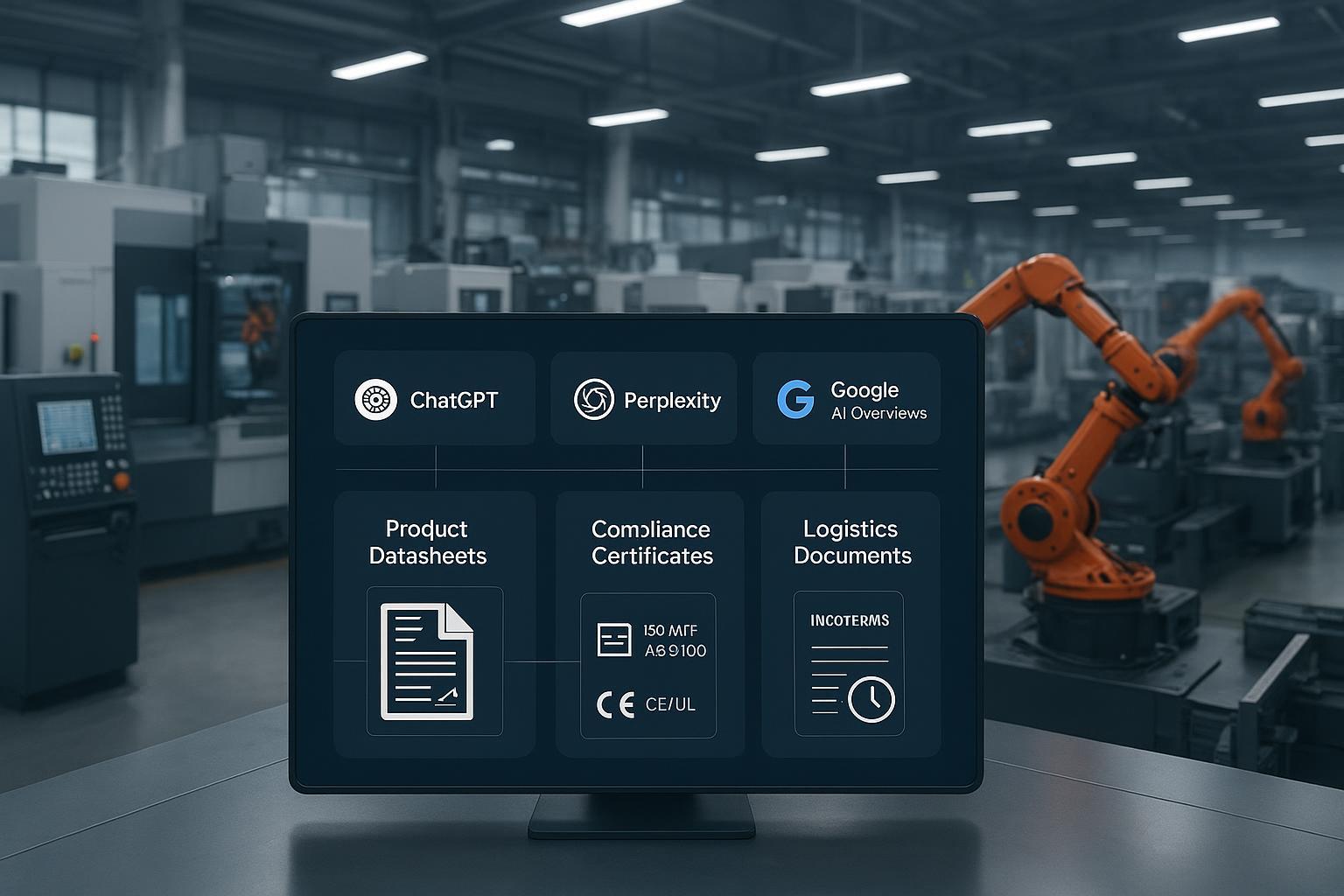
Manufacturing buyers now ask AI assistants to vet vendors before they ever reach out. The questions are concrete: specs, compliance, logistics, integration, and sustainability. Your job, as an agency, is to make those answers safe to cite and easy to recommend across ChatGPT, Perplexity, and Google’s AI Overviews. Google’s documentation explains that inclusion in AI features depends on crawlable, high‑quality, unique content that systems can retrieve and summarize; see Search Central’s AI features overview (2025). For measurement and iteration, industry guides emphasize visibility‑first KPIs and cross‑engine tracking in zero‑click environments; see Search Engine Land’s GEO/AEO tracking guidance (2025).
Buyer stages, the questions they ask, and what agencies should publish
| Buyer stage | Typical AI assistant questions | Optimization assets agencies should ship |
|---|---|---|
| Discovery | “Which suppliers meet my basic spec?” “Will this survive washdown?” “Does it fit my PLC/system?” | Product datasheets with ranges (temperature, IP/NEMA, materials, tolerances), application notes, integration pages (PLC protocols; ISA‑95 Level 3/4 context). |
| Evaluation | “Is the manufacturer certified (ISO/IATF/AS9100, CE/UL)?” “What are typical lead times, MOQs, warranty terms?” | Certification pages with verification links (IAQG OASIS; UL Product iQ), CE Declarations of Conformity, procurement tables (lead‑time tiers, MOQs), warranty/RMA policy. |
| Qualification | “Can you ship under specific Incoterms and provide traceability or ITAR compliance?” “Do you have EPDs/LCA?” | Export controls documentation (ITAR classifications, end‑use policies), Incoterms coverage with named place, traceability/CoC/MTR procedures, sustainability pages with EPDs/LCA. |
FAQ: What do manufacturing customers actually ask AI assistants—and how do we optimize for inclusion?
1) “Which suppliers meet my basic spec for this part or assembly?”
AI assistants favor pages that state precise ranges and standards, not vague claims. Publish datasheets with operating temperature, ingress protection (IP65, IP67, IP69K), materials (304 vs. 316L), tolerances, and electrical ratings, and spell out application conditions like washdown and vibration. Make PLC compatibility explicit and, where relevant, align interface language with ISA‑95 (IEC 62264) for Level 3/4 integration so systems can map concepts consistently; see ISA’s overview of ISA‑95 (publisher; ongoing).
Good practice is to add short “Where it’s commonly used” notes per product and keep tables scannable. Assistants can safely quote pages that present spec ranges alongside usage contexts.
2) “Is this product compatible with my environment and PLC/system integration?”
Compatibility questions blend environmental ratings with system interfaces. Create integration pages that list supported protocols (e.g., EtherNet/IP, PROFINET, Modbus TCP), tag naming conventions, and sample payloads. Include a brief cybersecurity posture (network segmentation, patch practices) because risk questions often surface adjacent to integration.
When your content names interfaces using ISA‑95 terminology and shows examples, retrieval systems are more likely to treat it as authoritative and cite it.
3) “Is the manufacturer certified—ISO 9001, IATF 16949, AS9100—and are products CE/UL compliant?”
Certification pages should be an Organization‑level hub: certificates, scope, expiry, surveillance/audit cadence, and verification links. For aerospace, IAQG’s OASIS directory is the canonical place buyers and assistants check; for UL compliance, Product iQ and UL directories let them verify listings. See IAQG OASIS (publisher; ongoing) and UL Solutions’ Product iQ (publisher; ongoing). For CE, outline the core steps—identify applicable legislation and standards, determine if a notified body is required, compile technical documentation, conduct conformity assessment, issue the EU Declaration of Conformity, and affix the mark—consistent with European Commission CE guidance (2025).
Build the hub as plain‑English pages with downloadable PDFs and descriptive metadata. Avoid unsupported “Certification” schema; assistants will still cite clear, verifiable pages.
4) “What are typical lead times, MOQs, warranty terms, and service policies?”
Procurement queries need concrete numbers. Publish a single procurement page that explains lead times by quantity/configuration, MOQs per product family, and warranty/RMA procedures. Add a tooling ownership statement if applicable. Clarify Incoterms implications for delivery and risk transfer, and name the place precisely (e.g., FCA – Chicago, IL; CIF – Port of Hamburg). ICC materials remain the canonical reference; see ICC’s Incoterms 2020 resources (publisher; ongoing).
Pages like this are highly citeable because assistants can summarize tabled numbers and conditions without ambiguity.
5) “Can you ship under specific Incoterms and provide traceability or ITAR compliance?”
Qualification‑stage buyers ask about export controls and traceability. Provide jurisdiction classifications, end‑use restrictions, licensing procedures, and recordkeeping policies, and link to official agencies for verification. See DDTC’s ITAR knowledge base (publisher; ongoing). Add traceability statements (Certificates of Conformance, Material Test Reports), serial/lot tracking, and supplier screening protocols.
Publishing a single Export & Compliance page with these elements gives assistants a safe source to cite and reduces back‑and‑forth during qualification.
6) “Do you have EPDs/LCA for sustainability requirements?”
EPDs are Type III environmental declarations based on LCA and verified against product category rules. Provide links to program operator pages and your verified EPDs, and define recyclability and end‑of‑life steps. The framework is governed by standards such as ISO 14025 (publisher; standard).
A concise Sustainability hub that lists EPDs/LCA, PCR references, and end‑of‑life guidance is straightforward for assistants to cite and for buyers to trust.
7) “How can agencies monitor and improve AI citations and recommendations?”
Zero‑click discovery is common in AI answers, so agencies need to measure citations and iterate content. Track metrics like AI mentions, share of voice, total citations, platform breakdown, and sentiment, and run ongoing audits aligned with best practice; see Search Engine Land’s GEO/AEO tracking guidance (2025).
Disclosure: Geneo (Agency) is our product. In practice, agencies can use Geneo or similar tools to monitor brand mentions across ChatGPT, Perplexity, and Google AI Overviews, aggregate signals like AI Mentions and Share of Voice, and export client‑ready dashboards to inform iteration. For a demonstrative reference of multi‑engine monitoring patterns, see Geneo’s public query report example showing cross‑engine visibility outputs.
Rapid action checklist for agencies serving manufacturing clients
- Map buyer stages to questions and publish the missing assets: datasheets, integration pages, certifications hub, procurement tables, export/sustainability hubs.
- Keep content crawlable and verifiable; avoid unsupported structured data and favor plain‑English pages with downloadable documentation.
- Add verification links (OASIS, UL Product iQ, CE DoC, ITAR/agency references) so assistants can safely cite your pages.
- Measure and iterate: track AI citations and mentions across engines; update FAQs and documentation when gaps appear.