
How to Run an AI Visibility Audit: Step-by-Step for Agencies
Learn step-by-step how agencies can audit brand visibility across ChatGPT, Perplexity, and Google AI Overview, and deliver client-ready, white-label reports.
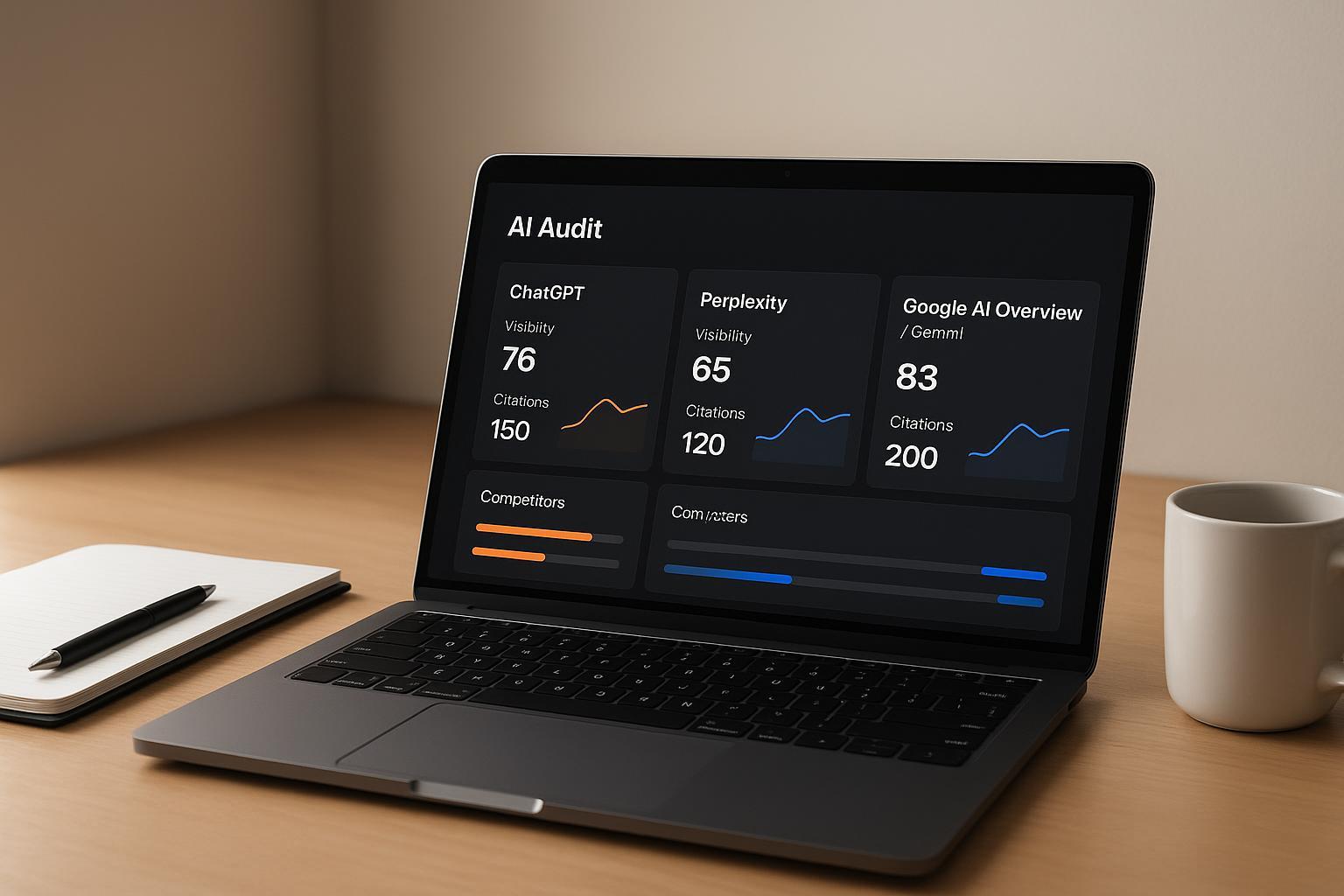
How to Perform an AI Visibility Audit for Your Brand: A Comprehensive Step-by-Step Guide by Geneo
If your clients are asking “How do we show up in ChatGPT or Perplexity?” you need an audit you can run, repeat, and present in a client-ready report. That’s what this guide delivers: a practical, agency-first workflow that measures AI visibility across multiple engines and turns findings into a white-label deliverable.
Quick definition: AI visibility is the degree to which your brand is mentioned, cited, or recommended inside AI answers across engines like ChatGPT, Perplexity, and Google AI Overviews. For a deeper primer on concepts and metrics, see the explainer on AI visibility from Geneo’s blog: AI visibility definition and why it matters for brand exposure in AI search.
1) Set scope and governance
Start like an auditor, not a tinkerer. Define what “good” looks like and who owns what.
Objectives: inclusion (does the brand appear?), accuracy (are claims correct?), source quality (are citations authoritative?), and actionability (does the answer guide users to you?).
Roles: audit lead, data verifier, client-facing owner, and escalation to legal for sensitive claims.
Cadence: monthly monitoring with a quarterly deep audit. Document your sampling method and scoring rules so results are reproducible.
For governance structure and reproducibility, the Institute of Internal Auditors outlines practical controls for AI-related reviews in the IIA’s AI Framework (2024 update).
2) Build a topic inventory and intent map
List 20–100 topics your client cares about: branded queries, product categories, head-to-head comparisons, troubleshooting, and “best X for Y” scenarios. Tag each with intent (informational, navigational, transactional) and priority. This inventory becomes your prompt universe and ensures you’re auditing what actually moves pipeline.
A useful mindset: think in “use cases,” not keywords. What would a buyer really ask an AI assistant at each stage? Map those to prompts you’ll test across engines.
3) Design a stratified sampling matrix (by engine and mode)
Different engines behave differently, so your sampling must account for it. Perplexity is retrieval-first with clickable citations; Gemini/AI Overviews and ChatGPT often rely more on concentrated sources or pre-trained knowledge. That difference changes how you weigh citations and why you must test multiple prompt variants, as discussed in UOF Digital’s overview of AI visibility across fragmented search and Search Engine Land’s explainer on how engines generate and cite answers.
If you need a quick refresher on platform nuances, this comparison guide can help: ChatGPT vs. Perplexity vs. Gemini vs. Bing — monitoring differences. For Google AI Overview specifics and tracking approaches, see this primer on AI Overview tracking tools and GEO context.
Build a table that crosses Topic × Prompt Variant × Engine/Mode. Keep metadata so you can replicate runs.
Topic | Prompt variant | Engine/mode | Locale | Model/browsing | Notes |
|---|---|---|---|---|---|
Brand basics | “Who is [Brand]?” | ChatGPT (no browsing) | US | gpt-4o | Baseline knowledge |
Category fit | “Best [category] tools for SMBs” | Perplexity (default) | US | Web retrieval | Clickable citations |
Comparison | “Brand A vs Brand B for [use case]” | Google AI Overviews | US | Gemini (Search-integrated) | Source mix varies |
Pro tip: sample 3–5 prompt variants per topic (canonical phrasing, natural language, and one edge-case). That variety reduces single-prompt bias.
4) Execute baseline runs and capture evidence
Run your matrix once per engine to establish a baseline. Treat each run like a lab experiment: timestamp everything and keep it immutable.
Minimum evidence to capture per run:
Full prompt and variant ID
Platform and mode (e.g., Perplexity long-form)
Model/version (if shown), browsing on/off
Timestamp and locale
Full response text
All citations: URL, anchor text, and their order of appearance
Screenshots for client evidence
Store logs in CSV/JSON with a run_id. Don’t overwrite. When you re-run later, you’ll be able to compare runs and isolate changes from model updates or content fixes.
5) Verify and score each answer
Not all “mentions” are equal. Create a rubric to score every response and turn qualitative judgment into a number you can track and report.
Recommended weighted rubric (adjust to your use case):
Accuracy: 30% — verify 3–5 claims against primary sources.
Visibility: 20% — is your brand named and how prominently?
Source quality: 20% — authority, freshness, and originality.
Actionability: 20% — does the answer guide users to owned assets or next steps?
Sentiment: 10% — positive/neutral/negative framing.
Average scores by topic and by engine to produce an AI Visibility Score your client can understand at a glance. This rubric-based approach also makes it clear where to act: if accuracy is strong but visibility is low, you’ll prioritize entity and citation improvements.
For a step-by-step practitioner view of verification and logging, see Wellows’ guide on auditing brand visibility on LLMs.
6) Compute AI Share of Voice and citation-weighted impact
Because AI answers are probabilistic and engines cite sources differently, move beyond raw “mention counts.” Compute a Share of Voice (SOV) that accounts for position, quality, and engine differences.
Think of each citation as carrying value based on where it appears and what it points to. A simple formula you can implement in a spreadsheet:
Positional weight: the first citation counts most. Use a decay like 0.7^(position−1).
Originality and authority: give higher credit to canonical/original publishers and trusted domains.
Clickability: engines with clickable citations (often Perplexity) contribute more practical traffic value than text-only mentions.
Combine these into a per-engine score, then calculate cross-engine SOV using weights for exposure or empirical citation propensity. Large-scale analyses support these differences in how engines cite and the types of sources they prefer; for example, Yext’s 2025 study on how Gemini, ChatGPT, and Perplexity cite brands across 6.8M AI citations.
7) Troubleshoot variability and model drift
Two runs rarely look identical. That’s normal—and manageable—if you control for it.
Isolate sessions and prompts: run tests in clean sessions with the exact same prompts and modes; record model names when available.
Timestamp and re-run: schedule periodic re-runs to assess drift after model or content updates; store diffs.
Verify citations like hypotheses: fetch each cited URL and check that the claim is actually supported by the page.
Watch for syndication: if an AI cites a syndicated copy instead of the original, note it and improve canonicalization on the source. If Google AI Overviews keep surfacing secondary URLs, this guide to AI Overview tracking and GEO context outlines what to monitor and why.
Industry practitioners emphasize probabilistic measurement over single-snapshot tracking; for background on why this matters, see the UOF Digital primer on fragmented AI search behavior and Search Engine Land’s piece on how engines generate and cite answers.
8) Package a white-label report clients can act on
This is where agencies win: clear story, clean evidence, and a roadmap. The deliverable should include:
Executive summary: scope, top findings, and quick wins—plus annotated screenshots of problematic answers.
Visibility snapshot: AI SOV and citation rates by platform, with competitor benchmarks.
Evidence bank: prompts, outputs, screenshots, and source URLs for transparency.
Fix plan: schema/entity updates, content and page improvements, external profile work (directories, reviews), and ownership.
Cadence: monthly monitoring, quarterly deep audits, and SLAs—more on why cadence matters in this post on preparing for organic traffic shifts as AI answers expand.
Don’t overlook entity signals outside your site. Your team and brand graph influence how you’re summarized in AI answers. If you need a checklist, this guide to LinkedIn team branding for AI visibility is a practical place to start.
9) Practical example (disclosure): using Geneo to streamline auditing and reporting
Disclosure: Geneo is our product.
Here’s a neutral, replicable way agencies use Geneo to reduce manual lift while keeping the audit method above intact:
Configure a topic inventory and prompt variants, then schedule synthetic queries across ChatGPT, Perplexity, and Google AI Overviews/Gemini.
Collect evidence automatically: full responses, citations, and screenshots are bundled per run_id and stored for re-audits.
Compute rubric scores and AI SOV with your weights; compare visibility against key competitors.
Export a white-label report on a custom domain for client review, including the evidence bank and a prioritized roadmap.
Under the hood, the workflow mirrors this guide—stratified sampling, timestamped logs, verification checkpoints—so your team can focus on interpretation and action.
10) Next steps
Run a small pilot first: five topics, three variants each, across the three engines. Verify, score, compute SOV, and present a white-label report with three fixes. Then scale to your full topic inventory and roll the cadence into your monthly retainer.
Want to see how agencies package this as a client-ready asset—without rebuilding the plumbing? Book a Demo and we’ll walk through a white-label report on a custom domain, end to end.