
Why Every Brand Needs an AI Visibility Audit in the Age of Generative Search
Learn how to run a precise AI visibility audit across Google AI Overview, ChatGPT, and Perplexity. Step-by-step workflow, metrics, and competitor benchmarking included.
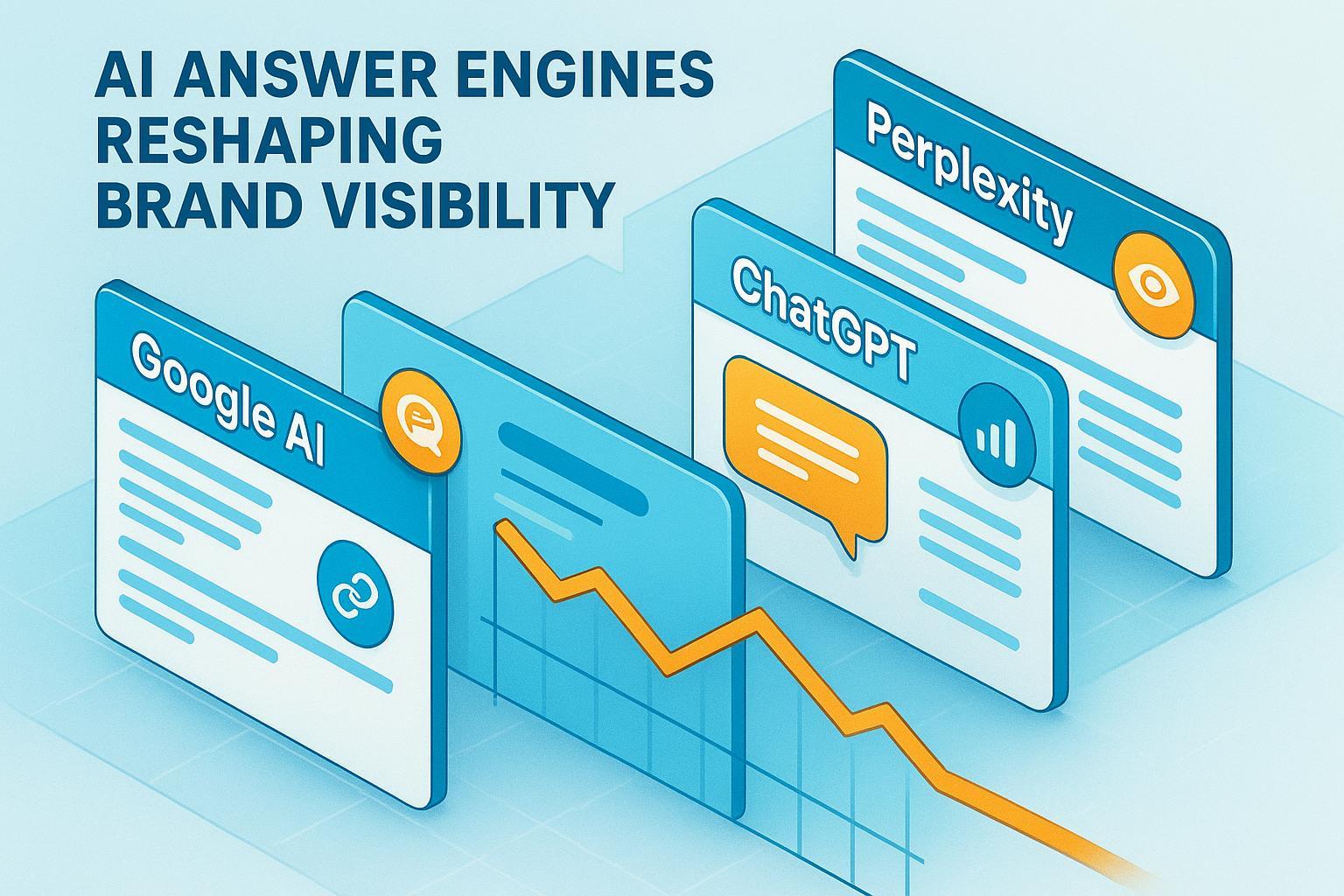
Generative answers now compete for attention before the click. When Google’s AI Overview (and AI Mode), ChatGPT, or Perplexity summarize a topic, they shape what people believe, which sources they trust, and whether they ever visit your site. Multiple industry analyses in 2024–2025 reported notable click-through rate declines for informational queries that trigger AI Overviews—top organic positions were hit hardest—pushing marketers to focus on visibility and share of voice inside the answers themselves. For example, Search Engine Journal’s 2024 coverage reported that the top organic result’s CTR fell by about 32% after AI Overview rollout, and Search Engine Land documented broader reductions and methodology details across categories; see the summarized analysis in 2024–2025: Google CTRs drop ~32% for the top result after AI Overview rollout (SEJ, 2024) and AI Overviews drive drops in organic and paid CTR (Search Engine Land, 2025).
This is why every brand needs an AI visibility audit. You’re measuring how often and how well your brand appears inside AI-generated answers, whether those answers cite your first‑party pages, and how your presence compares to competitors. Think of it as moving the measurement upstream—into the pre‑click moment where mindshare is won or lost.
What You’re Measuring (Definitions)
AI visibility: The frequency and prominence of your brand within AI-generated answers across platforms, plus the quality of the context (accuracy, sentiment, freshness). For a deeper primer, see the concept overview in “What Is AI Visibility? Brand Exposure in AI Search Explained” on Geneo: AI visibility definition.
Citation frequency: How often the AI answer includes links to your first‑party pages; track both count and destination quality.
First‑party citation rate: The percentage of answers (for a tracked prompt set) that cite one or more of your owned pages.
AI share of voice (SOV): Your brand’s portion of total “impressions” or mentions among tracked brands for a prompt set. A practical approximation is mentions weighted by prominence. Ahrefs popularized SOV-style approaches in their audit methodology; use consistent definitions when trending results.
Prominence and context: Score whether you’re a lead mention (top summary), secondary, or footnote. Note sentiment and whether the framing supports your positioning.
Accuracy and freshness: Verify brand facts and publication/update dates. For time-sensitive topics, target ≤12 months recency.
How this differs from a classic SEO audit: You still care about crawlability and blue-link rankings, but audits now include cross-engine prompt sampling, mention/citation logging, and competitor benchmarking inside answer engines. For a broader comparison of traditional SEO and GEO (Generative Engine Optimization), see Geneo’s explainer: Traditional SEO vs GEO (2025 marketer’s comparison).
The Step-by-Step AI Visibility Audit
Step 1: Set Objectives, Scope, and Tracked Entities
Clarify why you’re auditing (e.g., informational traffic loss in a key category; brand misrepresentation risk). Define platforms (Google AI Overview/AI Mode, ChatGPT with browsing or Deep Research when relevant, Perplexity; optionally Gemini/Bing for your audience). List tracked entities: brand, flagship products, and relevant executives/authors. Choose 3–5 competitors.
Decide on core metrics: mentions, citation frequency, first‑party citation rate, AI SOV, average prominence score, accuracy rate (target ≥90% for brand facts), freshness compliance (≤12 months for time-sensitive topics), and sentiment distribution.
Step 2: Build a Prompt Bank and Sampling Plan
Create a bank of 50–100 prompts spanning intents:
Buyer’s guides and comparison prompts (“best X for Y,” “X vs Y”).
Branded queries (“is [brand] trustworthy,” “[brand] pricing,” “[brand] alternative”).
Problem–solution prompts your audience actually asks.
For each prompt, log the platform, timestamp, locale/device if relevant, and model/tool settings (e.g., ChatGPT with Deep Research or browsing; Perplexity mode). Plan a weekly subset re-run and a monthly full re-run to manage volatility.
Step 3: Environment Setup (Manual vs Tool-Enabled)
Manual workflow: Prepare a spreadsheet with columns for prompt, platform, timestamp, brand mentions (direct/implicit/partial), citations (present/absent), destination URLs (first‑party vs third‑party), prominence/context score, sentiment, accuracy flags, freshness notes, and model/tool settings.
Tool-enabled workflow (example): Disclosure: Geneo is our product. The platform supports multi‑engine monitoring, citation/mention tracking, competitor benchmarking, and reporting. Teams use it to log prompt runs, track first‑party citation rates and visibility deltas, and produce white‑label reports for stakeholders. Explore workflows in the docs: Geneo docs.
Step 4: Run Cross‑Engine Sampling and Log Results
Execute your prompt bank on each platform. Capture:
Mentions: Direct (explicit brand name), implicit (product names/pronouns), and partial.
Citations: Whether links appear; mark first‑party vs third‑party and the destination pages.
Prominence/context: Score lead vs secondary vs footnote; annotate sentiment and positioning.
Accuracy/freshness: Spot-check facts; record publication/update dates when visible.
Model/tool settings: Note if ChatGPT used browsing or Deep Research and any visible versioning cues on Perplexity.
Step 5: Stop‑and‑Verify Gates
Introduce verification checks after the first sampling round:
Accuracy gate: Target ≥90% accuracy for brand facts. If errors surface, document them and plan corrections.
Freshness gate: For time-sensitive topics, aim for ≤12 months recency. Flag outdated citations and plan content updates.
For Google AI Overviews/AI Mode, confirm whether cited pages align with the summary and note any “fan‑out” behavior where subtopic links expand beyond traditional top results. Google’s site owner guidance on AI features is helpful context: see the 2025 Search Central blog on succeeding in AI Search: Succeeding in AI Search (Google, 2025) and the documentation on appearance: AI features and your website.
Step 6: Competitor Benchmarking
Run the same prompts for competitors. Compute AI SOV per platform: divide your brand’s mentions/impressions (weighted by prominence) by the total among all tracked brands. Identify prompts where competitors dominate, where you’re missing entirely, or where your citations point to third‑party pages rather than your own.
Step 7: Compute Metrics and Trends
Calculate:
First‑party citation rate by platform.
Average prominence and sentiment distribution.
Accuracy and freshness compliance.
AI SOV by prompt cluster (informational vs transactional vs branded).
Trend weekly and month-over-month. Use rolling averages to handle non‑determinism, and document model/tool settings to keep comparisons fair. For practical logging and cadence tips, see Geneo’s guide: Best practices for tracking and analyzing AI traffic (2025).
Step 8: Prioritize Fixes and Governance
Start with high‑impact issues:
Entity and schema reinforcement: Ensure Organization/Person schema, sameAs links to authoritative profiles, and clear, dated facts on key pages.
Strengthen authoritative sources: Publish well‑structured summaries, FAQs, and data pages that are easy to cite.
Refresh outdated content: Update About pages, product specs, and policy statements; add publication and update dates.
Governance: Establish review SLAs for sensitive claims, add legal/compliance checks for regulated topics, and define correction workflows (e.g., submitting feedback on AI Overviews where possible).
Step 9: Re‑run Cadence and Reporting
Weekly: Re-run 15–25 prompts to monitor volatility.
Monthly: Re-run the full prompt set.
Reporting: Connect visibility deltas to business outcomes (awareness, qualified demand, pipeline). Remember that AI Mode traffic may be under‑attributed; annotate findings accordingly.
Agencies can produce white‑label visibility reports using tooling; if you use Geneo, the reporting features support stakeholder-friendly summaries without promotional framing: Welcome to Geneo (Docs).
Troubleshooting Playbook
Non‑deterministic outputs: Generative answers vary by session, personalization, and evolving models. Counter this by sampling larger prompt sets and trending results over time; industry commentary emphasizes the need to track visibility rather than rely on single-shot checks.
Missing citations: Often tied to weak entity signals or insufficiently structured facts. Improve Organization/Person schema, add sameAs to authoritative profiles, and provide clear, dated facts on source pages.
Misattribution: Conflicting data across third‑party sources can pull answers away from your brand. Build an entity map, update structured data, and submit corrections where possible; provide feedback in Google’s AI Overviews if applicable.
Outdated information: Refresh official profiles and cornerstone pages regularly; re-audit after major AI updates.
Access/crawling issues: Verify robots.txt, indexability, JS rendering, and X-Robots-Tag headers to ensure source pages can be discovered and cited.
International/device nuances: Segment tests by locale and device; fix hreflang mistakes and confirm region-specific content alignment.
Authoritative references for platform behaviors and reliability guidance include Google’s Search Central pages on AI features (2025), OpenAI’s Model Spec recommendations for browsing/citation and human review (2025), and Perplexity Help Center materials on inline citation transparency.
Platform Nuances and Reliability Guidance (Context)
Google’s AI features show sourcing alongside answers and continue to evolve. Google’s 2025 guidance explains how AI features appear within Search and how site owner controls still apply: Succeeding in AI Search (Google, 2025) and documentation on appearance: AI features and your website.
Perplexity consistently displays numbered inline citations. Their Help Center outlines how citations tie to specific claims in the answer and encourages verification: How Perplexity works.
ChatGPT includes citations primarily when web browsing or Deep Research is enabled, and OpenAI’s Model Spec advises using these features for low‑confidence queries and combining outputs with human review for high‑stakes tasks. See OpenAI’s guidance: Model Spec (2025) and Introducing Deep Research.
For platform differences and monitoring approaches across engines, see Geneo’s contextual resources: Best practices for tracking and analyzing AI traffic (2025).
What to Do Next
Build your prompt bank and baseline spreadsheet today; schedule weekly and monthly re-runs.
Log mentions, citations (first‑party vs third‑party), prominence/context, accuracy, freshness, and competitor presence.
Prioritize entity/schema fixes and refresh high‑impact pages with clear, dated facts.
Tie visibility deltas to outcomes, and brief stakeholders on pre‑click mindshare shifts.
If you need a cross‑engine monitoring layer and reporting support, Geneo can be used to streamline sampling, tracking, and stakeholder reporting while you run this audit. Disclosure applies per first mention above. For definitions and audit context, revisit the overview on AI visibility.