

How to Monitor Brand Mentions in AI Search Sources (AI Brand Mention Monitoring Guide)
Complete playbook to monitor brand mentions across ChatGPT, Google AI Overviews, and Perplexity — 10-step checklist, KPIs, remediation playbooks, and tool matrix. Request a demo.
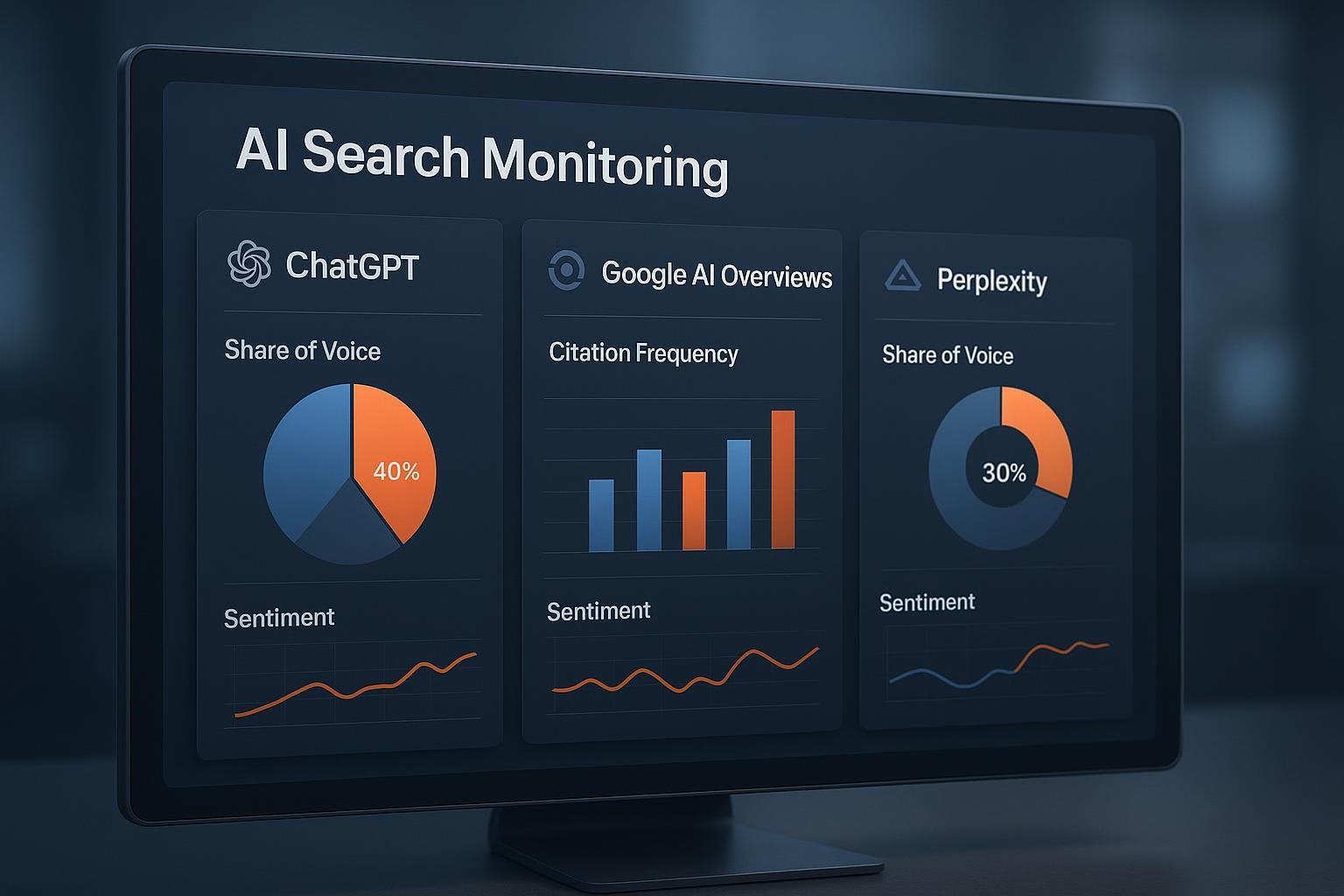
Executive Summary
If AI engines are where buyers get answers, your brand must be visible, accurate, and cited. This guide gives you a vendor‑neutral, comparative playbook to stand up AI brand mention monitoring across ChatGPT, Google AI Overviews, and Perplexity—plus the KPIs, cadences, and remediation steps to keep results trustworthy. Expect reproducible prompt sets, receipt‑ready evidence capture, and a pragmatic tool stack that blends classic SEO suites with modern AI monitors. Bottom line: AI brand mention monitoring should become a weekly operating habit, not a one‑off audit.
10‑Step Cross‑Platform Checklist (first setup times per engine)
Define tier‑1 prompt clusters (commercial, navigational, category): 60–90 min (applies to all engines)
Build canonical prompt set and naming convention: 45–60 min (all)
Instrument scheduled runs (or use a monitor) for ChatGPT: 30–45 min; AIO: 60–90 min; Perplexity: 20–30 min
Capture receipts (screenshots + archived links) for every run: ChatGPT 15 min; AIO 20–30 min; Perplexity 10–15 min
Log citations/mentions, positions, and co‑mentions in an evidence sheet: 30–45 min (all)
Score KPIs (citation frequency, mention velocity, sentiment trend, SOV): 45–60 min (all)
Set alert thresholds and routing (sev‑levels): 30 min (all)
Verify positioning accuracy vs your canonical facts: 30–45 min (all)
Remediate defects (feedback, page updates, entity data, PR outreach): variable; first pass 2–6 hours
Review cadence and drift weekly; optimize prompt baskets and owners: 30–45 min (all)
Quick Start (jump links)
ChatGPT fast setup → See ChatGPT Monitoring
Google AI Overviews detection → See Google AI Overviews Monitoring
Perplexity citations tracking → See Perplexity Monitoring
KPI formulas and dashboards → See KPI Framework for AI Brand Mention Monitoring
Tools and decision matrix → See Classic vs Modern Monitoring Stacks and Decision Matrix
Key takeaways
Monitor where buyers ask: ChatGPT, Google AI Overviews, and Perplexity.
Blend stacks: classic SEO suites diagnose sites; modern AI monitors capture answer‑level visibility and drift.
Track four core KPIs weekly: citation frequency, mention velocity, sentiment trend, and share of voice.
Always keep receipts: timestamped screenshots and archived links are your source of truth.
Remediate with content, entities, and in‑product feedback; document and re‑test.
Classic vs Modern Monitoring Stacks for AI Brand Mention Monitoring
AI brand mention monitoring requires two complementary layers:
Classic SEO suites (e.g., Ahrefs, Semrush, Moz): great for keyword/links, site audits, and informing content strategy. Many now publish AIO research and workarounds, but they rely on proxies because Google doesn’t expose AI Overviews metrics directly in Search Console. See the methodology in the Ahrefs guide on tracking AI Overviews and their updates on impact ranges: Ahrefs’ AIO tracking and CTR studies (2025–2026) and the update on reduced clicks: Ahrefs’ 2026 AIO impact update. Semrush likewise summarizes prevalence and CTR effects in its study: Semrush’s AI Overviews study (2025).
Modern AI visibility monitors (market category): purpose‑built to query engines on schedules, detect AIO panels, parse citations, and log evidence. Independent market roundups describe daily checks, sentiment scoring, and SOV features across engines (including Perplexity and often Google AI Mode): see SE Ranking Visible’s overview of AI visibility tools (2026) and Siftly’s 2026 platform summary.
Where each shines
Classic suites: crawl health, keyword gaps, link earning, and traditional SERP features that still influence AI mentions (supported by research indicating correlation between strong SERP presence and LLM mentions; see Seer’s analysis: Seer Interactive’s research on what drives AI mentions).
Modern monitors: repeatable prompt runs across AI engines, AIO appearance detection, citation parsing, co‑mention mapping, and drift alerting.
Coverage gaps you must plan around
Google AI Overviews: no public API; trigger variance by query, account, and region. Google’s official guidance details that AI features and supporting links vary and appear when useful: Google’s AI features and your website. Result: you need scheduled tests and evidence capture rather than relying on GSC.
ChatGPT consumer UI: no monitoring API. OpenAI documents citations when using the web search tool via API, but that’s separate from consumer UI logs; see OpenAI web search tool guide and OpenAI Enterprise Compliance APIs.
Perplexity: transparent citations are shown in‑product, but there’s no official push‑monitoring API for consumer answers. Platform docs explain the citation model: How Perplexity works.
Decision guidance
SMBs and agencies typically succeed with a hybrid: classic suite for diagnostics + modern monitor for cross‑engine visibility, sentiment, and SOV. Use the Decision Matrix below to set cadence and stack by risk profile.
KPI Framework for AI Brand Mention Monitoring
These KPIs make AI brand mention monitoring measurable and report‑ready. Pair with a simple evidence log and an executive dashboard.
Citation frequency (%): share of tracked prompts where your brand/domain is cited (AIO/Perplexity) or named (ChatGPT).
Formula: citations_or_mentions_returned ÷ total_prompts_tracked, per engine and per prompt cluster.
Tracking: receipts + run logs; segment by engine and topic; roll up weekly.
Mention velocity (Δ/week): week‑over‑week change in total mentions/citations per engine.
Formula: mentions_t(w) − mentions_t(w−1); alert on accelerations/decelerations.
Sentiment trend (rolling): average sentiment score of answer text around your brand mentions; verify negatives with human QA.
Tracking: short excerpts per mention; model‑assisted sentiment with a human‑in‑the‑loop for sev‑2+.
Share of Voice (SOV): your mentions (or citations) ÷ total mentions across your competitive set for a fixed prompt basket.
Tracking: compute per engine and per cluster; display in stacked bars.
Positioning accuracy (%): percent of answers with correct brand description and current facts.
Tracking: compare to a canonical “fact sheet”; log defects with severity.
Coverage gap rate (%): prompts where competitors appear but you don’t.
Use: roadmap prioritization and stakeholder reporting.
Verification rate (%): percent of flagged issues triaged with receipts and remediated inside SLA.
Further reading on KPI design and dashboards: see the internal primer on AI KPI frameworks: AI Search KPI frameworks (Geneo).
ChatGPT Monitoring
Reality check: There’s no public API that streams consumer ChatGPT answers for monitoring. Enterprise workspaces can export certain logs via compliance APIs, but that doesn’t substitute for public answer monitoring. See OpenAI’s Enterprise Compliance APIs.
Quick steps (first run ~45–60 min; weekly ~20–30 min)
Define 25–50 prompts covering your tier‑1 intents (brand, category, competitor, problem).
Run on a consistent model/version and mode. Save the full text output for each prompt.
Record whether your brand is named, how it’s described, and any explicit links.
Capture receipts: timestamped screenshots + copy of the answer; archive if possible.
Tag sentiment on the brand excerpt; flag misstatements or omissions.
Log KPIs (citation frequency proxy = mention presence, positioning accuracy, sentiment) and roll up weekly.
Verification
Re‑run a 10‑prompt subset to check drift; any material change triggers a broader rerun.
Validate facts against your canonical source list (site FAQs, product pages, Wikipedia/Wikidata entries).
Maintain an incident log with receipts and triage status.
Known limitations to note in reports
Consumer UI behavior can change; no native citation panel unless web search is invoked; no push alerts.
Treat “mention presence” as a proxy for citations; be explicit about assumptions in your dashboard notes.
Google AI Overviews Monitoring
Google documents that AI features, including AI Overviews and AI Mode, appear when they add value and may vary in links shown. There’s no public API to retrieve AIO programmatically. See Google’s AI features and your website and their AI Mode post: Google product blog on AI Mode. Independent analyses show CTR often drops where AIO appears; see Ahrefs’ AIO impact update (2026) and Semrush’s prevalence/impact study (2025).
Quick steps (first run 60–90 min; ongoing 2–3×/week)
Build a 30–60 prompt basket per cluster (brand, category, comparison, problem).
Schedule checks on neutral profiles; note geography/device; capture whether AIO appears.
If AIO appears, record all cited domains, their positions, and any of your pages included.
Screenshot the panel and each cited source; archive links.
Compute KPIs: citation frequency (AIO), coverage gaps, and SOV by cited domains.
Flag content/entity gaps; add to remediation queue.
Verification
Reproduce on a second device/profile and, if possible, a second region.
Cross‑reference with Search Console trends for affected queries (acknowledging GSC doesn’t split AIO impressions/clicks; use as a proxy alongside your evidence). For context, see Ahrefs’ how‑to on tracking AIO.
Perplexity Monitoring
Perplexity’s product emphasizes transparent citations, letting users verify sources in‑product. See How Perplexity works.
Quick steps (first run 20–30 min; weekly ~20 min)
Run your prompt basket and capture the full answer plus the citations panel.
Log whether your domain is cited, citation position, and co‑mentioned competitors.
Store screenshots of the answer and the source list; archive URLs.
Compute citation frequency, SOV (by citation counts), and sentiment on the answer excerpt.
Track movement of your domain’s citation position week‑to‑week.
Verification
Re‑run a 10‑prompt subset 48 hours later; large swings may indicate crawl/index changes.
Validate that cited pages align with your most authoritative content; fix outdated pages.
Verification and Remediation Playbooks
Receipts (always)
For every engine run, save: timestamp, prompt, engine/version, answer text, cited domains/positions, screenshots, and archived links. Google confirms link variability and lack of API; OpenAI confirms no public UI monitoring; Perplexity shows citations in‑product. Sources: Google AI features, OpenAI data/compliance, Perplexity help.
In‑product feedback and on‑site fixes
Use native feedback tools where available.
Update or publish high‑authority content (FAQs, glossaries, product pages) that answers the exact prompts; add schema where relevant.
Strengthen entity data (Wikidata/Wikipedia) with third‑party citations; pursue PR/digital PR to earn authoritative mentions.
Wikipedia/Wikidata SOP (human‑reviewed)
Disclose conflicts of interest; prefer Talk pages for contested edits.
Rely on reliable, independent sources; avoid original research.
Document diffs and outcomes in your incident log.
Policies: COI guidance, Reliable sources, NPOV, Citing sources.
Governance and SLAs
Severity 3 (harmful misinformation): triage within 24h; route to Legal/Comms; publish correction and request feedback.
Severity 2 (material inaccuracy): triage in 72h; fix source content; submit feedback; re‑test for 2–4 weeks.
Severity 1 (minor omission): add to backlog; address in next sprint; monitor for movement.
Cadence, Alerts, and Roles
Below is a scan‑friendly table for implementation. Adapt to your team size.
Track | First setup (est.) | Ongoing cadence | Owner | Alerts route |
|---|---|---|---|---|
ChatGPT prompt set (tier‑1 intents) | 2–3h | Weekly (drift) | Content Ops | Slack #ai-visibility; pager for sev‑2+ |
Google AIO detection + citations | 2–4h | 2–3×/week (volatile) | SEO Lead | Slack + email digest |
Perplexity citations + positions | 1–2h | Weekly | Research/Analyst | Slack + incident log |
Sentiment scan (flag negatives) | 1h | Weekly | Brand/Comms | Slack + PR triage |
SOV by engine/cluster | 1–2h | Bi‑weekly | Analytics | Exec dashboard |
Verification receipts QA | 1–2h | Weekly | QA/PMM | Evidence repo update |
Wikipedia/Wikidata watchlist | 1h | Bi‑weekly | Knowledge Ops | Talk page review |
Decision Matrix
Choose monitoring cadence and tools based on your brand size and risk profile.
Low risk (small local brand; low volatility)
Cadence: ChatGPT weekly (10‑prompt subset), AIO weekly spot check, Perplexity weekly.
Tools: classic SEO suite + lightweight modern monitor or manual scripts.
KPI focus: positioning accuracy and citation frequency on branded prompts.
Medium risk (regional SMB; competitive category)
Cadence: ChatGPT weekly full basket; AIO 2×/week; Perplexity weekly; sentiment scan weekly; SOV bi‑weekly.
Tools: hybrid stack (classic suite + modern monitor with alerting and evidence capture).
KPI focus: citation frequency by cluster, mention velocity, sentiment trend, coverage gaps.
High risk (national brand; sensitive category)
Cadence: ChatGPT 2×/week; AIO 3×/week; Perplexity 2×/week; daily sentiment watch; Wikipedia watchlist bi‑weekly.
Tools: robust modern monitor with roles/SLAs + classic suite; alert routing to Legal/Comms for sev‑3.
KPI focus: SOV by engine, negative sentiment rate, verification rate, and time‑to‑remediation.
Troubleshooting and FAQs
Q: Why do AIO appearances swing so much week to week? A: Google notes AI features vary by query, account, and time; different models/techniques can surface different links. Plan for drift and confirm with reproducible checks. See Google’s AI features.
Q: Why can’t I get AIO clicks/impressions in Search Console? A: GSC doesn’t break out AIO; vendors recommend proxy tracking via AIO detection, citation logging, and CTR gap analyses. See Ahrefs’ how‑to and Semrush’s study.
Q: Can I monitor ChatGPT answers via API? A: There’s no public API for consumer UI answers. Enterprise Compliance APIs enable workspace exports but aren’t push monitors. See OpenAI’s Enterprise Compliance.
Q: Do Perplexity answers always show citations? A: Platform help emphasizes transparent citations, enabling verification in‑product; always capture screenshots and archive. See Perplexity help.
Q: How do I prove ROI if CTR falls where AIO appears? A: Triangulate: (1) SOV and citation frequency improvements per engine, (2) branded traffic stability in GSC where AIO triggers, and (3) assisted conversions from cited pages in analytics. Cite external ranges to set context; e.g., Ahrefs’ 2026 update and Search Engine Land rollups.
Practical Workflow Example (neutral)
Here’s how a weekly loop looks in practice for a 25‑prompt basket per engine:
Monday: run prompts, capture receipts, log citations/mentions and sentiment.
Tuesday: compute KPIs (citation frequency, mention velocity, SOV) and review sev‑2+ incidents.
Wednesday: execute remediations (content refreshes; Wikidata updates; feedback submissions) and schedule retests.
Friday: QA receipts, finalize dashboard notes, and circulate a one‑page executive summary.
Many teams automate steps 1–2 with a modern monitor while continuing to use a classic suite for site fixes. As an example, platforms like Geneo and peers centralize cross‑engine monitoring (ChatGPT, AIO, Perplexity), sentiment tagging, SOV, and client‑ready reporting; alternatives include other modern monitors referenced above. Choose the stack that fits your governance model and budget.
Additional Resources (contextual)
GEO market context and why AI engines matter: GEO market overview (Geneo)
Engine comparisons when deciding coverage: ChatGPT vs Perplexity vs Gemini vs Bing (Geneo)
Agency dashboards for reporting: White‑label dashboards (Geneo)
Notes on Evidence and Assumptions
AIO prevalence and CTR impact vary by dataset; industry studies from 2025–2026 report ranges from double‑digit CTR declines to 50%+ drops on affected queries. See Search Engine Land’s rollups of multiple studies (2025–2026) for context and links to originals.
ChatGPT consumer UI has no push monitoring API; treat mention presence as a proxy and document assumptions in dashboards. See OpenAI data/compliance docs.
Next steps
Stand up your hybrid stack, run your first prompt baskets, and baseline KPIs this week. If you want a faster path with cross‑engine evidence capture and reporting, request a short demo to see how a modern monitor can operationalize this workflow. Effective AI brand mention monitoring turns ambiguity into measurable, defensible visibility.