
How to Map YourSite to AI Search Engines for Maximum Citations
Step-by-step guide: Make YourSite discoverable and cited in Google AI Overviews, Perplexity, Bing Copilot, and ChatGPT. Simple, actionable mapping steps.
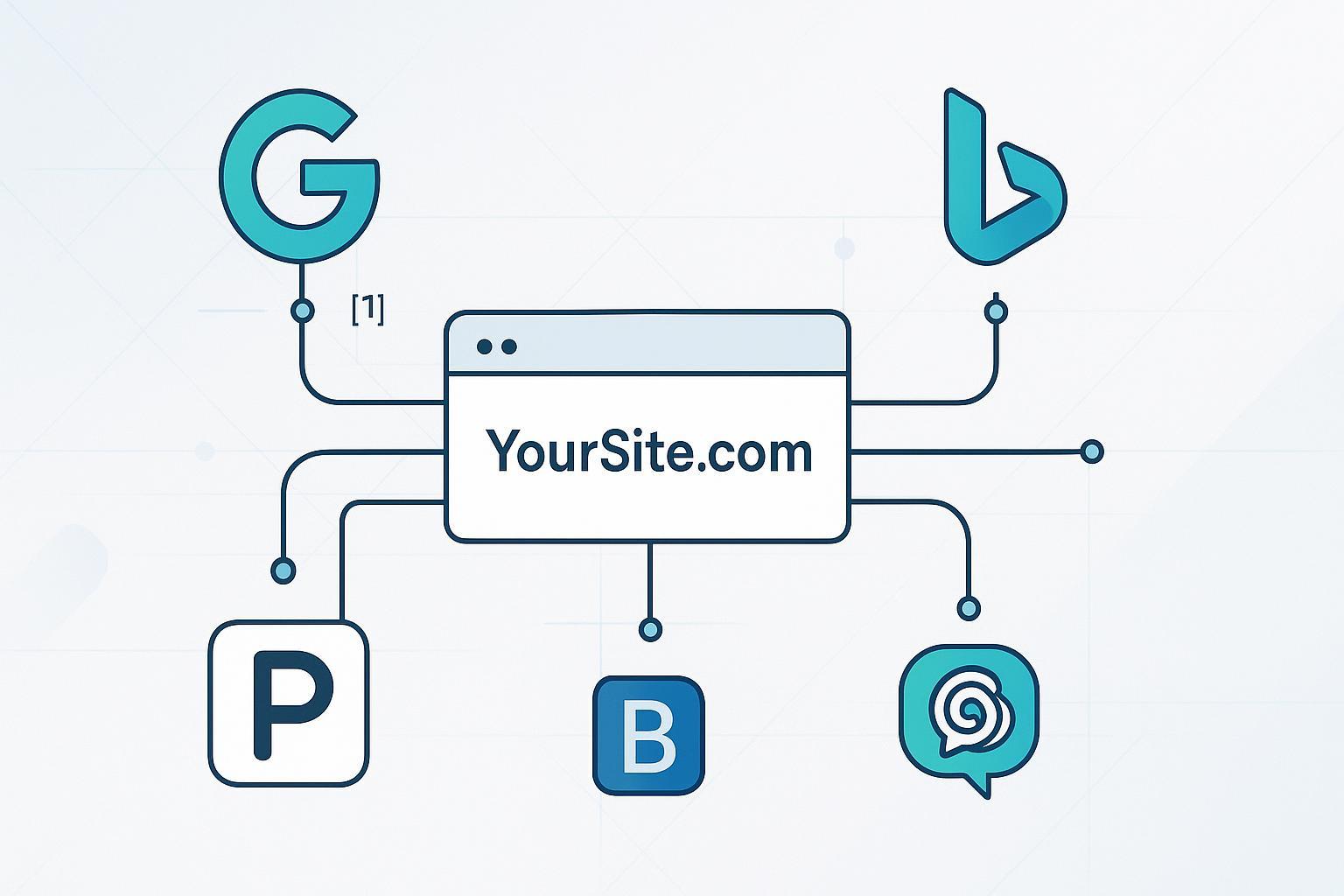
If AI search engines can’t confidently understand who you are, what you’ve published, and why you’re authoritative, they won’t cite you. “Mapping” YourSite to AI search is the practical work of making your pages easy to discover, easy to parse, and easy to quote—so Google AI Overviews/AI Mode, Perplexity, Bing Copilot, and ChatGPT Browse can reference you correctly.
This guide focuses on repeatable steps, validation points, and a light monitoring workflow. The payoff: more accurate citations, fewer misattributions, and a measurable lift in AI visibility.
1) Lay the foundation: crawl, render, index
Start where every engine starts: discovery and rendering. If core pages are blocked, slow, or buried, optimization elsewhere won’t matter.
- Robots and canonicals: Confirm robots.txt doesn’t block essential paths. Use meta robots and canonical tags consistently. Keep duplication under control and ensure there’s a clean canonical on every canonicalizable URL.
- Sitemaps and proximity: Maintain XML sitemaps that include your primary templates (articles, products, locations). Keep key pages within 2–3 clicks from the homepage with descriptive internal anchors.
- Rendering and performance: Make sure primary content renders server-side or becomes visible reliably with client-side hydration. Optimize Core Web Vitals and reduce layout shifts that can hide content on first paint.
- Sanity checks: Inspect a few representative pages with Google Search Console’s URL Inspection (live test), then verify similar status in Bing Webmaster Tools. Scan server logs for crawler access to CSS/JS and large assets; correct any 4xx/5xx on critical resources.
For strategic context, Google’s May 2025 guidance on how to succeed across AI features reinforces that fundamentals (discovery, indexability, helpful content, and demonstrated experience) drive eligibility in AI experiences, not a special “AI tag.” See the summary in Google’s own post, Top ways to ensure your content performs well in Google’s AI features (2025): Google’s “Succeeding in AI Search”.
2) Make your entities unambiguous: schema and identity
AI systems need to know exactly which organization, author, or location they’re quoting. Use JSON-LD to declare your entities sitewide and on each content type.
- Organization identity: Add Organization with legal name, logo, sameAs (official profiles), and contactPoint if relevant. Use a stable @id URL and reference it from content.
- Site context: Add WebSite with optional SearchAction for site search. Implement BreadcrumbList for hierarchical clarity.
- Content types: On articles and guides, use Article or BlogPosting with headline, author, datePublished, dateModified, image, and a link to the author entity. For products, use Product and Offer. For local pages, use LocalBusiness with accurate NAP.
- Validation: Use Google’s Rich Results Test to confirm fields parse cleanly and nesting is valid: Google Rich Results Test.
Two quick tips: (1) avoid stuffing irrelevant properties; completeness beats clutter, and (2) connect entities via @id and sameAs so engines can reconcile profiles and citations.
| Schema type | Where it lives | Must-have properties (baseline) | Why it matters for AI search |
|---|---|---|---|
| Organization | Sitewide (global JSON-LD) | name, url, logo, sameAs, @id | Disambiguates your brand and links profiles |
| WebSite | Sitewide | name, url, potentialAction (SearchAction optional) | Gives engines site context and search entry |
| BreadcrumbList | Every indexable page | itemListElement (linked hierarchy) | Clarifies content position and relationships |
| Article/BlogPosting | Article pages | headline, author, datePublished, dateModified, image, mainEntityOfPage | Enables clean extraction, authorship, freshness |
| Product/Offer | Product pages | name, description, image, brand, offers (price, availability) | Surfaces specs and commercial context |
| LocalBusiness | Location pages | name, address, telephone, geo (if possible), sameAs | Ties citations to the correct location entity |
3) Write for citation: answer-first, structured, source-backed
Engines and answer models favor passages that resolve a question quickly, then expand with steps, evidence, and context.
- Lead with the answer: Open with a 1–2 sentence direct answer before elaboration. Follow with steps, examples, and caveats. Add a short, scannable FAQ at the end of substantive pages to capture follow-up intent.
- Use question-led subheads: Convert research questions into H2/H3s (“How do I…”, “What’s the difference…”, “When should you…”). Keep each section’s intro tight and on-topic.
- Prefer tables, steps, and specs: Where readers expect structure (comparisons, requirements), use tables and numbered steps. Keep crucial data in HTML text—never only in images or PDFs.
- Show authorship and freshness: Include an author with relevant experience, a datePublished, and a dateModified when you materially update the page. Cite authoritative sources in-line with descriptive anchors.
Think of it this way: you’re creating “snippable” building blocks that models can quote without misrepresenting you.
4) Platform-specific checkpoints
Each AI surface has quirks. Use these quick checks during implementation.
Google AI Overviews / AI Mode
Eligibility stems from overall Search quality and helpfulness. Maintain precise titles/URLs, comprehensive topical coverage, and clear experience/credentials on author pages. As of mid‑2025, AI Mode impressions and clicks roll into the broader Web totals in Search Console; isolation is limited, so trend monitoring is key. For the official stance on how to show up across AI features, see Google’s “Succeeding in AI Search”. For reporting expectations, industry coverage notes AI Mode metrics fold into Web totals in 2025; see the explanation by Search Engine Land: AI Mode traffic data in Search Console (2025).
Practical checks: ensure your most complete, source‑cited pages exist for core queries; add related subtopics with internal links; keep facts current; and verify structured data passes validation.
Perplexity
Perplexity is retrieval‑centric and shows explicit citations by design. It prefers accessible, answer‑first pages with clear authorship and dates, and it extracts well from concise definition and FAQ blocks. Review its developer guidance on how results are sourced and filtered: Perplexity Search Guide.
Practical checks: avoid gating content you want cited; include definition boxes and crisp steps; ensure indexable, canonical URLs with unique titles; add source links on your pages so Perplexity can verify claims.
Bing Copilot
Copilot relies on Bing’s index and quality signals. Verify site ownership in Bing Webmaster Tools, submit sitemaps, and inspect key URLs for coverage. Microsoft recommends standard clarity and authority signals; begin with the official guidelines: Bing Webmaster Guidelines.
Practical checks: implement structured data with author and date, ensure fast mobile performance, and consider IndexNow to accelerate discovery for new or updated content.
ChatGPT Browse and agents
ChatGPT’s browsing relies on fetchers that respect many robots controls (e.g., GPTBot), although documentation is still evolving. Keep public pages accessible, lead with summary passages, and include citations to primary sources that the browsing agent can follow. Review OpenAI’s stance for publishers and developers: OpenAI Publishers & Developers FAQ.
Practical checks: verify in server logs that your pages are fetched successfully; avoid blocking critical resources; and, if you choose to limit certain bots, test robots directives and confirm behavior in logs.
5) Validate implementation: your quick toolkit
Use three checkpoints to confirm you’re parse‑ready. First, the Rich Results Test validates your JSON‑LD (Article, Product, LocalBusiness, and more), flags missing or invalid properties, and shows what Google can parse: run a few representative URLs here: Google Rich Results Test.
Next, Google Search Console’s URL Inspection tells you if the live page is indexable, what Google considers canonical, and whether structured data was detected. The “Test live URL” option helps compare rendered output with the indexed version.
Finally, Bing Webmaster Tools includes a URL Inspection that reports crawl and index status from Bing’s perspective. Use it to catch blocked resources, server errors, and markup issues that could limit Copilot citations.
Aim to fix all errors and most warnings before proceeding to content expansion.
6) Measure and iterate: a weekly workflow you can keep
Visibility in AI search isn’t set‑and‑forget. Build a light loop to track coverage, sentiment, and accuracy.
- Run an AI citation sweep: Weekly, test your priority queries in Google AI Mode/Overviews, Perplexity, Bing Copilot, and ChatGPT Browse. Capture screenshots of answers and the citations bar. Log query, engine, date, and whether your site was cited.
- Monitor search trends: Track impressions, clicks, and query coverage in GSC and BWT; annotate major changes (schema updates, content refreshes) so you can correlate trends.
- Check sentiment and accuracy: When your brand is mentioned, note tone and correctness. Flag misattributions and plan a content fix or clarification.
Disclosure: Geneo is our product. After you implement the steps above, a practical way to centralize monitoring is to use Geneo to run a weekly sweep for AI citations across ChatGPT, Perplexity, and Google AI Overviews. In one example workflow, teams add their target query lists, review which pages are cited (with captured references), and scan a sentiment chart to spot negative or neutral shifts that may require content updates. It supports side‑by‑side history so you can confirm whether a new schema or copy change coincided with a citation gain.
If you’re formalizing KPIs, we published a working model for visibility, sentiment, and conversion proxies in AI search. See the definitions and dashboards in our explainer: AI Search KPI Frameworks: visibility, sentiment, conversion. If you’re new to the concept of AI visibility itself, this quick primer helps you frame it for stakeholders: What is AI visibility?.
7) Troubleshooting mini‑FAQ
Why aren’t we being cited yet? If crawlability is sound, the top causes are ambiguous entities (missing Organization/LocalBusiness with sameAs), burying the answer (no direct 1–2 sentence lead), shallow topical coverage, or unclear authorship/dates. Strengthen internal links between cluster pages, expand FAQs to cover fan‑out queries, and update pages with current data and sources. Google’s guidance underscores that helpfulness and demonstrated experience influence whether content appears across AI features; see Google’s “Succeeding in AI Search” for what to emphasize.
How long should we wait before calling it? For SMB sites, 1–3 weeks is typical to see crawl and early coverage after fixes; for larger or multilingual sites, expect 4–8 weeks. Use GSC/BWT inspections to verify discovery. If nothing moves, revisit robots, sitemaps, internal linking, and page performance.
What if a bot ignores our robots rules? Robots.txt is advisory, and agent behavior can evolve. Combine robots directives with server/WAF rules and log monitoring if strict control is required. If your goal is citation, default to accessibility: make the content public, render essential text in HTML, and ensure fast, reliable fetches.
Next steps
- Ship the foundations: verify crawl/index health, implement baseline schema, and refactor priority pages with answer‑first structures.
- Set the loop: schedule a weekly AI citation sweep and a monthly content refresh sprint tied to KPI deltas.
- Resource your team: pair a technical SEO (schema, rendering) with a content lead (clusters, updates) and give them clear targets.
If you’d like hands‑on help to operationalize this across teams, our agency partners can support implementation and monitoring. Learn more here: Geneo Agency Services.