
How to Leverage External References for GEO
Learn actionable steps to earn and structure external references for AI engines like Google Overviews, Perplexity, and Bing Copilot.
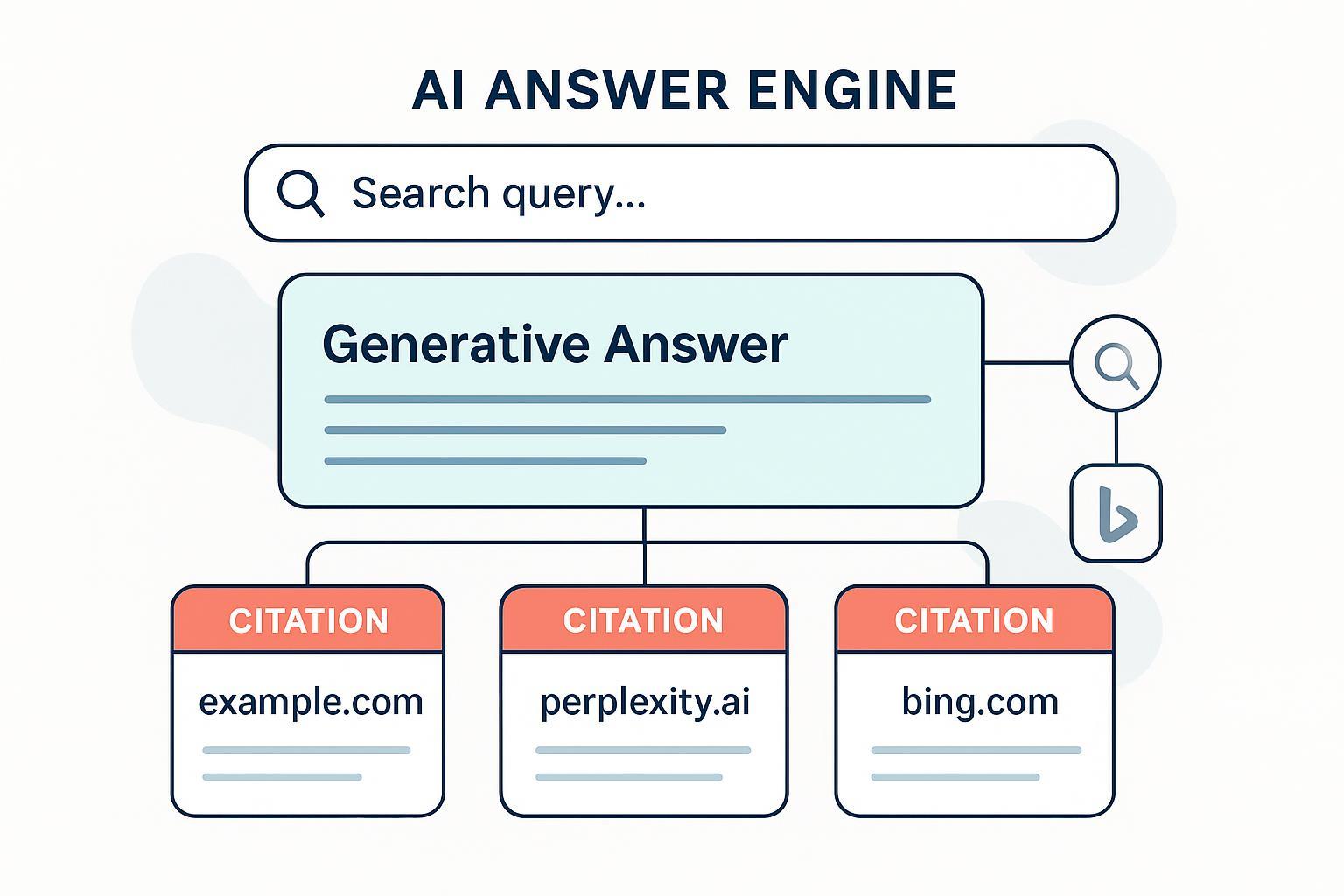
If AI answer engines increasingly “show their work,” then the sources they choose to cite become your new distribution channels. The practical question is: how do you engineer your content and outreach so those external references consistently point to you?
Let’s define terms quickly. In GEO (Generative Engine Optimization)—see a short primer on acronyms if you need one in our guide to GEO/GSVO/GSO/AIO/LLMO—“external references” are third‑party validations that strengthen your content’s credibility and extractability: hyperlinks to authoritative sources, named attributions and quotes, references to primary datasets or proprietary research, and independent mentions/links to your pages. These signals help AI engines select, ground, and cite your work.
Why external references matter to AI engines
AI answer systems rely on grounding and attribution to maintain reliability. Google explains that its AI features (AI Overviews and AI Mode) spread queries across subtopics and “display a wider and more diverse set of helpful links associated with the response,” while applying standard SEO practices—there’s no special LLM markup to add. See Google’s guidance in “AI features and your website,” which also notes AI traffic is rolled into Search Console’s Web performance reports (Google Search Central – AI features and your website).
Perplexity emphasizes real‑time search with explicit citations in every answer, rewarding sources that are timely, specific, and easy to quote (Perplexity – Getting started).
Microsoft describes how Copilot grounds responses in Bing’s index and returns answers with citations, so authority, freshness, and clean structure matter (Microsoft Learn – Grounding with Bing Search).
Independent research suggests AI citations frequently overlap with already‑strong organic performers. Ahrefs’ 2025 analyses report substantial overlap between AI Overview citations and pages ranking highly in classic organic results, though figures vary by dataset and time window (Ahrefs – AI citations and rankings overlap). On the flip side, credible media research has documented misattributions and broken/fictional URLs in AI answers; verification remains essential (Columbia Journalism Review Tow Center – AI search engines and citations).
Platform playbooks: what “external references” look like in practice
Google AI Overviews and AI Mode
Start by aligning to Google’s public stance: focus on helpful, people‑first content, clear structure, and accurate citations to primary sources. In practice, lead with a concise, declarative answer to the core question, then expand with scannable sections that cover steps, trade‑offs, and costs. When you have specs or benchmarks, a compact table helps models and readers alike. Attribute claims to primary sources inside the body, not just in footnotes. Add appropriate schema (Article, HowTo, FAQ) that mirrors what’s visible on the page, keep pages fast and mobile‑friendly, and make sure canonical tags are correct. Finally, earn third‑party coverage for original assets—like proprietary datasets or annual benchmarks—so the model encounters your entity and URL through multiple independent paths.
Perplexity
Perplexity surfaces numbered citations prominently, which means your prose should be easy to excerpt. Use short, factual sentences that can stand alone, and put the attribution right next to the claim on your page. Keep time‑sensitive topics fresh; Perplexity’s real‑time search favors up‑to‑date sources. Clear URLs, descriptive titles, and orderly sections reduce ambiguity when the system extracts a snippet and picks which source to credit.
Bing Copilot
Because Copilot grounds via the Bing index, make sure Bing can crawl and interpret your content cleanly. Accurate schema and crisp headings help. Consolidate canonical versions so syndicated copies don’t outrank the original, or enforce rel=canonical with partners. Provide small evidence blocks and explicit attributions so both users and the model can verify a statement in one glance.
How to earn and structure external references (a compact workflow)
Think of this as a weekly operating rhythm, not a one‑off campaign.
-
Select reference‑worthy assets. Prioritize topics where you can publish proprietary insight: surveys, benchmarks, pricing tallies, checklists, glossaries with precise definitions, or methods no one else explains clearly.
-
Structure for extraction. Lead with the answer; follow with method and caveats. Use a light FAQ and, where relevant, a small table. Attribute claims inside the body, not just in footnotes.
-
Distribute for authority. Pitch topically authoritative publications and analysts, and contribute expert commentary. Aim for contextual mentions that link to the exact asset, not a homepage.
-
Maintain provenance. Timestamp your original, include a methods section, host downloadable data, and use canonical tags on any licensed syndication. Request corrections when third parties mis‑attribute.
Reference types and how to earn them:
| External reference type | What it signals to engines | Practical way to earn it |
|---|---|---|
| Primary data/benchmark | You’re the origin; high authority and quote‑worthiness | Run a survey, publish methodology, host raw tables |
| Standards/gov/edu citation on your page | You build on authoritative sources | Link to primary standards and explain implications |
| Trade/analyst coverage linking to your asset | Third‑party validation and distribution | Pitch findings with a one‑slide summary and quotable stats |
| Expert quote with named attribution | Clear authorship and expertise (E‑E‑A‑T) | Publish author bios, affiliations, and vettable credentials |
Troubleshooting: if your work isn’t getting cited
If you rank but aren’t cited in AI answers, start with a reality check: AI citations often overlap with high‑ranking organic pages. Strengthen clarity by answering first, add a small table or FAQ, and tighten attributions to primary sources. Then pursue authoritative coverage of your original assets and refresh the page for recency.
If your original research is being cited via a third party, fix the plumbing. Ensure canonicalization, include first‑published timestamps, and host source files. Ask syndication partners to point rel=canonical to your original. A concise provenance section outlining datasets and methods makes correct attribution more likely, and you can request corrections when needed.
If citations are incorrect or broken, keep a monitoring log and capture screenshots/URLs. Some misattribution is a documented limitation in AI answers; reduce ambiguity with clean titles, explicit author/organization schema, and a prominent “Sources and methods” block near the top.
Measurement and reporting (make it repeatable)
Define success in terms you can audit and reproduce. A simple KPI set:
- Inclusion rate: percentage of priority topics where your pages are cited by AI Overviews/AI Mode, Perplexity, or Copilot.
- Citation count and share: number of citations by platform and your share versus named competitors on the same topics.
- Time‑to‑citation: days from publishing an asset to first observed citation.
- Authority and sentiment: authority of referring domains and the sentiment of mentions in AI outputs.
- Engagement on cited pages: clicks and on‑page behavior, tracked in analytics and Search Console (AI traffic is included in the Web report per Google’s documentation).
For deeper context on visibility concepts, see our primer on AI visibility. For a structured scoreboard, adapt the cross‑engine metrics in our AI search KPI frameworks.
Example: a light workflow to monitor impact after a PR push
Disclosure: Geneo is our product.
Say you publish a pricing benchmark with a clean methodology and a table of results. You brief two trade outlets and one analyst who cover your space. Over the next two weeks, you want to track whether AI engines start citing you or the coverage pieces.
Use a cross‑engine monitor to log which answers cite your original vs. third‑party coverage, and capture sentiment. For instance, you can use Geneo to record citations across AI Overviews/AI Mode, Perplexity, and Copilot, store snapshots, and compare inclusion before and after your PR outreach. If Perplexity cites the analyst instead of you, emphasize provenance by adding a “Source and methods” block near the top of your page and a downloadable CSV. Consider asking the analyst to include a prominent “via [Your Brand]” link. Annotate the publish date and outreach windows in your reporting. If inclusion lags, release a follow‑up insight (e.g., a regional cut) and pitch a complementary outlet.
Next steps
External references aren’t a bolt‑on tactic; they’re the connective tissue between your expertise and how AI systems justify answers. Pick one asset this month to turn into a quotable, reference‑rich page—and set up a simple monitoring loop to learn what each engine responds to. If you want a single place to watch citations across engines and keep a clean historical record as you iterate, you can explore Geneo.
Notes on sources used in this guide
- Google’s stance on AI features, link diversity, and reporting: Google Search Central – AI features and your website
- Perplexity’s citation‑forward product approach: Perplexity – Getting started
- Bing Copilot grounding and citations: Microsoft Learn – Grounding with Bing Search
- Independent overlap analysis: Ahrefs – AI citations and rankings overlap
- Limitations and misattribution risks: Columbia Journalism Review Tow Center – AI search engines and citations