
How Geneo App Helps Improve AI Search Ranking
Discover how to improve your brand's visibility in Google AI Overviews, Perplexity, and ChatGPT with step-by-step workflows, KPI tracking, and actionable tips.
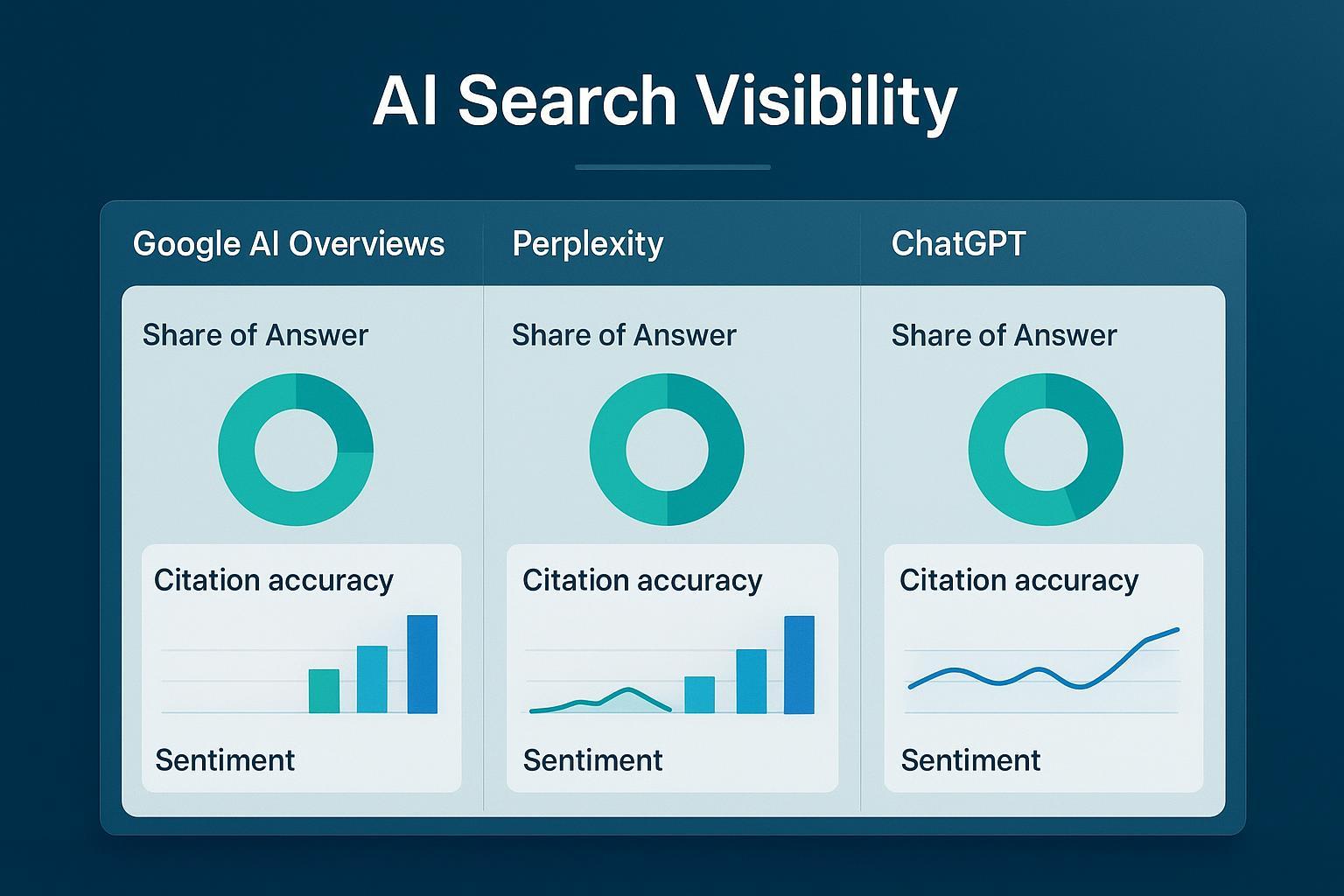
If your brand depends on organic discovery, you can’t ignore how AI-generated answers pick, summarize, and cite sources. The goal isn’t “rank #1” in a classic sense—it’s showing up as a cited, trusted source inside Google AI Overviews, Perplexity responses, and ChatGPT with browsing. What’s the practical path to get there?
Why AI visibility now matters (and how to measure it)
AI visibility means the consistency with which your brand is included and correctly cited in AI-generated answers across engines. Rather than relying on vague notions of “authority,” treat it like an operations problem with concrete KPIs:
- Share of answer: the percentage of target queries where your brand appears as a cited source and the proportion of those citations relative to competitors. See our KPI definitions in the AI search KPI frameworks.
- Citation accuracy rate: the ratio of correct citations to misattributions or incorrect links.
- Sentiment distribution: the split of positive/neutral/negative mentions within AI answers. For measurement dimensions like accuracy and relevance, review LLMO metrics.
- Freshness recency: the median age of the content that engines cite for your brand.
- Entity coverage/completeness: whether core brand entities (Organization, People, Products) are clearly defined and consistent across your site and major profiles. For a concise definition of AI visibility, see AI visibility: brand exposure in AI search.
Why does this matter now? Google explicitly states AI Overviews are meant to cite and link to the web pages they use, sending traffic to publishers. In May 2024, the company outlined how AI Overviews work and their intent to surface relevant sources in the AI Overviews announcement. Their site owner guidance in AI features and your website reinforces helpful content, clarity, and structured data.
The fundamentals that lift inclusion probability
Think of inclusion as the outcome of many small, well-executed fundamentals. These basics improve the odds that AI systems can understand, excerpt, verify, and cite your pages.
- Content structure and snippability: Put concise, self-contained answers near the top of the page. Use descriptive H2/H3 headings, bullets, and lightweight tables to make passages extractable. Microsoft’s guidance emphasizes skimmable, precise structure for AI answers in Optimizing your content for inclusion in AI search answers (2025).
- Schema.org structured data: Implement JSON-LD for Article, FAQPage (Q&A), HowTo (procedures), Product (offers), Review (ratings), Organization/Person (entity grounding), and BreadcrumbList. Validate with Google’s tools and align schema to on-page content. See Google’s intro to structured data.
- Freshness and maintenance cadence: Audit and refresh priority assets 6–12 months minimum, faster for time-sensitive topics. Google’s guidance around helpful, up-to-date content and recent core updates is covered in AI features and your website. When you materially update pages, consider submitting for recrawl via Search Console.
- Entity SEO and off-site signals: Clarify organization/person/product entities with schema; connect profiles via sameAs (LinkedIn, Wikipedia if eligible). In local contexts, ChatGPT often cites Wikipedia, business sites, and trusted directories, according to BrightLocal’s study on ChatGPT search sources (2024)—so ensure your presence and accuracy in those ecosystems. For broader context on AI SEO, see Search Engine Land’s AI SEO overview.
- Technical SEO foundations: Maintain crawlability (robots.txt, XML sitemaps), canonicalization, clean internal linking, descriptive metadata, mobile performance, and strong Core Web Vitals. These remain prerequisites for inclusion in AI and traditional search.
Nuances across Google AI Overviews, Perplexity, and ChatGPT
Each engine retrieves and grounds answers differently. The nuances matter because they shape which sources get cited.
- Google AI Overviews: Designed to cite multiple relevant sources and send traffic to publishers. Keep content verifiable, structured, and fresh. See Google’s AI Overviews announcement (May 2024) and AI features and your website.
- Perplexity: Responses are web-grounded with inline citations; Deep Research rounds up multi-source outputs. While exact ranking factors aren’t fully documented, being precise, comparison-friendly, and supported with primary sources helps. Explore Deep Research and the Chat Completions SDK to understand platform behavior.
- ChatGPT with browsing: OpenAI’s experience retrieves web sources and includes links within results. For local queries, third-party analyses indicate a bias toward Wikipedia and authoritative directories. See Introducing ChatGPT search (Oct 2024) and BrightLocal’s 2024 study.
| Engine | Typical citation behavior | Practical implications |
|---|---|---|
| Google AI Overviews | Cites multiple sources; prioritizes relevance, clarity, and freshness | Provide concise answer blocks, validate schema, keep content updated |
| Perplexity | Inline citations by design; favors precise, multi-source grounding | Publish comparison-friendly content with tables and references to primary data |
| ChatGPT (browsing) | Links to sources in results; often uses Wikipedia/directories for local | Ensure entity clarity and authoritative third-party profiles; add snippable Q&A on your pages |
A measurement-first workflow you can run this quarter
You don’t need guesswork. Set up a quarterly workflow that turns visibility into a measurable loop.
- Baseline readiness audit
- Technical: crawlable/indexable, valid schema, clean internal links, reliable performance.
- Content: concise answer blocks near the top; clear headers; FAQs/HowTos; entity disambiguation; updated dates and data.
- Off-site: accurate directory listings; eligibility and compliance for Wikipedia; authoritative mentions and list placements.
- Measurement: define tracked queries, engines, and KPIs; set a weekly monitoring cadence for priority pages.
- Weekly monitoring and diagnosis
- Track presence and citations across Google AI Overviews, Perplexity, and ChatGPT browsing; record sentiment and misattributions.
- Identify gaps: missing presence, incorrect or competing citations, stale sections, unclear entities, weak off-site coverage.
- Prioritize fixes
- Focus on high-impact pages tied to commercial outcomes.
- On-page: add top-of-page concise answers, tighten headings, add summary tables, expand entity schema and clarifying copy, refresh with current stats, request recrawl.
- Off-site: secure authoritative list placements, pitch expert commentary, update Wikipedia/knowledge profiles, correct directory inconsistencies.
- Iterate and re-measure
- Recheck share of answer, citation count/accuracy, sentiment distribution, and content recency after 2–4 weeks; adjust backlog accordingly.
Disclosure: Geneo is our product. In this workflow, Geneo can be used to centralize cross-engine monitoring and shorten the diagnosis-to-action cycle:
- Monitor where your brand is cited (or missing) across engines, track sentiment, and flag misattributions in one place.
- Compare query-level visibility and freshness, then queue content updates and PR actions tied to KPIs.
- Measure lift over time using the KPI definitions introduced above and the visibility concepts in AI visibility: brand exposure in AI search.
Troubleshooting: three common issues and how to fix them
- Missing from Google AI Overviews
- Diagnose: confirm your query triggers an overview; review cited competitors; compare your page’s extractability and schema coverage.
- Fixes: add Q&A blocks; implement FAQPage/HowTo schema; strengthen internal linking; update with current data; secure authoritative third-party mentions; submit the page for recrawl.
- Evidence anchors: Google’s AI features and your website and Microsoft’s AI answer inclusion guidance.
- Misattributed or incorrect citations
- Diagnose: collect examples; look for naming collisions, ambiguous product names, unclear headings.
- Fixes: add explicit disambiguation (e.g., “BrandName [Category]”); enhance Organization/Product schema with sameAs and identifiers; add clarifying copy near first mention; pursue authoritative third-party clarifications (media/Wikipedia) where appropriate.
- Weak presence in Perplexity or low ChatGPT citation likelihood
- Diagnose: check if your content matches comparison/evaluation intent; verify competitors’ inclusion in reputable lists; ensure pages offer verifiable facts.
- Fixes: publish structured comparisons with tables and pros/cons; cite primary data; secure inclusion in reputable “best of” lists; validate schema and Q&A sections.
- Evidence anchors: Perplexity Deep Research and OpenAI’s ChatGPT search announcement; for local patterns, see BrightLocal’s study (2024).
Next steps
Operationalize this work with a simple cadence: weekly monitoring for priority pages, biweekly diagnosis, and a monthly sprint for content/entity/PR fixes. Keep governance light but rigorous—define owners for technical, content, and off-site actions, and align KPIs to business outcomes.
If you want a centralized way to monitor cross-engine visibility, diagnose citations and sentiment, and track KPI progress, you can try Geneo to support this workflow. For terminology clarity across AI SEO (GEO/AEO/LLMO), keep this cheat sheet handy: AI SEO acronyms explained.