
How GEO Tools Audit E-E-A-T Signals
Learn how to audit E-E-A-T signals using GEO tools with a step-by-step workflow for AI search visibility and improved authority. Actionable, practical, complete.
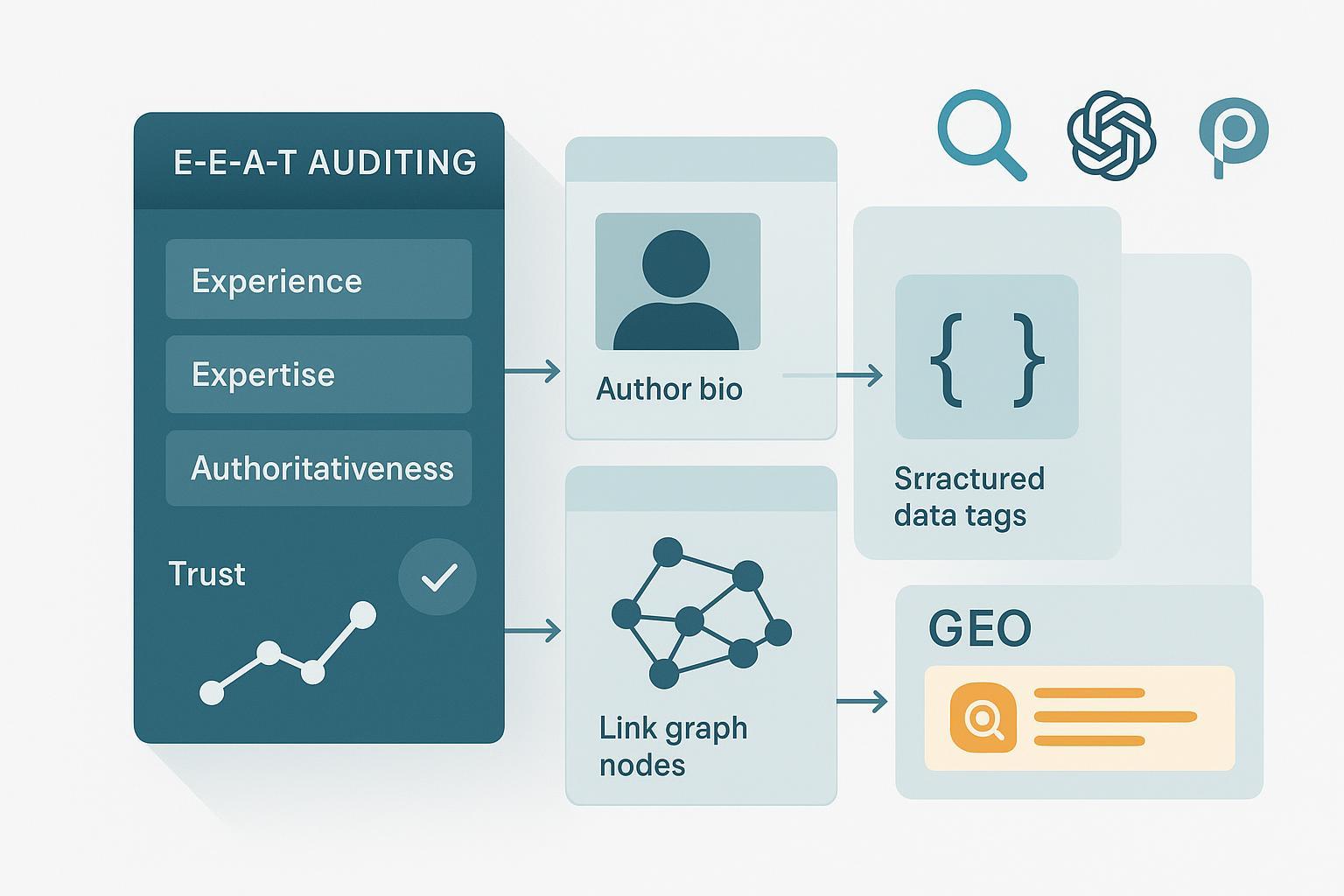
When AI answer engines synthesize results, they choose a handful of sources to cite—or none at all. If your brand isn’t showing up, the question isn’t only “How do we rank?” but “What trust and authority signals are machines confident enough to quote?” This guide shows a repeatable way to audit E-E-A-T (Experience, Expertise, Authoritativeness, Trustworthiness) and connect it to GEO outcomes—your visibility and citations in AI Overviews, ChatGPT-style answers, and similar systems.
E-E-A-T, clarified (and why Trust leads)
E-E-A-T comes from Google’s Search Quality Rater Guidelines (QRG), which outline how evaluators assess page quality and reputation. The document emphasizes that Trust is the most important factor; if a page isn’t trustworthy, other strengths can’t compensate. See the current PDF in Google’s Search Quality Rater Guidelines. The QRG isn’t a direct ranking factor, but it expresses principles Google aims to reward with helpful content systems. For YMYL topics (health, finance, safety, public information), the bar is higher and off-site reputation research matters more. Also see Google’s Search Quality Rater Guidelines update note (Nov 16, 2023) for context on simplifications and scope.
GEO, defined and connected to E-E-A-T
Generative Engine Optimization (GEO) is about earning visibility and citations inside AI-driven answer engines (e.g., Google’s AI experiences, ChatGPT with browsing, Perplexity, Copilot). Industry coverage frames GEO as distinct from classic blue links because systems synthesize answers and cite sources selectively. Authoritative, verifiable, and up-to-date pages are more likely to be cited. Review Google’s AI features and your website for orientation on how AI surfaces content, and see Search Engine Land’s What is Generative Engine Optimization (GEO)? for a concise industry explainer. For foundational terminology, you can also review our acronyms explainer (GEO, GSVO, GSO, AIO, LLMO) and this definition of AI visibility.
The auditor’s mapping: from E-E-A-T to measurable checks
| E-E-A-T element | Observable on-site signals | Off-site/reputation proxies | GEO metrics you can track | Tools to verify |
|---|---|---|---|---|
| Experience | First‑hand photos, methods, case studies, reviewer notes | Interviews, expert quotes, conference talks | Citations where the answer references your unique data | CMS review, manual sampling; crawlers for custom extraction |
| Expertise | Author bios with credentials, linked profiles, reviewer credits | Author profiles on professional/org sites; citations by peers | AI answers preferring credentialed pages | Author/Article schema; Rich Results Test |
| Authoritativeness | Clear org identity, editorial standards, About/Contact | High‑quality referring domains; press coverage | Share‑of‑answer vs named competitors | Ahrefs/Semrush/Moz; knowledge panel/entity checks |
| Trustworthiness | HTTPS, privacy/corrections/ads policies; date hygiene; primary-source citations | Third‑party reviews; lack of serious negative reports | Stable or improving citation frequency and sentiment | Lighthouse, PageSpeed Insights, policy page review |
Think of the table as your flight plan: on-site truth and clarity, off-site corroboration, and AI visibility as the outcome signal.
A step-by-step E-E-A-T audit workflow for the GEO era
- Preparation and scoping
- Pick 10–50 priority queries with business value. Include informational, comparison, and transactional intents.
- Capture a baseline of AI answers and citations across platforms (Google AI experiences, Perplexity, ChatGPT-browsing, Copilot). Save screenshots and timestamps.
- Ensure access to Google Search Console, your analytics, a crawler, a structured data validator, and a link intelligence suite.
- Site identity and transparency
- Inspect About, Contact, leadership, and ownership details. Add editorial standards, corrections, and advertising disclosures; link them from your footer.
- Validate Organization schema (name, url, logo, sameAs, contactPoint) and ensure visible-text parity.
- Confirm HTTPS, security headers, and a clean robots/meta directives posture.
- Author credibility and experience
- Ensure every byline links to a real bio page with qualifications, first-hand contributions, and off-site profiles where appropriate.
- Add Person schema on bio pages; represent authors correctly in Article schema (Person or Organization when appropriate). Validate with the Rich Results Test.
- Where YMYL applies, consider reviewer roles and display reviewer credentials.
- Content integrity and sourcing
- Sample priority pages. Are claims backed by primary sources? Is the last updated date genuine and recent enough? Are methods and datasets disclosed when relevant?
- Remove thin aggregation and paraphrase-heavy pages; add unique analysis, data, or expert quotes.
- Align headings, summaries, and images with the core question so AI systems can extract succinct support.
- Technical trust and accessibility
- Crawl your site to surface indexation, canonical, and rendering issues. Eliminate JS-delayed rendering that hides main content.
- Check Core Web Vitals and accessibility basics via Lighthouse/PageSpeed Insights. Avoid intrusive interstitials.
- Validate structured data and keep @id values stable for Organization and authors. Ensure dates reflect real editorial history.
- External reputation and links
- Review referring domain quality and topical relevance; prioritize editorially earned links and expert mentions.
- Locate unlinked brand mentions for outreach. Curate authoritative sameAs for your organization and key authors.
- Monitor knowledge panel/entity consistency over time.
- AI visibility benchmarking (GEO)
- For your query set, log whether your domains/URLs are cited, where in the panel they appear, and in what context.
- Record co-cited competitors and sentiment (supportive, neutral, critical). Track freshness of the pages earning citations.
- Repeat weekly to see trends. Treat results as directional—platforms differ in how they cite.
- Triage and reporting
- Group fixes into Content (bios, methods, sources), Technical (schema, rendering), and Authority/PR (editorial links, expert features). Assign owners and timelines.
- Tie each action to a hypothesis: “Adding reviewer credits to YMYL guides may improve AI citation for medical queries.”
- Report quarterly on on-site E-E-A-T completion, off-site authority growth, and AI citation/share-of-answer changes.
Practical example: linking E-E-A-T fixes to AI citations
Disclosure: Geneo is our product.
Let’s say you’ve improved author bios and added reviewer credits across your buying guides. Next, you want to observe whether AI engines start citing your pages more often for “best X for Y” queries.
- Create a fixed query list and capture current AI answers with screenshots across Google AI experiences and Perplexity.
- In an AI visibility dashboard such as Geneo, track citation frequency by platform and query group, and tag the date when reviewer credits shipped. Note the sentiment of mentions (supportive vs. neutral) and any misattributions to correct in content.
- After four weeks, compare share-of-answer against your baseline. If citations grew for guides with reviewer credits but not others, your hypothesis gains support—ship the pattern to the rest of the library and re-measure.
This isn’t magic; it’s an auditable loop that ties specific E-E-A-T improvements to observable GEO outcomes. For a broader primer on how we define “AI visibility,” see our AI visibility definition.
Troubleshooting top blockers (symptom → likely cause → fix)
- No author displayed in markup → Article schema missing or inconsistent → Add author as Person, link to bio, validate in the Rich Results Test.
- Bios exist but feel thin → Little first-hand detail, no off-site corroboration → Expand bios with credentials, methods, awards; link to authoritative profiles.
- Organization identity seems fragmented → Multiple brand names, outdated logo, messy sameAs → Standardize Organization schema with a stable @id; update logo; prune sameAs to authoritative properties.
- AI answers rarely cite you → Weak evidence density, outdated pages, low off-site authority → Add original data/examples, refresh YMYL content, pursue editorial features and relevant links, improve entity consistency.
- Structured data warnings → Parity issues or date manipulation → Make on-page text match schema; ensure datePublished/dateModified are truthful.
Measure, monitor, repeat
What can you reliably track today?
- Citation frequency and position inside AI answers for a fixed query set.
- Share-of-answer/voice vs a competitor cohort.
- Sentiment/context of mentions and misattributions to correct.
- Freshness of cited pages and the cadence of substantive updates.
Helpful references and guardrails:
- Google’s AI features and your website explains how AI experiences present links and how to control previews.
- Google’s March 2024 core update and spam policies clarify expectations around helpful content and scaled content abuse; keep automation in check and maintain editorial review.
- Treat AI visibility metrics directionally—methodologies vary by platform and tool. Keep raw evidence (screenshots, query lists, timestamps) for reproducibility. For structuring KPIs, see our KPI frameworks for AI search and for deeper measurement thinking, our LLMO metrics post.
Next steps
- Schedule a quarterly E-E-A-T + GEO audit. Start with identity/policy pages, then authors, then content integrity and structured data, followed by off-site reputation and AI visibility.
- Maintain a living query set and a screenshot-backed log of AI answers. Re-test after each material content or PR change.
- Align fixes with hypotheses and owners; report on on-site completion, off-site authority, and AI citation trends.
If you want a single workspace to log cross-LLM citations and sentiment while your team ships E-E-A-T improvements, consider evaluating Geneo for AI visibility tracking.
References and further reading
- Google’s Search Quality Rater Guidelines (latest PDF)
- Google Search Central — AI features and your website
- Google Search Central — March 2024 core update and spam policies
- Search Engine Land — What is Generative Engine Optimization (GEO)?
Internal reading (contextual)