
Using Geneo to Detect and Quantify Tone Inconsistencies That Impact AI Search Visibility
Step-by-step guide for growth marketing teams to detect, measure, and fix multilingual tone inconsistencies that harm AI search visibility using reproducible metrics.
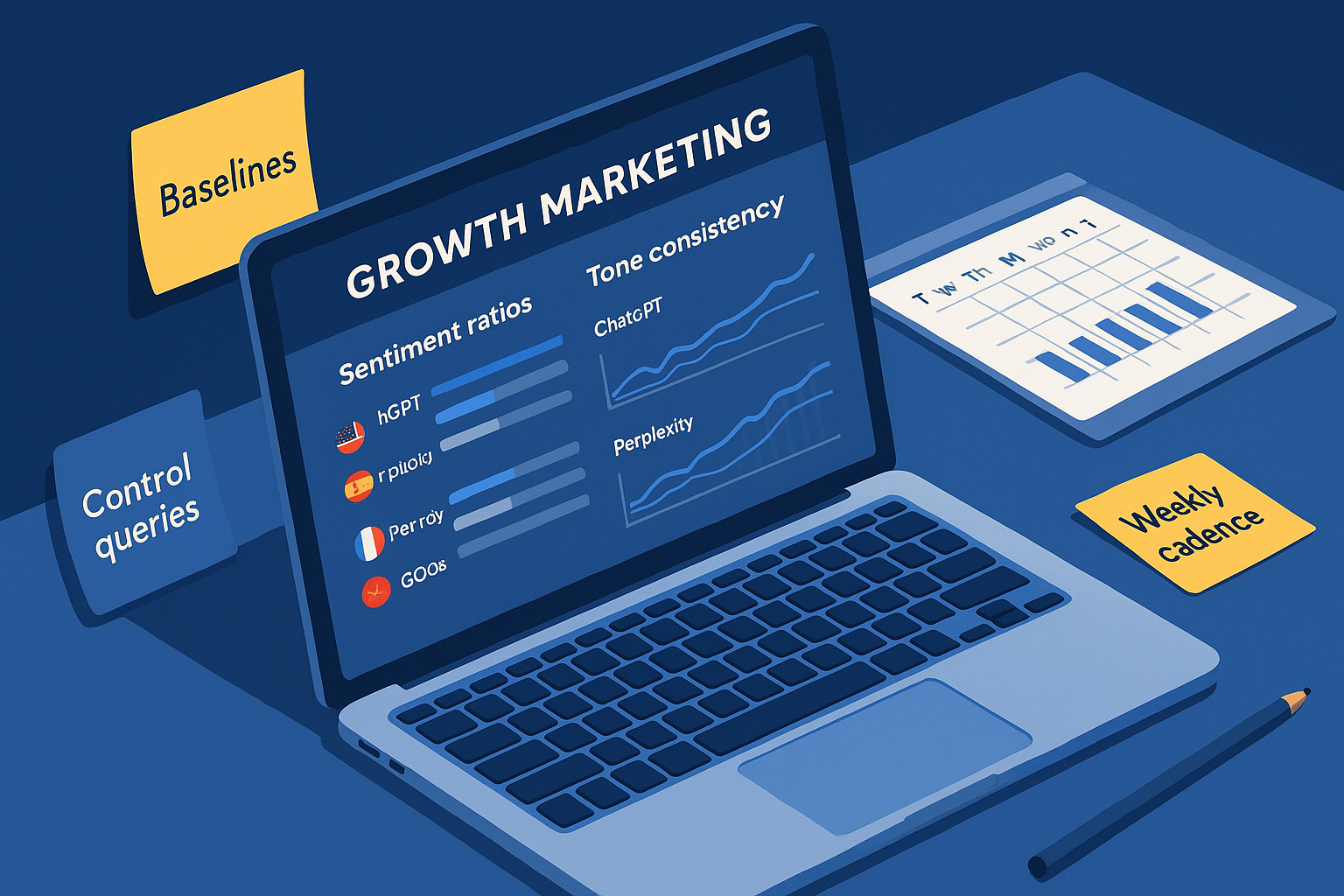
Growth marketing teams are increasingly judged by how their brands show up in AI answers. When tone drifts across languages or platforms, the brand can look warmer in one place and skeptical in another—changing the share of positive, neutral, and negative mentions. This tutorial gives you a reproducible workflow to monitor multilingual tone, capture evidence, score sentiment and tone-consistency, and close the loop with corrections across ChatGPT, Perplexity, and Google AI Overviews.
Who it’s for: teams responsible for AI search visibility operating in multiple markets and languages.
What you’ll build today: a baseline dataset, a prompt library in four languages, a simple CSV schema for evidence capture, weekly scoring for sentiment and tone-consistency, and a correction loop you can re-run after updates.
Assets and access you’ll need
Accounts or access modes for ChatGPT, Perplexity, and Google AI Overviews (use standard search with AI Overviews enabled where applicable).
A spreadsheet/BI workspace and a shared repository for screenshots and raw responses.
Native-language sentiment tooling (model or API) for your target languages.
Your canonical tone-of-voice guide mapped per language/locale.
Step 1: Set baselines with control queries
Start with “control” prompts—stable, high-intent questions that matter to your brand. Think of them like calibrated yardsticks you’ll revisit every week.
Define 12–20 control queries per language covering discovery, comparison, and decision intents. Keep wording stable.
Segment by engine: run the same controls on ChatGPT, Perplexity, and Google AI Overviews.
Establish cadence: weekly for six weeks to build a baseline; then move to biweekly.
Prepare storage: create folders per engine/language and a shared CSV or Sheet with strict columns (see Step 3).
Why baselines matter: platforms evolve. Fixed controls let you measure drift rather than chasing noise.
Step 2: Sample and prompt across engines (multilingual)
Use concise, answer-first prompts that mirror real user intent. Below are templates in English (EN), Spanish (ES), French (FR), and Simplified Chinese (ZH). Adapt brand/product names and market specifics.
ChatGPT (EN): “What do customers say about [Brand] for [use case]? Cite sources and summarize pros/cons.”
ChatGPT (ES): “¿Qué dicen los clientes sobre [Marca] para [caso de uso]? Cita fuentes y resume pros/contras.”
ChatGPT (FR): “Que disent les clients à propos de [Marque] pour [cas d’usage] ? Cite des sources et résume les avantages/inconvénients.”
ChatGPT (ZH): “关于[品牌]在[使用场景]的客户反馈如何?请引用来源并总结优缺点。”
Perplexity (EN): “Compare [Brand] with [Competitor] for [use case] in [market]. Include citations and sentiment.”
Perplexity (ES): “Compara [Marca] con [Competidor] para [caso de uso] en [mercado]. Incluye citas y sentimiento.”
Perplexity (FR): “Comparez [Marque] à [Concurrent] pour [cas d’usage] dans [marché]. Incluez des citations et le sentiment.”
Perplexity (ZH): “在[市场]比较[品牌]与[竞品]在[使用场景]的表现。请包含引用与情绪倾向。”
Google AI Overviews (EN): Search query: “[Brand] vs [Competitor] for [use case]” or “Is [Brand] good for [use case]?”
Google AI Overviews (ES/FR/ZH): Translate naturally; avoid awkward phrasing that users wouldn’t type.
Stratified sampling tip: choose prompts across stages (awareness, consideration, decision) and content types (reviews, how-tos, comparisons). Keep your set compact to avoid prompt sprawl.
Step 3: Capture evidence the same way every time
Every sample must have verifiable evidence. Store raw text, screenshots, and citations using a simple, consistent schema.
Suggested CSV columns:
date_time, engine, language, market, prompt, raw_answer_text, screenshot_path, citation_urls, sentiment_label, sentiment_confidence, tone_match_flag, tone_notes, reviewer_id
Naming conventions:
Screenshots: /evidence/[engine]/[language]/YYYY-MM-DD/[intent]-[short_slug].png
Raw text dumps: /evidence/[engine]/[language]/YYYY-MM-DD/[short_slug].txt
Parsing citations: Perplexity shows numbered sources; AI Overviews display links within the card; ChatGPT may provide references depending on the mode. Save each citation URL as a comma-separated list in citation_urls.
Verification checkpoints:
Spot review 10–20% of samples per language to calibrate sentiment labels and tone matches.
If two reviewers disagree, reconcile and update the rubric before proceeding.
Step 4: Score sentiment and tone-consistency with clear formulas
Compute two core metrics per engine and language for each time window.
Formulas:
Positive Share = Positive / (Positive + Neutral + Negative)
Negative Share = Negative / (Positive + Neutral + Negative)
Tone-Consistency Match Rate = Matches / Total Samples
Thresholds to start with (adjust per brand after 2–3 cycles):
Investigate if Negative Share exceeds 15% or if Tone-Consistency falls below 70% in any engine-language segment.
Segmentation and trend tracking:
Keep separate tables per engine and language; avoid direct cross-engine comparisons without normalization.
Compare current week to baseline averages; flag material deviations.
Evidence notes: Accuracy in non-English languages varies. Prefer native-language sentiment models or cloud APIs. Periodically run human reviews to recalibrate.
Step 5: Aggregate and report (weekly)
Turn your scores and evidence into a concise weekly view. Aim for one page per engine/language segment with a small summary.
Sample summary table (one segment):
Week | Samples | Positive Share | Negative Share | Tone-Consistency |
|---|---|---|---|---|
W1 | 24 | 0.58 | 0.12 | 0.76 |
W2 | 24 | 0.61 | 0.11 | 0.78 |
W3 | 24 | 0.55 | 0.16 | 0.70 |
Narrative tips:
Explain the “why” when a segment dips: Was it a new UGC thread, a critical review video, or a translation nuance?
Link to representative evidence: attach 2–3 example screenshots and cited passages.
Context and external references:
Google’s guidance emphasizes helpful, unique content and standard controls for AI features; see the Search Central article on succeeding in AI search experiences (2025).
Perplexity provides numbered citations and transparency; review how Perplexity works to standardize capture.
Industry analyses show AI Overviews often cite UGC and video sources; see Ahrefs’ AI Overview brand visibility correlations (2025) for context. These are correlations, not guarantees.
How this workflow improves AI search visibility
When you measure sentiment and tone-consistency by engine and language—and tie corrections to the sampled queries—you reduce negative portrayals and align tone across markets. Over time, this governance improves how your brand is represented in AI answers and helps sustain predictable AI search visibility.
Step 6: Correction loop and re-test
When a segment crosses thresholds, run targeted fixes and then re-measure.
Content and entity fixes:
Align tone across languages using a “tone ladder” (e.g., Formal → Balanced → Conversational) with examples per market.
Strengthen entity clarity: validate Organization, Article, and FAQPage structured data; ensure sameAs references and consistent naming.
Publish answer-first, helpful content that addresses the exact queries you sample, including local-language FAQs.
Off-site signals:
Consider engaging on platforms commonly cited in AI Overviews (e.g., YouTube, Reddit) where appropriate.
Re-test cadence:
After fixes, re-run controls for 2–3 cycles; track whether Negative Share falls and Tone-Consistency improves.
Neutral product example:
Disclosure: Geneo is our product. In practice, Geneo can be used to centralize AI visibility monitoring across ChatGPT, Perplexity, and Google AI Overviews. Teams store evidence, track sentiment/mentions, and compare trends per engine and language. For definitions of AI visibility dimensions and measurement, see the Geneo docs.
Verification and troubleshooting
Multilingual sentiment noise: Use native-language models/APIs (e.g., XLM-RoBERTa variants on Hugging Face) and calibrate with human review.
Platform variance: Maintain separate baselines per engine; don’t overreact to short-term swings.
Evidence gaps: Enforce capture at time of check; never rely on memory.
API limits: Throttle queries; schedule during off-peak; keep logs.
Templates and automation
Use a lightweight script to schedule weekly exports of your prompts and capture raw responses. Adapt authentication and API calls for your chosen tooling.
# cron (macOS/Linux) — run every Monday at 08:15
  15 8 * * 1 /usr/local/bin/python3 /opt/geo/run_sampling.py >> /opt/geo/logs/sampling.log 2>&1
CSV starter schema (columns):
date_time, engine, language, market, prompt, raw_answer_text, screenshot_path, citation_urls, sentiment_label, sentiment_confidence, tone_match_flag, tone_notes, reviewer_id
Extended reading:
Differentiate GEO/AEO from traditional SEO with this comparison.
For prompt-to-stage mapping in AI search, see buyer journey mapping for FinTech.
What “good” looks like after two cycles
Negative Share holds below 10–12% in priority segments; Tone-Consistency averages ≥75–80%.
Evidence archive is complete: every sample has raw text, screenshot, and citations.
Control queries are stable; new queries are added only for emerging intents.
Teams close the loop within two weeks: fixes are implemented and re-tests scheduled.
Final note: tone consistency isn’t a guaranteed ranking factor, but it’s a measurable governance lever. By scoring sentiment and tone—and tying corrections to the queries and languages that matter—you maintain a predictable, defensible approach to AI search visibility.