
How to Create Authoritative GEO Topic Clusters
Learn how to build authoritative GEO topic clusters that get cited in AI answers. Step-by-step guide for maximizing AI search inclusion and brand authority.
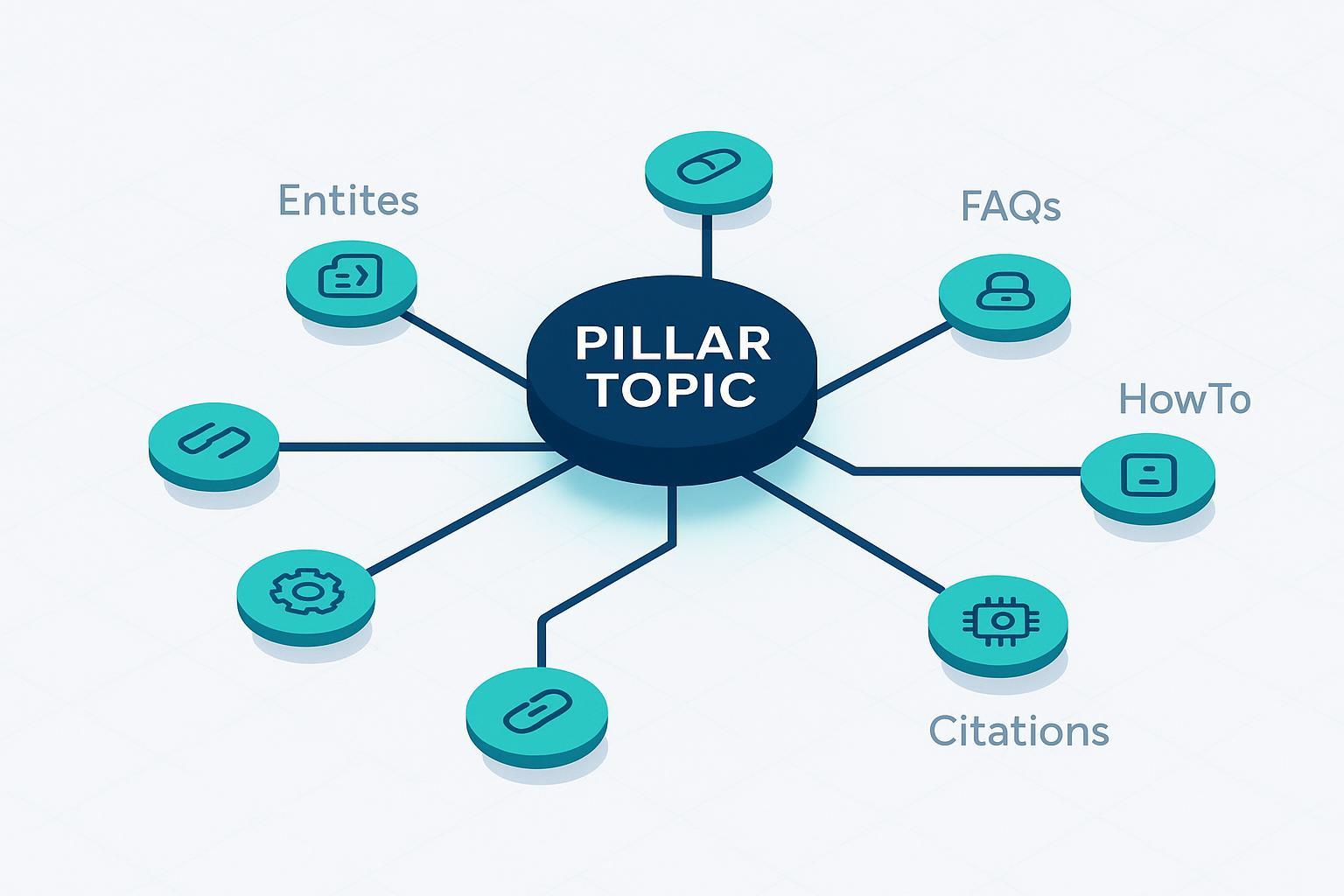
If AI answers mention everyone but you, the problem likely isn’t your expertise—it’s your structure. Authoritative GEO topic clusters make your expertise legible to AI systems so they can interpret, quote, and cite you reliably across ChatGPT, Perplexity, and Google AI Overviews.
GEO topic clusters, defined—and why they work
Generative Engine Optimization (GEO) is the practice of earning presence and citations inside AI-generated answers, not just ranking in classic SERPs. Authoritative clusters are built around a pillar page with tightly scoped, interlinked subpages that cover the entity, its attributes, actions, and related questions. This approach helps AI engines parse what you’re about and where the best answer lives.
- According to the practitioner overview from Search Engine Land, GEO emphasizes entity clarity, answer extractability, and trust signals that improve inclusion in AI answers; topic clusters are a natural fit for that mandate, as explained in the Search Engine Land guide to GEO (2024–2025).
- Backlinko’s frameworks for both GEO and topic clusters underscore how comprehensive coverage plus clear structure increases the chance of being retrieved and cited; see Backlinko’s GEO guide (2025) and the complementary Topic Clusters 101 for patterns that map well to AI extraction.
For a quick primer on why this matters to visibility beyond SERPs, see our explanation of AI visibility and brand exposure in AI search.
Step 1 — Pick a pillar and map entities (light knowledge graph)
Choose a pillar that represents a single, definable entity—something you can introduce cleanly in one paragraph and support with sub-entities and actions. Then sketch a lightweight knowledge graph: pillar entity, sub-entities, attributes, actions, and relationships. Give each sub-entity its own page, and on the pillar list the sub-entities with brief summaries and links. On each subpage, restate the connection back to the pillar using natural-language anchors that mirror common questions (e.g., “What is lifecycle assessment in sustainable marketing?”).
Example seed set: Pillar entity: “Sustainable Marketing.” Sub-entities: “Lifecycle Assessment,” “Greenwashing Risks,” “Supplier Audits,” “Eco Labels,” “Carbon Accounting Basics,” “Campaign Measurement.” Attributes: definitions, metrics, standards, tooling, examples. Actions/relationships: “conducts,” “complies with,” “measures,” “reports,” “avoids.”
Step 2 — Mine conversational queries AI actually answers
Work backwards from the questions people ask and the way AI engines frame them. Pull prompts from your support/sales logs, People Also Ask and related searches, community threads, and live queries to AI systems (note how they paraphrase and which passages they cite). Group questions by intent—definitions, comparisons, steps, compliance, and troubleshooting. Assign 5–7 priority FAQs to each sub-entity page and one compact FAQ set to the pillar. Keep answers short, factual, and source-bound so an AI can quote them without distortion.
Step 3 — Architect the pillar, cluster depth, and internal links
Use a hub-and-spoke structure: pillar → sub-pillars/subtopics → tactical pages. Every page should link up to the pillar, and siblings should crosslink when it adds context. Think of internal links as the edges in your knowledge graph. Anchor text should read like how users ask (“How do supplier audits reduce greenwashing risk?” beats “read more”). Keep navigation simple and consistent. Avoid orphan pages. Use BreadcrumbList schema to reinforce hierarchy.
Step 4 — Write for extractability (what AI can quote cleanly)
You’re writing for two audiences at once: humans scanning for clarity and AI systems seeking crisp, attributable facts. Start with a brief definition block; include numbered procedures where relevant, keeping each step a single, unambiguous action with required inputs; and add a compact FAQ with a few high-intent questions. Place the most general questions near the top of the page; reserve niche variants for subpages. Bind claims to sources inside sentences with descriptive anchors. Google’s documentation emphasizes that structured data clarifies meaning but doesn’t guarantee AI Overview inclusion; it still helps engines understand your page purpose, as noted in Google’s AI features and structured data guidance and the structured data introduction.
Step 5 — Add schema to bind the entities
Use JSON-LD with consistent @id values. Declare what each page is about and mention closely related entities. Connect pages with isPartOf/hasPart and add a BreadcrumbList. Validate in Search Console and Google’s Rich Results Test.
{
    "@context": "https://schema.org",
    "@type": "WebPage",
    "@id": "https://example.com/sustainable-marketing#webpage",
    "url": "https://example.com/sustainable-marketing",
    "name": "Sustainable Marketing",
    "about": {
      "@type": "Thing",
      "@id": "https://example.com/id/sustainable-marketing",
      "name": "Sustainable Marketing",
      "sameAs": [
        "https://www.wikidata.org/wiki/Q5611588"
      ]
    },
    "mentions": [
      { "@type": "Thing", "@id": "https://example.com/id/lifecycle-assessment", "name": "Lifecycle Assessment" },
      { "@type": "Thing", "@id": "https://example.com/id/eco-labels", "name": "Eco Labels" }
    ],
    "isPartOf": { "@id": "https://example.com/#website" },
    "breadcrumb": {
      "@type": "BreadcrumbList",
      "itemListElement": [
        {"@type": "ListItem", "position": 1, "name": "Home", "item": "https://example.com/"},
        {"@type": "ListItem", "position": 2, "name": "Sustainable Marketing", "item": "https://example.com/sustainable-marketing"}
      ]
    }
  }
Keep schema simple and strongly supported. Favor WebPage/WebSite, Article/BlogPosting, FAQPage, HowTo, Organization, AboutPage, and ContactPage. Use about, mainEntity, mentions, isPartOf, and hasPart to express relationships.
Step 6 — Platform-specific finishing passes
Different engines favor different patterns. Before publishing, run a tight finishing pass for each target platform.
- Google AI Overviews: Make sure pages are indexable, fast, and up to date. Lead with a direct answer and include compact FAQs. Observational studies show a heavy overlap between AI Overview sources and top 10 organic results, so classic SEO fundamentals still matter; SE Ranking’s analysis summarizes this overlap in its study of AIO source selection (2024).
- Perplexity: Recency is often rewarded, and original data/methodology pages tend to earn citations. Keep summaries crisp and show your sources clearly. See platform differences discussed in Profound’s 2025 platform citation patterns.
- ChatGPT (with browsing): Provide extractable definitions, step-by-step sections, and comparison-friendly formatting. Include author credentials and last updated. OpenAI’s release materials for GPT‑4.1 indicate browsing is invoked for fresh or external info; design pages so they’re easy to cite when browsing is used, as described in OpenAI’s GPT‑4.1 overview.
Step 7 — Measure, learn, and iterate
If you don’t measure inclusion and citations, you can’t improve them. Track inclusion rate by platform (share of prompts where you’re shown or cited), citation count and share of voice across tracked prompts, sentiment and faithfulness (did the answer paraphrase you correctly?), and recency coverage for time-sensitive topics. Translate these into editorial decisions: patch missing sub-entities, add definitional clarity where inclusion lags, refresh pages that used to be cited but dropped, and promote original data pages when they win more Perplexity citations. For a detailed framework, see our AI search KPI playbook for visibility, sentiment, and conversion.
Maintenance and troubleshooting
Quarterly, review your pillar and top cluster pages. Update claims with 2024–2025 sources, add or retire FAQs, validate schema, and repair link architecture. When volatility hits—say, after a major change to how AI answers are assembled—compare before/after inclusion and citations. For search context tied to AI answer engines, you can keep tabs on shifts like those discussed in our note on the October 2025 Google algorithm update.
Common symptoms and fast fixes: Low inclusion or citations? Strengthen the opening definition, add a concise summary box, and bind key claims to authoritative sources; ensure subpages answer specific questions directly and are linked from the pillar. Wrong entity interpretation? Add explicit disambiguation (what it is and isn’t) near the top, and include sameAs links to canonical IDs where appropriate. Stale pages? Update data and examples; add “last updated” and a brief changelog; surface recent FAQs based on how AI engines are answering now.
Practical workflow micro‑example (tool-agnostic with one disclosed option)
Disclosure: Geneo is our product.
Here’s a simple weekly loop you can replicate. After publishing your cluster on “Sustainable Marketing,” list 30–50 prompts that span definitions, comparisons, and procedures. Check inclusion and citations on ChatGPT (with browsing), Perplexity, and Google AI Overviews. Note where your pages appear, how they’re paraphrased, and whether the tone is accurate. A platform like Geneo can be used to monitor multi-platform AI visibility, track citations and mentions over time, and record sentiment on those mentions; feed gaps directly into your backlog (e.g., add a “Carbon Accounting Basics” FAQ or refresh the pillar definition). Keep the loop tight: review deltas weekly, then perform a deeper quarterly refresh.
Further reading
For agencies coordinating many clusters and brands, see Geneo for Agencies. Or explore our blog for AI search and GEO workflows: Geneo Blog.
References and notes
- GEO fundamentals and cluster rationale: Search Engine Land’s GEO guide (2024–2025) and Backlinko’s GEO guide (2025).
- Topic clusters and IA: Backlinko’s Topic Clusters 101.
- Google guidance on AI features and structured data: AI features eligibility and Structured data intro.
- AI Overview sourcing overlap with organic: SE Ranking’s AIO sources study (2024).
- Platform behavior differences: Profound on platform citation patterns (2025).
- OpenAI platform behavior: GPT‑4.1 overview.