
How to Conduct an AI Visibility Audit: Step-by-Step Using Geneo
Master the essential steps to audit your brand’s AI visibility across ChatGPT, Perplexity, and Google AI Overviews—learn metrics, data capture, and reporting using Geneo.
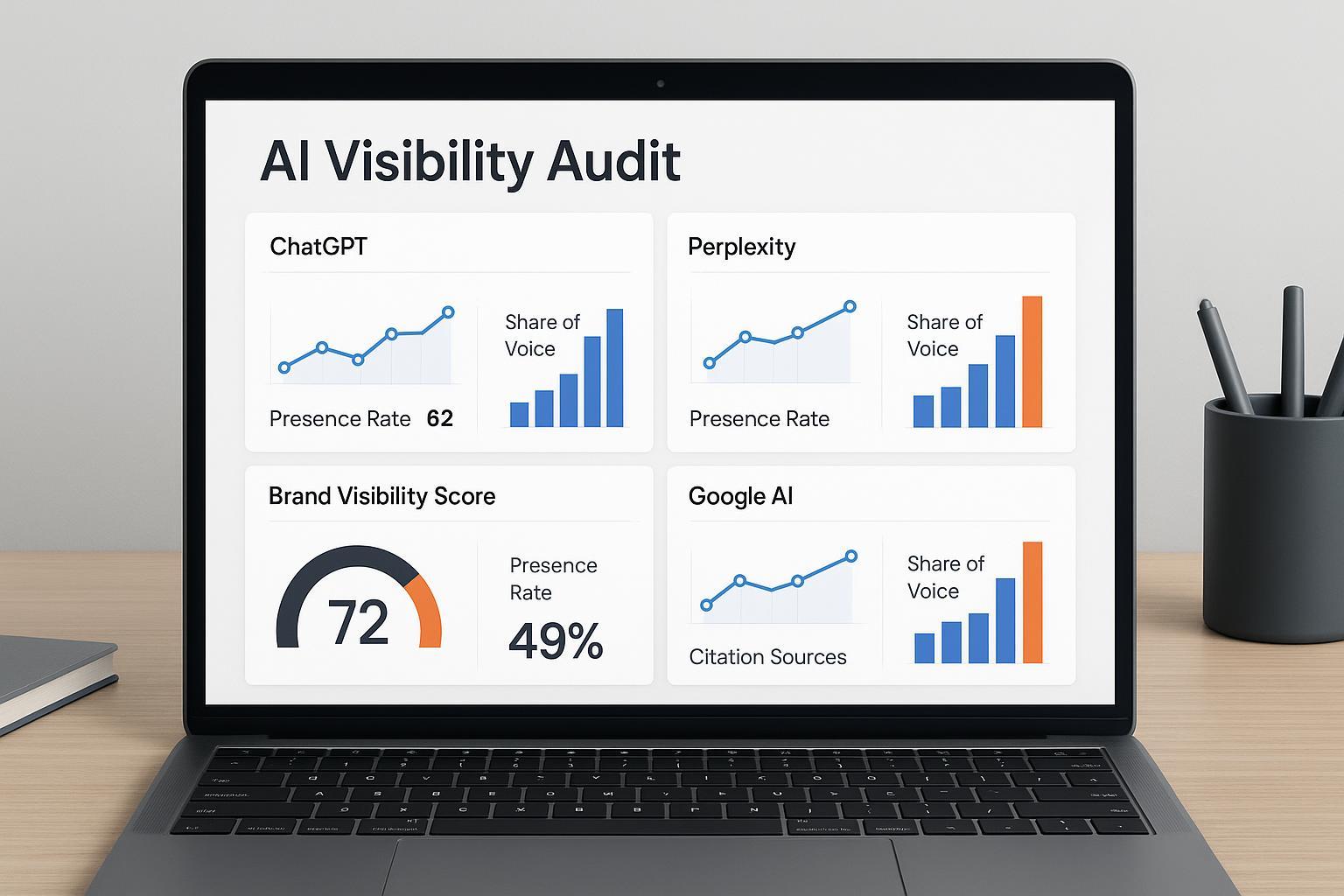
Essential Steps to Conduct an Effective AI Visibility Audit for Your Brand Using Geneo’s Platform
Your clients are asking a new question: “How do we show up in AI answers?” Without a standard, repeatable audit, teams bounce between screenshots and anecdotes. This guide gives agency SEO leads a rigorous, step-by-step workflow to measure—and then improve—brand visibility across ChatGPT (with browsing), Perplexity, and Google AI Overviews/AI Mode. You’ll walk away with clear metrics, verification checkpoints, and a cadence your team can run every month.
1) Build a focused audit query set
Start with business impact, not just volume. Pull conversion-backed queries from GA4 (landing pages tied to revenue/leads) and high-intent terms from GSC. Include brand, category, and competitor‑modified prompts. Cap the initial bank at 50–200 queries to balance coverage with repeatability. Mirror how people actually ask: mix short fact‑seeking prompts (for example, “best SOC 2 automation platforms”) with task‑oriented prompts (for example, “compare SOC 2 automation vendors for startups”). Assign each prompt a theme, funnel stage, and target URL(s), and note the locale and industry nuances you’ll test later.
Completion criteria: a labeled prompt bank (50–200) with intent tags and target URLs, plus a defined peer set (3–5 competitors) for benchmarking. As a quick verification, spot‑check 10 prompts for clarity and remove overloaded brand names; if ambiguity exists, add a disambiguated version (brand + category or location).
2) Run a cross‑engine baseline the right way
Test across ChatGPT (browsing enabled), Perplexity, and Google AI Overviews/AI Mode with a consistent method. For each prompt, record engine, model/version (when shown), locale, timestamp, and any follow‑up clarifications. Capture the full answer and citations, then immediately note presence (is your brand mentioned?), prominence (where it appears in the answer), and every cited URL/domain. Run identical prompts across all engines within the same 24‑hour window to limit volatility effects. For why cross‑engine differences matter, see our internal primer on the cross‑engine monitoring comparison. For a practitioner overview of measuring visibility in AI search, Search Engine Land’s guide (2025) offers a strong foundation: How to measure brand visibility in AI search.
Completion criteria: baseline results captured for each prompt × engine with presence and prominence noted, plus a full citation list exported per answer.
3) Capture evidence and normalize your data
Reproducibility builds trust—especially with clients and leadership. Take full‑page screenshots and copy raw answer text. Store the exact prompt and timestamp in your log. Extract all cited URLs, normalize to domains, and classify by type (owned, editorial, reference, UGC/video, forum/social). At minimum, your data model should store prompt × engine × timestamp, answer text, ordered mentions, prominence category, cited URLs/domains, and locale. Re‑run a small sample (5–10 prompts) after 48 hours to confirm the overall pattern holds. For a reproducible SOP, see the step‑by‑step workflow by Wellows (2025).
4) Measure the core metrics (and the composite score)
Below are the metrics most agencies standardize. They’re the backbone of reporting and prioritization: presence rate (responses that mention your brand ÷ total responses); prominence (where your first brand mention appears, mapped to a numeric score); AI Share of Voice (normalize mentions across brands and weight by order/position); citation rate and quality mix (how often your owned domain is cited and the authority/recency mix of all citations); and sentiment/tonality (positive/neutral/negative framing, with human review of flagged negatives). A composite Brand Visibility Score (BVS) rolls these into a weighted index—e.g., AI‑SOV_pos, owned citation rate, citation quality, and sentiment. Choose weights that reflect client goals and keep them consistent for trend reporting.
Metric | What it captures | Example collection notes |
|---|---|---|
Presence rate | Baseline inclusion across prompts | Binary per prompt × engine; average by theme |
Prominence score | How early/visibly you appear | Map lead=1.0; first para=0.8; citation-only=0.6; later=0.3; absent=0 |
AI‑SOV (position‑weighted) | Relative share vs. competitors | Apply decay weights to 1st/2nd/3rd mentions; normalize across brands |
Owned citation rate | How often the engine cites your site | Extract URLs; compute (owned citations ÷ mentions) |
Citation quality mix | Authority/recency/type of sources | Weight by DA/DR, freshness, and source type (editorial, reference, UGC/video) |
Sentiment index | Tone framing over time | Lightweight classifier + human QA for negatives |
For methodology background on how these roll into a composite, see our explainer on LLMO metrics for GEO measurement. For how Google frames AI answers and corroborating links, review Google’s AI features guidance.
Completion criteria: all core metrics computed per engine, and a composite BVS calculated with documented weights.
5) Benchmark against competitors and surface gaps
Compare your metrics against a defined peer set of 3–5 direct competitors that regularly appear for your prompts. Evaluate presence, prominence, AI‑SOV, and owned citation rate per engine. Note where a competitor dominates a theme or where engines disagree. When Google AIO cites editorial reviews while Perplexity leans on Reddit/YouTube, your content and channel strategy should reflect those patterns. Go Fish Digital’s updated guidance explains how to align with Google’s systems without “gaming it”: AI Overviews SEO: what matters now (updated 2025).
Completion criteria: a gap list per engine (content, schema, links, third‑party coverage, UGC/video) and prioritized opportunity themes tied to revenue pages.
6) Turn findings into a prioritized optimization roadmap
Tie actions to metrics you can re‑measure. Refresh or create pillar pages with crisp summaries, comparison blocks, and verifiable references, and publish first‑party data studies your market will cite. Implement Organization/Product/FAQ/HowTo schema where relevant; add expert bylines and contributor bios; ensure server‑side rendering for heavy JS. Secure editorial reviews and industry directory listings; expand into UGC/video where engines repeatedly cite those ecosystems; add transcripts to videos. Target sources your engines already prefer in citations (editorial/reference) to improve your citation quality mix. Finally, define expected movement—say, a +15% owned citation rate in Perplexity or a +0.1 prominence score in Google AIO for a “solutions” cluster—so you can confirm impact later.
Completion criteria: a 6–8 week backlog of prioritized tasks with owners, plus metric deltas defined for post‑implementation checks.
7) Reporting cadence, alerts, and agency packaging
Clients need consistency more than a single “win.” Trend the composite Brand Visibility Score, presence, prominence, AI‑SOV, and citation mix per engine each month. Highlight gained/lost prompts and notable source changes, and re‑audit the full prompt bank quarterly, recalibrating weights if business priorities shift. Set alerts for sharp drops in presence, owned citation rate, or sentiment flips on high‑impact prompts. Package results as clean, client‑ready visuals with engine splits and a short narrative (“what changed, why it matters, what we’re doing”). For examples of finished outputs, see our sample AI visibility reports.
Optional internal reading to equip your team: our cross‑engine monitoring comparison dives deeper into engine behaviors and trade‑offs.
Practical workflow example (product)
Disclosure: Geneo is our product.
Here’s one way an agency team can operationalize this audit with Geneo in the loop. Start by importing your 50–200 prompt bank and selecting engines (ChatGPT browsing, Perplexity, Google AIO/AI Mode). Run tests in a 24‑hour window so answers and citations auto‑log by prompt × engine × timestamp. From there, Geneo computes presence, prominence, owned citation rate, and a composite Brand Visibility Score based on documented weights you control, and trend lines show 7/28/90‑day movement. Finally, export a white‑label dashboard for your client domain (CNAME) with engine‑level splits and a prioritized fix list—supporting your monthly cadence without manual screenshots. These are capabilities the platform supports; your team still owns prompt selection, roadmap prioritization, and QA.
Troubleshooting and exceptions: quick SOP
Start with crawler access and rendering. Verify robots.txt directives for GPTBot/OAI‑SearchBot (OpenAI), PerplexityBot, and Googlebot/Google‑Extended, and ensure server‑side rendering for JS‑heavy pages. If answers omit your brand in category prompts, strengthen entity clarity with titles/H1s, Organization/Product schema, authoritative third‑party profiles, and comparison pages. Expect volatility after model updates or algorithm changes; watch rolling windows (7/28/90 days) and alert on drops in presence, owned citation rate, and position‑weighted SOV. For a broad measurement overview and current best practices, the Search Engine Land guide remains a useful reference: How to measure brand visibility in AI search.
Reveal Hidden Opportunities in AI!
Begin your free trial now and upgrade your AI visibility strategy
Next steps
If you’d like a working audit you can show clients next month—complete with composite scoring, engine-by-engine splits, and white‑label reporting—Book a Demo and we’ll walk your team through this workflow using your market’s prompts.