
How to Build a Long-Term GEO Roadmap: Step-by-Step Guide
Learn how to create a sustainable long-term GEO roadmap with practical, step-by-step guidance for optimizing AI visibility, citation, and measurable impact.
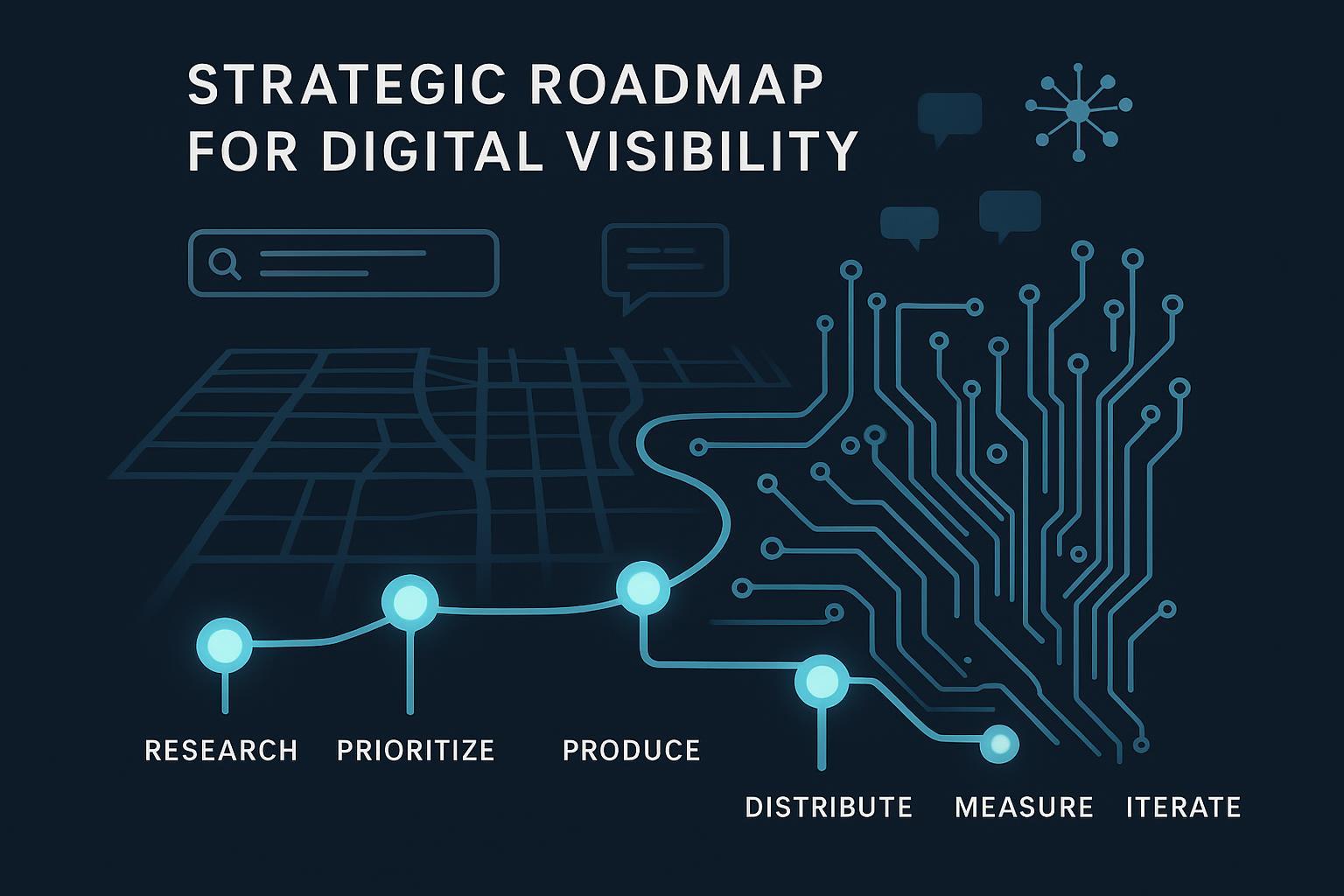
If AI engines are where answers get assembled, your roadmap is the assembly plan. This guide shows senior SEO and growth teams how to build a durable Generative Engine Optimization (GEO) program you can run quarter after quarter—research to governance—with clear checkpoints and evidence.
GEO in one page (primer)
GEO focuses on increasing how often and how well your brand is cited in AI-generated responses across Google AI Overviews/AI Mode, Bing Copilot, and Perplexity. It sits on top of SEO fundamentals: if you aren’t discovered and indexed, you won’t be cited. It also overlaps with AEO (answer features like snippets and voice), but GEO centers on extractable facts, source transparency, and distribution where AI systems select citations.
For a concise definition and scope, see Search Engine Land’s overview, What is generative engine optimization (GEO), which anchors terminology without overpromising on opaque ranking rules: What is generative engine optimization (GEO). Google notes there’s no special markup to “enable” AI features; qualifying content comes from the same index as search—focus on quality, clarity, and accessibility per Google Search Central’s AI features guidance.
Phase 1: Research — Map prompts, intents, and engines
Start with a prompt library built around your product journeys and categories. Group by topic → question → variants; tag intent (informational, how-to, comparison) and the engine/mode you test.
As you test, log whether Google surfaces an AI Overview and which sources appear; record Bing Copilot’s inline citations and Perplexity’s citation cards. Track patterns across runs. Industry studies suggest strong overlap between AI Overview citations and high-ranking organic results; treat this as correlation, not a rule. See the methodology and findings in the SE Ranking AI Overviews sources research and a complementary perspective in Duda’s analysis, Whom Google prioritizes in its AI Overview results. For broader optimization practices oriented to AI answers, iPullRank’s guide is useful context: How to optimize for AI Overviews.
Checkpoint: You should have a timestamped log of prompts with screenshots, detected AIO presence by query, and a list of cited domains. If you don’t see your brand or your closest competitors, reassess topic selection or the way your answers are structured.
Phase 2: Prioritize — Score for impact, effort, likelihood
Not all initiatives are equal. Use a simple scoring model to pick what ships this quarter. I like Impact × Likelihood ÷ Effort to balance business value, probability of success, and required lift. Apply it across four streams: content refreshes, net-new content, structured data improvements, and authority/citation building.
Below is a lightweight worksheet you can copy. Adjust scales to your organization’s norms.
| Initiative | Impact (1–5) | Likelihood (1–5) | Effort (1–5) | Priority Score (Impact × Likelihood ÷ Effort) |
|---|---|---|---|---|
| Refresh: Top “how-to” hub with answer-first sections | 5 | 4 | 2 | 10.0 |
| Net-new: Original dataset + explainer | 5 | 3 | 4 | 3.8 |
| Schema: Add/validate FAQPage + HowTo on 8 pages | 3 | 4 | 2 | 6.0 |
| Authority: Expert quotes + partner syndication | 4 | 3 | 3 | 4.0 |
Cadence: Lock a quarterly slate; keep a parking lot for promising ideas that didn’t make the cut. Revisit monthly based on evidence.
Phase 3: Produce — Make extractable, citable content
Write answers the way an AI would want to quote them: short, verifiable, and clearly segmented. Put the direct, factual answer high on the page, then elaborate. Break complex concepts into crisp paragraphs, steps, or small tables so each block can stand alone. Reinforce E-E-A-T with expert bylines, credentials, transparent references to primary sources, and visible timestamps/revision notes. Use consistent names and definitions across topic clusters and interlink accordingly.
For structured data, implement JSON-LD for Article/FAQPage/HowTo/Organization/Person where appropriate and validate alignment to visible content. Google recommends JSON-LD and documents supported types and validation in its structured data docs; start with the Structured Data intro and Search Gallery.
Pro tip: Use the term AI visibility in stakeholder materials to align on goals beyond traffic. If you need a concise definition and KPI framing, see AI visibility: brand exposure in AI search.
Phase 4: Ship — Technical accessibility and QA
Before and after you publish, confirm engines can discover and lift your content. Ensure renderable HTML, correct canonicals, healthy internal linking, and allowed resources in robots.txt. Keep pages fast and stable; make sure images and videos are indexable and carry descriptive captions where relevant. Run pages through Google’s Rich Results Test and fix warnings to match visible content.
Checkpoint: If a page isn’t indexed or has major rendering issues, fix those before chasing AI citations. Think of it this way: GEO can’t compensate for foundational SEO gaps.
Practical example: Logging prompts and monitoring citations with Geneo
Disclosure: Geneo is our product.
Here’s a neutral, replicable workflow many teams use to centralize research and monitoring. In a single workspace like Geneo you can create a prompt library by topic, add variants, and tag engine/mode (Google with/without AI Overview, Bing Copilot, Perplexity). Capture screenshots and source lists for each prompt run; the system stores history so you can compare month over month. Track whether your domain is cited, how it’s described (sentiment), and how often competitors appear.
You can do this manually with spreadsheets and screenshot folders; the benefit of a platform is persistence, consistency, and team access. Use whatever stack helps your organization maintain evidence over time.
Phase 5: Distribute — Expand your source footprint
AI answers pull from what’s discoverable and trusted. Distribution widens the pool of credible sources that can cite or mention you. Publish original datasets and expert commentary on respected publications and ensure clear canonicals. Contribute explainers and Q&A in partner blogs and professional communities, keeping entities and definitions consistent.
Engines sometimes attribute to republished copies; maintain canonical agreements and monitor for misattribution. For transparency strengths and gaps across engines, see the Tow Center audit, We compared eight AI search engines—They’re all bad at citing news. If your agency arm needs repeatable reporting across brands, align rollout and stakeholder reporting with an agency-ready stack such as Geneo for agencies.
Phase 6: Measure — KPIs and verification workflow
Define north-star and diagnostic metrics that reflect AI answer ecosystems: citation coverage (share of tracked prompts where your domain appears among sources), AI share of voice versus competitors within a prompt cluster, and sentiment/recommendation type (mention, example, explicit recommendation).
Verification workflow: Maintain “control” prompts to track monthly and run the broader library quarterly. For each engine/mode, capture timestamped screenshots of answers and citations; store source titles and URLs. Roll up metrics by topic and engine and annotate with content shipments and distribution pushes. Compare cited domains against your distribution map; where engines prefer a syndicated copy, tighten canonical signals and relationships.
Context: Google states that AI features draw from the same index as Search and do not require special markup; focus on helpful, accurate content and accessibility per Google Search Central’s AI features guidance. Observational studies indicate strong top-10 organic overlap among AI Overview citations—use these as directional inputs, as in the SE Ranking AI Overviews sources research—and balance them with practical content operations.
Phase 7: Iterate & Govern — Cadence, RACI, and troubleshooting
Treat GEO like a product program with a clear owner, cross-functional roles, and predictable ceremonies. Content owns drafts and updates; SEO/Web owns technical implementation; PR/Comms owns distribution and expert sourcing; Analytics owns measurement; one program owner is accountable for roadmap calls. Keep Consulted and Informed lists short to avoid bottlenecks.
Cadence: Weekly working meeting for blockers; monthly KPI deep-dive for reprioritization; quarterly roadmap refresh anchored to evidence from your prompt logs and citation coverage.
Common pitfalls and quick fixes: If you’re not cited despite ranking, tighten answer-first structure, add explicit facts with sources, reinforce expert bylines, and ensure sections are extractable. If schema seems ignored, validate JSON-LD alignment with visible content, remove irrelevant types, and monitor enhancements. If you plateau, expand topic clusters, publish original data, diversify distribution, and review competitor citations to find gaps.
Resources and next steps
- Ongoing GEO and AI visibility insights: Geneo blog hub.
- Broader implementation perspectives and tactics: Generative engine optimization strategies (Search Engine Land).
Next steps: Stand up your prompt library and run a first measurement cohort this week. Select 2–3 high-scoring initiatives using the scoring worksheet and schedule them into the next sprint. Decide where your evidence will live—shared drive, internal wiki, or a monitoring platform. If you want an all-in-one place to log prompts, track citations, and review sentiment across engines, consider trialing a monitoring tool such as Geneo.