
How to Build an Internal GEO Wiki: Practical Guide for Teams
Learn how to build an internal GEO (Generative Engine Optimization) wiki with actionable structure, governance, templates, and monitoring steps.
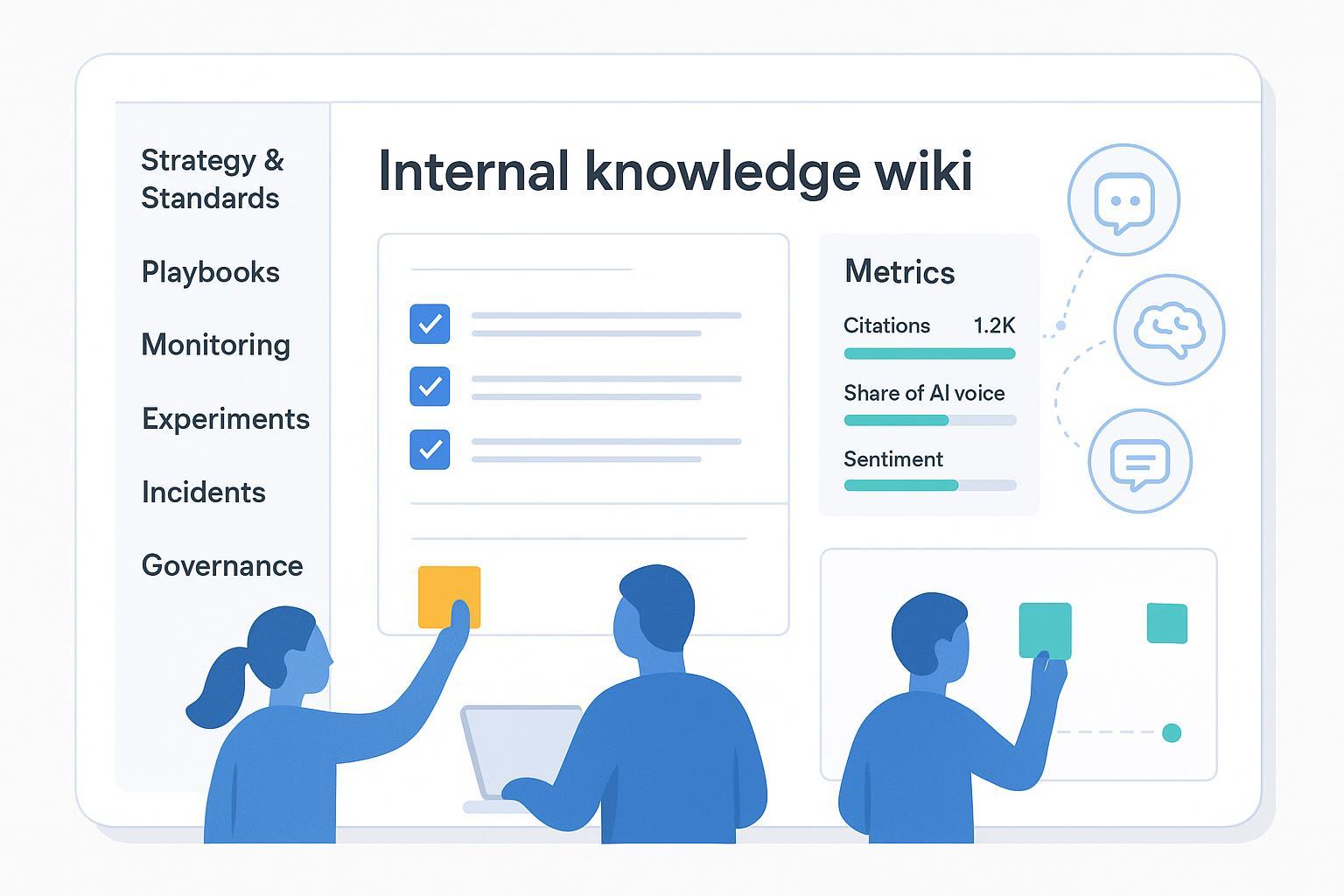
Your teams are experimenting with prompts, watching AI answers shift week to week, and swapping screenshots in Slack. What’s missing is a single, durable place to define how you practice GEO—how you document standards, run experiments, track citations, and respond when AI answers get your brand wrong. That place is your internal GEO wiki.
Below is a practical, platform-agnostic blueprint you can stand up in 30–60 days. It focuses on structure, governance, and repeatable workflows—not hype.
First, align on what “GEO” means
GEO stands for Generative Engine Optimization: the discipline of shaping your content and evidence so AI answer engines (Google AI Overviews, ChatGPT with search/browsing, Perplexity, and others) can accurately surface and cite it. In short, you’re optimizing for inclusion and trust in AI-generated answers, not just blue links. For context, see Search Engine Land’s overview defining GEO as optimizing for AI answer inclusion and citation in 2024 (What is Generative Engine Optimization, 2024), and Google’s owner-facing guidance on how content appears in AI experiences in Search (AI features and your website, 2025). GEO complements, not replaces, SEO.
Choose your wiki platform (decision criteria, not a catalogue)
Pick the platform your teams will actually use. Prioritize:
- Permissions you can reason about (read-open, write-restricted, group-based)
- Templates and version history so procedures don’t drift
- Fast search and sensible URLs
- SSO and export/backups for resilience
- Automations/APIs for notifications and reporting
Here’s a fast comparison to help you shortlist:
| Platform | Where it shines | Considerations |
|---|---|---|
| Confluence | Mature permissions, strong version history, tight Jira/Slack/Teams ecosystem | Heavier admin; enforce templates to avoid sprawl |
| Notion | Flexible databases, quick templating, approachable UI | Govern permissions carefully at teamspace/page level; plan exports |
| GitBook | Clean docs, review/change requests, AI search on published spaces | Publishing-first; validate export options and access model for internal-only |
| MediaWiki | Industrial-strength revisions, templates/transclusion | Requires admin expertise; extensions may be needed |
| Wiki.js | Git-backed storage option, modern RBAC, good search | Needs thoughtful setup; map Git/backup strategy |
If you must decide in a week, choose the one your organization already uses for specs or runbooks and enforce a stricter governance model there.
Design the GEO-specific information architecture (IA)
Set up top-level sections that mirror how GEO actually operates so people can find and maintain what matters:
- Strategy & Standards: Definitions for entities (brand, products, executives), naming conventions, citation policies, controlled vocabularies, and schema guidelines. Link to “canonical fact” pages that AI engines should echo.
- Playbooks (by AI engine): Separate, engine-specific procedures—e.g., ChatGPT (search/browsing), Perplexity (modes and source handling), Google AI Overviews (owner-facing best practices). Each playbook should include prompts, QA checklists, acceptance criteria, and escalation paths.
- Monitoring & Reporting: How to log citations, answer quality, and sentiment by engine and query set. Define dashboards and weekly/quarterly cadences.
- Content Factory: Brief templates, editorial steps, required evidence (tables, quotes, data), and review matrices. As you centralize knowledge from scattered sources, patterns from the internal knowledge work described in our piece on Security Questionnaire Response Automation Tools can help you standardize source-of-truth inputs.
- Experiments: Hypotheses, query sets, variants (content, schema, prompts), metrics, and decisions. Treat this like a lab book.
- Incidents & Changes: Where you file inaccuracies or regressions in AI answers, track root causes, and maintain a change log. For inspiration on documenting external shifts, see our note on the Google Algorithm Update (October 2025).
- Governance: Owners, reviewers, review cadences, access tiers, archival/deprecation rules, and compliance notes.
Two credible references can guide your governance stance: Nielsen Norman Group’s emphasis on defining ownership and maintenance within content strategy (Content strategy study guide) and the GOV.UK approach to assigning owners, review schedules, and withdrawal/deprecation of stale standards (Guide to governance and management frameworks).
Templates you can copy (with a micro-example)
Use templates to make contributions consistent and reviewable. Adapt these fields to your platform.
-
SOP (process) page: Purpose; Scope; Definitions; Preconditions; Steps (numbered, with screenshots when helpful); Owners/roles; Inputs/outputs; SLAs; Risks/mitigations; Version/approval; Last reviewed/Next review.
-
Playbook page: Audience; Supported engines; Preconditions; Prompt library; QA checklist; Acceptance criteria; Escalation path; Related incidents; Change history.
-
Experiment log: ID; Hypothesis; Query set; Engine(s); Variant design (prompt/content/schema); Start/end dates; Metrics (share of AI voice, citation count, sentiment, freshness); Results; Decision; Learnings; Links to diffs.
-
Incident review/change log: Title; Date; Trigger; Impacted queries/entities; Observed answer (attach captures); Expected facts; Root cause (when known); Mitigation; Owner; Status; Follow-ups; Links to tickets.
Micro-example (Experiment Log)
ID: EXP-014 Hypothesis: Adding a tabular specs block to the “Pricing Tiers” page increases citations in Perplexity answers for “[Your Brand] pricing tiers.” Query set: “[Your Brand] pricing tiers,” “Is [Your Brand] free?” “[Your Brand] enterprise plan limits.” Engines: Perplexity, ChatGPT (search) Variants: V0 control (current page); V1 adds table with plan names, limits, last-updated stamp. Window: 2025-01-10 → 2025-01-24 Metrics: SoAIV; citation frequency; sentiment polarity Result: Perplexity cited V1 page in 2/5 tracked queries (from 0/5); neutral-to-positive tone maintained Decision: Promote V1; add freshness reminder every 60 days Learnings: Tabular facts improved scanability for engines that show inline citations. Maintain a visible last-updated date.
Permissions, roles, and compliance
Keep reading simple and writing controlled. Start with read-open/write-restricted for the whole space, then grant edit to contributor groups for specific sections (e.g., Playbooks: SEO + Content Ops; Incidents: GEO duty officer + leads; Governance: steering committee only). Maintain owners on each page, display “last reviewed” and “next review” metadata, and enforce quarterly reviews for critical content.
Handle sensitive data with least privilege. Don’t put credentials, unreleased product details, or customer PII in the wiki. If you must reference sensitive data, link to the secure system-of-record and document the retrieval process instead of copying the data.
Monitoring, KPIs, and a practical workflow
Define metrics your stakeholders can understand and reproduce:
- Share of AI voice (SoAIV): Percent of tracked questions where your brand is cited in AI answers, by engine and topic cluster.
- Citation frequency and source mix: Which pages get cited most, and where.
- Sentiment index: Polarity of AI answers mentioning your brand; capture examples and shifts.
- Freshness/adherence: Percent of critical pages updated within SLA; number of AI answers citing content updated within N days when freshness matters.
- AI referrals (where available): Visits attributed from AI surfaces; note engines that don’t pass referrers.
Run weekly spot checks on priority intents. Capture screenshots of answers and citations, date-stamp them, and compare against your canonical facts. Document anomalies as incidents. This complements broader SEO measurement, which is shifting to account for AI answer inclusion; see the 2025 framing on outcomes and answer presence in Search Engine Land’s piece on measurement during AI changes (how to measure success as AI changes search, 2025).
Practical example: centralizing monitoring in your wiki
Disclosure: Geneo is our product. You can use Geneo to log multi-engine observations (e.g., citations from ChatGPT search, Perplexity, and Google’s AI experiences), sentiment, and history. Each week, export a date-stamped report or paste structured summaries into your Monitoring space, then link incidents to specific entries. Keep it descriptive—no performance claims—so your wiki stays an auditable record of what you observed and how you responded.
Integrations that drive adoption
Bring the wiki into the tools people already use. Connect your space to Slack or Microsoft Teams to notify channels when a playbook changes or an incident is filed. Link pages to your project tracker so mitigations and experiments are tracked to completion. If you use Confluence, that ecosystem integrates well with Slack/Teams and Jira. Notion teams can trigger updates via the Notion API to Slack or Teams through automations. Wiki.js users often sync with Git for versioned backups and use OIDC/SAML for SSO. Whatever you choose, keep notifications scoped to relevant channels to avoid noise.
Troubleshooting: a quick diagnostic you can keep in the wiki
- Not being cited in AI answers: Check entity disambiguation (consistent names, schema reflecting visible content), evidence density (clear facts, tables, quotes), and corroboration by reputable third parties. Re-read your playbook for that engine and test with your defined query set.
- Incorrect brand facts in answers: File an incident. Create or update canonical fact pages. Tighten structured data parity. Seek credible third-party corroboration where appropriate. Capture before/after evidence.
- Loss of AI Overviews presence: Review recent site changes or known product guidance from Google. Confirm structured data health and maintain a change log. Compare competitor coverage for the same intents.
- Stale wiki content: Enforce page owners and review cadences. Surface freshness scores in your Governance dashboard. Automate reminders in Slack/Teams to nudge reviewers.
- Permissions sprawl: Audit groups quarterly. Prefer group-based permissions over individual grants. Keep write access limited and documented.
What to do this week
Name owners for each top-level section and create the empty pages with page metadata fields. Stand up the Monitoring space and start a weekly log with your top 25 intents across Google AI Overviews, ChatGPT search, and Perplexity; capture screenshots and citations. Convert one existing process into an SOP and one recurring check into a Playbook, and ship them with acceptance criteria. Finally, schedule the first “GEO hour” with Content, SEO, Support, and Product Marketing.
When you see the first incident flow through to a documented fix—and your next experiment improves an AI answer—you’ll know the wiki is doing its job. Keep it lean, keep it current, and let it be the quiet backbone of your GEO practice.